Thank you for visiting SNEWPapers!
Sign up free
Editorial
November 30, 1798
Virginia Argus
Richmond, Virginia
What is this article about?
An anonymous editorial signed 'Curtius' in the Virginia Argus criticizes a prominent Federalist general for his loyalty to the federal administration, defense of its policies, and perceived anti-republican stance, linking it to broader partisan divisions and foreign policy delusions involving France and Britain.
Clipping
OCR Quality
95%
Excellent
Full Text
For the Virginia Argus.
Number
To General
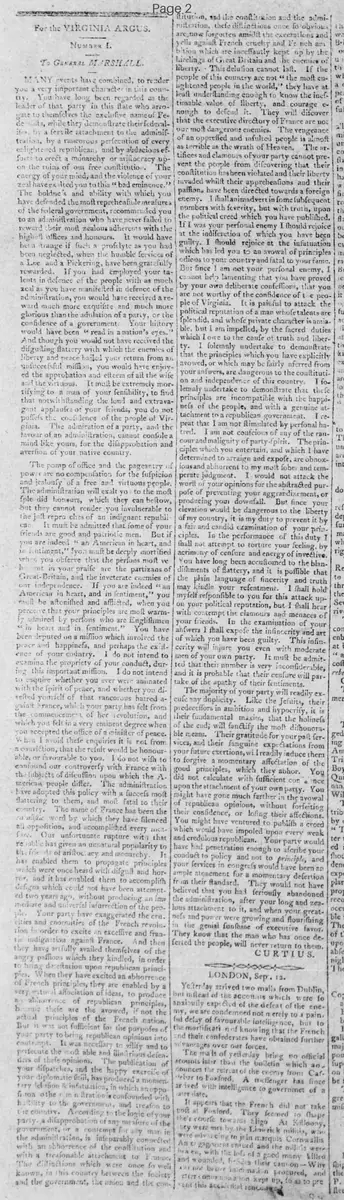
Many events have combined, to render you a very important character in this country. You have long been regarded as the leader of that party in this state who arrogate to themselves the exclusive name of Federalists, while they demonstrate their federalism, by a servile attachment to the administration, by a rancorous persecution of every enlightened republican, and by audacious efforts to erect a monarchy or aristocracy upon the ruins of our free constitution. The energy of your mind, and the violence of your zeal have exalted you to this bad eminence. The boldness and ability with which you have defended the most reprehensible measures of the federal government, recommended you to an administration who have never failed to reward their most zealous adherents with the highest offices and honours. It would have been strange if such a proselyte as you had been neglected, when the humble services of a Lee, and a Pickering, have been gratefully rewarded. If you had employed your talents in defence of the people with as much zeal as you have manifested in defence of the administration, you would have received a reward much more exquisite and much more glorious than the adulation of a party, or the confidence of a government. Your history would have been read in a nation's eyes. And though you would not have received the disgusting flattery with which the enemies of liberty and peace hailed your return from an unsuccessful mission, you would have enjoyed the approbation and esteem of all the wise and the virtuous. It must be extremely mortifying to a man of your sensibility, to find that notwithstanding the loud and extravagant applause of your friends, you do not possess the confidence of the people of Virginia. The admiration of a party, and the favour of an administration, cannot console a mind like yours, for the disapprobation and aversion of your native country. The pomp of office and the pageantry of power are no compensation for the suspicion and jealousy of a free and virtuous people. The administration will exalt you to the most splendid honours, which they can bestow. But they cannot render you invulnerable to the just reproaches of an indignant republican. It must be admitted that some of your friends are good and patriotic men. But if you are indeed an American in heart, and in sentiment, you must be deeply mortified when you observe that the persons most vehement in your praise are the partizans of Great-Britain, and the inveterate enemies of our independence. If you are indeed an American in heart, and in sentiment, you must be astonished and afflicted, when you perceive that your principles are most warmly admired by persons who are Englishmen in heart and in sentiment. You have been deputed on a mission which involved the peace and happiness, and perhaps the existence of your country. I do not intend to examine the propriety of your conduct, during this important mission. I do not intend to enquire whether you ever were animated with the spirit of peace, and whether you divested yourself of that rancorous hatred against France, which your party has felt from the commencement of her revolution, and which you felt in a very eminent degree when you accepted the office of a minister of peace. When I avoid these enquiries it is not from a conviction, that the result would be honourable, or favourable to you. I do not wish to confound our controversy with France with the subjects of discussion upon which the American people differ. The administration have adopted this policy with a success most flattering to them, and most fatal to their country. The name of France has been the talismanic word by which they have silenced all opposition, and accomplished every measure. Our unfortunate rupture with that republic has given an unnatural popularity to the friends of aristocracy and monarchy. It has enabled them to propagate principles which were once heard with disgust and horror, and it has enabled them to accomplish designs which could not have been attempted two years ago, without producing an immediate and universal insurrection of the people. Your party have exaggerated the cruelties and enormities of the French revolution in order to excite an excessive and frantic indignation against France. And then they have artfully availed themselves of the angry passions which they kindled, in order to bring desolation upon republican principles. When they have excited an abhorrence of French principles, they are enabled by a very natural association of ideas, to produce an abhorrence of republican principles, because these are the avowed, if not the actual principles of the French nation. But it was not sufficient for the purposes of your party to bring republican opinions into contempt. It was necessary to vilify and to persecute the most able and illustrious defenders of these opinions. The publication of your despatches, and the happy exercise of your diplomatic skill, has produced a momentary delusion and infatuation, in which an opposition to the administration is confounded with hostility to the government, and treason to the country. According to the logic of your party, a disapprobation of any measure of the government, or a contempt for any man in the administration, is inseparably connected with an abhorrence of the constitution and with a treasonable attachment to France. The distinctions which were once so well known, in this country between the society and the government, the union and the constitution, and the constitution and the administration, these distinctions once so obvious, are now forgotten amidst the execrations and yells against French cruelty and French ambition which are incessantly kept up by the hirelings of Great Britain and the enemies of liberty. This delusion cannot last. If the people of this country are not the most enlightened people in the world, they have at least understanding enough to know the inestimable value of liberty, and courage enough to defend it. They will discover that the executive directory of France are not our most dangerous enemies. The vengeance of an oppressed and insulted people is almost as terrible as the wrath of Heaven. The artifices and clamours of your party cannot prevent the people from discovering that their constitution has been violated and their liberty invaded whilst their apprehensions and their passions have been directed towards a foreign enemy. I shall animadvert in some subsequent numbers with severity, but with truth, upon the political creed which you have published. If I was your personal enemy I should rejoice at the indiscretion of which you have been guilty. I should rejoice at the infatuation which has led you to an avowal of principles odious to your country and fatal to your fame. But since I am not your personal enemy, I cannot help lamenting that you have proved by your own deliberate confessions, that you are not worthy of the confidence of the people of Virginia. It is painful to attack the political reputation of a man whose talents are splendid, and whose private character is amiable, but I am impelled, by the sacred duties which I owe to the cause of truth and liberty. I solemnly undertake to demonstrate that the principles which you have explicitly avowed, or which may be fairly inferred from your answers, are dangerous to the constitution and independence of this country. I solemnly undertake to demonstrate that these principles are incompatible with the happiness of the people, and with a genuine attachment to a republican government. I repeat that I am not stimulated by personal hatred. I am not conscious of any of the rancour and malignity of party-spirit. The principles which you entertain, and which I have determined to arraign and expose, are obnoxious and abhorrent to my most sober and temperate judgment. I would not attack the works of your opinions for the abstracted purpose of preventing your aggrandizement, or producing your downfall. But since your elevation would be dangerous to the liberty of my country, it is my duty to prevent it by a fair and candid examination of your principles. In the performance of this duty I shall not attempt to torture your feeling, by acrimony of censure and energy of invective. You have long been accustomed to the blandishments of flattery, and it is possible that the plain language of sincerity and truth may kindle your resentment. I shall hold myself responsible to you for this attack upon your political reputation, but I shall hear with contempt the clamours and menaces of your friends. In the examination of your answers I shall expose the insincerity and art of which you have been guilty. This insincerity will injure you even with moderate men of your own party. It must be admitted that their number is very inconsiderable, and it is probable that their censure will partake of the apathy of their sentiments. The majority of your party will readily excuse any duplicity. Like the Jesuits, their predecessors in ambition and hypocrisy, it is their fundamental maxim, that the holiness of the end will sanctify the most dishonourable means. Their gratitude for your past services, and their sanguine expectations from your future exertions, will readily induce them to forgive a momentary affectation of the good principles, which they abhor. You did not calculate with sufficient confidence upon the attachment of your own party. You might have gone much farther in the avowal of republican opinions, without forfeiting their confidence, or losing their affections. You might have ventured to publish a creed which would have imposed upon every weak and credulous republican. Your party would have had penetration enough to ascribe your conduct to policy and not to principle, and your services in congress would have been an ample atonement for a momentary desertion from their standard. They would not have believed that you had seriously abandoned the administration, after your long and zealous attachment to it, and when your greatness and power were growing and flourishing in the genial sunshine of executive favor. They know that the man who has once deserted the people, will never return to them.
CURTIUS.
Number
To General
Many events have combined, to render you a very important character in this country. You have long been regarded as the leader of that party in this state who arrogate to themselves the exclusive name of Federalists, while they demonstrate their federalism, by a servile attachment to the administration, by a rancorous persecution of every enlightened republican, and by audacious efforts to erect a monarchy or aristocracy upon the ruins of our free constitution. The energy of your mind, and the violence of your zeal have exalted you to this bad eminence. The boldness and ability with which you have defended the most reprehensible measures of the federal government, recommended you to an administration who have never failed to reward their most zealous adherents with the highest offices and honours. It would have been strange if such a proselyte as you had been neglected, when the humble services of a Lee, and a Pickering, have been gratefully rewarded. If you had employed your talents in defence of the people with as much zeal as you have manifested in defence of the administration, you would have received a reward much more exquisite and much more glorious than the adulation of a party, or the confidence of a government. Your history would have been read in a nation's eyes. And though you would not have received the disgusting flattery with which the enemies of liberty and peace hailed your return from an unsuccessful mission, you would have enjoyed the approbation and esteem of all the wise and the virtuous. It must be extremely mortifying to a man of your sensibility, to find that notwithstanding the loud and extravagant applause of your friends, you do not possess the confidence of the people of Virginia. The admiration of a party, and the favour of an administration, cannot console a mind like yours, for the disapprobation and aversion of your native country. The pomp of office and the pageantry of power are no compensation for the suspicion and jealousy of a free and virtuous people. The administration will exalt you to the most splendid honours, which they can bestow. But they cannot render you invulnerable to the just reproaches of an indignant republican. It must be admitted that some of your friends are good and patriotic men. But if you are indeed an American in heart, and in sentiment, you must be deeply mortified when you observe that the persons most vehement in your praise are the partizans of Great-Britain, and the inveterate enemies of our independence. If you are indeed an American in heart, and in sentiment, you must be astonished and afflicted, when you perceive that your principles are most warmly admired by persons who are Englishmen in heart and in sentiment. You have been deputed on a mission which involved the peace and happiness, and perhaps the existence of your country. I do not intend to examine the propriety of your conduct, during this important mission. I do not intend to enquire whether you ever were animated with the spirit of peace, and whether you divested yourself of that rancorous hatred against France, which your party has felt from the commencement of her revolution, and which you felt in a very eminent degree when you accepted the office of a minister of peace. When I avoid these enquiries it is not from a conviction, that the result would be honourable, or favourable to you. I do not wish to confound our controversy with France with the subjects of discussion upon which the American people differ. The administration have adopted this policy with a success most flattering to them, and most fatal to their country. The name of France has been the talismanic word by which they have silenced all opposition, and accomplished every measure. Our unfortunate rupture with that republic has given an unnatural popularity to the friends of aristocracy and monarchy. It has enabled them to propagate principles which were once heard with disgust and horror, and it has enabled them to accomplish designs which could not have been attempted two years ago, without producing an immediate and universal insurrection of the people. Your party have exaggerated the cruelties and enormities of the French revolution in order to excite an excessive and frantic indignation against France. And then they have artfully availed themselves of the angry passions which they kindled, in order to bring desolation upon republican principles. When they have excited an abhorrence of French principles, they are enabled by a very natural association of ideas, to produce an abhorrence of republican principles, because these are the avowed, if not the actual principles of the French nation. But it was not sufficient for the purposes of your party to bring republican opinions into contempt. It was necessary to vilify and to persecute the most able and illustrious defenders of these opinions. The publication of your despatches, and the happy exercise of your diplomatic skill, has produced a momentary delusion and infatuation, in which an opposition to the administration is confounded with hostility to the government, and treason to the country. According to the logic of your party, a disapprobation of any measure of the government, or a contempt for any man in the administration, is inseparably connected with an abhorrence of the constitution and with a treasonable attachment to France. The distinctions which were once so well known, in this country between the society and the government, the union and the constitution, and the constitution and the administration, these distinctions once so obvious, are now forgotten amidst the execrations and yells against French cruelty and French ambition which are incessantly kept up by the hirelings of Great Britain and the enemies of liberty. This delusion cannot last. If the people of this country are not the most enlightened people in the world, they have at least understanding enough to know the inestimable value of liberty, and courage enough to defend it. They will discover that the executive directory of France are not our most dangerous enemies. The vengeance of an oppressed and insulted people is almost as terrible as the wrath of Heaven. The artifices and clamours of your party cannot prevent the people from discovering that their constitution has been violated and their liberty invaded whilst their apprehensions and their passions have been directed towards a foreign enemy. I shall animadvert in some subsequent numbers with severity, but with truth, upon the political creed which you have published. If I was your personal enemy I should rejoice at the indiscretion of which you have been guilty. I should rejoice at the infatuation which has led you to an avowal of principles odious to your country and fatal to your fame. But since I am not your personal enemy, I cannot help lamenting that you have proved by your own deliberate confessions, that you are not worthy of the confidence of the people of Virginia. It is painful to attack the political reputation of a man whose talents are splendid, and whose private character is amiable, but I am impelled, by the sacred duties which I owe to the cause of truth and liberty. I solemnly undertake to demonstrate that the principles which you have explicitly avowed, or which may be fairly inferred from your answers, are dangerous to the constitution and independence of this country. I solemnly undertake to demonstrate that these principles are incompatible with the happiness of the people, and with a genuine attachment to a republican government. I repeat that I am not stimulated by personal hatred. I am not conscious of any of the rancour and malignity of party-spirit. The principles which you entertain, and which I have determined to arraign and expose, are obnoxious and abhorrent to my most sober and temperate judgment. I would not attack the works of your opinions for the abstracted purpose of preventing your aggrandizement, or producing your downfall. But since your elevation would be dangerous to the liberty of my country, it is my duty to prevent it by a fair and candid examination of your principles. In the performance of this duty I shall not attempt to torture your feeling, by acrimony of censure and energy of invective. You have long been accustomed to the blandishments of flattery, and it is possible that the plain language of sincerity and truth may kindle your resentment. I shall hold myself responsible to you for this attack upon your political reputation, but I shall hear with contempt the clamours and menaces of your friends. In the examination of your answers I shall expose the insincerity and art of which you have been guilty. This insincerity will injure you even with moderate men of your own party. It must be admitted that their number is very inconsiderable, and it is probable that their censure will partake of the apathy of their sentiments. The majority of your party will readily excuse any duplicity. Like the Jesuits, their predecessors in ambition and hypocrisy, it is their fundamental maxim, that the holiness of the end will sanctify the most dishonourable means. Their gratitude for your past services, and their sanguine expectations from your future exertions, will readily induce them to forgive a momentary affectation of the good principles, which they abhor. You did not calculate with sufficient confidence upon the attachment of your own party. You might have gone much farther in the avowal of republican opinions, without forfeiting their confidence, or losing their affections. You might have ventured to publish a creed which would have imposed upon every weak and credulous republican. Your party would have had penetration enough to ascribe your conduct to policy and not to principle, and your services in congress would have been an ample atonement for a momentary desertion from their standard. They would not have believed that you had seriously abandoned the administration, after your long and zealous attachment to it, and when your greatness and power were growing and flourishing in the genial sunshine of executive favor. They know that the man who has once deserted the people, will never return to them.
CURTIUS.
What sub-type of article is it?
Partisan Politics
Foreign Affairs
Constitutional
What keywords are associated?
Federalist Critique
Republican Defense
Anti Administration
French Relations
British Partisans
Political Mission
Constitutional Liberty
What entities or persons were involved?
Federalists
Administration
Republicans
France
Great Britain
Lee
Pickering
Editorial Details
Primary Topic
Critique Of Federalist Leader's Loyalty To Administration And Anti Republican Principles
Stance / Tone
Strongly Anti Federalist And Pro Republican
Key Figures
Federalists
Administration
Republicans
France
Great Britain
Lee
Pickering
Key Arguments
Federalists Show Servile Attachment To Administration And Persecute Republicans
Critic's Diplomatic Mission Was Unsuccessful And Biased Against France
Administration Uses Anti French Sentiment To Suppress Opposition And Promote Aristocracy
Party Exaggerates French Revolution Cruelties To Discredit Republican Principles
Distinctions Between Government, Constitution, And Administration Are Obscured
People Will Recognize Threats To Liberty From Within Rather Than From France
Author Will Expose The General's Dangerous Political Creed In Future Writings
General's Principles Are Incompatible With Republican Government And National Independence