Thank you for visiting SNEWPapers!
Sign up free
Gazette Of The United States, & Philadelphia Daily Advertiser
Philadelphia, Philadelphia County, Pennsylvania
What is this article about?
In Burdon v. Cartwright, the plaintiff sued the defendant for criminal conversation with his wife and for seducing and harboring her. Evidence showed the wife lived with the defendant, her deceased sister's husband, posing as his sister. No adultery proven, but seduction was. Lord Kenyon directed the jury, who awarded £200 damages to the plaintiff.
Clipping
OCR Quality
Full Text
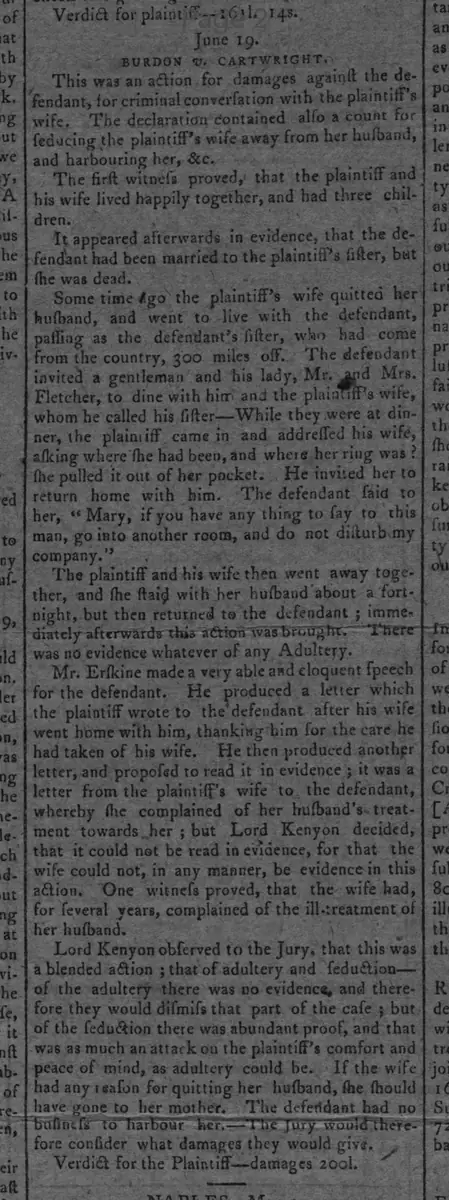
BURDON V. CARTWRIGHT.
This was an action for damages against the defendant, for criminal conversation with the plaintiff's wife. The declaration contained also a count for seducing the plaintiff's wife away from her husband, and harbouring her, &c.
The first witness proved, that the plaintiff and his wife lived happily together, and had three children.
It appeared afterwards in evidence, that the defendant had been married to the plaintiff's sister, but she was dead.
Some time ago the plaintiff's wife quitted her husband, and went to live with the defendant, passing as the defendant's sister, who had come from the country, 300 miles off. The defendant invited a gentleman and his lady, Mr. and Mrs. Fletcher, to dine with him and the plaintiff's wife, whom he called his sister—While they were at dinner, the plaintiff came in and addressed his wife, asking where she had been, and where her ring was? she pulled it out of her pocket. He invited her to return home with him. The defendant said to her, "Mary, if you have any thing to say to this man, go into another room, and do not disturb my company."
The plaintiff and his wife then went away together, and she stayed with her husband about a fortnight, but then returned to the defendant ; immediately afterwards this action was brought.There was no evidence whatever of any Adultery.
Mr. Erskine made a very able and eloquent speech for the defendant. He produced a letter which the plaintiff wrote to the defendant after his wife went home with him, thanking him for the care he had taken of his wife. He then produced another letter, and proposed to read it in evidence ; it was a letter from the plaintiff's wife to the defendant, whereby she complained of her husband's treatment towards her : but Lord Kenyon decided, that it could not be read in evidence, for that the wife could not, in any manner, be evidence in this action. One witness proved, that the wife had, for several years, complained of the ill-treatment of her husband.
Lord Kenyon observed to the Jury, that this was a blended action ; that of adultery and seduction of the adultery there was no evidence, and therefore they would dismiss that part of the case ; but of the seduction there was abundant proof, and that was as much an attack on the plaintiff's comfort and peace of mind, as adultery could be. If the wife had any reason for quitting her husband, she should have gone to her mother. The defendant had no business to harbour her. The Jury would therefore consider what damages they would give.
Verdict for the Plaintiff—damages £200.
What sub-type of article is it?
What keywords are associated?
What entities or persons were involved?
Foreign News Details
Event Date
June 19.
Key Persons
Outcome
verdict for the plaintiff—damages £200.
Event Details
The plaintiff sued the defendant for criminal conversation with his wife and for seducing and harboring her. The wife had left her husband to live with the defendant, her deceased sister's widower, posing as his sister from 300 miles away. During a dinner with guests, the plaintiff confronted her and took her home briefly, but she returned to the defendant. No evidence of adultery, but seduction proven. Mr. Erskine defended, producing letters, but one was ruled inadmissible. Lord Kenyon instructed the jury to award damages for seduction.