Thank you for visiting SNEWPapers!
Sign up free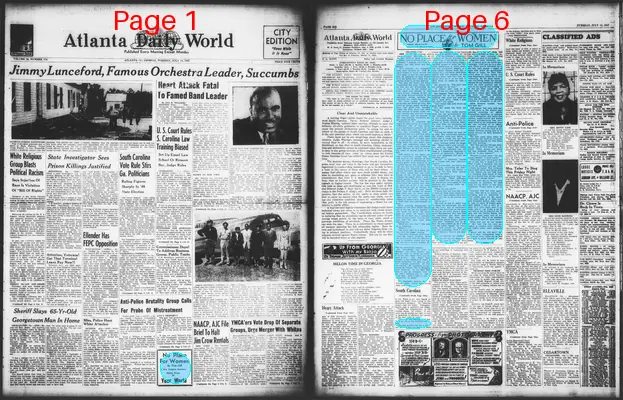
Literary
July 15, 1947
Atlanta Daily World
Atlanta, Fulton County, Georgia
What is this article about?
In this serial adventure, tough businessman Cliff Bogard clashes with Janet Norman, a government envoy, en route by plane to revive rubber plantations in New Dixie, South America. Tensions arise over gender roles, past failures, and local opposition from Blacklanders and authorities.
Merged-components note: Merged introductory blurb from page 1 with continued serialized story on page 6 for complete literary component.
Clippings
1 of 2
OCR Quality
75%
Good
Full Text
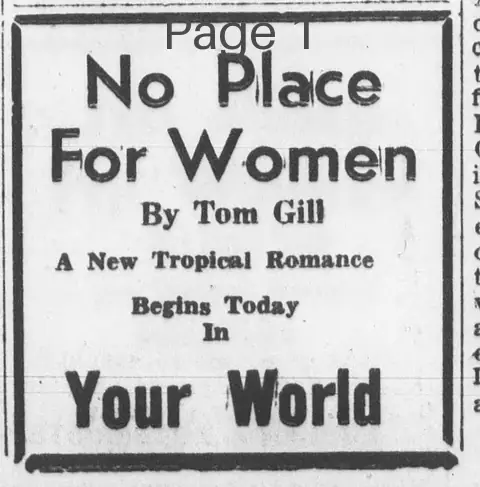
No Place For Women
By Tom Gill
New Tropical Romance Begins Today,
In Your World
NO PLACE FOR WOMEN
Copyright, 1946, by Tom Gill
Distributed by King Features Syndicate
by TOM GILL
Her voice was shaking with resentful anger. "Men like you, Mr. Bogard, seem to think a woman shouldn't have anything to do with business I suppose you think we should just stay home and have babies"
"It's certainly one occupation men can't compete in" Cliff Bogard nodded in entire accord, and once again he saw her eyes gather fire He pretended to busy himself with his safety belt--there was no earthly sense to all this fighting.
But they just hadn't got along. Everything had gone wrong since he first saw her Everything Because of her, he had junked his own plans and started on this fool's errand: because of her, he was being bounced around in this asthmatic sewing machine five thousand feet above the jungle.
For three bumpy, rain-lashed hours they had flown up-river, buffeted by savage gusts, bucking a headwind that grew ever stronger. Twice the little plane had made wide detours to avoid storm centers-already they were low on gas and overdue And all because of this ivory-skinned, red-haired person across the aisle
Reluctantly he admitted she might be called lovely, in a remote, withdrawn sort of way-lovely. and a meddlesome nuisance In the four hours since they met she had acted like everything from a frightened kid to a stubborn bully Mostly she had been plain bossy.
H frowned, partly in anger, partly in speculation-there was something about her that didn't quite click. And something about her name that raised vague memories. Janet Norman He had an irritating sense of having heard it before
Clif looked at her again-not over twenty-five, maybe less. It was hard to tell, because of that trick she had of withdrawing into herself, either from shyness or as a screen against his curiosity. She was tall. and very trim in the tan traveling suit, shoulders broad and carried well back Beneath the hat her thick, coarse hair was richly bronze, so that the sun, breaking through the clouds, filled it with a million sparks There was warmth and rich vitality about that hair: there could be warmth and vitality about all of her if she would let herself go and be human. At first he thought her eyes were black, then he decided on dusky blue-then that he didn't know.
They weren't exactly unfriendly, those eyes, but wary They were taking no unnecessary chances in a world that was unpredictable at best.
With growing disapproval he looked at the little metal sketch box in her lap So she dabbled in that stuff! An artist He didn't need an artist. He wasn't sure what he did need, but it certainly didn't include artists Then he realized that the dark eyes were watching him
"Have you seen this?" She held up a magazine
"What is it?"
"All about you." In a clear, precise voice she began reading
"Peacetime demands have intensified the rubber problem With the controversy over the effectiveness of synthetic rubber still raging, the newly revived Rubber Division
vision has announced it will insure a supply of natural rubber for the U. S A by creating a permanent industry in South America The white hope of the Rubber Division is big, good-looking Clifton Bogard, recently picked to bring the New Dixie plantations of South America into production Bogard is a wise choice. Known from Rio to Laredo as a two-fisted, hard-boiled realist with few illusions, he has already made-and lost-two fortunes. Now he is on his way to New Dixie to make-or lose-a third."
She glanced up. "You don't look old enough for all that."
"It doesn't take long to go broke if you put your mind to it."
She laughed. There was an unsuspected lilt to her infrequent laughter that made you wish she did it more often. "Shall I read the rest?" she asked.
"Just repeat that part about my good looks."
But she shook her head and read on.
"The New Dixie rubber plantations are the government's best bet. Established in the late days of the rubber boom by a colony of United States citizens who migrated to South America before the Civil War, the plantation can be made to produce the highest grade rubber in the Western Hemisphere.
Getting the rubber out may not be easy. One well-known operator has already tried-and failed. It looks like a tough job, but Cliff Bogard can be a very tough man."
Janet Norman closed the magazine. "Maybe that's your trouble you were too tough." She looked at him in the detached way one looks at a laboratory specimen in process of dissection. "Maybe it was your toughness that got you into this jam."
"Maybe," he amended, "maybe all I needed was your Olympian wisdom."
She ignored that-she had a way of ignoring everything she didn't like. "What made you decide to open up the New Dixie plantations?"she asked.
His lean tanned face went suddenly somber. "What difference does it make? For one thing, I had the machinery, and a gang of wild Irishmen who needed work. So I looked into it."
"What did you find?"
"I found that one man had tried to open up those same plantations just a few weeks before. He'd been told to get out of the country and stay out."
"Did he go?"
"He went so fast he didn't stop to empty his warehouse. It's still up the-river, full-of-machinery. When I saw him down on the coast he told me the story about a gang called Blacklanders who live near the plantations and don't want anybody there. They must have treated him pretty rough--nothing could have persuaded him to go back. He was washed up. So I took over his option, bought his warehouse, and moved my boys up from the Argentine. Then I went to New Dixie to look at the plantations"
"And got thrown out yourself."
"Yes, but not by the Blacklanders. In my case it was the New Dixie authorities They held me at the boundary for two days, told me they'd decided to recall the option, and next morning they shipped me back to the coast."
Bogard's slow, deliberate manner of speech gave his words grim emphasis. That put me in a sweet spot. When you've borrowed up to the hilt, time counts. I began to build fires under the government officials to make the New Dixie crowd stick to their option, and then Washington cabled me to hold everything. So for three weeks I held everything while the storage charges on my machinery whittled down my bank account, and the men on my payroll had nothing to do but eat their heads off and raise heck with the local ordinances-I nearly went broke bailing them out. Then yesterday Washington cabled that everything was fine-they were sending someone to straighten it all out."
Janet Norman nodded.
"And they sent me."
Cliff sighed. Yes, they sent her.
He had gone to the airport that morning expecting an official Washington dignitary, or perhaps a whole delegation, and found this tailored, copper-haired girl whose outward self-assurance was curiously belied by her frightened eyes,
She was traveling on an official business visa, and presented Clif with a letter from the chief of the Rubber Division, asking him to be guided entirely by Miss Norman's judgment.
The first clash came when he learned she had reserved two seats on the plane leaving for New Dixie that very morning.
"But they just got through kicking me out of New Dixie." he objected. "What makes you think you can persuade them now to take me to their bosoms?"
"Because I know them," she answered shortly. "I lived there."
"That may seem like a good reason to you, but it doesn't to me. What I need is someone who can put on the pressure and get them to honor my option. That certainly makes more sense than flying back on the chance you can talk them into changing their minds. If they say no a second time, all the king's horses won't change them."
They won't say no. They're just suspicious of outsiders. It took years for my father to win their confidence. Please leave it all to me
Patiently Cliff had tried again.
"Look. This job is no peanut undertaking, and it's important to more people than me. My equipment alone adds up to three hundred thousand dollars, and I have to train an army of rubber gatherers before I get a cent of it back.-If-I-don't-start-soon-I-go broke, and if I go broke, a lot of men will be out of jobs and out of cash, and the United States will be shy a good many tons of top grade rubber. They're all banking on me, and I can't let them down."
Then just you let me handle it." Her tone was the tone one evoked to placate little children, and Cliff's collar went suddenly tight.
"Mama will fix it, will she?" He drew a deep, exasperated breath and turned away--after all, he had been told to place himself in her hands.
(To Be Continued)
By Tom Gill
New Tropical Romance Begins Today,
In Your World
NO PLACE FOR WOMEN
Copyright, 1946, by Tom Gill
Distributed by King Features Syndicate
by TOM GILL
Her voice was shaking with resentful anger. "Men like you, Mr. Bogard, seem to think a woman shouldn't have anything to do with business I suppose you think we should just stay home and have babies"
"It's certainly one occupation men can't compete in" Cliff Bogard nodded in entire accord, and once again he saw her eyes gather fire He pretended to busy himself with his safety belt--there was no earthly sense to all this fighting.
But they just hadn't got along. Everything had gone wrong since he first saw her Everything Because of her, he had junked his own plans and started on this fool's errand: because of her, he was being bounced around in this asthmatic sewing machine five thousand feet above the jungle.
For three bumpy, rain-lashed hours they had flown up-river, buffeted by savage gusts, bucking a headwind that grew ever stronger. Twice the little plane had made wide detours to avoid storm centers-already they were low on gas and overdue And all because of this ivory-skinned, red-haired person across the aisle
Reluctantly he admitted she might be called lovely, in a remote, withdrawn sort of way-lovely. and a meddlesome nuisance In the four hours since they met she had acted like everything from a frightened kid to a stubborn bully Mostly she had been plain bossy.
H frowned, partly in anger, partly in speculation-there was something about her that didn't quite click. And something about her name that raised vague memories. Janet Norman He had an irritating sense of having heard it before
Clif looked at her again-not over twenty-five, maybe less. It was hard to tell, because of that trick she had of withdrawing into herself, either from shyness or as a screen against his curiosity. She was tall. and very trim in the tan traveling suit, shoulders broad and carried well back Beneath the hat her thick, coarse hair was richly bronze, so that the sun, breaking through the clouds, filled it with a million sparks There was warmth and rich vitality about that hair: there could be warmth and vitality about all of her if she would let herself go and be human. At first he thought her eyes were black, then he decided on dusky blue-then that he didn't know.
They weren't exactly unfriendly, those eyes, but wary They were taking no unnecessary chances in a world that was unpredictable at best.
With growing disapproval he looked at the little metal sketch box in her lap So she dabbled in that stuff! An artist He didn't need an artist. He wasn't sure what he did need, but it certainly didn't include artists Then he realized that the dark eyes were watching him
"Have you seen this?" She held up a magazine
"What is it?"
"All about you." In a clear, precise voice she began reading
"Peacetime demands have intensified the rubber problem With the controversy over the effectiveness of synthetic rubber still raging, the newly revived Rubber Division
vision has announced it will insure a supply of natural rubber for the U. S A by creating a permanent industry in South America The white hope of the Rubber Division is big, good-looking Clifton Bogard, recently picked to bring the New Dixie plantations of South America into production Bogard is a wise choice. Known from Rio to Laredo as a two-fisted, hard-boiled realist with few illusions, he has already made-and lost-two fortunes. Now he is on his way to New Dixie to make-or lose-a third."
She glanced up. "You don't look old enough for all that."
"It doesn't take long to go broke if you put your mind to it."
She laughed. There was an unsuspected lilt to her infrequent laughter that made you wish she did it more often. "Shall I read the rest?" she asked.
"Just repeat that part about my good looks."
But she shook her head and read on.
"The New Dixie rubber plantations are the government's best bet. Established in the late days of the rubber boom by a colony of United States citizens who migrated to South America before the Civil War, the plantation can be made to produce the highest grade rubber in the Western Hemisphere.
Getting the rubber out may not be easy. One well-known operator has already tried-and failed. It looks like a tough job, but Cliff Bogard can be a very tough man."
Janet Norman closed the magazine. "Maybe that's your trouble you were too tough." She looked at him in the detached way one looks at a laboratory specimen in process of dissection. "Maybe it was your toughness that got you into this jam."
"Maybe," he amended, "maybe all I needed was your Olympian wisdom."
She ignored that-she had a way of ignoring everything she didn't like. "What made you decide to open up the New Dixie plantations?"she asked.
His lean tanned face went suddenly somber. "What difference does it make? For one thing, I had the machinery, and a gang of wild Irishmen who needed work. So I looked into it."
"What did you find?"
"I found that one man had tried to open up those same plantations just a few weeks before. He'd been told to get out of the country and stay out."
"Did he go?"
"He went so fast he didn't stop to empty his warehouse. It's still up the-river, full-of-machinery. When I saw him down on the coast he told me the story about a gang called Blacklanders who live near the plantations and don't want anybody there. They must have treated him pretty rough--nothing could have persuaded him to go back. He was washed up. So I took over his option, bought his warehouse, and moved my boys up from the Argentine. Then I went to New Dixie to look at the plantations"
"And got thrown out yourself."
"Yes, but not by the Blacklanders. In my case it was the New Dixie authorities They held me at the boundary for two days, told me they'd decided to recall the option, and next morning they shipped me back to the coast."
Bogard's slow, deliberate manner of speech gave his words grim emphasis. That put me in a sweet spot. When you've borrowed up to the hilt, time counts. I began to build fires under the government officials to make the New Dixie crowd stick to their option, and then Washington cabled me to hold everything. So for three weeks I held everything while the storage charges on my machinery whittled down my bank account, and the men on my payroll had nothing to do but eat their heads off and raise heck with the local ordinances-I nearly went broke bailing them out. Then yesterday Washington cabled that everything was fine-they were sending someone to straighten it all out."
Janet Norman nodded.
"And they sent me."
Cliff sighed. Yes, they sent her.
He had gone to the airport that morning expecting an official Washington dignitary, or perhaps a whole delegation, and found this tailored, copper-haired girl whose outward self-assurance was curiously belied by her frightened eyes,
She was traveling on an official business visa, and presented Clif with a letter from the chief of the Rubber Division, asking him to be guided entirely by Miss Norman's judgment.
The first clash came when he learned she had reserved two seats on the plane leaving for New Dixie that very morning.
"But they just got through kicking me out of New Dixie." he objected. "What makes you think you can persuade them now to take me to their bosoms?"
"Because I know them," she answered shortly. "I lived there."
"That may seem like a good reason to you, but it doesn't to me. What I need is someone who can put on the pressure and get them to honor my option. That certainly makes more sense than flying back on the chance you can talk them into changing their minds. If they say no a second time, all the king's horses won't change them."
They won't say no. They're just suspicious of outsiders. It took years for my father to win their confidence. Please leave it all to me
Patiently Cliff had tried again.
"Look. This job is no peanut undertaking, and it's important to more people than me. My equipment alone adds up to three hundred thousand dollars, and I have to train an army of rubber gatherers before I get a cent of it back.-If-I-don't-start-soon-I-go broke, and if I go broke, a lot of men will be out of jobs and out of cash, and the United States will be shy a good many tons of top grade rubber. They're all banking on me, and I can't let them down."
Then just you let me handle it." Her tone was the tone one evoked to placate little children, and Cliff's collar went suddenly tight.
"Mama will fix it, will she?" He drew a deep, exasperated breath and turned away--after all, he had been told to place himself in her hands.
(To Be Continued)
What sub-type of article is it?
Prose Fiction
What themes does it cover?
Commerce Trade
Political
Social Manners
What keywords are associated?
Rubber Plantations
New Dixie
Cliff Bogard
Janet Norman
South America
Gender Roles
Business Adventure
What entities or persons were involved?
By Tom Gill
Literary Details
Title
No Place For Women
Author
By Tom Gill
Key Lines
"Men Like You, Mr. Bogard, Seem To Think A Woman Shouldn't Have Anything To Do With Business I Suppose You Think We Should Just Stay Home And Have Babies"
"It's Certainly One Occupation Men Can't Compete In"
"All About You." In A Clear, Precise Voice She Began Reading "Peacetime Demands Have Intensified The Rubber Problem..."
"Maybe That's Your Trouble You Were Too Tough."