Thank you for visiting SNEWPapers!
Sign up free
Editorial
July 30, 1821
The Alexandria Herald
Alexandria, Virginia
What is this article about?
Editorial defends John Quincy Adams's 4th of July oration in Washington against critics, attributing attacks to foreign (British) influence and detailing numerous insults from British journals and reviewers to justify the patriotic response.
Clipping
OCR Quality
95%
Excellent
Full Text
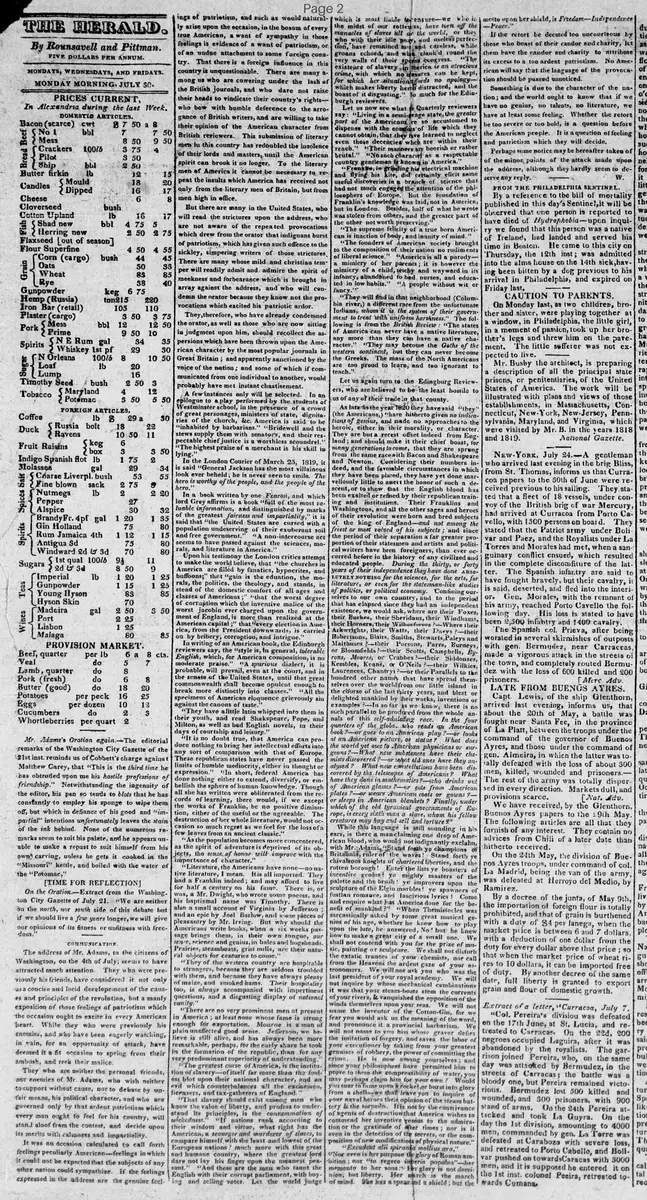
Mr. Adams's Oration again.—The editorial remarks of the Washington City Gazette of the 21st inst. reminds us of Cobbett's charge against Matthew Carey, that "This is the third time he has obtruded upon me his hostile professions of friendship." Notwithstanding the ingenuity of the editor, his pen so tends to blots that he has constantly to employ his sponge to wipe them off, but which in defiance of his good and "impartial" intentions unfortunately leaves the stain of the ink behind. None of the numerous remarks seem to suit his palate, and he appears unable to make a repast to suit himself from his own carving, unless he gets it cooked in the "Missouri" kettle, and boiled with the water of the "Potomac,"
TIME FOR REFLECTION
On the Oration. Extract from the Washington City Gazette of July 21. "We are neither on the north, nor south side of this debate but if we should live a few years longer, we will give our opinions of its fitness or unfitness with freedom."
COMMUNICATION.
The address of Mr. Adams, to the citizens of Washington, on the 4th of July; seems to have attracted much attention. They who were previously his friends, have considered it not only as a concise and lucid development of the causes and principles of the revolution, but a manly exposition of those feelings of patriotism which "the occasion ought to excite in every American heart. While they who were previously his enemies, and who have been eagerly watching, in vain, for an opportunity of attack, have deemed it a fit occasion to spring from their ambush, and wreak their malice.
They who are neither the personal friends, nor enemies of Mr. Adams, who wish neither to support without cause, nor to debase by unfair means, his political character, and who are governed only by that ardent patriotism which every man ought to feel for his country, will stand aloof from the contest, and decide upon its merits with calmness and impartiality.
It was an occasion calculated to call forth feelings peculiarly American—feelings in which it could not be expected that the subjects of any other nation could sympathize. If the feelings expressed in the address are the genuine feelings of patriotism, and such as would naturally arise upon the occasion, in the bosom of every true American, a want of sympathy in those feelings is evidence of a want of patriotism, or of an undue attachment to some foreign country. That there is a foreign influence in this country is unquestionable. There are many among us who are cowering under the lash of the British journals, and who dare not raise their heads to vindicate their country's rights—who bow with humble deference to the arrogance of British writers, and are willing to take their opinion of the American character from British reviewers. This submission of literary men in this country has redoubled the insolence of their lords and masters, until the American spirit can brook it no longer. To the literary men of America it cannot be necessary to repeat the insults which America has received not only from the literary men of Britain, but from men high in office.
But there are many in the United States, who will read the strictures upon the address, who are not aware of the repeated provocations which drew from the orator that indignant burst of patriotism, which has given such offence to the sickly, simpering writers of those strictures. There are many whose mild and christian temper will readily admit and admire the spirit of meekness and forbearance which is brought in array against the address, and who will condemn the orator because they know not the provocations which excited his patriotic ardor.
They, therefore, who have already condemned the orator, as well as those who are now sitting in judgment upon him, should recollect the aspersions which have been thrown upon the American character by the most popular journals in Great Britain; and apparently sanctioned by the voice of the nation; and some of which if communicated from one individual to another, would probably have met instant chastisement.
A few instances only will be selected. In an epilogue to a play performed by the students of Westminster school, in the presence of a crowd of great personages, ministers of state, dignitaries of the church, &c. America is said to be "inhabited by barbarians." "Bridewell and the stews supply them with senators, and their respectable chief justice is a worthless scoundrel." "The highest praise of a merchant is his skill in lying."
In the London Courier of March 25, 1819, it is said "General Jackson has the most villainous look ever beheld; he is never seen to smile. The hero is worthy of the people, and the people of the hero."
In a book written by one Fearon, and which lord Grey affirms is a book "full of the most valuable information, and distinguished by marks of the greatest fairness and impartiality," it is said that "the United States are cursed with a population undeserving of their exuberant soil and free government." "A non-intercourse act seems to have passed against the sciences, morals, and literature in America."
Upon his testimony the London critics attempt to make the world believe, that "the churches in America are filled by fanatics, hypocrites, and buffoons;" that "gain is the education, the morals, the politics, the theology, and stands, in stead of the domestic comfort of all ages and classes of Americans;" "that the worst degree of corruption which the inventive malice of the worst jacobin ever charged upon the government of England, is more than realized at the American capital;" that "every election in America, from the President downwards, is carried on by bribery, corruption, and intrigue."
In writing of an American book, the Edinburgh reviewers say, the "style is, in general, tolerable English, which, for American composition, is no moderate praise."
"A spurious dialect, it is probable, will prevail, even at the court, and in the senate of the United States, until that great commonwealth shall become opulent enough to break more distinctly into classes." "All the specimens of American eloquence grievously sin against the canons of taste."
"They have a little latin whipped into them in their youth, and read Shakspeare, Pope, and Milton, as well as bad English novels, in their days of courtship and leisure."
"It is no doubt true, that America can produce nothing to bring her intellectual efforts into any sort of comparison with that of Europe. These republican states have never passed the limits of humble mediocrity, either in thought or expression." "In short, federal America has done nothing either to extend, diversify, or embellish the sphere of human knowledge. Though all she has written were obliterated from the records of learning, there would, if we except the works of Franklin, be no positive diminution, either of the useful or the agreeable. The destruction of her whole literature, would not occasion so much regret as we feel for the loss of a few leaves from an ancient classic."
"As the population becomes more concentrated, as the spirit of adventure is deprived of its objects, the sense of honor will improve with the importance of character."
"Literature, the Americans have none—no native literature, I mean. It is all imported. They had a Franklin indeed; and may afford to live for half a century on his fame. There is, or was, a Mr. Dwight, who wrote some poems, and his baptismal name was Timothy. There is also a small account of Virginia by Jefferson; and an epic by Joel Barlow, and some pieces of pleasantry by Mr. Irving. But why should the Americans write books, when a six weeks passage brings them, in their own tongue, our sense, science and genius, in bales and hogsheads. Prairies, steamboats, grist mills, are their natural objects for centuries to come."
"They of the western country are hospitable to strangers, because they are seldom troubled with them, and because they have always plenty of maize, and smoked hams. Their hospitality too, is always accompanied with impertinent questions, and a disgusting display of national vanity."
"There are no very prominent men at present in America; at least none whose fame is strong enough for exportation. Monroe is a man of plain unaffected good sense. Jefferson, we believe is still alive, and has always been more remarkable, perhaps, for the early share he took in the formation of the republic, than for any very predominant superiority of understanding."
"The greatest curse of America, is the institution of slavery—of itself far more than the foulest blot upon their national character, and an evil which counterbalances all the excisemen, licensers, and tax-gatherers of England."
"That slavery should exist among men who know the value of liberty, and profess to understand its principles, is the consummation of wickedness." "If nations rank according to their wisdom and virtue, what right has the American, a scourger and murderer of slaves, to compare himself with the least and lowest of the European nations? much more with this great and humane country, where the greatest lord dare not lay his finger upon the meanest peasant." "And these are the men who taunt the English with their corrupt parliament, with buying and selling votes. 'Let the world judge which is most liable to censure—we who in the midst of our rottenness, have torn off the manacles of slaves all over the world, or they who with their idle prury, and useless perfection, have remained moy and careless, while groans echoed, and chains clank'd round the very walls of their speess congress.' "The existence of slavery in America is an atrocious crime, with which no measures can be kept, for which her situation affords no apology—which makes liberty her distracted, and the boast of it disgusting."
So much for the Edinburgh reviewers.
Let us now see what the Quarterly reviewers say: "Living in a semi-savage state, the greater part of the Americans are so accustomed to dispense with the comforts of life which they cannot obtain, that they have learned to neglect even those decencies which are within their reach." "Their manners are boorish or rather brutal." "No such character as a respectable country gentleman is known in America."
"Franklin, in grinding his electrical machine and flying his kite, did certainly elicit some useful discoveries in a branch of science that had not much engaged the attention of the philosophers of Europe. But the foundation of Franklin's knowledge was laid, not in America, but in London. Besides, half of what he wrote was stolen from others, and the greater part of the other not worth preserving."
"The supreme felicity of a true born American is inaction of body, and inanity of mind."
"The founders of American society brought to the composition of their nation no rudiments of liberal science." "America is all a parody—a mimicry of her parents; it is however the mimicry of a child, tetchy and wayward in its infancy, abandoned to bad nurses, and educated in low habits."
people without wit or fancy.
"They will find in that neighborhood (Columbia river,) a different race from the unfortunate Indians, whom it is the system of their government to treat with uniform harshness." The following is from the British Review: "The states of America can never have a native literature, any more than they can have a native character," "They may become the Goths of the western continent, but they can never become the Greeks. The mass of the North Americans are too proud to learn, and too ignorant to teach."
Let us again turn to the Edinburgh Reviewers, who are believed to be the least hostile to us of any of their trade in that country.
As late as the year 1820 they have said "they (the Americans,) have hitherto given no indications of genius, and made no approaches to the heroic, either in their morality, or character. They are but a recent offset indeed from England; and should make it their chief boast, for many generations to come, that they are sprung from the same race with Bacon and Shakespeare and Newton. Considering their numbers indeed, and the favorable circumstances in which they have been placed, they have yet done marvellously little to assert the honor of such a descent, or to show that the English blood has been exalted or refined by their republican training and institutions. Their Franklins and Washingtons, and all the other sages and heroes of their revolution were born and bred subjects of the king of England—and not among the freest or most valued of his subjects; and since the period of their separation a far greater proportion of their statesmen and artists and political writers have been foreigners, than ever occurred before in the history of any civilized and educated people. During the thirty, or forty years of their independence they have done ABSOLUTELY NOTHING for the sciences, for the arts, for literature, or even for the statesman-like studies of politics, or political economy. Confining ourselves to our own country, and to the period that has elapsed since they had an independent existence, we would ask, where are their Foxes, their Burkes, their Sheridans, their Windhams, their Horners, Their Wilberforces?—Where their Arkwrights, their Watts, their Davys?—their Robertsons, Blairs, Smiths, Stewarts, Paleys and Malthuses?—their Porsons, Parrs, Burneys, or Bloomfields?—their Scotts, Campbells, Byrons, Moores, or Crabbes?—their Siddonses, Kembles, Keans, or O'Neils?—their Wilkies, Laurences, Chantry?—or their Parallels to the hundred other names that have spread themselves over the world from our little island in the course of the last thirty years, and blest or delighted mankind by their works, inventions or examples?—In so far as we know, there is no such parallel to be produced from the whole annals of this self-adulating race. In the four quarters of the globe, who reads an American book?—or goes to an American play?—or looks at an American picture, or statue? What does the world yet owe to American physicians or surgeons?—What new substances have their chemists discovered?—or what old ones have they analyzed? What new constellations have been discovered by the telescopes of Americans? What have they done in mathematics?—who drinks out of American glasses?—or eats from American plates?—or wears American coats or gowns?—or sleeps in American blankets? Finally, under which of the old tyrannical governments of Europe, is every sixth man a slave, whom his fellow creatures may buy and sell and torture?"
While this language is still sounding in his ears, is there a man claiming one drop of American blood, who would not indignantly exclaim, with Mr. Adams, "Stand forth ye champions of Britannia, ruler of the waves! Stand forth ye chivalrous knights of chartered liberties, and the rotten borough! Enter the lists ye boasters of inventive genius! ye mighty masters of the palette and the brush! ye improvers upon the sculpture of the Elgin marbles! ye spawners of fustian romance, and lascivious lyrics! Come and enquire what has America done for the benefit of mankind?" "When Themistocles was sarcastically asked by some great musical genius of his age, whether he knew how to play upon the lute, he answered, No! but he knew how to make a great city of a small one. We shall not contend with you for the prize of music, painting or sculpture. We shall not disturb the extatic trances of your chemists, nor call from the Heavens the ardent gaze of your astronomers. We will not ask you who was the last president of your royal academy. We will not inquire by whose mechanical combinations it was that your steam-boats stem the currents of your rivers, & vanquished the opposition of the winds themselves upon your seas. We will not name the inventor of the Cotton-Gin, for we fear you would ask us the meaning of the word, and pronounce it a provincial barbarism. We will not name to you him whose graver defies the imitation of forgery, and saves the labor of your executioner by taking from your greatest geniuses of robbery, the power of committing the crime. He is now among yourselves; and since your philosophers have permitted him to prove to them the compressibility of water, you may perhaps claim him for your own? Would you soar to fame upon a rocket, or burst into glory from a shell we shall leave you to inquire of your naval heroes their opinion of the steam battery & the torpedo. It is not by the contrivance of agents of destruction that America wishes to commend her inventive genius to the admiration or the gratitude of future times; nor is it even in the detection of the secrets, or the composition of new modifications of physical nature."
"Excudent alii spirantia mollius aera,"
"Nor even is her purpose the glory of Roman ambition; nor 'tu regere imperio populus'—her memento to her sons. Her glory is not dominion, but liberty. Her march is the march of mind. She has a spear and a shield; but the motto upon her shield, is Freedom—Independence—Peace.
If the retort be deemed too uncourteous by those who boast of their candor and charity, let them have the candor and charity to attribute its excess to a too ardent patriotism. No American will say that the language of the provocation should be passed unnoticed. Something is due to the character of the nation; and the world ought to know that if we have no genius, no talents, no literature, we have at least some feeling. Whether the retort be too severe or too bold, is a question before the American people. It is a question of feeling and patriotism which they will decide.
Perhaps some notice may be hereafter taken of the minor points of the attack made upon the address, although they hardly seem to deserve any reply.
W.
TIME FOR REFLECTION
On the Oration. Extract from the Washington City Gazette of July 21. "We are neither on the north, nor south side of this debate but if we should live a few years longer, we will give our opinions of its fitness or unfitness with freedom."
COMMUNICATION.
The address of Mr. Adams, to the citizens of Washington, on the 4th of July; seems to have attracted much attention. They who were previously his friends, have considered it not only as a concise and lucid development of the causes and principles of the revolution, but a manly exposition of those feelings of patriotism which "the occasion ought to excite in every American heart. While they who were previously his enemies, and who have been eagerly watching, in vain, for an opportunity of attack, have deemed it a fit occasion to spring from their ambush, and wreak their malice.
They who are neither the personal friends, nor enemies of Mr. Adams, who wish neither to support without cause, nor to debase by unfair means, his political character, and who are governed only by that ardent patriotism which every man ought to feel for his country, will stand aloof from the contest, and decide upon its merits with calmness and impartiality.
It was an occasion calculated to call forth feelings peculiarly American—feelings in which it could not be expected that the subjects of any other nation could sympathize. If the feelings expressed in the address are the genuine feelings of patriotism, and such as would naturally arise upon the occasion, in the bosom of every true American, a want of sympathy in those feelings is evidence of a want of patriotism, or of an undue attachment to some foreign country. That there is a foreign influence in this country is unquestionable. There are many among us who are cowering under the lash of the British journals, and who dare not raise their heads to vindicate their country's rights—who bow with humble deference to the arrogance of British writers, and are willing to take their opinion of the American character from British reviewers. This submission of literary men in this country has redoubled the insolence of their lords and masters, until the American spirit can brook it no longer. To the literary men of America it cannot be necessary to repeat the insults which America has received not only from the literary men of Britain, but from men high in office.
But there are many in the United States, who will read the strictures upon the address, who are not aware of the repeated provocations which drew from the orator that indignant burst of patriotism, which has given such offence to the sickly, simpering writers of those strictures. There are many whose mild and christian temper will readily admit and admire the spirit of meekness and forbearance which is brought in array against the address, and who will condemn the orator because they know not the provocations which excited his patriotic ardor.
They, therefore, who have already condemned the orator, as well as those who are now sitting in judgment upon him, should recollect the aspersions which have been thrown upon the American character by the most popular journals in Great Britain; and apparently sanctioned by the voice of the nation; and some of which if communicated from one individual to another, would probably have met instant chastisement.
A few instances only will be selected. In an epilogue to a play performed by the students of Westminster school, in the presence of a crowd of great personages, ministers of state, dignitaries of the church, &c. America is said to be "inhabited by barbarians." "Bridewell and the stews supply them with senators, and their respectable chief justice is a worthless scoundrel." "The highest praise of a merchant is his skill in lying."
In the London Courier of March 25, 1819, it is said "General Jackson has the most villainous look ever beheld; he is never seen to smile. The hero is worthy of the people, and the people of the hero."
In a book written by one Fearon, and which lord Grey affirms is a book "full of the most valuable information, and distinguished by marks of the greatest fairness and impartiality," it is said that "the United States are cursed with a population undeserving of their exuberant soil and free government." "A non-intercourse act seems to have passed against the sciences, morals, and literature in America."
Upon his testimony the London critics attempt to make the world believe, that "the churches in America are filled by fanatics, hypocrites, and buffoons;" that "gain is the education, the morals, the politics, the theology, and stands, in stead of the domestic comfort of all ages and classes of Americans;" "that the worst degree of corruption which the inventive malice of the worst jacobin ever charged upon the government of England, is more than realized at the American capital;" that "every election in America, from the President downwards, is carried on by bribery, corruption, and intrigue."
In writing of an American book, the Edinburgh reviewers say, the "style is, in general, tolerable English, which, for American composition, is no moderate praise."
"A spurious dialect, it is probable, will prevail, even at the court, and in the senate of the United States, until that great commonwealth shall become opulent enough to break more distinctly into classes." "All the specimens of American eloquence grievously sin against the canons of taste."
"They have a little latin whipped into them in their youth, and read Shakspeare, Pope, and Milton, as well as bad English novels, in their days of courtship and leisure."
"It is no doubt true, that America can produce nothing to bring her intellectual efforts into any sort of comparison with that of Europe. These republican states have never passed the limits of humble mediocrity, either in thought or expression." "In short, federal America has done nothing either to extend, diversify, or embellish the sphere of human knowledge. Though all she has written were obliterated from the records of learning, there would, if we except the works of Franklin, be no positive diminution, either of the useful or the agreeable. The destruction of her whole literature, would not occasion so much regret as we feel for the loss of a few leaves from an ancient classic."
"As the population becomes more concentrated, as the spirit of adventure is deprived of its objects, the sense of honor will improve with the importance of character."
"Literature, the Americans have none—no native literature, I mean. It is all imported. They had a Franklin indeed; and may afford to live for half a century on his fame. There is, or was, a Mr. Dwight, who wrote some poems, and his baptismal name was Timothy. There is also a small account of Virginia by Jefferson; and an epic by Joel Barlow, and some pieces of pleasantry by Mr. Irving. But why should the Americans write books, when a six weeks passage brings them, in their own tongue, our sense, science and genius, in bales and hogsheads. Prairies, steamboats, grist mills, are their natural objects for centuries to come."
"They of the western country are hospitable to strangers, because they are seldom troubled with them, and because they have always plenty of maize, and smoked hams. Their hospitality too, is always accompanied with impertinent questions, and a disgusting display of national vanity."
"There are no very prominent men at present in America; at least none whose fame is strong enough for exportation. Monroe is a man of plain unaffected good sense. Jefferson, we believe is still alive, and has always been more remarkable, perhaps, for the early share he took in the formation of the republic, than for any very predominant superiority of understanding."
"The greatest curse of America, is the institution of slavery—of itself far more than the foulest blot upon their national character, and an evil which counterbalances all the excisemen, licensers, and tax-gatherers of England."
"That slavery should exist among men who know the value of liberty, and profess to understand its principles, is the consummation of wickedness." "If nations rank according to their wisdom and virtue, what right has the American, a scourger and murderer of slaves, to compare himself with the least and lowest of the European nations? much more with this great and humane country, where the greatest lord dare not lay his finger upon the meanest peasant." "And these are the men who taunt the English with their corrupt parliament, with buying and selling votes. 'Let the world judge which is most liable to censure—we who in the midst of our rottenness, have torn off the manacles of slaves all over the world, or they who with their idle prury, and useless perfection, have remained moy and careless, while groans echoed, and chains clank'd round the very walls of their speess congress.' "The existence of slavery in America is an atrocious crime, with which no measures can be kept, for which her situation affords no apology—which makes liberty her distracted, and the boast of it disgusting."
So much for the Edinburgh reviewers.
Let us now see what the Quarterly reviewers say: "Living in a semi-savage state, the greater part of the Americans are so accustomed to dispense with the comforts of life which they cannot obtain, that they have learned to neglect even those decencies which are within their reach." "Their manners are boorish or rather brutal." "No such character as a respectable country gentleman is known in America."
"Franklin, in grinding his electrical machine and flying his kite, did certainly elicit some useful discoveries in a branch of science that had not much engaged the attention of the philosophers of Europe. But the foundation of Franklin's knowledge was laid, not in America, but in London. Besides, half of what he wrote was stolen from others, and the greater part of the other not worth preserving."
"The supreme felicity of a true born American is inaction of body, and inanity of mind."
"The founders of American society brought to the composition of their nation no rudiments of liberal science." "America is all a parody—a mimicry of her parents; it is however the mimicry of a child, tetchy and wayward in its infancy, abandoned to bad nurses, and educated in low habits."
people without wit or fancy.
"They will find in that neighborhood (Columbia river,) a different race from the unfortunate Indians, whom it is the system of their government to treat with uniform harshness." The following is from the British Review: "The states of America can never have a native literature, any more than they can have a native character," "They may become the Goths of the western continent, but they can never become the Greeks. The mass of the North Americans are too proud to learn, and too ignorant to teach."
Let us again turn to the Edinburgh Reviewers, who are believed to be the least hostile to us of any of their trade in that country.
As late as the year 1820 they have said "they (the Americans,) have hitherto given no indications of genius, and made no approaches to the heroic, either in their morality, or character. They are but a recent offset indeed from England; and should make it their chief boast, for many generations to come, that they are sprung from the same race with Bacon and Shakespeare and Newton. Considering their numbers indeed, and the favorable circumstances in which they have been placed, they have yet done marvellously little to assert the honor of such a descent, or to show that the English blood has been exalted or refined by their republican training and institutions. Their Franklins and Washingtons, and all the other sages and heroes of their revolution were born and bred subjects of the king of England—and not among the freest or most valued of his subjects; and since the period of their separation a far greater proportion of their statesmen and artists and political writers have been foreigners, than ever occurred before in the history of any civilized and educated people. During the thirty, or forty years of their independence they have done ABSOLUTELY NOTHING for the sciences, for the arts, for literature, or even for the statesman-like studies of politics, or political economy. Confining ourselves to our own country, and to the period that has elapsed since they had an independent existence, we would ask, where are their Foxes, their Burkes, their Sheridans, their Windhams, their Horners, Their Wilberforces?—Where their Arkwrights, their Watts, their Davys?—their Robertsons, Blairs, Smiths, Stewarts, Paleys and Malthuses?—their Porsons, Parrs, Burneys, or Bloomfields?—their Scotts, Campbells, Byrons, Moores, or Crabbes?—their Siddonses, Kembles, Keans, or O'Neils?—their Wilkies, Laurences, Chantry?—or their Parallels to the hundred other names that have spread themselves over the world from our little island in the course of the last thirty years, and blest or delighted mankind by their works, inventions or examples?—In so far as we know, there is no such parallel to be produced from the whole annals of this self-adulating race. In the four quarters of the globe, who reads an American book?—or goes to an American play?—or looks at an American picture, or statue? What does the world yet owe to American physicians or surgeons?—What new substances have their chemists discovered?—or what old ones have they analyzed? What new constellations have been discovered by the telescopes of Americans? What have they done in mathematics?—who drinks out of American glasses?—or eats from American plates?—or wears American coats or gowns?—or sleeps in American blankets? Finally, under which of the old tyrannical governments of Europe, is every sixth man a slave, whom his fellow creatures may buy and sell and torture?"
While this language is still sounding in his ears, is there a man claiming one drop of American blood, who would not indignantly exclaim, with Mr. Adams, "Stand forth ye champions of Britannia, ruler of the waves! Stand forth ye chivalrous knights of chartered liberties, and the rotten borough! Enter the lists ye boasters of inventive genius! ye mighty masters of the palette and the brush! ye improvers upon the sculpture of the Elgin marbles! ye spawners of fustian romance, and lascivious lyrics! Come and enquire what has America done for the benefit of mankind?" "When Themistocles was sarcastically asked by some great musical genius of his age, whether he knew how to play upon the lute, he answered, No! but he knew how to make a great city of a small one. We shall not contend with you for the prize of music, painting or sculpture. We shall not disturb the extatic trances of your chemists, nor call from the Heavens the ardent gaze of your astronomers. We will not ask you who was the last president of your royal academy. We will not inquire by whose mechanical combinations it was that your steam-boats stem the currents of your rivers, & vanquished the opposition of the winds themselves upon your seas. We will not name the inventor of the Cotton-Gin, for we fear you would ask us the meaning of the word, and pronounce it a provincial barbarism. We will not name to you him whose graver defies the imitation of forgery, and saves the labor of your executioner by taking from your greatest geniuses of robbery, the power of committing the crime. He is now among yourselves; and since your philosophers have permitted him to prove to them the compressibility of water, you may perhaps claim him for your own? Would you soar to fame upon a rocket, or burst into glory from a shell we shall leave you to inquire of your naval heroes their opinion of the steam battery & the torpedo. It is not by the contrivance of agents of destruction that America wishes to commend her inventive genius to the admiration or the gratitude of future times; nor is it even in the detection of the secrets, or the composition of new modifications of physical nature."
"Excudent alii spirantia mollius aera,"
"Nor even is her purpose the glory of Roman ambition; nor 'tu regere imperio populus'—her memento to her sons. Her glory is not dominion, but liberty. Her march is the march of mind. She has a spear and a shield; but the motto upon her shield, is Freedom—Independence—Peace.
If the retort be deemed too uncourteous by those who boast of their candor and charity, let them have the candor and charity to attribute its excess to a too ardent patriotism. No American will say that the language of the provocation should be passed unnoticed. Something is due to the character of the nation; and the world ought to know that if we have no genius, no talents, no literature, we have at least some feeling. Whether the retort be too severe or too bold, is a question before the American people. It is a question of feeling and patriotism which they will decide.
Perhaps some notice may be hereafter taken of the minor points of the attack made upon the address, although they hardly seem to deserve any reply.
W.
What sub-type of article is it?
Foreign Affairs
Moral Or Religious
Press Freedom
What keywords are associated?
Adams Oration
British Insults
American Patriotism
Foreign Influence
National Character
Literary Criticism
Slavery Critique
What entities or persons were involved?
Mr. Adams
Washington City Gazette
British Journals
Edinburgh Reviewers
Quarterly Reviewers
General Jackson
Franklin
Jefferson
Monroe
Editorial Details
Primary Topic
Defense Of John Quincy Adams's 4th Of July Oration Against British Insults
Stance / Tone
Strongly Patriotic Defense Of American Honor
Key Figures
Mr. Adams
Washington City Gazette
British Journals
Edinburgh Reviewers
Quarterly Reviewers
General Jackson
Franklin
Jefferson
Monroe
Key Arguments
The Oration Expresses Genuine American Patriotism Unfit For Foreign Sympathy.
Critics Of The Oration Show Lack Of Patriotism Or Foreign Attachment.
American Submission To British Literary Insults Has Increased Their Insolence.
Numerous British Publications Insult American Character, Literature, And Institutions.
Adams's Indignant Response Is Justified By Repeated Provocations From British Sources.
American Achievements In Invention And Liberty Outweigh British Cultural Boasts.
The Retort's Excess Stems From Ardent Patriotism, Not Malice.