Thank you for visiting SNEWPapers!
Sign up free
Literary
April 25, 1812
Alexandria Daily Gazette, Commercial & Political
Alexandria, Virginia
What is this article about?
Chapter II of the Memoirs details the British cabinet's 1777 plan to conquer the United States via the northern campaign, led by Burgoyne from Canada. It covers the fall of Ticonderoga, American recovery under Gates, battles at Saratoga, Burgoyne's surrender, and contrasts in receptions by their governments. Includes notes on forces and Clinton's expedition.
Clipping
OCR Quality
95%
Excellent
Full Text
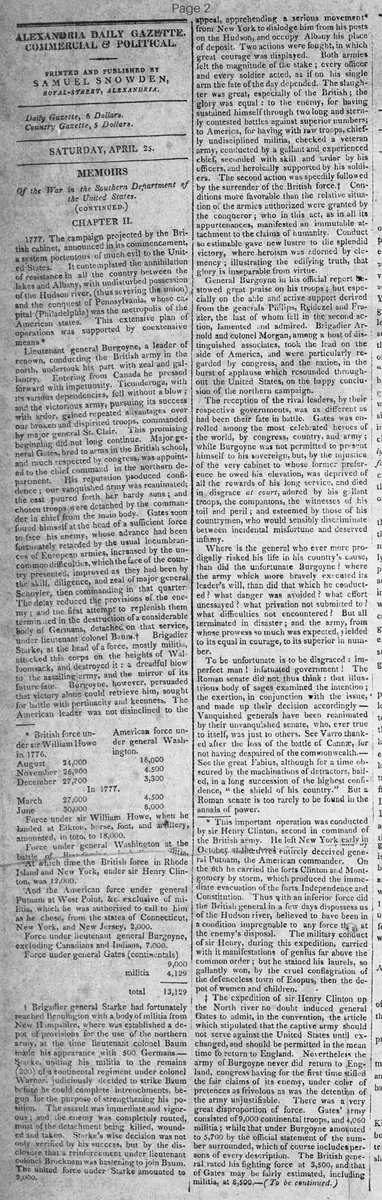
MEMOIRS
Of the War in the Southern Department of
the United States.
(Continued.)
CHAPTER II.
A system portentous of much evil to the United States British cabinet, announced in its commencement, 1777. The campaign projected by the British to take possession of the lakes and Albany, with undisturbed possession of resistance in all the country between.
It contemplated the annihilation of the United States.
And the conquest of Pennsylvania, whose capital (Philadelphia) was the metropolis of the American states. This extensive plan of operations was supported by coextensive means.*
Lieutenant general Burgoyne, a leader of renown, conducting the British army in the January. Entering from Canada he pressed forward with impetuosity. Ticonderoga, with its various dependencies, fell without a blow; and the victorious army, pursuing its success with ardor, gained repeated advantages over our broken and dispirited troops, commanded by major general St. Clair. This promising beginning did not long continue. Major general Gates, bred to arms in the British school, and much respected by congress, was appointed to the chief command in the northern department. His reputation produced confidence; our vanquished army was reanimated; the east poured forth her hardy sons; and chosen troops were detached by the commander in chief from the main body. Gates soon found himself at the head of a sufficient force to face his enemy, whose advance had been fortunately retarded by the usual incumbrances of European armies, increased by the uncommon difficulties, which the face of the country presented, improved as they had been by the skill, diligence, and zeal of major general Schuyler, then commanding in that quarter.
The delay reduced the provisions of the enemy; and the first attempt to replenish them terminated in the destruction of a considerable body of Germans, detached on that service, under lieutenant colonel Baum.† Brigadier Starke, at the head of a force, mostly militia, attacked this corps on the heights of Walloomsack, and destroyed it: a dreadful blow to the assailing army, and the mirror of its future fate. Burgoyne, however, persuaded that victory alone could retrieve him, sought for battle with pertinacity and keenness. The American leader was not disinclined to the appeal, apprehending a serious movement from New York to dislodge him from his posts on the Hudson, and occupy Albany his place of deposit. Two actions were fought, in which great courage was displayed. Both armies felt the magnitude of the stake; every officer and every soldier acted, as if on his single arm the fate of the day depended. The slaughter was great, especially of the British; the glory was equal: to the enemy, for having sustained himself through two long and sternly contested battles against superior numbers; to America, for having with raw troops, chiefly undisciplined militia, checked a veteran army, conducted by a gallant and experienced chief, seconded with skill and ardor by his officers, and heroically supported by his soldiers. The second action was speedily followed by the surrender of the British force.† Conditions more favorable than the relative situation of the armies authorized were granted by the conqueror; who in this act, as in all its appurtenances, manifested an immutable attachment to the claims of humanity. Conduct so estimable gave new lustre to the splendid victory, where heroism was adorned by clemency; illustrating the edifying truth, that glory is inseparable from virtue.
General Burgoyne in his official report bestowed great praise on his troops; but especially on the able and active support derived from the generals Phillips, Reidezel and Frazier, the last of whom fell in the second action, lamented and admired. Brigadier Arnold and colonel Morgan, among a host of distinguished associates, took the lead on the side of America, and were particularly regarded by congress, and the nation, in the burst of applause which resounded throughout the United States, on the happy conclusion of the northern campaign.
The reception of the rival leaders, by their respective governments, was as different as had been their fate in battle. Gates was enrolled among the most celebrated heroes of the world, by congress, country, and army; while Burgoyne was not permitted to present himself to his sovereign, but, by the injustice of the very cabinet to whose former preference he owed his elevation, was deprived of all the rewards of his long service, and died in disgrace at court, adored by his gallant troops, the companions, the witnesses of his toil and peril; and esteemed by those of his countrymen, who would sensibly discriminate between incidental misfortune and deserved infamy.
Where is the general who ever more prodigally risked his life in his country's cause than did the unfortunate Burgoyne? where the army which more bravely executed its leader's will, than did that which he conducted? what danger was avoided? what effort unessayed? what privation not submitted to? what difficulties not encountered? But all terminated in disaster; and the army, from whose prowess so much was expected, yielded to its equal in courage, to its superior in number.
To be unfortunate is to be disgraced: imperfect man! inatuated government! The Roman senate did not thus think: that illustrious body of sages examined the intention; the exertion, in conjunction with the issue, and made up their decision accordingly. Vanquished generals have been reanimated by their unvanquished senate, who, ever true to itself, was just to others. See Varro thanked after the loss of the battle of Cannæ, for not having despaired of the commonwealth. See the great Fabius, although for a time obscured by the machinations of detractors, hailed, in a long succession of the highest confidence, "the shield of his country." But a Roman senate is too rarely to be found in the annals of power.
* This important operation was conducted by sir Henry Clinton, second in command of the British army. He left New York early in October and his manoeuvres entirely deceived general Putnam, the American commander. On the 6th he carried the forts Clinton and Montgomery by storm, which produced the immediate evacuation of the forts Independence and Constitution. Thus with an inferior force did the British general in a few days dispossess us of the Hudson river, believed to have been in a condition impregnable to any force that the enemy's disposal. The military conduct of sir Henry, during this expedition, carried with it manifestations of genius far above the common order; but he stained his laurels, so gallantly won, by the cruel conflagration of the defenceless town of Esopus, then the depot of women and children.
The expedition of sir Henry Clinton up the North river no doubt induced general Gates to admit, in the convention, the article which stipulated that the captive army should not serve against the United States until exchanged, and should be permitted in the mean time to return to England. Nevertheless the army of Burgoyne never did return to England, congress having for the first time stifled the fair claims of its enemy, under color of pretences as frivolous as was the detention of the army unjustifiable. There was a very great disproportion of force. Gates' army consisted of 9,000 continental troops, and 4,060 militia; while that under Burgoyne amounted to 5,700 by the official statement of the number surrounded, which of course includes persons of every description. The British general rated his fighting force at 3,500, and that of Gates may be fairly estimated, including militia, at 8,500.--(To be continued.)
* British force under sir William Howe in 1776.
August 24,000
November 26,900
December 27,700
In 1777.
March 27,000
June 30,000
Force under sir William Howe, when he landed at Elkton, horse, foot, and artillery, amounted, in toto, to 18,000.
Force under general Washington at the battle of Brandywine. 16,000
At which time the British force in Rhode Island and New York, under sir Henry Clinton, was 12,000.
And the American force under general Putnam at West Point, &c. exclusive of militia, which he was authorised to call to him as he chose, from the states of Connecticut, New York, and New Jersey, 2,000.
Force under lieutenant general Burgoyne, excluding Canadians and Indians, 7,000.
Force under general Gates (continentals) 9,000 militia 4,129 total 13,129
Brigadier general Starke had fortunately reached Bennington with a body of militia from New Hampshire, where was established a depot of provisions for the use of the northern army, at the time lieutenant colonel Baum made his appearance with 500 Germans.--Starke, uniting his militia to the remains (200) of a continental regiment under colonel Warner, judiciously decided to strike Baum before he could complete intrenchments, begun for the purpose of strengthening his position. The assault was immediate and vigorous; and the enemy was completely routed, most of the detachment being killed, wounded and taken. Starke's wise decision was not only verified by his success, but by the disclosure that a reinforcement under lieutenant colonel Breyman was hastening to join Baum. The united force under Starke amounted to 2,000.
Of the War in the Southern Department of
the United States.
(Continued.)
CHAPTER II.
A system portentous of much evil to the United States British cabinet, announced in its commencement, 1777. The campaign projected by the British to take possession of the lakes and Albany, with undisturbed possession of resistance in all the country between.
It contemplated the annihilation of the United States.
And the conquest of Pennsylvania, whose capital (Philadelphia) was the metropolis of the American states. This extensive plan of operations was supported by coextensive means.*
Lieutenant general Burgoyne, a leader of renown, conducting the British army in the January. Entering from Canada he pressed forward with impetuosity. Ticonderoga, with its various dependencies, fell without a blow; and the victorious army, pursuing its success with ardor, gained repeated advantages over our broken and dispirited troops, commanded by major general St. Clair. This promising beginning did not long continue. Major general Gates, bred to arms in the British school, and much respected by congress, was appointed to the chief command in the northern department. His reputation produced confidence; our vanquished army was reanimated; the east poured forth her hardy sons; and chosen troops were detached by the commander in chief from the main body. Gates soon found himself at the head of a sufficient force to face his enemy, whose advance had been fortunately retarded by the usual incumbrances of European armies, increased by the uncommon difficulties, which the face of the country presented, improved as they had been by the skill, diligence, and zeal of major general Schuyler, then commanding in that quarter.
The delay reduced the provisions of the enemy; and the first attempt to replenish them terminated in the destruction of a considerable body of Germans, detached on that service, under lieutenant colonel Baum.† Brigadier Starke, at the head of a force, mostly militia, attacked this corps on the heights of Walloomsack, and destroyed it: a dreadful blow to the assailing army, and the mirror of its future fate. Burgoyne, however, persuaded that victory alone could retrieve him, sought for battle with pertinacity and keenness. The American leader was not disinclined to the appeal, apprehending a serious movement from New York to dislodge him from his posts on the Hudson, and occupy Albany his place of deposit. Two actions were fought, in which great courage was displayed. Both armies felt the magnitude of the stake; every officer and every soldier acted, as if on his single arm the fate of the day depended. The slaughter was great, especially of the British; the glory was equal: to the enemy, for having sustained himself through two long and sternly contested battles against superior numbers; to America, for having with raw troops, chiefly undisciplined militia, checked a veteran army, conducted by a gallant and experienced chief, seconded with skill and ardor by his officers, and heroically supported by his soldiers. The second action was speedily followed by the surrender of the British force.† Conditions more favorable than the relative situation of the armies authorized were granted by the conqueror; who in this act, as in all its appurtenances, manifested an immutable attachment to the claims of humanity. Conduct so estimable gave new lustre to the splendid victory, where heroism was adorned by clemency; illustrating the edifying truth, that glory is inseparable from virtue.
General Burgoyne in his official report bestowed great praise on his troops; but especially on the able and active support derived from the generals Phillips, Reidezel and Frazier, the last of whom fell in the second action, lamented and admired. Brigadier Arnold and colonel Morgan, among a host of distinguished associates, took the lead on the side of America, and were particularly regarded by congress, and the nation, in the burst of applause which resounded throughout the United States, on the happy conclusion of the northern campaign.
The reception of the rival leaders, by their respective governments, was as different as had been their fate in battle. Gates was enrolled among the most celebrated heroes of the world, by congress, country, and army; while Burgoyne was not permitted to present himself to his sovereign, but, by the injustice of the very cabinet to whose former preference he owed his elevation, was deprived of all the rewards of his long service, and died in disgrace at court, adored by his gallant troops, the companions, the witnesses of his toil and peril; and esteemed by those of his countrymen, who would sensibly discriminate between incidental misfortune and deserved infamy.
Where is the general who ever more prodigally risked his life in his country's cause than did the unfortunate Burgoyne? where the army which more bravely executed its leader's will, than did that which he conducted? what danger was avoided? what effort unessayed? what privation not submitted to? what difficulties not encountered? But all terminated in disaster; and the army, from whose prowess so much was expected, yielded to its equal in courage, to its superior in number.
To be unfortunate is to be disgraced: imperfect man! inatuated government! The Roman senate did not thus think: that illustrious body of sages examined the intention; the exertion, in conjunction with the issue, and made up their decision accordingly. Vanquished generals have been reanimated by their unvanquished senate, who, ever true to itself, was just to others. See Varro thanked after the loss of the battle of Cannæ, for not having despaired of the commonwealth. See the great Fabius, although for a time obscured by the machinations of detractors, hailed, in a long succession of the highest confidence, "the shield of his country." But a Roman senate is too rarely to be found in the annals of power.
* This important operation was conducted by sir Henry Clinton, second in command of the British army. He left New York early in October and his manoeuvres entirely deceived general Putnam, the American commander. On the 6th he carried the forts Clinton and Montgomery by storm, which produced the immediate evacuation of the forts Independence and Constitution. Thus with an inferior force did the British general in a few days dispossess us of the Hudson river, believed to have been in a condition impregnable to any force that the enemy's disposal. The military conduct of sir Henry, during this expedition, carried with it manifestations of genius far above the common order; but he stained his laurels, so gallantly won, by the cruel conflagration of the defenceless town of Esopus, then the depot of women and children.
The expedition of sir Henry Clinton up the North river no doubt induced general Gates to admit, in the convention, the article which stipulated that the captive army should not serve against the United States until exchanged, and should be permitted in the mean time to return to England. Nevertheless the army of Burgoyne never did return to England, congress having for the first time stifled the fair claims of its enemy, under color of pretences as frivolous as was the detention of the army unjustifiable. There was a very great disproportion of force. Gates' army consisted of 9,000 continental troops, and 4,060 militia; while that under Burgoyne amounted to 5,700 by the official statement of the number surrounded, which of course includes persons of every description. The British general rated his fighting force at 3,500, and that of Gates may be fairly estimated, including militia, at 8,500.--(To be continued.)
* British force under sir William Howe in 1776.
August 24,000
November 26,900
December 27,700
In 1777.
March 27,000
June 30,000
Force under sir William Howe, when he landed at Elkton, horse, foot, and artillery, amounted, in toto, to 18,000.
Force under general Washington at the battle of Brandywine. 16,000
At which time the British force in Rhode Island and New York, under sir Henry Clinton, was 12,000.
And the American force under general Putnam at West Point, &c. exclusive of militia, which he was authorised to call to him as he chose, from the states of Connecticut, New York, and New Jersey, 2,000.
Force under lieutenant general Burgoyne, excluding Canadians and Indians, 7,000.
Force under general Gates (continentals) 9,000 militia 4,129 total 13,129
Brigadier general Starke had fortunately reached Bennington with a body of militia from New Hampshire, where was established a depot of provisions for the use of the northern army, at the time lieutenant colonel Baum made his appearance with 500 Germans.--Starke, uniting his militia to the remains (200) of a continental regiment under colonel Warner, judiciously decided to strike Baum before he could complete intrenchments, begun for the purpose of strengthening his position. The assault was immediate and vigorous; and the enemy was completely routed, most of the detachment being killed, wounded and taken. Starke's wise decision was not only verified by his success, but by the disclosure that a reinforcement under lieutenant colonel Breyman was hastening to join Baum. The united force under Starke amounted to 2,000.
What sub-type of article is it?
Memoir
Historical Narrative
What themes does it cover?
Political
War Peace
Liberty Freedom
What keywords are associated?
American Revolution
Burgoyne Campaign
Saratoga Battles
Gates Victory
British Surrender
Northern Department
Military Forces
Literary Details
Title
Chapter Ii.
Subject
British Campaign Of 1777 And Burgoyne's Surrender At Saratoga
Form / Style
Prose Historical Account
Key Lines
The Second Action Was Speedily Followed By The Surrender Of The British Force.
Conduct So Estimable Gave New Lustre To The Splendid Victory, Where Heroism Was Adorned By Clemency; Illustrating The Edifying Truth, That Glory Is Inseparable From Virtue.
To Be Unfortunate Is To Be Disgraced: Imperfect Man! Inatuated Government!