Thank you for visiting SNEWPapers!
Sign up free
Letter to Editor
February 20, 1834
Morning Star
Limerick, York County, Maine
What is this article about?
A theological letter responding to a prior article, arguing that God possesses foreknowledge of human moral actions without implying fate or predestination. The writer refutes claims of divine repentance and uses numerous biblical passages to support foreknowledge. Signed J.F. from Dover, February 1834.
Clipping
OCR Quality
98%
Excellent
Full Text
For the Morning Star.
Messrs Editors,
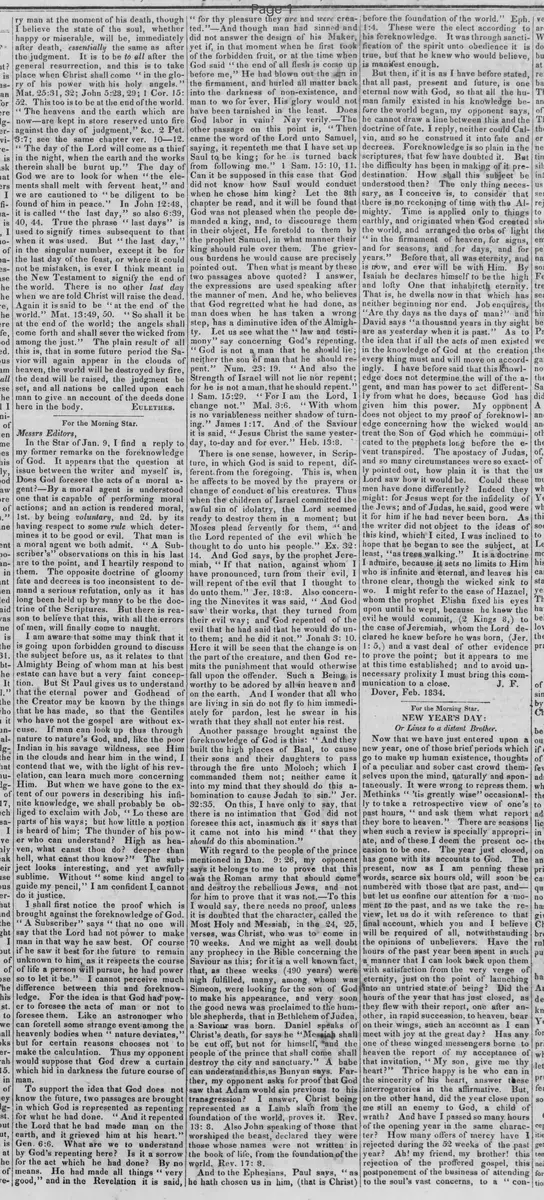
In the Star of Jan. 9, I find a reply to my former remarks on the foreknowledge of God. It appears that the question at issue between the writer and myself is, Does God foresee the acts of a moral agent?—By a moral agent is understood one that is capable of performing moral actions; and an action is rendered moral, 1st. by being voluntary, and 2d. by its having respect to some rule which determines it to be good or evil. That man is a moral agent we both admit. "A Subscriber's" observations on this in his last are to the point, and I heartily respond to them. The opposite doctrine of gloomy fate and decrees is too inconsistent to demand a serious refutation, only as it has long been held up by many to be the doctrine of the Scriptures. But there is reason to believe that this, with all the errors of men, will finally come to naught.
I am aware that some may think that it is going upon forbidden ground to discuss the subject before us, as it relates to that Almighty Being of whom man at his best estate can have but a very faint conception. But St Paul gives us to understand that the eternal power and Godhead of the Creator may be known by the things that he has made. so that the Gentiles who have not the gospel are without excuse. If man can look up thus through nature to nature's God, and, like the poor Indian in his savage wildness, see Him in the clouds and hear him in the wind, I contend that we, with the light of his revelation, can learn much more concerning Him. But when we have gone to the extent of our powers in describing his infinite knowledge, we shall probably be obliged to exclaim with Job, "Lo these are parts of his ways; but how little a portion is heard of him; The thunder of his power who can understand? High as heaven, what canst thou do? deeper than hell, what canst thou know?" The subject looks interesting, and yet awfully sublime. Without "some kind angel to guide my pencil," I am confident I cannot do it justice.
I shall first notice the proof which is brought against the foreknowledge of God. "A Subscriber" says "that no one will say that the Lord had not power to make man in that way he saw best. Of course if he saw it best for the future to remain unknown to him, as it respects the course of life a person will pursue, he had power so to let it be." I cannot perceive much difference between this and foreknowledge. For the idea is that God had power to foresee the acts of man or not to foresee them. Like an astronomer who can foretell some strange event among the heavenly bodies when "nature deviates," but for certain reasons chooses not to make the calculation. Thus my opponent would suppose that God drew a curtain which hid in darkness the future course of man.
To support the idea that God does not know the future, two passages are brought in which God is represented as repenting for what he had done. "And it repented the Lord that he had made man on the earth, and it grieved him at his heart." Gen. 6:6. What are we to understand by God's repenting here? Is it a sorrow for the act which he had done? By no means. He had made all things "very good," and in the Revelation it is said, "for thy pleasure they are and were created."—And though man had sinned and did not answer the design of his Maker. yet if, in that moment when he first took of the forbidden fruit, or at the time when God said "the end of all flesh is come up before me." He had blown out the n in the firmament, and hurled all matter back into the darkness of non-existence, and man to wo for ever, His glory would not have been tarnished in the least. Does God labor in vain? Nay verily.—The other passage on this point is, "Then came the word of the Lord unto Samuel. saying, it repenteth me that I have set up Saul to be king; for he is turned back from following me." 1 Sam. 15: 10, 11. Can it be supposed in this case that God did not know how Saul would conduct when he chose him king? Let the 8th chapter be read, and it will be found that God was not pleased when the people demanded a king, and, to discourage them in their object, He foretold to them by the prophet Samuel, in what manner their king should rule over them. The grievous burdens he would cause are precisely pointed out. Then what is meant by these two passages above quoted? I answer, the expressions are used speaking after the manner of men. And he, who believes that God regretted what he had done, as man does when he has taken a wrong step, has a diminutive idea of the Almighty. Let us see what the "law and testimony" say concerning God's repenting "God is not a man that he should lie; neither the son of man that he should repent." Num. 23: 19. "And also the Strength of Israel will not lie nor repent; for he is not a man, that he should repent." 1 Sam. 15:29. "For I am the Lord, I change not." Mal. 3:6. "With whom is no variableness neither shadow of turning." James 1:17. And of the Saviour it is said, "Jesus Christ the same yesterday, to-day and for ever." Heb. 13:8.
There is one sense, however, in Scripture, in which God is said to repent, different from the foregoing. This is, when he affects to be moved by the prayers or change of conduct of his creatures. Thus when the children of Israel committed the awful sin of idolatry, the Lord seemed ready to destroy them in a moment; but Moses plead fervently for them, "and the Lord repented of the evil which he thought to do unto his people." Ex. 32:14. And God says, by the prophet Jeremiah, "If that nation, against whom I have pronounced, turn from their evil, I will repent of the evil that I thought to do unto them." Jer. 18:8. Also concerning the Ninevites it was said, "And God saw their works, that they turned from their evil way; and God repented of the evil that he had said that he would do unto them; and he did it not." Jonah 3: 10. Here it will be seen that the change is on the part of the creature, and then God remits the punishment that would otherwise fall upon the offender. Such a Being is worthy to be adored by all in heaven and on the earth. And I wonder that all who are living in sin do not fly to him immediately for pardon, lest he swear in his wrath that they shall not enter his rest.
Another passage brought against the foreknowledge of God is this: "And they built the high places of Baal, to cause their sons and their daughters to pass through the fire unto Moloch; which I commanded them not; neither came it into my mind that they should do this abomination to cause Judah to sin." Jer. 32:35. On this. I have only to say, that there is no intimation that God did not foresee this act, inasmuch as it says that it came not into his mind "that they should do this abomination."
With regard to the people of the prince mentioned in Dan. 9: 26, my opponent says it belongs to me to prove that this was the Roman army that should come and destroy the rebellious Jews, and not for him to prove that it was not.—To this I would say, there needs no proof, unless it is doubted that the character, called the Most Holy and Messiah, in the 24, 25, verses, was Christ, who was to come in 70 weeks. And we might as well doubt any prophecy in the Bible concerning the Saviour as this; for it is a well known fact. that, as these weeks (490 years) were nigh fulfilled, many, among whom was Simeon, were looking for the son of God to make his appearance, and very soon the good news was proclaimed to the humble shepherds, that in Bethlehem of Judea, a Saviour was born. Daniel speaks of Christ's death, for says he "Messiah shall be cut off, but not for himself, and the people of the prince that shall come shall destroy the city and sanctuary." A babe can understand this, as Bunyan says. Farther, my opponent asks for proof that God saw that Adam would sin previous to his transgression? I answer, Christ being represented as a Lamb slain from the foundation of the world. proves it. Rev. 13: 8. Also John speaking of those that worshiped the beast, declared they were those whose names were not written in the book of life, from the foundation of the world. Rev. 17: 8. And to the Ephesians, Paul says, "as he hath chosen us in him, (that is Christ) before the foundation of the world." Eph. 1:4. These were the elect according to his foreknowledge. It was through sanctification of the spirit unto obedience it is true, but that he knew who would believe, is manifest enough.
But then, if it is as I have before stated, that all past, present and future, is one eternal now with God, so that all the human family existed in his knowledge before the world began, my opponent says, he cannot draw a line between this and the doctrine of fate. I reply, neither could Calvin, and so he construed it into fate and decrees. Foreknowledge is so plain in the scriptures, that few have doubted it. But the difficulty has been in making of it predestination. How shall this subject be understood then? The only thing necessary, as I conceive is, to consider that there is no reckoning of time with the Almighty. Time is applied only to things earthly, and originated when God created the world, and arranged the orbs of light "in the firmament of heaven, for signs, and for seasons, and for days, and for years." Before that, all was eternity, and is now, and ever will be with Him. By Isaiah he declares himself to be the high and lofty One that inhabiteth eternity. That is, he dwells now in that which has neither beginning nor end. Job enquires, "Are thy days as the days of man?" and David says "a thousand years in thy sight are as yesterday when it is past." As to the idea that if all the acts of men existed in the knowledge of God at the creation every thing must and will move on accordingly. I have before said that this knowledge does not determine the will of the agent, and man has power to act differently from what he does, because God has given him this power. My opponent does not object to my proof of foreknowledge concerning how the wicked would treat the Son of God which he communicated to the prophets long before the event transpired." The apostacy of Judas, and so many circumstances were so exactly pointed out, how plain it is that the Lord saw how it would be. Could these men have done differently? Indeed they might: for Jesus wept for the infidelity of the Jews; and of Judas, he said, good were it for him if he had never been born. As the writer did not object to the ideas of this kind, which I cited, I was inclined to hope that he began to see the subject, at least, "as trees walking." It is a doctrine I admire, because it sets no limits to Him who is infinite and eternal, and leaves his throne clear, though the wicked sink to wo. I might refer to the case of Hazael, whom the prophet Elisha fixed his eyes upon until he wept, because he knew the evil he would commit, (2 Kings 8,) to the case of Jeremiah, whom the Lord declared he knew before he was born, (Jer. 1: 5,) and a vast deal of other evidence to prove the point; but it appears to me at this time established; and to avoid unnecessary prolixity I must bring this communication to a close.
J. F.
Dover, Feb. 1834.
Messrs Editors,
In the Star of Jan. 9, I find a reply to my former remarks on the foreknowledge of God. It appears that the question at issue between the writer and myself is, Does God foresee the acts of a moral agent?—By a moral agent is understood one that is capable of performing moral actions; and an action is rendered moral, 1st. by being voluntary, and 2d. by its having respect to some rule which determines it to be good or evil. That man is a moral agent we both admit. "A Subscriber's" observations on this in his last are to the point, and I heartily respond to them. The opposite doctrine of gloomy fate and decrees is too inconsistent to demand a serious refutation, only as it has long been held up by many to be the doctrine of the Scriptures. But there is reason to believe that this, with all the errors of men, will finally come to naught.
I am aware that some may think that it is going upon forbidden ground to discuss the subject before us, as it relates to that Almighty Being of whom man at his best estate can have but a very faint conception. But St Paul gives us to understand that the eternal power and Godhead of the Creator may be known by the things that he has made. so that the Gentiles who have not the gospel are without excuse. If man can look up thus through nature to nature's God, and, like the poor Indian in his savage wildness, see Him in the clouds and hear him in the wind, I contend that we, with the light of his revelation, can learn much more concerning Him. But when we have gone to the extent of our powers in describing his infinite knowledge, we shall probably be obliged to exclaim with Job, "Lo these are parts of his ways; but how little a portion is heard of him; The thunder of his power who can understand? High as heaven, what canst thou do? deeper than hell, what canst thou know?" The subject looks interesting, and yet awfully sublime. Without "some kind angel to guide my pencil," I am confident I cannot do it justice.
I shall first notice the proof which is brought against the foreknowledge of God. "A Subscriber" says "that no one will say that the Lord had not power to make man in that way he saw best. Of course if he saw it best for the future to remain unknown to him, as it respects the course of life a person will pursue, he had power so to let it be." I cannot perceive much difference between this and foreknowledge. For the idea is that God had power to foresee the acts of man or not to foresee them. Like an astronomer who can foretell some strange event among the heavenly bodies when "nature deviates," but for certain reasons chooses not to make the calculation. Thus my opponent would suppose that God drew a curtain which hid in darkness the future course of man.
To support the idea that God does not know the future, two passages are brought in which God is represented as repenting for what he had done. "And it repented the Lord that he had made man on the earth, and it grieved him at his heart." Gen. 6:6. What are we to understand by God's repenting here? Is it a sorrow for the act which he had done? By no means. He had made all things "very good," and in the Revelation it is said, "for thy pleasure they are and were created."—And though man had sinned and did not answer the design of his Maker. yet if, in that moment when he first took of the forbidden fruit, or at the time when God said "the end of all flesh is come up before me." He had blown out the n in the firmament, and hurled all matter back into the darkness of non-existence, and man to wo for ever, His glory would not have been tarnished in the least. Does God labor in vain? Nay verily.—The other passage on this point is, "Then came the word of the Lord unto Samuel. saying, it repenteth me that I have set up Saul to be king; for he is turned back from following me." 1 Sam. 15: 10, 11. Can it be supposed in this case that God did not know how Saul would conduct when he chose him king? Let the 8th chapter be read, and it will be found that God was not pleased when the people demanded a king, and, to discourage them in their object, He foretold to them by the prophet Samuel, in what manner their king should rule over them. The grievous burdens he would cause are precisely pointed out. Then what is meant by these two passages above quoted? I answer, the expressions are used speaking after the manner of men. And he, who believes that God regretted what he had done, as man does when he has taken a wrong step, has a diminutive idea of the Almighty. Let us see what the "law and testimony" say concerning God's repenting "God is not a man that he should lie; neither the son of man that he should repent." Num. 23: 19. "And also the Strength of Israel will not lie nor repent; for he is not a man, that he should repent." 1 Sam. 15:29. "For I am the Lord, I change not." Mal. 3:6. "With whom is no variableness neither shadow of turning." James 1:17. And of the Saviour it is said, "Jesus Christ the same yesterday, to-day and for ever." Heb. 13:8.
There is one sense, however, in Scripture, in which God is said to repent, different from the foregoing. This is, when he affects to be moved by the prayers or change of conduct of his creatures. Thus when the children of Israel committed the awful sin of idolatry, the Lord seemed ready to destroy them in a moment; but Moses plead fervently for them, "and the Lord repented of the evil which he thought to do unto his people." Ex. 32:14. And God says, by the prophet Jeremiah, "If that nation, against whom I have pronounced, turn from their evil, I will repent of the evil that I thought to do unto them." Jer. 18:8. Also concerning the Ninevites it was said, "And God saw their works, that they turned from their evil way; and God repented of the evil that he had said that he would do unto them; and he did it not." Jonah 3: 10. Here it will be seen that the change is on the part of the creature, and then God remits the punishment that would otherwise fall upon the offender. Such a Being is worthy to be adored by all in heaven and on the earth. And I wonder that all who are living in sin do not fly to him immediately for pardon, lest he swear in his wrath that they shall not enter his rest.
Another passage brought against the foreknowledge of God is this: "And they built the high places of Baal, to cause their sons and their daughters to pass through the fire unto Moloch; which I commanded them not; neither came it into my mind that they should do this abomination to cause Judah to sin." Jer. 32:35. On this. I have only to say, that there is no intimation that God did not foresee this act, inasmuch as it says that it came not into his mind "that they should do this abomination."
With regard to the people of the prince mentioned in Dan. 9: 26, my opponent says it belongs to me to prove that this was the Roman army that should come and destroy the rebellious Jews, and not for him to prove that it was not.—To this I would say, there needs no proof, unless it is doubted that the character, called the Most Holy and Messiah, in the 24, 25, verses, was Christ, who was to come in 70 weeks. And we might as well doubt any prophecy in the Bible concerning the Saviour as this; for it is a well known fact. that, as these weeks (490 years) were nigh fulfilled, many, among whom was Simeon, were looking for the son of God to make his appearance, and very soon the good news was proclaimed to the humble shepherds, that in Bethlehem of Judea, a Saviour was born. Daniel speaks of Christ's death, for says he "Messiah shall be cut off, but not for himself, and the people of the prince that shall come shall destroy the city and sanctuary." A babe can understand this, as Bunyan says. Farther, my opponent asks for proof that God saw that Adam would sin previous to his transgression? I answer, Christ being represented as a Lamb slain from the foundation of the world. proves it. Rev. 13: 8. Also John speaking of those that worshiped the beast, declared they were those whose names were not written in the book of life, from the foundation of the world. Rev. 17: 8. And to the Ephesians, Paul says, "as he hath chosen us in him, (that is Christ) before the foundation of the world." Eph. 1:4. These were the elect according to his foreknowledge. It was through sanctification of the spirit unto obedience it is true, but that he knew who would believe, is manifest enough.
But then, if it is as I have before stated, that all past, present and future, is one eternal now with God, so that all the human family existed in his knowledge before the world began, my opponent says, he cannot draw a line between this and the doctrine of fate. I reply, neither could Calvin, and so he construed it into fate and decrees. Foreknowledge is so plain in the scriptures, that few have doubted it. But the difficulty has been in making of it predestination. How shall this subject be understood then? The only thing necessary, as I conceive is, to consider that there is no reckoning of time with the Almighty. Time is applied only to things earthly, and originated when God created the world, and arranged the orbs of light "in the firmament of heaven, for signs, and for seasons, and for days, and for years." Before that, all was eternity, and is now, and ever will be with Him. By Isaiah he declares himself to be the high and lofty One that inhabiteth eternity. That is, he dwells now in that which has neither beginning nor end. Job enquires, "Are thy days as the days of man?" and David says "a thousand years in thy sight are as yesterday when it is past." As to the idea that if all the acts of men existed in the knowledge of God at the creation every thing must and will move on accordingly. I have before said that this knowledge does not determine the will of the agent, and man has power to act differently from what he does, because God has given him this power. My opponent does not object to my proof of foreknowledge concerning how the wicked would treat the Son of God which he communicated to the prophets long before the event transpired." The apostacy of Judas, and so many circumstances were so exactly pointed out, how plain it is that the Lord saw how it would be. Could these men have done differently? Indeed they might: for Jesus wept for the infidelity of the Jews; and of Judas, he said, good were it for him if he had never been born. As the writer did not object to the ideas of this kind, which I cited, I was inclined to hope that he began to see the subject, at least, "as trees walking." It is a doctrine I admire, because it sets no limits to Him who is infinite and eternal, and leaves his throne clear, though the wicked sink to wo. I might refer to the case of Hazael, whom the prophet Elisha fixed his eyes upon until he wept, because he knew the evil he would commit, (2 Kings 8,) to the case of Jeremiah, whom the Lord declared he knew before he was born, (Jer. 1: 5,) and a vast deal of other evidence to prove the point; but it appears to me at this time established; and to avoid unnecessary prolixity I must bring this communication to a close.
J. F.
Dover, Feb. 1834.
What sub-type of article is it?
Religious
Philosophical
Persuasive
What themes does it cover?
Religion
Morality
What keywords are associated?
Gods Foreknowledge
Moral Agents
Divine Repentance
Scriptural Proof
Predestination
Eternal Now
Calvinism
What entities or persons were involved?
J. F.
Messrs Editors
Letter to Editor Details
Author
J. F.
Recipient
Messrs Editors
Main Argument
god possesses foreknowledge of the voluntary moral actions of humans without determining their will or implying fate; biblical passages suggesting repentance are anthropomorphic or conditional on human change.
Notable Details
References Genesis 6:6, 1 Samuel 15:10 11, Numbers 23:19, Malachi 3:6, James 1:17, Hebrews 13:8
Discusses Conditional Repentance In Exodus 32:14, Jeremiah 18:8, Jonah 3:10
Cites Daniel 9:26 On Roman Destruction Of Jerusalem
Mentions Revelation 13:8, Ephesians 1:4 For Pre Creation Foreknowledge