Thank you for visiting SNEWPapers!
Sign up free
Literary
May 21, 1849
Alexandria Gazette
Alexandria, Alexandria County, District Of Columbia
What is this article about?
Literary notes quoting Longfellow's Kavanagh on viewing objects from past, present, and future perspectives and on simplicity as supreme excellence. Reports on La Revue des Deux Mondes articles: 'Reminiscences of an Emigrant' and review of 'Evangeline' praising Longfellow as America's most original poet with expertise in Icelandic and Danish. Notes Bulwer's acknowledgment of his anonymous poem 'The New Timon.'
Clipping
OCR Quality
98%
Excellent
Full Text
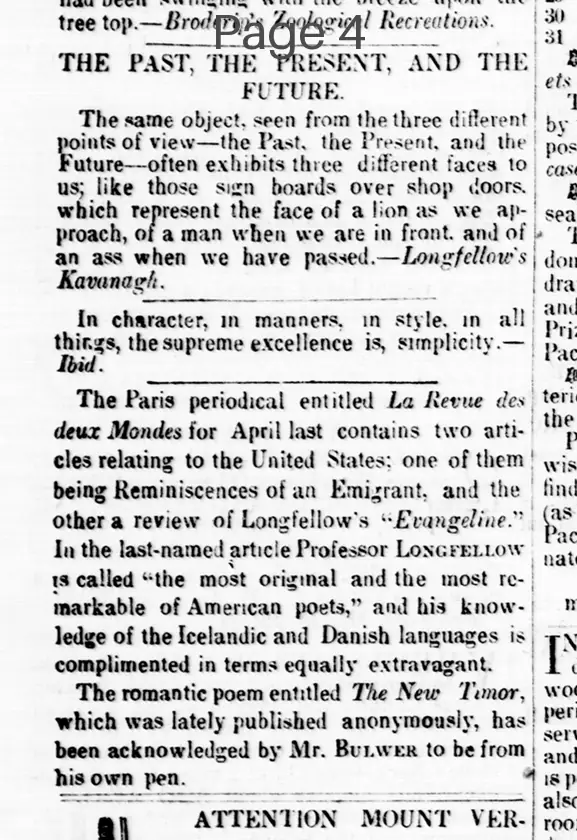
THE PAST, THE PRESENT, AND THE FUTURE.
The same object, seen from the three different points of view—the Past, the Present, and the Future—often exhibits three different faces to us; like those sign boards over shop doors which represent the face of a lion as we approach, of a man when we are in front, and of an ass when we have passed.—Longfellow's Kavanagh.
In character, in manners, in style, in all things, the supreme excellence is, simplicity.—Ibid.
The Paris periodical entitled La Revue des Deux Mondes for April last contains two articles relating to the United States; one of them being Reminiscences of an Emigrant, and the other a review of Longfellow's "Evangeline."
In the last-named article Professor Longfellow is called "the most original and the most remarkable of American poets," and his knowledge of the Icelandic and Danish languages is complimented in terms equally extravagant.
The romantic poem entitled The New Timon which was lately published anonymously, has been acknowledged by Mr. Bulwer to be from his own pen.
The same object, seen from the three different points of view—the Past, the Present, and the Future—often exhibits three different faces to us; like those sign boards over shop doors which represent the face of a lion as we approach, of a man when we are in front, and of an ass when we have passed.—Longfellow's Kavanagh.
In character, in manners, in style, in all things, the supreme excellence is, simplicity.—Ibid.
The Paris periodical entitled La Revue des Deux Mondes for April last contains two articles relating to the United States; one of them being Reminiscences of an Emigrant, and the other a review of Longfellow's "Evangeline."
In the last-named article Professor Longfellow is called "the most original and the most remarkable of American poets," and his knowledge of the Icelandic and Danish languages is complimented in terms equally extravagant.
The romantic poem entitled The New Timon which was lately published anonymously, has been acknowledged by Mr. Bulwer to be from his own pen.
What sub-type of article is it?
Essay
What keywords are associated?
Longfellow
Kavanagh
Simplicity
La Revue Des Deux Mondes
Evangeline
Reminiscences Of An Emigrant
New Timon
Bulwer
Literary Details
Title
The Past, The Present, And The Future.
Key Lines
The Same Object, Seen From The Three Different Points Of View—The Past, The Present, And The Future—Often Exhibits Three Different Faces To Us; Like Those Sign Boards Over Shop Doors Which Represent The Face Of A Lion As We Approach, Of A Man When We Are In Front, And Of An Ass When We Have Passed.—Longfellow's Kavanagh.
In Character, In Manners, In Style, In All Things, The Supreme Excellence Is, Simplicity.—Ibid.
Professor Longfellow Is Called "The Most Original And The Most Remarkable Of American Poets," And His Knowledge Of The Icelandic And Danish Languages Is Complimented In Terms Equally Extravagant.
The Romantic Poem Entitled The New Timon Which Was Lately Published Anonymously, Has Been Acknowledged By Mr. Bulwer To Be From His Own Pen.