Thank you for visiting SNEWPapers!
Sign up free
Atlanta Daily World
Atlanta, Fulton County, Georgia
What is this article about?
In Washington, a commission investigates WWII military segregation; army and selective service deflect blame. GIs testify to humiliations; professors debate civil disobedience in fighting racial injustices.
Merged-components note: Merged section title (headline) with the main story body and its continuation across pages, as they form a single logical article on army segregation policy.
Clippings
1 of 2
OCR Quality
Full Text
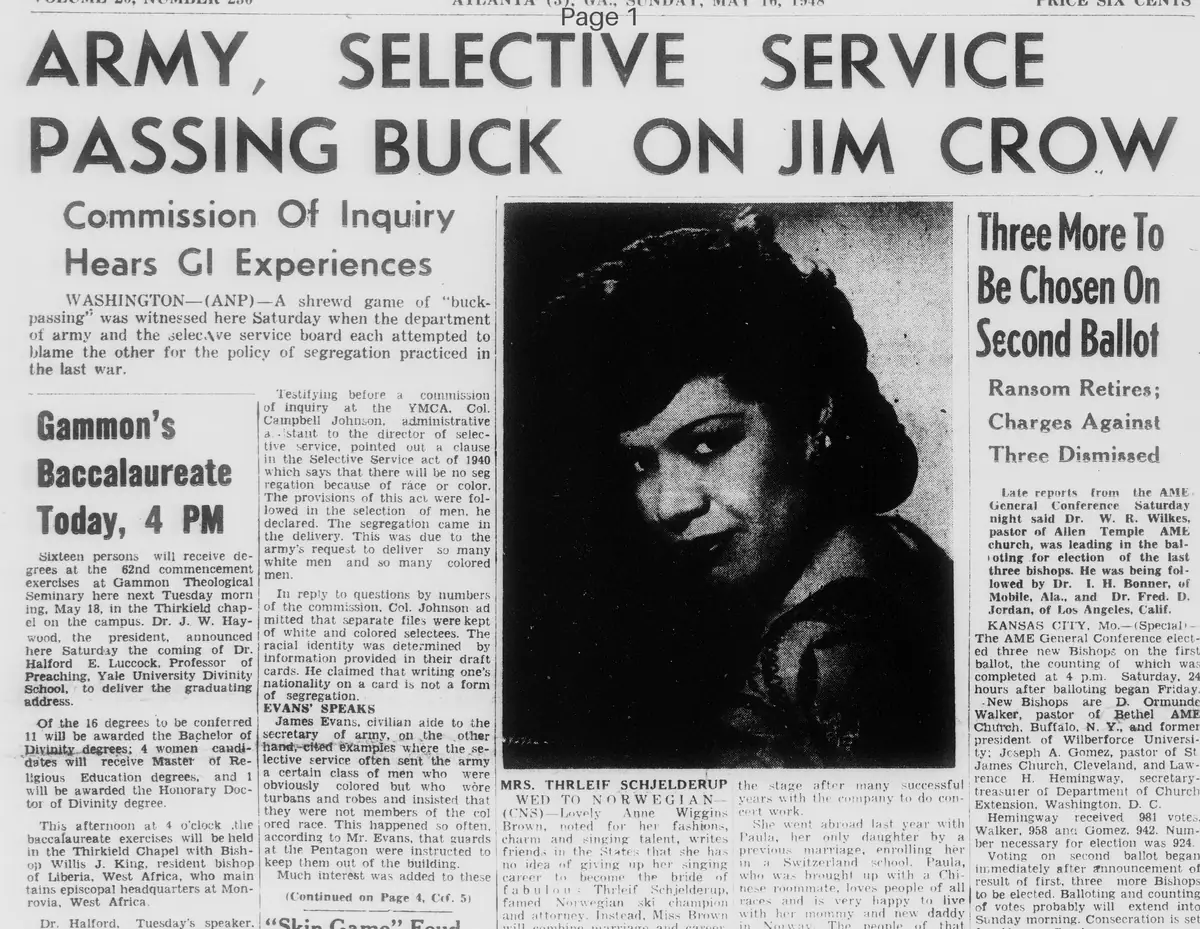
SELECTIVE
SERVICE
PASSING
BUCK
ON
JIM
CROW
Commission Of Inquiry
Hears GI Experiences
WASHINGTON-(ANP)-A shrewd game of "buck-
passing" was witnessed here Saturday when the department
of army and the selective service board each attempted to
blame the other for the policy of segregation practiced in
the last war.
Testifying before a
commission
of inquiry
at
the
YMCA. Col.
Campbell Johnson. administrative
assistant to the director of selec-
tive service. pointed out a clause
in the Selective Service act of 1940
which says that there will be no seg-
regation because of race or color.
'The provisions of this act were fol-
lowed in the selection of men, he
declared. The segregation came in
the delivery. This was due to the
army's request to deliver so many
white men and so many colored
men.
In reply to questions by members
of the commission, Col. Johnson ad-
mitted that separate files were kept
of white and colored selectees. The
racial identity was determined
by
information provided in their draft
cards. He claimed that writing one's
nationality on a card is not a form
of segregation.
EVANS SPEAKS
James Evans. civilian aide to the
secretary of army. on the other
hand. -cited examples where the se-
lective service often sent the army
a certain class of men who were
obviously colored but who wore
turbans and robes and insisted that
they were not members of the col-
ored race. This happened so often.
according to Mr. Evans. that guards
at the Pentagon were instructed to
keep them out of the building.
Much interest was added to these
(Continued on Page 4, Col. 5)
Commission
(Continued from Page One)
hearings by former GIs who related varied experience and humiliations to which they were subjected while in the army. Several white ex-army officers of their observations while in camps in this country.
Among those testifying Sunday were Brig. Gen. H. C. Holdridge, candidate for nomination for President of the U. S. and Clifford Smith, a former naval officer.
Smith a native of Oklahoma referred to the testimonies by the army officials as being most provoking. He said that was his first opportunity to hear testimonies by any of the policy makers. In regard to the navy's policy of integration mentioned the previous day, the former officer declared that such a policy had never been made known to the officers while he was serving, he had never heard of any such order.
SWORDS CROSSED
Two university professors and World War I veterans crossed swords on the question of civil disobedience. Frank Coleman, professor of physics at Howard, speaking for two Negro posts of the American Legion, read a resolution favoring UMT and selective service, but strongly disapproving the Randolph-Reynolds movement.
Prof. Coleman said he believed that all laws should be obeyed, therefore, he would not like to see Negroes or whites get in the habit of ignoring the law.
Dr. Joseph Johnson, dean of the school of medicine at Howard requested to testify because he said he wanted the record to show that all university professors did not feel the way Prof. Coleman did. He declared that he was not altogether opposed to Mr. Randolph's position. "Randolph is rendering to the country a valuable service by defending or building a more substantial democracy," he said.
TO FIGHT EVILS
Although he would take no part in any attempt to overthrow the government of his country, Dr. Johnson declared that he would fight the evils of his country whether they come from the stronger who oppress the weak, or from the weak ones themselves.
This country was founded on civil disobedience, he declared, referring to the Boston Tea Party. He cited the underground railroad as an instrument to deliver his people from slavery and an act of civil disobedience.
Some of the other witnesses were Winfred Lynn of the famous New York Lynn case which tested the legality of drafting men into a segregated army during the war. His brother, Conrad Lynn, the attorney who defended Winfred, charged Col. Johnson with visiting his office the day before the trial requesting him to drop the case.
Thomas Parks of the Bronx, a conscientious objector who served 19 months in a federal prison because he refused to be drafted into the army, was another. After serving his term, he still refused and was sentenced to another four-year term.
What sub-type of article is it?
What themes does it cover?
What keywords are associated?
What entities or persons were involved?
Where did it happen?
Story Details
Key Persons
Location
Washington, At The Ymca
Story Details
A commission of inquiry hears testimonies on segregation in the army during WWII, with the army and selective service blaming each other for Jim Crow policies. Former GIs share experiences of humiliation. Debates on civil disobedience arise, with professors differing on obeying laws versus fighting evils like segregation.