Thank you for visiting SNEWPapers!
Sign up free
The New Hampshire Gazette
Portsmouth, Rockingham County, New Hampshire
What is this article about?
In the House of Commons on March 6, Mr. Whitbread delivers a speech criticizing British policy towards America, referencing the American War of Independence, the recent Orders in Council, and the government's refusal of American cooperation, warning of potential conflict and economic harm.
Clipping
OCR Quality
Full Text
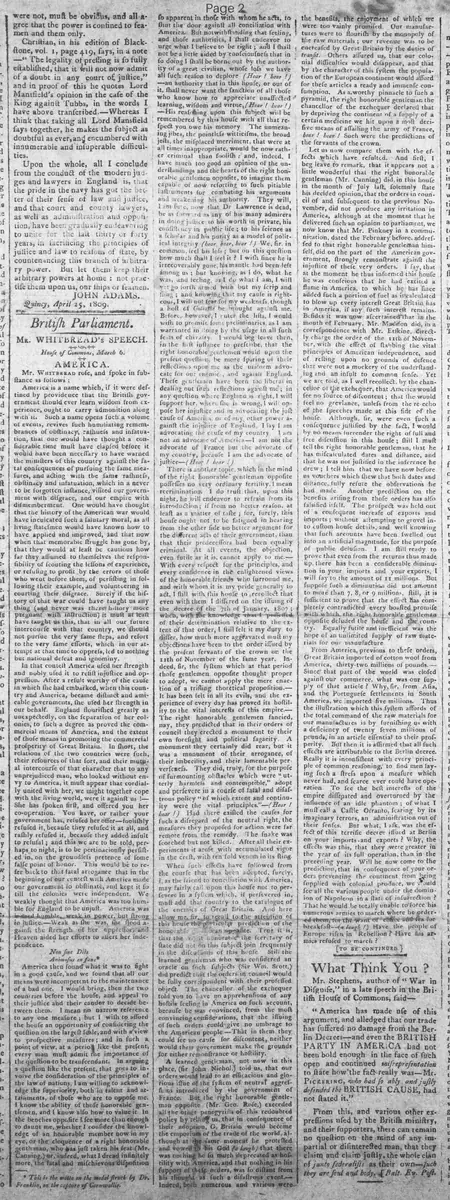
Mr. WHITBREAD'S SPEECH.
House of Commons, March 6.
AMERICA.
Mr. WHITBREAD rose, and spoke in substance as follows:
America is a name which, if it were destined by providence that the British government should ever learn wisdom from experience, ought to carry admonition along with it. Such a name opens such a volume of events, revives such humiliating remembrances of obstinacy, rashness and infatuation, that one would have thought a considerable time must have elapsed before it would have been necessary to have warned the ministers of this country against the fatal consequences of pursuing the same measures, and acting with the same rashness, obstinacy and infatuation, which in a never to be forgotten instance, visited our government with disgrace, and our empire with dismemberment. One would have thought that the history of the American war would have inculcated such a salutary moral, as all living statesmen would have known how to have applied and improved, and that now when that memorable struggle has gone by. that they would at least be cautious how far they assumed to themselves the responsibility of scouting the lessons of experience, or refusing to profit by the errors of those who went before them, of persisting in following their example, and volunteering in courting their disgrace. Surely if the history of that war could have taught us anything (and never was there a history more pregnant with instruction) it must at least have taught us this, that in all our future intercourse with that country, we should not pursue the very same steps, and resort to the very same efforts, which in our attempt at that time to oppress, led to nothing but national defeat and ignominy.
In that contest America used her strength and nobly used it to resist injustice and oppression. After a result worthy of the cause in which she had embarked, when this country and America, became distinct and amicable governments, she used her strength in our behalf. England flourished greatly as unexpectedly, on the separation of her colonies, to such a degree as proved the commercial means of America, and the extent of those means in promoting the commercial prosperity of Great Britain. In short, the relations of the two countries were such, their resources of that sort, and their mutual intercourse of that character that to any unprejudiced man, who looked without envy to America, it must appear that cordially united with her, we might together cope with the living world, were it against us!-
She has spoken first, and offered you her co-operation. You have, or rather your government has, refused her offer—foolishly refused it, because they refused it at all, and rashly refused it, because they added insult to refusal; and this we are to be told, perhaps to night, is to be pertinaciously persisted in, on the groundless pretence of some false point of honor. This would be to refer back to that fatal arrogance that in the beginning of our contest with America made our government so obstinate, and kept it so till the colonies were independent. We weakly thought that America was too humble for England to be unjust. America was indeed humble weak in power. but strong in justice.-Weak as she was, she stood against the strength of her oppressor, and Heaven aided her efforts to assert her independence.
Non ine Dits
Animosis en fans
America then found what it was to fight in a good cause, and we found that all our means were incompetent to the maintenance of a bad one. I would bring, then the two countries before the house, and appeal to their justice and their candor to decide between them. I mean no narrow reference to any one measure; but I wish to afford the house an opportunity of considering the question on the largest scale, and with a view to prospective measures; and in such a point of view, at a period like the present, every man must admit the importance of the question to be transcendent. In arguing a question like the present, that goes to involve the consideration of the principles of the law of nations, I am willing to acknowledge the superiority, both in talent and attainments, of those who are to oppose me. I know the ability of those honorable gentlemen, and I know also how to value it. In the benches opposite I see more than enough to daunt me, whether I consider the knowledge of an honorable member now in my eye, or the eloquence of a right honorable gentleman, who has just taken his seat (Mr. Canning,) or, indeed, what I dread infinitely more, the fatal and mischievous disposition so apparent in those with whom he acts, to shut the door against all conciliation with America. But notwithstanding that feeling, and those authorities, I shall endeavor to urge what I believe to be right ; and I shall not be a little aided by consciousness that in so doing I shall be borne out by the authority of a great civilian, whose loss we have all such reason to deplore (Hear ! hear !) -an authority that in this house, or out of it, shall never want the sanction of all those who know how to appreciate unaffected learning, wisdom and virtue,(Hear ! hear!) -His reasoning upon this subject will be remembered by this house with all that respect you owe his memory. The unmeaning jibes, the pointless witticisms, the broad jests, the misplaced merriment, that were at all times inappropriate, would be now rather criminal than foolish : and, indeed, I have much too good an opinion of the understandings and the hearts of the right honorable gentlemen opposite, to imagine them capable of now resorting to such pitiable instruments for combating his arguments and weakening his authority. They will, I am sure, now that Dr Lawrence is dead, be as forward as any of his many admirers in doing justice to his worth in private, his consistency in public life ; to his science as a scholar and his purity as a model of political integrity (hear, hear, hear !) We, sir, in common, feel his loss ; but on this question how much shall I feel it ? I wish since he is irrecoverably gone. his mantle had been left among us ; but knowing, as I do, what he was, and feeling, as I do what I am, I will yet go forth armed with but my scrip and sling ; and knowing that my cause is righteous, I will not fear for my weakness, though a host of Goliaths be brought against me.
Before, however, I enter the lists, I would wish to promise some preliminaries, as I am warranted in doing by the usage in all such feats of chivalry I would beg leave then, in the first instance to prescribe, that the right honorable gentlemen would upon the present question, be more sparing of their reflections upon me as the uniform advocate for our enemies , and against England. These gentlemen have been too liberal in dealing out such reflections against me ; in any question where England is right, I will support her, where she is wrong, I will oppose her injustice and in advocating the just cause of America or of any, other power against the injustice of England. I say I am advocating the cause of my country. I am not an advocate of America--I am not the advocate of France but the advocate of my country, because I am the advocate of justice-(Hear ! hear !)
There is another topic, which in the mind of the right honorable gentleman opposite possesses no very ordinary fertility, I mean recrimination. I do trust that. upon this night, he will endeavor to refrain from its introduction; if from no better reason, at least as a matter of taste ; for, surely, this house ought not to be fatigued in hearing from the other side no better argument for the different acts of their government, than that their predecessors had been equally criminal. At all events, the objection, even futile as it is, cannot apply to me.- With every respect for the principles, and every confidence in the enlightened views of the honorable friends who surround me, and with whom it is my pride generally to act, I still wish this house to recollect that even with them I differed on the issuing of the decree of the 7th of January, 1807 ; when, with the knowledge that I possessed of their determination relative to the extent of that order, I still felt it my duty to differ, how much more aggravated must my objections have been to the order issued by the present servants of the crown on the 11th of November of the same year. Indeed, sir, the system which at that period those gentlemen opposite thought proper to adopt, we cannot apply the mere enactment of a trifling theoretical proposition.-- It has been felt in all its evils, and the experience of every day has proved its hostility to the vital interests of this empire.-- The right honorable gentlemen fancied. nay, they predicted that in their orders of council they erected a monument to their own foresight and political sagacity. A monument they certainly did rear, but it was a monument of their arrogance, of their imbecility, and their lamentable perseverance. They did, truly, for the purpose of surmounting obstacles which were "utterly harmless and contemptible," adopt and persevere in a course of fatal and disastrous policy "of which extent and continuity were the vital principles."--Hear ! hear !) Had there existed the causes for such a disregard of the neutral right, the measures they proposed for action were far remote from the remedy. The snake was scorched but not killed. After all their experiments it arose with accumulated vigor in the crest, with ten fold venom in its sting. When such effects have followed from the course that has been adopted, surely, I, as the friend to conciliation with America, may fairly call upon this house not to persevere in a system which, if persevered in, must add that country to the catalogue of the enemies of Great Britain. And here allow me, sir. to recall to the attention of this house the particular prediction of the honorable man opposite. True it is, that the right honorable the secretary of state did not on this subject join frequently in the discussions of this house Still the learned gentleman who was considered an oracle on such subjects (Sir Wm. Scott,) did predict that the orders in council would be fully correspondent with their professed object. The chancellor of the exchequer told you to have no apprehensions of any hostile feeling in America on such account, because he was convinced, from the most convincing considerations, that the issuing of such orders could-give no umbrage to the American people -That in them they could see no cause for discontent, neither would their government make the grounds for either remonstrance or hostility.
A learned gentleman, not now in this place, (Sir John Nichol.) told us, that our orders would lead to an efficacious and glorious issue of the system of neutral aggressions introduced by the government of France. But the right honorable gentleman opposite (Mr. Geo. Rose,) exceeded all the other panegyrists of this redoubted policy by telling us, that in consequence of their adoption, G. Britain would become the emporium of the trade of the world, although at the same moment he protested and vowed to his God (a laugh) that there was nothing he so much deprecated as hostility with America, and that nothing in his support of these orders, was so distant from his thoughts as such a disastrous event.
Indeed, both numerous and various were the benefits, the enjoyment of which we were too vainly promised. Our manufactures were to flourish by the monopoly of the raw materials ; our revenue was to be increased by Great Britain by the duties of transit. Others assured us, that our colonial difficulties would disappear, and that by the character of this system the population of the European continent would afford for these articles a ready and immense consumption. As a worthy pinnacle to such a pyramid, the right honorable gentleman the chancellor of the exchequer declared that by depriving the continent of a supply of a certain medicine we hit upon a most decisive means of assailing the army of France, hear ! hear ! Such were the predictions of the servants of the crown.
Let us now compare them with the effects which have resulted. And first, I beg leave to remark, that it appears not a little wonderful that the right honorable gentleman (Mr. Canning) did, in this house in the month of July last, solemnly state his decided opinion, that the orders in council of and subsequent to the previous November, did not produce any irritation in America, although at the moment that he delivered such an opinion to parliament, we now know that Mr. Pinkney in a communication, dated the February before. addressed to that right honorable gentleman himself, did on the part of the American government, strongly remonstrate against the injustice of these very orders. I say, that at the moment he thus informed this house he was conscious that he had excited a flame in America, to which he has since added such a portion of fuel as is calculated to blow up every interest Great Britain has in America, if any such interest remains.
Besides it was now ascertained that in the month of February, Mr. Madison did, in a correspondence with Mr. Erskine, directly charge the order of the 11th of November, with the effect of stabbing the vital principles of American independence, and of resting upon no grounds of defence that were not a mockery of the understanding and an insult to common sense. . Yet we are told, as I well recollect, by the chancellor of the exchequer, that America would see no source of discontent; that she would feel no grievance, unless from the re-echo of the speeches made at this side of the house. Although, sir, were even such a consequence justified by the fact, I would by no means surrender the right of full and free discussion in this house; still I must tell the right honorable gentleman, that he has miscalculated dates and distance, and that he was not justified in the inference he drew ; I tell him that we have now before us vouchers which show that both dates and distance, fully refute the observations he had made. Another prediction on the benefits arising from those orders has also falsified itself. The prospect was held out of a consequent increase of exports and imports; without attempting to grovel into custom house details, and well knowing that such accounts have been swelled out into an artificial magnitude, for the purpose of public delusion. I am still ready to prove that even from the returns thus made up, there has been a considerable diminution in your imports and your exports, I will say to the amount of 11 millions. But suppose such a diminution did not amount to more than 7, 8, or 9 millions, still, it is sufficient to prove that the effect has completely contradicted every boasted promise with which the right honorable gentleman opposite deluded the house and the country. Equally futile and inefficient was the hope of an unlimited supply of raw materials for our manufacture
From America, previous to these orders. Great Britain imported of cotton wool from America, thirty-two millions of pounds.- Since that part of the world was closed against our commerce, what was our supply of that article ? Why, sir, from Asia, and the Portuguese settlements in South America, we imported five millions. Thus the illustration which this system affords of the total command of the raw materials for our manufactures is by furnishing us with a deficiency of twenty seven millions of pounds, in an article essential to their prosperity. But then it is affirmed that all such effects are attributable to the Berlin decree. Really it is inconsistent with every principle of common reasoning, to find men laying such a stress upon a measure which never had, and scarce ever could have operation. To see the best interests of the empire destroyed and overturned by the influence of an idle phantom; of what I must call a Castle Otranto, carrying by its imaginary terrors, an administration out of their senses. But what, I ask, was the effect of this terrific decree issued at Berlin on your imports.and exports ? Why, the effects was this, that they were greater in the year of its full operation, than in the preceding year. Will he now come to the prediction, that in consequence of your orders preventing the continent from being supplied with colonial produce, we would see all the various people under the dominion of Napoleon in a state of insurrection ? That he would be totally unable to force his numerous armies to march where he ordered them, for the want of coffee and tea for breakfast--(a laugh) Have the people of Europe risen in Rebellion? Have his armies refused to march ?
[TO BE CONTINUED.]
What sub-type of article is it?
What keywords are associated?
What entities or persons were involved?
Where did it happen?
Foreign News Details
Primary Location
America
Event Date
House Of Commons, March 6
Key Persons
Outcome
criticism of british orders in council leading to strained relations, economic losses including reduced imports/exports by up to 11 millions and cotton wool deficiency of 27 millions of pounds; warning of potential addition of america to britain's enemies.
Event Details
Mr. Whitbread's speech in the House of Commons criticizes the British government's refusal of American cooperation, draws lessons from the American War of Independence, condemns the Orders in Council of 1807 for violating neutral rights and causing economic harm, references American remonstrances by Mr. Pinkney and Mr. Madison, and urges conciliation to avoid conflict, highlighting failed predictions of benefits from the policy.