Thank you for visiting SNEWPapers!
Sign up free
Story
August 5, 1863
The Weekly Perrysburg Journal
Perrysburg, Wood County, Ohio
What is this article about?
Article on Scottish ministers' practice of memorizing sermons by heart, termed 'mandating,' involving audible repetition; discusses benefits like accuracy and spontaneity versus risks of breakdown, preferring it over reading from notes.
Clipping
OCR Quality
98%
Excellent
Full Text
Preaching from Memory.
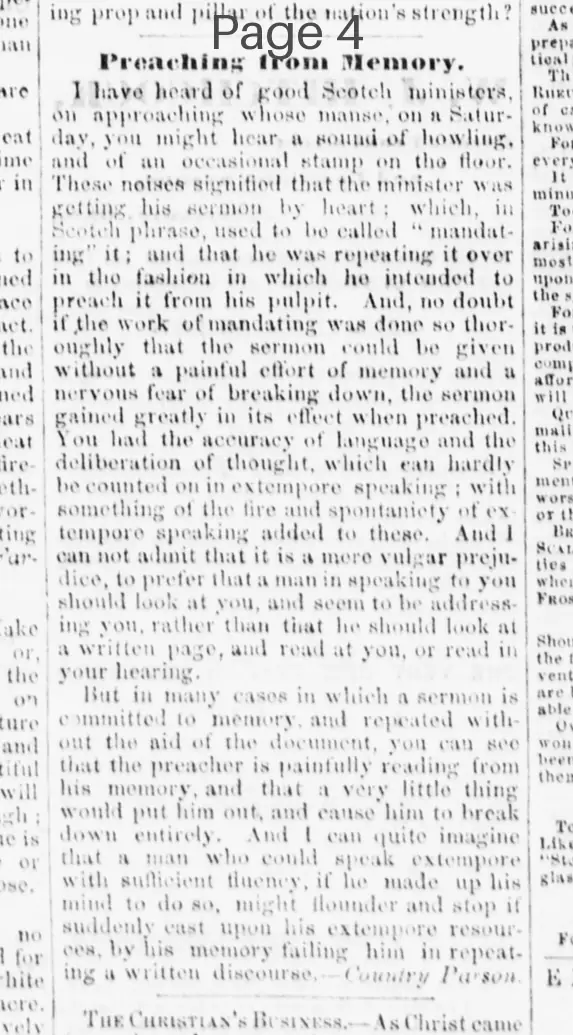
I have heard of good Scotch ministers, on approaching whose manse, on a Saturday, you might hear a sound of howling, and of an occasional stamp on the floor. Those noises signified that the minister was getting his sermon by heart: which, in Scotch phrase, used to be called "mandating" it; and that he was repeating it over in the fashion in which he intended to preach it from his pulpit. And, no doubt if the work of mandating was done so thoroughly that the sermon could be given without a painful effort of memory and a nervous fear of breaking down, the sermon gained greatly in its effect when preached. You had the accuracy of language and the deliberation of thought, which can hardly be counted on in extempore speaking: with something of the fire and spontaneity of extempore speaking added to these. And I can not admit that it is a more vulgar prejudice, to prefer that a man in speaking to you should look at you, and seem to be addressing you, rather than that he should look at a written page, and read at you, or read in your hearing.
But in many cases in which a sermon is committed to memory and repeated without the aid of the document, you can see that the preacher is painfully reading from his memory, and that a very little thing would put him out, and cause him to break down entirely. And I can quite imagine that a man who could speak extempore with sufficient fluency, if he made up his mind to do so, might totter and stop suddenly cast upon his extempore resources, by his memory failing him in repeating a written discourse. - Westminster Review.
I have heard of good Scotch ministers, on approaching whose manse, on a Saturday, you might hear a sound of howling, and of an occasional stamp on the floor. Those noises signified that the minister was getting his sermon by heart: which, in Scotch phrase, used to be called "mandating" it; and that he was repeating it over in the fashion in which he intended to preach it from his pulpit. And, no doubt if the work of mandating was done so thoroughly that the sermon could be given without a painful effort of memory and a nervous fear of breaking down, the sermon gained greatly in its effect when preached. You had the accuracy of language and the deliberation of thought, which can hardly be counted on in extempore speaking: with something of the fire and spontaneity of extempore speaking added to these. And I can not admit that it is a more vulgar prejudice, to prefer that a man in speaking to you should look at you, and seem to be addressing you, rather than that he should look at a written page, and read at you, or read in your hearing.
But in many cases in which a sermon is committed to memory and repeated without the aid of the document, you can see that the preacher is painfully reading from his memory, and that a very little thing would put him out, and cause him to break down entirely. And I can quite imagine that a man who could speak extempore with sufficient fluency, if he made up his mind to do so, might totter and stop suddenly cast upon his extempore resources, by his memory failing him in repeating a written discourse. - Westminster Review.
What sub-type of article is it?
Biography
Curiosity
What themes does it cover?
Moral Virtue
What keywords are associated?
Sermon Memorization
Scottish Ministers
Mandating
Extempore Preaching
Preaching Methods
Where did it happen?
Scotch Manse
Story Details
Location
Scotch Manse
Story Details
Description of Scottish ministers memorizing sermons through audible repetition and stamping, known as 'mandating'; benefits include accuracy and spontaneity, but risks breakdown if memory fails; preference for direct address over reading.