Thank you for visiting SNEWPapers!
Sign up free
Letter to Editor
August 18, 1802
Alexandria Advertiser And Commercial Intelligencer
Alexandria, Virginia
What is this article about?
An anonymous writer under 'TRUEMAN' critiques William Duane of the Aurora newspaper for misapplying 'Tory' to political opponents, arguing that by Thomas Jefferson's 1798 definition, Duane and Jefferson supporters are now Tories for backing the administration. Questions revolutionaries' service in 1781 and defends true patriots.
Clipping
OCR Quality
98%
Excellent
Full Text
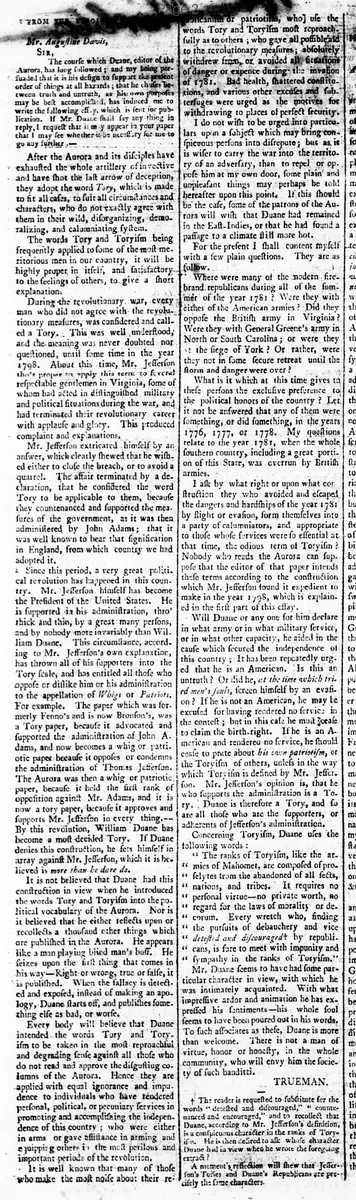
The course which Duane, editor of the Aurora, has long followed; and my being persuaded that it is his design to support the present order of things at all hazards; that he chooses between truth and untruth, as his own purposes may be best accomplished, has induced me to write the following essay, which is sent for publication. If Mr. Duane has said anything in reply, I request that it may appear in your paper that I may see whether it be necessary for me to go any further.
After the Aurora and its disciples have exhausted the whole artillery of invective and have shot the last arrow of deception, they adopt the word Tory, which is made to fit all cases, to suit all circumstances and characters, who do not exactly agree with them in their wild, disorganizing, demoralizing, and calumniating system.
The words Tory and Toryism being frequently applied to some of the most meritorious men in our country, it will be highly proper in itself, and satisfactory to the feelings of others, to give a short explanation.
During the revolutionary war, every man who did not agree with the revolutionary measures, was considered and called a Tory. This was well understood, and the meaning was never doubted nor questioned, until some time in the year 1798. About this time, Mr. Jefferson thought proper to apply this term to several respectable gentlemen in Virginia, some of whom had acted in distinguished military and political situations during the war, and had terminated their revolutionary career with applause and glory. This produced complaint and explanations.
Mr. Jefferson extricated himself by an answer, which clearly showed that he wished either to close the breach, or to avoid a quarrel. The affair terminated by a declaration, that he considered the word Tory to be applicable to them, because they countenanced and supported the measures of the government, as it was then administered by John Adams: that it was well known to bear that signification in England, from which country we had adopted it.
Since this period, a very great political revolution has happened in this country. Mr. Jefferson himself has become the President of the United States. He is supported in his administration, through thick and thin, by a great many persons, and by nobody more invariably than William Duane. This circumstance, according to Mr. Jefferson's own explanation, has thrown all of his supporters into the Tory class, and has entitled all those who oppose or dislike him or his administration to the appellation of Whigs or Patriots.
For example. The paper which was formerly Fenno's and is now Bronson's, was a Tory paper, because it advocated and supported the administration of John Adams, and now becomes a whig or patriotic paper because it opposes or condemns the administration of Thomas Jefferson.
The Aurora was then a whig or patriotic paper, because it held the first rank of opposition against Mr. Adams, and it is now a tory paper, because it approves and supports Mr. Jefferson in every thing.
By this revolution, William Duane has become a most decided Tory. If Duane denies this construction, he sets himself in array against Mr. Jefferson, which it is believed is more than he dare do.
It is not believed that Duane had this construction in view when he introduced the words Tory and Toryism into the political vocabulary of the Aurora. Nor is it believed that he either reflects upon or recollects a thousand other things which are published in the Aurora. He appears like a man playing blind man's buff. He seizes upon the first thing that comes in his way—Right or wrong, true or false, it is published. When the fallacy is detected and exposed, instead of making an apology, Duane starts off, and publishes something else as bad, or worse.
Every body will believe that Duane intended the words Tory and Toryism to be taken in the most reproachful and degrading sense against all those who do not read and approve the disgusting columns of the Aurora. Hence they are applied with equal ignorance and impudence to individuals who have tendered personal, political, or pecuniary services in promoting and accomplishing the independence of this country; who were either in arms or gave assistance in arming and equipping others in the most perilous and important periods of the revolution.
It is well known that many of those who make the most noise about their republicanism or patriotism, who use the words Tory and Toryism most reproachfully as to others; who gave all possible aid to the revolutionary measures; absolutely withdrew from, or avoided all situations of danger or expense during the invasion of 1781. Bad health, shattered constitutions, and various other excuses and subterfuges were urged as the motives for withdrawing to places of perfect security.
I do not wish to be urged into particulars upon a subject which may bring conspicuous persons into disrepute; but as it is wiser to carry the war into the territory of an adversary, than to repel or oppose him at my own door, some plain and unpleasant things may perhaps be told hereafter upon this point. If this should be the case, some of the patrons of the Aurora will wish that Duane had remained in the East-Indies, or that he had found a passage to a climate still more hot.
For the present I shall content myself with a few plain questions. They are as follow.
Where were many of the modern fire-brand republicans during all of the summer of the year 1781? Were they with either of the American armies? Did they oppose the British army in Virginia? Were they with General Greene's army in North or South Carolina: or were they at the siege of York? Or rather, were they not in some secure retreat until the storm and danger were over?
What is it which at this time gives to these persons the exclusive preference to the political honors of the country? Let it not be answered that any of them were something, or did something, in the years 1776, 1777, or 1778. My questions relate to the year 1781, when the whole southern country, including a great portion of this State, was overrun by British armies.
I ask by what right or upon what construction they who avoided and escaped the dangers and hardships of the year 1781 by flight or evasion, form themselves into a party of calumniators, and appropriate to those whose services were so essential at that time, the odious term of Toryism?
Nobody who reads the Aurora can suppose that the editor of that paper intends these terms according to the construction which Mr. Jefferson found it expedient to make in the year 1798, which is explained in the first part of this essay.
Will Duane or any one for him declare in what army or in what military service, or in what other capacity, he aided in the cause which secured the independence of this country; It has been repeatedly urged that he is an American. Is this an untruth? Or did he, at the time which tried men's souls, screen himself by an evasion? If he is not an American, he may be excused for having rendered no service in the contest: but in this case he must cease to claim the birth-right. If he is an American and rendered no service, he should cease to prate about his own patriotism, or the Toryism of others, unless in the way which Toryism is defined by Mr. Jefferson.
Mr. Jefferson's opinion is, that he who supports the administration is a Tory. Duane is therefore a Tory, and so are all those who are the supporters, or adherents of Jefferson's administration.
Concerning Toryism, Duane uses the following words:
"The ranks of Toryism, like the armies of Mahomet, are composed of proselytes from the abandoned of all sects, nations, and tribes. It requires no personal virtue—no private worth, no regard for the laws of morality or decorum. Every wretch who, finding the pursuits of debauchery and vice countenanced and encouraged by republicans, is sure to meet with impunity and sympathy in the ranks of Toryism."
Mr. Duane seems to have had some particular character in view, with which he was intimately acquainted. With what impressive ardor and animation he has expressed his sentiments—his whole soul seems to have been poured out in his words.
To such associates as these, Duane is more than welcome. There is not a man of virtue, honor or honesty, in the whole community, who will envy him the society of such banditti.
TRUEMAN.
* The reader is requested to substitute for the words "countenanced and encouraged," "detested and discouraged," and to recollect that Duane, according to Mr. Jefferson's definition, is a conspicuous character in the ranks of Toryism. He is then desired to ask whose character Duane had in view when he wrote the foregoing extract?
A moment's reflection will show that Jefferson's Tories and Duane's Republicans are precisely the same characters.
After the Aurora and its disciples have exhausted the whole artillery of invective and have shot the last arrow of deception, they adopt the word Tory, which is made to fit all cases, to suit all circumstances and characters, who do not exactly agree with them in their wild, disorganizing, demoralizing, and calumniating system.
The words Tory and Toryism being frequently applied to some of the most meritorious men in our country, it will be highly proper in itself, and satisfactory to the feelings of others, to give a short explanation.
During the revolutionary war, every man who did not agree with the revolutionary measures, was considered and called a Tory. This was well understood, and the meaning was never doubted nor questioned, until some time in the year 1798. About this time, Mr. Jefferson thought proper to apply this term to several respectable gentlemen in Virginia, some of whom had acted in distinguished military and political situations during the war, and had terminated their revolutionary career with applause and glory. This produced complaint and explanations.
Mr. Jefferson extricated himself by an answer, which clearly showed that he wished either to close the breach, or to avoid a quarrel. The affair terminated by a declaration, that he considered the word Tory to be applicable to them, because they countenanced and supported the measures of the government, as it was then administered by John Adams: that it was well known to bear that signification in England, from which country we had adopted it.
Since this period, a very great political revolution has happened in this country. Mr. Jefferson himself has become the President of the United States. He is supported in his administration, through thick and thin, by a great many persons, and by nobody more invariably than William Duane. This circumstance, according to Mr. Jefferson's own explanation, has thrown all of his supporters into the Tory class, and has entitled all those who oppose or dislike him or his administration to the appellation of Whigs or Patriots.
For example. The paper which was formerly Fenno's and is now Bronson's, was a Tory paper, because it advocated and supported the administration of John Adams, and now becomes a whig or patriotic paper because it opposes or condemns the administration of Thomas Jefferson.
The Aurora was then a whig or patriotic paper, because it held the first rank of opposition against Mr. Adams, and it is now a tory paper, because it approves and supports Mr. Jefferson in every thing.
By this revolution, William Duane has become a most decided Tory. If Duane denies this construction, he sets himself in array against Mr. Jefferson, which it is believed is more than he dare do.
It is not believed that Duane had this construction in view when he introduced the words Tory and Toryism into the political vocabulary of the Aurora. Nor is it believed that he either reflects upon or recollects a thousand other things which are published in the Aurora. He appears like a man playing blind man's buff. He seizes upon the first thing that comes in his way—Right or wrong, true or false, it is published. When the fallacy is detected and exposed, instead of making an apology, Duane starts off, and publishes something else as bad, or worse.
Every body will believe that Duane intended the words Tory and Toryism to be taken in the most reproachful and degrading sense against all those who do not read and approve the disgusting columns of the Aurora. Hence they are applied with equal ignorance and impudence to individuals who have tendered personal, political, or pecuniary services in promoting and accomplishing the independence of this country; who were either in arms or gave assistance in arming and equipping others in the most perilous and important periods of the revolution.
It is well known that many of those who make the most noise about their republicanism or patriotism, who use the words Tory and Toryism most reproachfully as to others; who gave all possible aid to the revolutionary measures; absolutely withdrew from, or avoided all situations of danger or expense during the invasion of 1781. Bad health, shattered constitutions, and various other excuses and subterfuges were urged as the motives for withdrawing to places of perfect security.
I do not wish to be urged into particulars upon a subject which may bring conspicuous persons into disrepute; but as it is wiser to carry the war into the territory of an adversary, than to repel or oppose him at my own door, some plain and unpleasant things may perhaps be told hereafter upon this point. If this should be the case, some of the patrons of the Aurora will wish that Duane had remained in the East-Indies, or that he had found a passage to a climate still more hot.
For the present I shall content myself with a few plain questions. They are as follow.
Where were many of the modern fire-brand republicans during all of the summer of the year 1781? Were they with either of the American armies? Did they oppose the British army in Virginia? Were they with General Greene's army in North or South Carolina: or were they at the siege of York? Or rather, were they not in some secure retreat until the storm and danger were over?
What is it which at this time gives to these persons the exclusive preference to the political honors of the country? Let it not be answered that any of them were something, or did something, in the years 1776, 1777, or 1778. My questions relate to the year 1781, when the whole southern country, including a great portion of this State, was overrun by British armies.
I ask by what right or upon what construction they who avoided and escaped the dangers and hardships of the year 1781 by flight or evasion, form themselves into a party of calumniators, and appropriate to those whose services were so essential at that time, the odious term of Toryism?
Nobody who reads the Aurora can suppose that the editor of that paper intends these terms according to the construction which Mr. Jefferson found it expedient to make in the year 1798, which is explained in the first part of this essay.
Will Duane or any one for him declare in what army or in what military service, or in what other capacity, he aided in the cause which secured the independence of this country; It has been repeatedly urged that he is an American. Is this an untruth? Or did he, at the time which tried men's souls, screen himself by an evasion? If he is not an American, he may be excused for having rendered no service in the contest: but in this case he must cease to claim the birth-right. If he is an American and rendered no service, he should cease to prate about his own patriotism, or the Toryism of others, unless in the way which Toryism is defined by Mr. Jefferson.
Mr. Jefferson's opinion is, that he who supports the administration is a Tory. Duane is therefore a Tory, and so are all those who are the supporters, or adherents of Jefferson's administration.
Concerning Toryism, Duane uses the following words:
"The ranks of Toryism, like the armies of Mahomet, are composed of proselytes from the abandoned of all sects, nations, and tribes. It requires no personal virtue—no private worth, no regard for the laws of morality or decorum. Every wretch who, finding the pursuits of debauchery and vice countenanced and encouraged by republicans, is sure to meet with impunity and sympathy in the ranks of Toryism."
Mr. Duane seems to have had some particular character in view, with which he was intimately acquainted. With what impressive ardor and animation he has expressed his sentiments—his whole soul seems to have been poured out in his words.
To such associates as these, Duane is more than welcome. There is not a man of virtue, honor or honesty, in the whole community, who will envy him the society of such banditti.
TRUEMAN.
* The reader is requested to substitute for the words "countenanced and encouraged," "detested and discouraged," and to recollect that Duane, according to Mr. Jefferson's definition, is a conspicuous character in the ranks of Toryism. He is then desired to ask whose character Duane had in view when he wrote the foregoing extract?
A moment's reflection will show that Jefferson's Tories and Duane's Republicans are precisely the same characters.
What sub-type of article is it?
Persuasive
Political
Provocative
What themes does it cover?
Politics
Press Freedom
Morality
What keywords are associated?
Toryism
William Duane
Aurora Newspaper
Thomas Jefferson
John Adams
Revolutionary War
1781 Invasion
Patriotism
Political Revolution
What entities or persons were involved?
Trueman
The Printer
Letter to Editor Details
Author
Trueman
Recipient
The Printer
Main Argument
william duane and supporters of jefferson's administration are tories by jefferson's own 1798 definition, as they back the current government; the term is misused to attack true revolutionaries who served in 1781 while others evaded danger.
Notable Details
References Jefferson's 1798 Application Of 'Tory' To Adams Supporters
Questions Service In 1781 British Invasion Of Virginia And South
Quotes Duane's Description Of Toryism
Notes Duane's Potential Non American Origins And Lack Of Revolutionary Service