Thank you for visiting SNEWPapers!
Sign up free
Virginia Argus
Richmond, Virginia
What is this article about?
Letter from Gen. Andrew Jackson to Gov. Blount detailing the victory at the Battle of New Orleans on Jan. 8, 1815, reporting heavy British losses of 6,500 vs. American 56 killed, crediting divine providence, and noting the capture of a transport by Mr. Shields.
Clipping
OCR Quality
Full Text
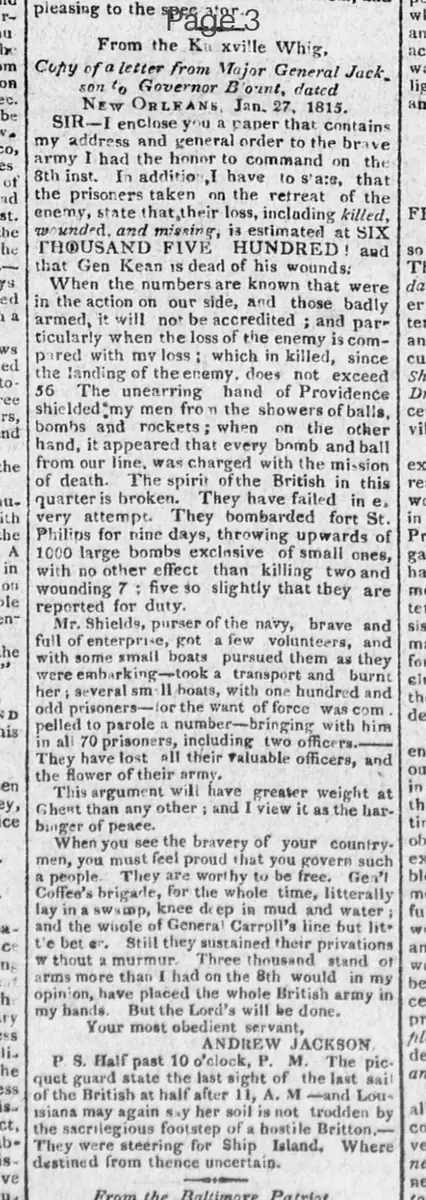
Copy of a letter from Major General Jackson to Governor Blount, dated
New Orleans. Jan. 27. 1815.
SIR-I enclose you a paper that contains my address and general order to the brave army I had the honor to command on the 8th inst. In addition, I have to state, that the prisoners taken on the retreat of the enemy, state that, their loss, including killed, wounded, and missing, is estimated at SIX THOUSAND FIVE HUNDRED! and that Gen Keane is dead of his wounds:
When the numbers are known that were in the action on our side, and those badly armed, it will not be accredited; and particularly when the loss of the enemy is compared with my loss; which in killed, since the landing of the enemy, does not exceed 56. The unerring hand of Providence shielded my men from the showers of balls, bombs and rockets; when on the other hand, it appeared that every bomb and ball from our line, was charged with the mission of death. The spirit of the British in this quarter is broken. They have failed in every attempt. They bombarded fort St. Philips for nine days, throwing upwards of 1000 large bombs exclusive of small ones, with no other effect than killing two and wounding 7; five so slightly that they are reported for duty.
Mr. Shields, purser of the navy, brave and full of enterprise, got a few volunteers, and with some small boats pursued them as they were embarking--took a transport and burnt her; several small boats, with one hundred and odd prisoners-for the want of force was compelled to parole a number-bringing with him in all 70 prisoners, including two officers.-
They have lost all their valuable officers, and the flower of their army.
This argument will have greater weight at Ghent than any other; and I view it as the harbinger of peace.
When you see the bravery of your countrymen, you must feel proud that you govern such a people. They are worthy to be free. Gen'l Coffee's brigade, for the whole time, literally lay in a swamp, knee deep in mud and water; and the whole of General Carroll's line but little better. Still they sustained their privations without a murmur. Three thousand stand of arms more than I had on the 8th would in my opinion, have placed the whole British army in my hands. But the Lord's will be done.
Your most obedient servant,
ANDREW JACKSON
P.S. Half past 10 o'clock, P.M. The picket guard state the last sight of the last sail of the British at half after 11, A.M.--and Louisiana may again say her soil is not trodden by the sacrilegious footstep of a hostile Briton.-
They were steering for Ship Island, Where destined from thence uncertain.
What sub-type of article is it?
What themes does it cover?
What keywords are associated?
What entities or persons were involved?
Where did it happen?
Story Details
Key Persons
Location
New Orleans, Fort St. Philips, Ship Island
Event Date
Jan. 27, 1815 (Battle On 8th Inst.)
Story Details
Gen. Jackson reports to Gov. Blount on the decisive American victory over the British at New Orleans on January 8, 1815, with enemy losses estimated at 6,500 versus 56 American killed, crediting divine protection; details failed British bombardment of Fort St. Philip; Mr. Shields captures a transport and prisoners; praises troops' endurance and views it as harbinger of peace.