Thank you for visiting SNEWPapers!
Sign up free
The Daily Herald
New Haven, New Haven County, Connecticut
What is this article about?
A large Whig political meeting at Faneuil Hall in Boston featured speeches by Daniel Webster, John Bell, William J. Graves, Joseph M. Underwood, Ogden Hoffman, and Benjamin Curtis, celebrating Whig victories and criticizing the administration's policies like the sub-treasury system.
Merged-components note: Continuation of the Faneuil Hall meeting story from the Boston Atlas across pages 1 and 2.
Clippings
1 of 2
OCR Quality
Full Text
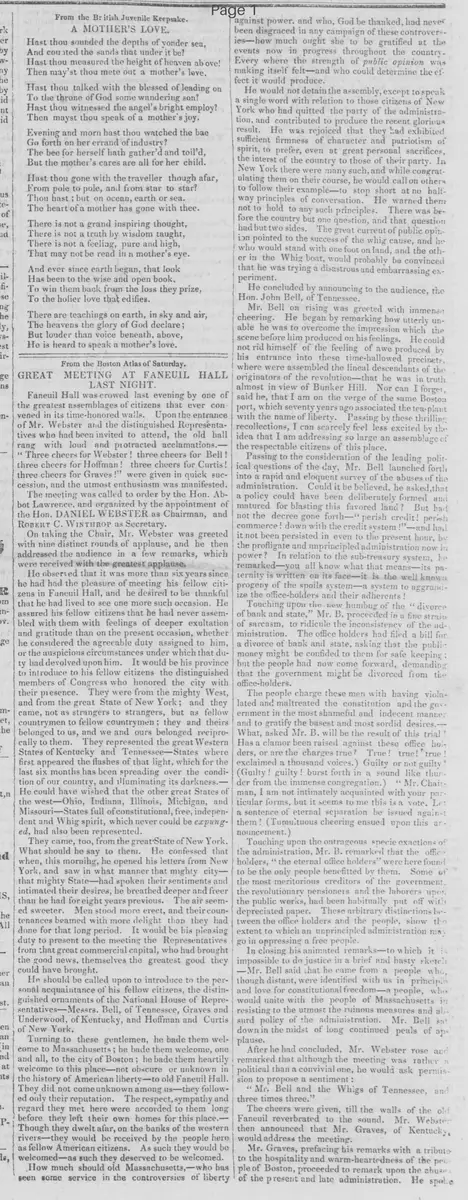
GREAT MEETING AT FANEUIL HALL LAST NIGHT.
Faneuil Hall was crowded last evening by one of the greatest assemblages of citizens that ever convened in its time-honored walls. Upon the entrance of Mr. Webster and the distinguished Representatives who had been invited to attend, the old hall rang with loud and protracted acclamations.—
"Three cheers for Webster! three cheers for Bell! three cheers for Hoffman! three cheers for Curtis! three cheers for Graves!" were given in quick succession, and the utmost enthusiasm was manifested.
The meeting was called to order by the Hon. Abbott Lawrence, and organized by the appointment of the Hon. DANIEL WEBSTER as Chairman, and Robert C. Winthrop as Secretary.
On taking the Chair, Mr. Webster was greeted with nine distinct rounds of applause, and he then addressed the audience in a few remarks, which were received with the greatest applause.
He observed that it was more than six years since he had had the pleasure of meeting his fellow citizens in Faneuil Hall, and he desired to be thankful that he had lived to see one more such occasion. He assured his fellow citizens that he had never assembled with them with feelings of deeper exultation and gratitude than on the present occasion, whether he considered the agreeable duty assigned to him, or the auspicious circumstances under which that duty had devolved upon him. It would be his province to introduce to his fellow citizens the distinguished members of Congress who honored the city with their presence. They were from the mighty West, and from the great State of New York; and they came, not as strangers to strangers, but as fellow countrymen to fellow countrymen; they and theirs belonged to us, and we and ours belonged reciprocally to them. They represented the great Western States of Kentucky and Tennessee—States where first appeared the flashes of that light, which for the last six months has been spreading over the condition of our country, and illuminating its darkness.— He could have wished that the other great States of the west—Ohio, Indiana, Illinois, Michigan, and Missouri—States full of constitutional, free, independent and Whig spirit, which never could be expunged, had also been represented.
They came, too, from the great State of New York. What should he say to them. He confessed that when, this morning, he opened his letters from New York, and saw in what manner that mighty city—that mighty State—had spoken their sentiments and intimated their desires, he breathed deeper and freer than he had for eight years previous. The air seemed sweeter. Men stood more erect, and their countenances beamed with more delight than they had done for that long period. It would be his pleasing duty to present to the meeting the Representatives from that great commercial capital, who had brought the good news, themselves the greatest good they could have brought.
He should be called upon to introduce to the personal acquaintance of his fellow citizens, the distinguished ornaments of the National House of Representatives—Messrs. Bell, of Tennessee, Graves and Underwood, of Kentucky, and Hoffman and Curtis of New York.
Turning to these gentlemen, he bade them welcome to Massachusetts; he bade them welcome, one and all, to the city of Boston; he bade them heartily welcome to this place—not obscure or unknown in the history of American liberty—to old Faneuil Hall. They did not come unknown among us—they followed only their reputation. The respect, sympathy and regard they met here were accorded to them long before they left their own homes for this place.— Though they dwelt afar, on the banks of the western rivers—they would be received by the people here as fellow American citizens. As such they would be welcomed—as such they deserved to be welcomed.
How much should old Massachusetts,—who has seen some service in the controversies of liberty against power, and who, God be thanked, had never been disgraced in any campaign of these controversies—how much ought she to be gratified at the events now in progress throughout the country. Every where the strength of public opinion was making itself felt—and who could determine the effect it would produce.
He would not detain the assembly, except to speak a single word with relation to those citizens of New York who had quitted the party of the administration, and contributed to produce the recent glorious result. He was rejoiced that they had exhibited sufficient firmness of character and patriotism of spirit, to prefer, even at great personal sacrifices, the interest of the country to those of their party. In New York there were many such, and while congratulating them on their course, he would call on others to follow their example—to stop short at no half-way principles of conversation. He warned them not to hold to any such principles. There was before the country but one question, and that question had but two sides. The great current of public opinion pointed to the success of the whig cause, and he who would stand with one foot on land, and the other in the Whig boat, would probably be convinced that he was trying a disastrous and embarrassing experiment.
He concluded by announcing to the audience, the Hon. John Bell, of Tennessee.
Mr. Bell on rising was greeted with immense cheering. He began by remarking how utterly unable he was to overcome the impression which the scene before him produced on his feelings. He could not rid himself of the feeling of awe produced by his entrance into these time-hallowed precincts, where were assembled the lineal descendants of the originators of the revolution—that he was in truth almost in view of Bunker Hill. Nor can I forget, said he, that I am on the verge of the same Boston port, which seventy years ago associated the tea-plant with the name of liberty. Passing by these thrilling recollections, I can scarcely feel less excited by the idea that I am addressing so large an assemblage of the respectable citizens of this place.
Passing to the consideration of the leading political questions of the day, Mr. Bell launched forth into a rapid and eloquent survey of the abuses of the administration. Could it be believed, he asked, that a policy could have been deliberately formed and matured for blasting this favored land? But had not the decree gone forth—"perish credit! perish commerce! down with the credit system!"—and had it not been persisted in even to the present hour, by the profligate and unprincipled administration now in power? In relation to the sub-treasury system, he remarked—you all know what that means—its paternity is written on its face—it is the well known progeny of the spoils system—a system to aggrandise the office-holders and their adherents!
Touching upon the new humbug of the "divorce of bank and state," Mr. B. proceeded in a fine strain of sarcasm, to ridicule the inconsistency of the administration. The office holders had filed a bill for a divorce of bank and state, asking that the public money might be confided to them for safe keeping; but the people had now come forward, demanding that the government might be divorced from the office-holders.
The people charge these men with having violated and maltreated the constitution and the government in the most shameful and indecent manner; and to gratify the basest and most sordid desires.— What, asked Mr. B. will be the result of this trial? Has a clamor been raised against these office holders, or are the charges true? True! true! true! exclaimed a thousand voices.) Guilty or not guilty? (Guilty! guilty! burst forth in a sound like thunder from the immense congregation.) "Mr. Chairman, I am not intimately acquainted with your particular forms, but it seems to me this is a vote. Let a sentence of eternal separation be issued against them!" (Tumultuous cheering ensued upon this announcement.)
Touching upon the outrageous specie exactions of the administration, Mr. B. remarked that the office holders, "the eternal office holders" were here found to be the only people benefitted by them. Some of the most meritorious creditors of the government, the revolutionary pensioners and the laborers upon the public works, had been habitually put off with depreciated paper. These arbitrary distinctions between the office holders and the people, show to what extent an unprincipled administration may go in oppressing a free people.
In closing his animated remarks—to which it is impossible to do justice in a brief and hasty sketch —Mr. Bell said that he came from a people who, though distant, were identified with us in principles and love for constitutional freedom—a people, who would unite with the people of Massachusetts in resisting to the utmost the ruinous measures and absurd policy of the administration. Mr. Bell sat down in the midst of long continued peals of applause.
After he had concluded, Mr. Webster rose and remarked that although the meeting was rather political than a convivial one, he would ask permission to propose a sentiment :
"Mr. Bell and the Whigs of Tennessee—and three times three."
The cheers were given, till the walls of the old Faneuil reverberated to the sound. Mr. Webster then announced that Mr. Graves, of Kentucky, would address the meeting.
Mr. Graves, prefacing his remarks with a tribute to the hospitality and warm-heartedness of the people of Boston, proceeded to remark upon the abuses of the present and late administration. He spoke
quite at length, but our confined limits prevent our giving even a sketch of his remarks. He concluded with a stirring appeal to the people of Massachusetts to maintain their glorious stand against the administration, and to proclaim their judgment by an increased vote.
Mr. Underwood, of Kentucky, followed his colleague in a few impressive and eloquent remarks. In speaking of the abuses of the administration, he remarked that it would be necessary to go to battle under one leader, and it was far from impossible that that leader would be chosen from Massachusetts. This allusion to Mr. Webster was enthusiastically applauded.
After the Kentucky representatives had finished, Mr. Webster remarked that with the name of Kentucky was associated the name of a very distinguished friend and advocate of constitutional freedom, and of one who was then present in that Hall, and of whom the people of Boston and of the whole Commonwealth had delighted to honor. With what joy, (said Mr. W.) will the glorious intelligence of the regeneration of New York be received in the name of Henry Clay. He would propose another sentiment:
The Whig Senators of Kentucky—Henry Clay and John J. Crittenden—the Whig Representatives of Kentucky—and the great Whig party of Kentucky.
Received with nine cheers.
Mr. Webster then introduced Mr. Ogden Hoffman, of New York, whose appearance was greeted with prolonged cheers.
Hon. Ogden Hoffman rose amidst deafening plaudits, and delivered a most thrilling, soul-stirring speech. His manner is remarkably pleasing, and his eloquence met with a response from every voice in the hall.
Alluding to his exhausted condition, he remarked that he was like a worn out and disabled soldier from the field of victory. His voice sounded unfamiliar to his ears, but he must be permitted to use it, to tell the people of Boston the noble deeds just done by their brethren of New York; for the last four days, his substance had been wasted in the tented field, and he could speak of nothing but feats of broil and of battles won.
He was almost in the state of the Athenian soldier who carried the news of the battle of Marathon to the city of Athens, and expired immediately after promulgating it. Should he expire after saying a word, he could almost consider his death happy, since his last breath would be expended in giving publicity to the glorious deeds of regenerated freemen.
New York, said Mr. H., has come. How could she hold back. Massachusetts; Vermont, Rhode Island were calling on her. Maine, degenerate Maine, had awakened from her long sleep of degradation and slavery at the sound of the oppressor's voice, and called on New York to join her in her new position. Kentucky, Indiana, Tennessee held out their hands to welcome her, told her what the freemen of the West had done, and called on them to partake of their glory! How could she stay? She did not; she came! The empire State was now to be found in the foremost rank of freedom—ready to die in the cause of the country.
Mr. Hoffman spoke for some moments and closed amidst such peals of applause as are rarely accorded to any public speaker. We may on Monday present a more extended sketch of his eloquent remarks.
Mr. Curtis of New York, being called upon, rose and said that having been introduced by the chairman, he was induced to come forward, simply for the purpose of tendering his thanks to the meeting for the very flattering reception they had given to his colleague and himself—at that time of the night, and after three hours of eloquent speaking, he knew that it became him, only, to express his gratitude to that great audience for their abundant kindness, and in the name of those whom he represented, the Whigs of New York, he begged them to receive his cordial thanks.
Mr. Webster then gave a closing sentiment—"Our cause, which we believe to be the cause of the country—and if our arm can make it successful, success shall attend it!"
Received with nine cheers.
It was then moved and carried that when this meeting adjourn it adjourn to meet at the polls at 12 o'clock on Monday next.
What sub-type of article is it?
What themes does it cover?
What keywords are associated?
What entities or persons were involved?
Where did it happen?
Story Details
Key Persons
Location
Faneuil Hall, Boston, Massachusetts
Event Date
Last Evening (Reported In Boston Atlas Of Saturday)
Story Details
Whig politicians from Tennessee, Kentucky, and New York addressed a large crowd at Faneuil Hall, chaired by Daniel Webster, celebrating recent Whig electoral successes, criticizing the Democratic administration's policies including the sub-treasury system and specie circular, and calling for unity against them.