Thank you for visiting SNEWPapers!
Sign up free
The National Intelligencer And Washington Advertiser
Washington, District Of Columbia
What is this article about?
In a U.S. House debate, Mr. Nicholson defends the Sinking Fund commissioners against Mr. Griswold's motion to investigate their report, arguing they properly applied over $7.3 million to public debt payments and interest, including advances for future obligations, and refuting claims of a $114,000 unaccounted deficiency with detailed calculations.
Clipping
OCR Quality
Full Text
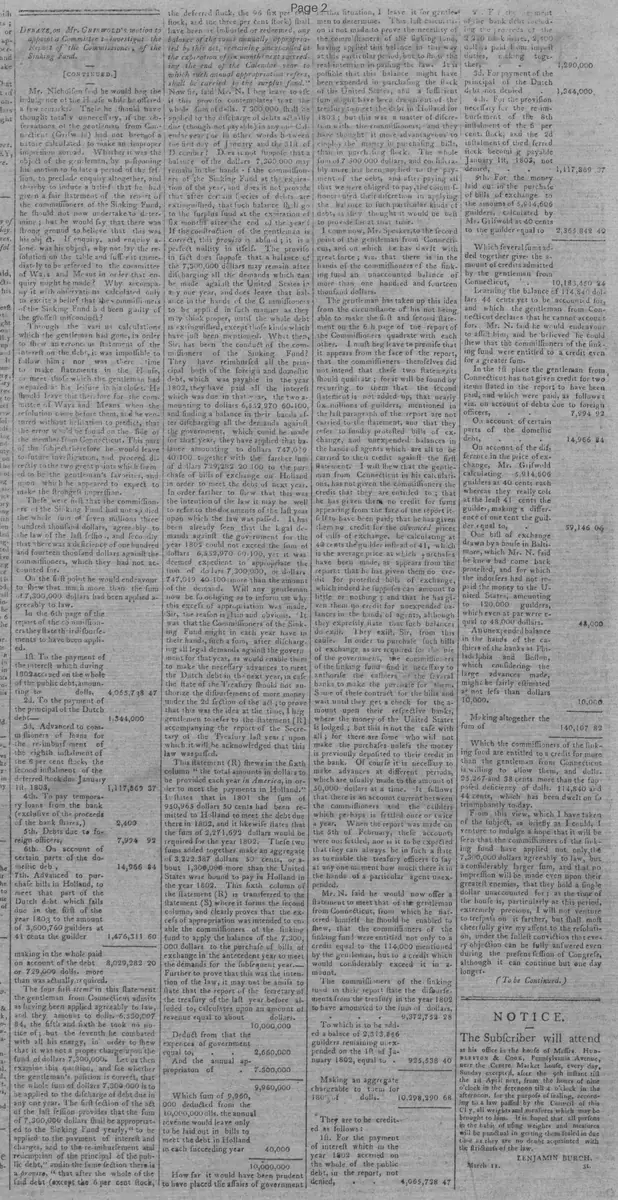
[CONTINUED.]
Mr. Nicholson said he would beg the indulgence of the House while he offered a few remarks. These he should have thought totally unnecessary, if the observations of the gentleman from Connecticut (Griswold) had not been of a nature calculated to make an improper impression abroad. Whether it was the object of the gentleman, by postponing his motion to so late a period of the session, to preclude enquiry altogether, and thereby to induce a belief that he had given a fair statement of the report of the commissioners of the Sinking Fund, he should not now undertake to determine; but he would say that there was strong ground to believe that this was his object. If enquiry, and enquiry alone, was his object, why not lay the resolution on the table and offer it immediately to be referred to the committee of Ways and Means in order that enquiry might be made? Why accompany it with observations calculated only to excite a belief that the commissioners of the Sinking Fund had been guilty of the grossest misconduct?
Through the various calculations which the gentleman had gone, in order to show an erroneous statement of the interest on the debt, it was impossible to follow him; nor was there time to make statements in the House, to meet those which the gentleman had prepared at his leisure in his closet. He should leave this therefore for the Committee of Ways and Means when the resolution came before them, and he ventured without hesitation to predict, that the error would be found on the side of the member from Connecticut. This part of the subject therefore he would leave to future investigation, and proceed directly to the two great points which seemed to be the gentleman's favorites, and upon which he appeared to expect to make the strongest impression.
These were first that the commissioners of the Sinking Fund had not applied the whole sum of seven millions three hundred thousand dollars, agreeably to the law of the last session, and secondly that there was a deficiency of one hundred and fourteen thousand dollars against the commissioners, which they had not accounted for.
On the first point he would endeavour to show that much more than the sum of 7,300,000 dollars had been applied agreeably to law.
To the 6th page of the report of the commissioners they state disbursements to have been applied.
1st. To the payment of the interest which during 1802 accrued on the whole of the public debt, amounting to 4,065,738 47 dolls.
2d. To the payment of the principal of the Dutch debt 1,344,000
3d. Advanced to commissioners of loans for the reimbursement of the eighth installment of the 6 per cent stocks the second installment of the deferred stock due January 1st, 1803, 1,117,869 37
4th. To pay temporary loans from the bank (exclusive of the proceeds of the bank shares,) 2,400
5th. Debts due to foreign officers, 7,994 92
6th. On account of certain parts of the domestic debt, 14,966 84
7th. Advanced to purchase bills in Holland, to meet that part of the Dutch debt which falls due in the first of the year 1803 to the amount of 3,600,760 guilders at 41 cents the guilder 1,476,311 60
making in the whole paid on account of the debt 8,029,282 20 or 729,000 dolls. more than was actually required.
The four first items in this statement the gentleman from Connecticut admits as having been applied agreeably to law, and they amount to dolls. 6,530,007 84, the fifth and sixth he took no notice of; but the seventh he combated with all his energy, in order to show that it was not a proper charge upon the fund of dollars 7,300,000. Let us then examine this question, and see whether the gentleman's position is correct, that the whole sum of dollars 7,300,000 is to be applied to the discharge of debt due in any one year. The first section of the act of the last session provides that the sum of 7,300,000 dollars shall be appropriated to the Sinking Fund yearly, "to be applied to the payment of interest and charges, and to the reimbursement and redemption of the principal of the public debt," and in the same section there is a proviso, "that after the whole of the said debt (except the 6 per cent stock, the deferred stock, the 3 1/2 per cent stock, and the three per cent stock) shall have been reimbursed or redeemed, any balance of the sums annually appropriated by this act, remaining unexpended at the expiration of six months next succeeding the end of the Calendar year to which such annual appropriation refers, shall be carried to the surplus fund."
Now sir, said Mr. N. I beg leave to ask if this proviso contemplates that the whole sum of dolls. 7,300,000 shall be applied to the discharge of debts annually due (though not payable) in any one calendar year; or in other words between the first day of January and the 31st of December? Does it not suppose that a balance of the dollars 7,300,000 may remain in the hands of the commissioners of the Sinking Fund at the expiration of the year, and does it not provide that after certain species of debts are extinguished, that such balance shall go to the surplus fund at the expiration of six months after the end of the year?
If the construction of the gentleman is correct, this proviso is absurd; it is a perfect nullity in itself. The proviso in fact does suppose that a balance of the 7,300,000 dollars may remain after discharging all the demands which can be made against the United States in any one year, and does leave that balance in the hands of the Commissioners to be applied in such manner as they may think proper, until the whole debt is extinguished, except those kinds which have just been mentioned. What then, Sir, has been the conduct of the commissioners of the Sinking Fund?
They have reimbursed all the principal both of the foreign and domestic debt, which was payable in the year 1802, they have paid all the interest which was due in that year, the two amounting to dollars 6,552,970 60-100. and finding a balance in their hands after discharging all the demands against the government, which could be made for that year, they have applied that balance amounting to dollars 747,029 40 100, together with the further sum of dollars 729,282 20 100 to the purchase of bills of exchange on Holland in order to meet the debt of next year.
In order further to show that this was the intention of the law it may be well to refer to the documents of the last year upon which the law was passed. It has been already seen that the legal demands against the government for the year 1802 could not exceed the sum of dollars 6,552,970 60.100, yet it was deemed expedient to appropriate the sum of dollars 7,300,000, or dollars 747,029 40.100 more than the amount of the demand. Will any gentleman now be so obliging as to inform me why this excess of appropriation was made.
Sir, the reason is plain and obvious. It was that the Commissioners of the Sinking Fund might in each year have in their hands such a sum, after discharging all legal demands against the government for that year, as would enable them to make the necessary advances to meet the Dutch debt in the next year, in case the state of the Treasury should not authorize the disbursement of more money under the 2d section of the act; to prove that this was the idea at the time, I beg gentlemen to refer to the statement [R] accompanying the report of the Secretary of the Treasury last year; upon which it will be acknowledged that this law was passed.
This statement (R) shows in the sixth column "the total amounts in dollars to be provided each year in America, in order to meet the payments in Holland." It states that in 1801 the sum of 950,965 dollars 50 cents had been remitted to Holland to meet the debt due there in 1802, and it likewise states that the sum of 2,271,692 dollars would be required for the year 1802. These two sums added together make an aggregate of 3,222,387 dollars 50 cents, or about 1,300,000 more than the United States were bound to pay in Holland in the year 1802. This sixth column of the statement (R) is transferred to the statement (S) where it forms the second column, and clearly proves that the excess of appropriation was intended to enable the commissioners of the sinking fund to apply the balance of the 7,300,000 dollars to the purchase of bills of exchange in the antecedent year to meet the demands for the subsequent year.
Further to prove that this was the intention of the law, it may not be amiss to state that the report of the secretary of the treasury of the last year before alluded to, calculates upon an amount of revenue equal to about dollars. 10,000,000
Deduct from that the expenses of government equal to, 2,660,000
And the annual appropriation of 7,300,000
9,960,000
Which sum of 9,960,000 deducted from the 10,000,000 dolls. the annual revenue would leave only to be laid out in bills to meet the debt in Holland in each succeeding year 40,000
10,000,000
How far it would have been prudent to have placed the affairs of government in this situation, I leave it for gentlemen to determine. This last calculation is not made to prove the necessity of the commissioners of the sinking fund, having applied this balance in this way at this particular period, but to show the real intention in passing the law. It is possible that this balance might have been expended in purchasing the stock of the United States, and a sufficient sum might have been drawn out of the treasury to meet the debt in Holland for 1803: but this was a matter of discretion with the commissioners, and they have thought it more advantageous' to employ the money in purchasing bills, than in purchasing stock. The whole sum of 7,300,000 dollars, and considerably more has been applied to the payment of the debt, and after paying all that we were obliged to pay, the commissioners used their discretion in applying the balance to such particular kinds of debt, as they thought it would be best to provide for at that time.
I come now, Mr. Speaker, to the second point of the gentleman from Connecticut, and on which he has dwelt with great force; viz. that there is in the hands of the commissioners of the sinking fund an unaccounted balance of more than one hundred and fourteen thousand dollars.
The gentleman has taken up this idea from the circumstance of his not being able to make the 1st and 2nd statements on the 6th page of the report of the Commissioners quadrate with each other. I must beg leave to premise that it appears from the face of the report, that the commissioners themselves did not intend that these two statements should quadrate; for it will be found by recurring to them that the second statement is not added up, that nearly six millions of guilders, mentioned in the last paragraph of the report are not carried to the statement, and that they refer to sundry protested bills of exchange, and unexpended balances in the hands of agents which are all to be carried to their credit against the first statement. I will show that the gentleman from Connecticut in his calculations, has not given the Commissioners the credit that they are entitled to; that he has given them no credit for sums appearing from the face of the report itself to have been paid; that he has given them no credit for the advanced prices of bills of exchange, he calculating at 40 cents the guilder instead of 41, which is the average price at which purchases have been made, as appears from the report: that he has given them no credit for protested bills of exchange, which indeed he supposes can amount to little or nothing; and that he has given them no credit for unexpended balances in the hands of agents, although they expressly state that such balances do exist. They exist, Sir, from this cause. In order to purchase such bills of exchange as are required for the use of the government, the commissioners of the sinking fund find it necessary to authorize the cashiers of the several banks to make the purchase for them. Some of these contract for the bills and wait until they get a check for the amount upon their respective banks, where the money of the United States is lodged; but this is not the case with all; for there are some who will not make the purchases unless the money is previously deposited to their credit in the bank. Of course it is necessary to make advances at different periods, which are usually made to the amount of 50,000 dollars at a time. It follows that there is an account current between the commissioners and the cashiers which perhaps is settled once or twice a year. When the report was made on the 5th of February, these accounts were not settled, nor is it to be expected that they can always be in such a state as to enable the treasury officers to say at any one moment how much there is in the hands of a particular agent unexpended.
Mr. N. said he would now offer a statement to meet that of the gentleman from Connecticut, from which he flattered himself he should be enabled to show, that the commissioners of the sinking fund were entitled not only to a credit equal to the 114,000 mentioned by the gentleman, but to a credit which would considerably exceed it in amount.
The commissioners of the sinking fund in their report state the disbursements from the treasury in the year 1802 to have amounted to the sum of dollars, 9,372,752 28
To which is to be added a balance of 2,313,846 guilders remaining unexpended on the 1st of January 1802, equal to . 925,538 40
Making an aggregate chargeable to them for 1802 of dolls. 10,298,290 68
These are to be credited as follows:
1st. For the payment of interest which in the year 1802 accrued on the whole of the public debt, in the report, not denied, 4,065,738 47
2d. For the proceeds of the bank stock excluding the proceeds of the 220 bank shares, 2,100 dolls. paid from import duties, making together, 1,290,000
3d. For payment of the principal of the Dutch debt not denied 1,344,000.
4th. For the provision necessary for the reimbursement of the 8th installment of the 6 per cent. stock, and the 2d installment of deferred stock becoming payable January 1st, 1803, not denied, 1,117,869 37
5th. For the money laid out in the purchase of bills of exchange to the amount of 5,914,606 guilders, calculated by Mr. Griswold at 40 cents to the guilder equal to 2,365,842 40
Which several sums added together give the amount of credits admitted by the gentleman from Connecticut, 10,183,450 24
Leaving the balance of 114,840 dolls. 44 cents yet to be accounted for, and which the gentleman from Connecticut declares that he cannot account for. Mr. N. said he would endeavour to assist him, and he believed he could show that the commissioners of the sinking fund were entitled to a credit even for a greater sum.
In the first place the gentleman from Connecticut has not given credit for two items stated in the report to have been paid, and which were paid, as follows: viz. on account of debts due to foreign officers, 7,994 92
On account of certain parts of the domestic debt, 14,966 84
On account of the difference in the price of exchange, Mr. Griswold calculating 5,914,606 guilders at 40 cents each whereas they really cost at the least 41 cents the guilder, making a difference of one cent the guilder equal to, 59,146 06
One bill of exchange drawn by a house in Baltimore, which Mr. N. said he knew had come back protested, and for which the indorsers had not repaid the money to the United States, amounting to 120,000 guilders, which even at par were equal to 48,000 dollars.
An unexpended balance in the hands of the cashiers of the banks at Philadelphia and Boston, which considering the large advances made, might be fairly estimated at not less than dollars 10,000.
Making altogether the sum of 140,107 82
Which the commissioners of the sinking fund are entitled to a credit for more than the gentleman from Connecticut is willing to allow them, and dolls. 25,267 38 cents more than the supposed deficiency of dolls. 114,840 44 cents, which has been dwelt on triumphantly to-day.
From this view, which I have taken of the subject, as briefly as I could, I venture to indulge a hope that it will be seen that the commissioners of the sinking fund have applied not only the 7,300,000 dollars agreeably to law, but a considerably larger sum, and that no impression will be made even upon their greatest enemies, that they hold a single dollar unaccounted for; as the time of the house is, particularly at this period, extremely precious, I will not venture to trespass on it farther, but shall most cheerfully give my assent to the resolution, under the fullest conviction that every objection can be fully answered even during the present session of Congress, although it can continue but one day longer.
(To be Continued.)
What sub-type of article is it?
What themes does it cover?
What keywords are associated?
What entities or persons were involved?
Where did it happen?
Story Details
Key Persons
Location
House Of Representatives
Event Date
1802
Story Details
Mr. Nicholson delivers a speech defending the Sinking Fund commissioners against Mr. Griswold's accusations of failing to apply $7.3 million according to law and having an unaccounted $114,000 deficiency, providing financial breakdowns showing proper application including advances for future Dutch debt and credits for overlooked items like protested bills and exchange rate differences.