Thank you for visiting SNEWPapers!
Sign up free
Editorial
September 3, 1804
Alexandria Daily Advertiser
Alexandria, Virginia
What is this article about?
Louisiana's remonstrance to U.S. Congress protests the proposed territorial government act, arguing it violates the Treaty of Paris by denying self-government and full citizenship rights. It demands immediate admission to the Union as a state with republican institutions, emphasizing local knowledge and historical orderliness of inhabitants.
Clipping
OCR Quality
95%
Excellent
Full Text
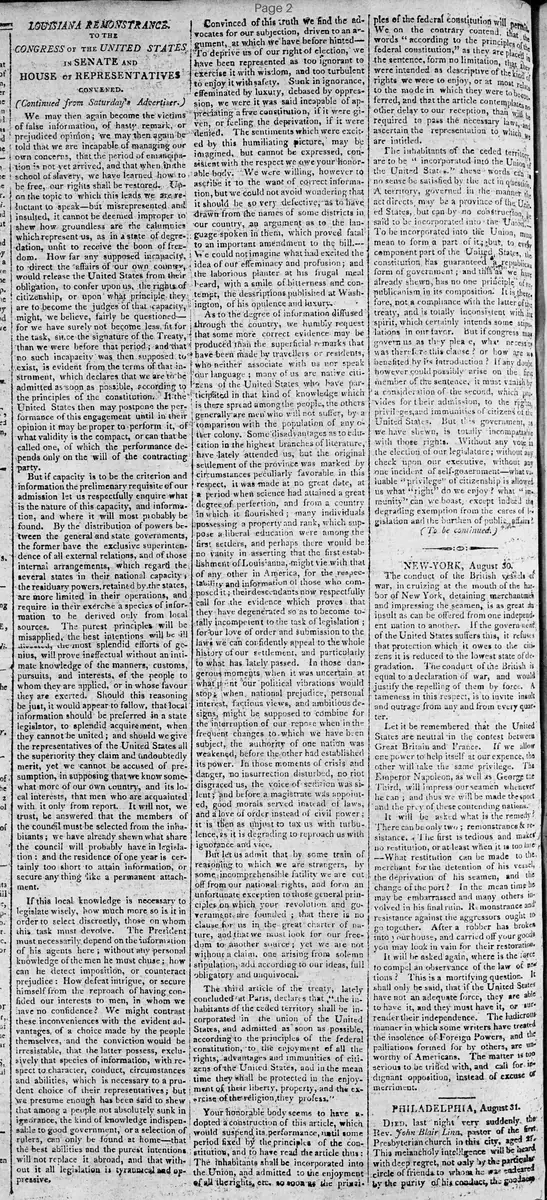
LOUISIANA REMONSTRANCE.
TO THE
CONGRESS OF THE UNITED STATES
SENATE AND
HOUSE of REPRESENTATIVES
CONVENED.
(Continued from Saturday's Advertiser:)
We may then again become the victims of false information, of hasty remark, or prejudiced opinion; we may then again be told that we are incapable of managing our own concerns, that the period of emancipation is not yet arrived, and that when in the school of slavery, we have learned how to be free, our rights shall be restored. Upon the topic to which this leads we are reluctant to speak—but misrepresented and insulted, it cannot be deemed improper to shew how groundless are the calumnies which represent us, as in a state of degradation, unfit to receive the boon of freedom. How far any supposed incapacity, to direct the affairs of our own country, would release the United States from their obligation, to confer upon us, the rights of citizenship, or upon what principle they are to become the judges of that capacity; might, we believe, fairly be questioned—for we have surely not become less fit for the task, since the signature of the Treaty, than we were before that period; and that no such incapacity was then supposed to exist, is evident from the terms of that instrument, which declares that we are to be admitted as soon as possible, according to the principles of the constitution. If the United States then may postpone the performance of this engagement until in their opinion it may be proper to perform it, of what validity is the compact, or can that be called one, of which the performance depends only on the will of the contracting party.
But if capacity is to be the criterion and information the preliminary requisite of our admission let us respectfully enquire what is the nature of this capacity, and information, and where it will most probably be found. By the distribution of powers between the general and state governments, the former have the exclusive superintendence of all external relations, and of those internal arrangements, which regard the several states in their national capacity; the residuary powers, retained by the states, are more limited in their operations, and require in their exercise a species of information to be derived only from local sources. The purest principles will be misapplied, the best intentions will be ill directed, the most splendid efforts of genius, will prove ineffectual without an intimate knowledge of the manners, customs, pursuits, and interests. of the people to whom they are applied, or in whose favour they are exerted. Should this reasoning be just, it would appear to follow, that local information should be preferred in a state legislator, to splendid acquirement, when they cannot be united; and should we give the representatives of the United States all the superiority they claim and undoubtedly merit, yet we cannot be accused of presumption, in supposing that we know something more of our own country, and its local interests, than men who are acquainted with it only from report. It will not, we trust, be answered that the members of the council must be selected from the inhabitants; we have already shewn what share the council will probably have in legislation: and the residence of one year is certainly too short to attain information, or secure any thing like a permanent attachment.
If this local knowledge is necessary to legislate wisely, how much more so is it in order to select discreetly, those on whom this task must devolve. The President must necessarily depend on the information of his agents here; without any personal knowledge of the men he must chuse; how can he detect imposition, or counteract prejudice: How defeat intrigue, or secure himself from the reproach of having confided our interests to men, in whom we have no confidence? We might contrast these inconveniences with the evident advantages, of a choice made by the people themselves, and the conviction would be irresistible, that the latter possess, exclusively that species of information, with respect to character, conduct, circumstances and abilities, which is necessary to a prudent choice of their representatives; but we presume enough has been said to shew that among a people not absolutely sunk in ignorance, the kind of knowledge indispensable to good government, or a selection of rulers, can only be found at home—that the best abilities and the purest intentions will not replace it abroad, and that without it all legislation is tyrannical and oppressive,
Convinced of this truth We find the advocates for our subjection, driven to an argument, at which we have before hinted— To deprive us of our right of election, we have been represented as too ignorant to exercise it with wisdom, and too turbulent to enjoy it with safety. Sunk in ignorance, effeminated by luxury, debased by oppression, we were it was said incapable of appreciating a free constitution, if it were given, or feeling the deprivation, if it were denied. The sentiments which were excited by this humiliating picture, may be imagined, but cannot be expressed, consistent with the respect we owe your honorable body. We were willing, however to ascribe it to the want of correct information, but we could not avoid wondering that it should be so very defective, as to have drawn from the names of some districts in your country, an argument as to the language spoken in them, which proved fatal to an important amendment to the bill.— We could not imagine what had excited the idea of our effeminacy and profusion; and the laborious planter at his frugal meal heard, with a smile of bitterness and contempt, the descriptions published at Washington, of his opulence and luxury.
As to the degree of information diffused through the country, we humbly request that some more correct evidence may be produced than the superficial remarks that have been made by travellers or residents, who neither associate with us nor speak our language; many of us are native citizens of the United States who have participated in that kind of knowledge which is there spread among the people, the others generally are men who will not suffer, by a comparison with the population of any other colony. Some disadvantages as to education in the highest branches of literature, have lately attended us, but the original settlement of the province was marked by circumstances peculiarly favorable in this respect, it was made at no great date, at a period when science had attained a great degree of perfection, and from a country in which it flourished; many individuals possessing a property and rank, which suppose a liberal education were among the first settlers, and perhaps there would be no vanity in asserting that the first establishment of Louisiana, might vie with that of any other in America, for the respectability and information of those who composed it; their descendants now respectfully call for the evidence which proves that they have degenerated so as to become totally incompetent to the task of legislation; for our love of order and submission to the laws we can confidently appeal to the whole history of our settlement, and particularly to what has lately passed. In those dangerous moments when it was uncertain at what point our political vibrations would stop: when national prejudice, personal interest, factious views, and ambitious designs, might be supposed to combine for the interruption of our repose when in the frequent changes to which we have been subject, the authority of one nation was weakened, before the other had established its power. In those moments of crisis and danger, no insurrection disturbed, no riot disgraced us, the voice of sedition was silent; and before a magistrate was appointed, good morals served instead of laws, and a love of order instead of civil power; it is then as unjust to tax us with turbulence, as it is degrading to reproach us with ignorance and vice,
But let us admit that by some train of reasoning to which we are strangers, by some incomprehensible fatality we are cut off from our national rights, and form an unfortunate exception to those general principles on which your revolution and government are founded : that there is no clause for us in the great charter of nature, and that we must look for our freedom to another source; yet we are not without a claim, one arising from solemn stipulation; and according to our ideas, full obligatory and unequivocal.
The third article of the treaty, lately concluded at Paris, declares that " the inhabitants of the ceded territory shall be incorporated in the union of the United States, and admitted as soon as possible, according to the principles of the federal constitution," to the enjoyment of all the rights, advantages and immunities of citizens of the United States, and in the mean time they shall be protected in the enjoyment of their liberty, property, and the exercise of the religion they profess."
Your honorable body seems to have adopted a construction of this article, which would suspend its performance, until some period fixed by the principles of the constitution, and to have read the article thus :
The inhabitants shall be incorporated into the Union, and admitted to the enjoyment of all the rights. etc. so soon as its principles of the federal Constitution will. We on the contrary contend [that the] words "according to the principles of the federal constitution" as they are [in] the sentence form no limitation [but] that [they] in were intended as descriptive of the kind [of] rights we were to enjoy or at most relate [to] the mode in which they were to be conferred, and that the article contemplates no other delay to our reception, than will [be] required to pass the necessary laws, and ascertain the representation to which we are entitled.
The inhabitants of the ceded territory are to be " incorporated into the Union of the United States?" these words can in no sense be satisfied by the act in question. A territory, governed in the manner the act directs, may be a province of the United States, but can by no construction, be said to be incorporated into the Union. To be incorporated into the Union, must mean to form a part of it; but to every component part of the United States, the constitution has guaranteed a republican form of government ; and this as we have already shewn, has no one principle of republicanism in its composition. It is therefore, not a compliance with the latter of the treaty, and is totally inconsistent with its spirit, which certainly intends some stipulations in our favor. But if congress may govern us as they please, what necessity therefore this clause ? or how are we benefited by its introduction ? If any doubt however could possibly arise on the first member of the sentence, it must vanish by a consideration of the second, which provides for their admission, to the rights, privileges, and immunities of citizens of the United States. But this government, as we have shewn, is totally incompatible with those rights. Without any vote in the election of our legislature; without any check upon our executive, without any one incident of self-government—what valuable "privilege" of citizenship is allowed us what "right" do we enjoy ? what "immunity" can we boast, except indeed the degrading exemption from the cares of legislation and the burthen of public affairs!.
(To be continued.)
TO THE
CONGRESS OF THE UNITED STATES
SENATE AND
HOUSE of REPRESENTATIVES
CONVENED.
(Continued from Saturday's Advertiser:)
We may then again become the victims of false information, of hasty remark, or prejudiced opinion; we may then again be told that we are incapable of managing our own concerns, that the period of emancipation is not yet arrived, and that when in the school of slavery, we have learned how to be free, our rights shall be restored. Upon the topic to which this leads we are reluctant to speak—but misrepresented and insulted, it cannot be deemed improper to shew how groundless are the calumnies which represent us, as in a state of degradation, unfit to receive the boon of freedom. How far any supposed incapacity, to direct the affairs of our own country, would release the United States from their obligation, to confer upon us, the rights of citizenship, or upon what principle they are to become the judges of that capacity; might, we believe, fairly be questioned—for we have surely not become less fit for the task, since the signature of the Treaty, than we were before that period; and that no such incapacity was then supposed to exist, is evident from the terms of that instrument, which declares that we are to be admitted as soon as possible, according to the principles of the constitution. If the United States then may postpone the performance of this engagement until in their opinion it may be proper to perform it, of what validity is the compact, or can that be called one, of which the performance depends only on the will of the contracting party.
But if capacity is to be the criterion and information the preliminary requisite of our admission let us respectfully enquire what is the nature of this capacity, and information, and where it will most probably be found. By the distribution of powers between the general and state governments, the former have the exclusive superintendence of all external relations, and of those internal arrangements, which regard the several states in their national capacity; the residuary powers, retained by the states, are more limited in their operations, and require in their exercise a species of information to be derived only from local sources. The purest principles will be misapplied, the best intentions will be ill directed, the most splendid efforts of genius, will prove ineffectual without an intimate knowledge of the manners, customs, pursuits, and interests. of the people to whom they are applied, or in whose favour they are exerted. Should this reasoning be just, it would appear to follow, that local information should be preferred in a state legislator, to splendid acquirement, when they cannot be united; and should we give the representatives of the United States all the superiority they claim and undoubtedly merit, yet we cannot be accused of presumption, in supposing that we know something more of our own country, and its local interests, than men who are acquainted with it only from report. It will not, we trust, be answered that the members of the council must be selected from the inhabitants; we have already shewn what share the council will probably have in legislation: and the residence of one year is certainly too short to attain information, or secure any thing like a permanent attachment.
If this local knowledge is necessary to legislate wisely, how much more so is it in order to select discreetly, those on whom this task must devolve. The President must necessarily depend on the information of his agents here; without any personal knowledge of the men he must chuse; how can he detect imposition, or counteract prejudice: How defeat intrigue, or secure himself from the reproach of having confided our interests to men, in whom we have no confidence? We might contrast these inconveniences with the evident advantages, of a choice made by the people themselves, and the conviction would be irresistible, that the latter possess, exclusively that species of information, with respect to character, conduct, circumstances and abilities, which is necessary to a prudent choice of their representatives; but we presume enough has been said to shew that among a people not absolutely sunk in ignorance, the kind of knowledge indispensable to good government, or a selection of rulers, can only be found at home—that the best abilities and the purest intentions will not replace it abroad, and that without it all legislation is tyrannical and oppressive,
Convinced of this truth We find the advocates for our subjection, driven to an argument, at which we have before hinted— To deprive us of our right of election, we have been represented as too ignorant to exercise it with wisdom, and too turbulent to enjoy it with safety. Sunk in ignorance, effeminated by luxury, debased by oppression, we were it was said incapable of appreciating a free constitution, if it were given, or feeling the deprivation, if it were denied. The sentiments which were excited by this humiliating picture, may be imagined, but cannot be expressed, consistent with the respect we owe your honorable body. We were willing, however to ascribe it to the want of correct information, but we could not avoid wondering that it should be so very defective, as to have drawn from the names of some districts in your country, an argument as to the language spoken in them, which proved fatal to an important amendment to the bill.— We could not imagine what had excited the idea of our effeminacy and profusion; and the laborious planter at his frugal meal heard, with a smile of bitterness and contempt, the descriptions published at Washington, of his opulence and luxury.
As to the degree of information diffused through the country, we humbly request that some more correct evidence may be produced than the superficial remarks that have been made by travellers or residents, who neither associate with us nor speak our language; many of us are native citizens of the United States who have participated in that kind of knowledge which is there spread among the people, the others generally are men who will not suffer, by a comparison with the population of any other colony. Some disadvantages as to education in the highest branches of literature, have lately attended us, but the original settlement of the province was marked by circumstances peculiarly favorable in this respect, it was made at no great date, at a period when science had attained a great degree of perfection, and from a country in which it flourished; many individuals possessing a property and rank, which suppose a liberal education were among the first settlers, and perhaps there would be no vanity in asserting that the first establishment of Louisiana, might vie with that of any other in America, for the respectability and information of those who composed it; their descendants now respectfully call for the evidence which proves that they have degenerated so as to become totally incompetent to the task of legislation; for our love of order and submission to the laws we can confidently appeal to the whole history of our settlement, and particularly to what has lately passed. In those dangerous moments when it was uncertain at what point our political vibrations would stop: when national prejudice, personal interest, factious views, and ambitious designs, might be supposed to combine for the interruption of our repose when in the frequent changes to which we have been subject, the authority of one nation was weakened, before the other had established its power. In those moments of crisis and danger, no insurrection disturbed, no riot disgraced us, the voice of sedition was silent; and before a magistrate was appointed, good morals served instead of laws, and a love of order instead of civil power; it is then as unjust to tax us with turbulence, as it is degrading to reproach us with ignorance and vice,
But let us admit that by some train of reasoning to which we are strangers, by some incomprehensible fatality we are cut off from our national rights, and form an unfortunate exception to those general principles on which your revolution and government are founded : that there is no clause for us in the great charter of nature, and that we must look for our freedom to another source; yet we are not without a claim, one arising from solemn stipulation; and according to our ideas, full obligatory and unequivocal.
The third article of the treaty, lately concluded at Paris, declares that " the inhabitants of the ceded territory shall be incorporated in the union of the United States, and admitted as soon as possible, according to the principles of the federal constitution," to the enjoyment of all the rights, advantages and immunities of citizens of the United States, and in the mean time they shall be protected in the enjoyment of their liberty, property, and the exercise of the religion they profess."
Your honorable body seems to have adopted a construction of this article, which would suspend its performance, until some period fixed by the principles of the constitution, and to have read the article thus :
The inhabitants shall be incorporated into the Union, and admitted to the enjoyment of all the rights. etc. so soon as its principles of the federal Constitution will. We on the contrary contend [that the] words "according to the principles of the federal constitution" as they are [in] the sentence form no limitation [but] that [they] in were intended as descriptive of the kind [of] rights we were to enjoy or at most relate [to] the mode in which they were to be conferred, and that the article contemplates no other delay to our reception, than will [be] required to pass the necessary laws, and ascertain the representation to which we are entitled.
The inhabitants of the ceded territory are to be " incorporated into the Union of the United States?" these words can in no sense be satisfied by the act in question. A territory, governed in the manner the act directs, may be a province of the United States, but can by no construction, be said to be incorporated into the Union. To be incorporated into the Union, must mean to form a part of it; but to every component part of the United States, the constitution has guaranteed a republican form of government ; and this as we have already shewn, has no one principle of republicanism in its composition. It is therefore, not a compliance with the latter of the treaty, and is totally inconsistent with its spirit, which certainly intends some stipulations in our favor. But if congress may govern us as they please, what necessity therefore this clause ? or how are we benefited by its introduction ? If any doubt however could possibly arise on the first member of the sentence, it must vanish by a consideration of the second, which provides for their admission, to the rights, privileges, and immunities of citizens of the United States. But this government, as we have shewn, is totally incompatible with those rights. Without any vote in the election of our legislature; without any check upon our executive, without any one incident of self-government—what valuable "privilege" of citizenship is allowed us what "right" do we enjoy ? what "immunity" can we boast, except indeed the degrading exemption from the cares of legislation and the burthen of public affairs!.
(To be continued.)
What sub-type of article is it?
Constitutional
What keywords are associated?
Louisiana Remonstrance
Treaty Of Paris
Constitutional Rights
Self Government
Territorial Government
Citizenship Admission
Local Knowledge
What entities or persons were involved?
Congress Of The United States
President
Inhabitants Of Louisiana
Treaty Of Paris
Editorial Details
Primary Topic
Louisiana's Demand For Immediate Admission To The Union And Rejection Of Territorial Government
Stance / Tone
Strongly Advocating For Self Government And Full Citizenship Rights Per Treaty Obligations
Key Figures
Congress Of The United States
President
Inhabitants Of Louisiana
Treaty Of Paris
Key Arguments
Territorial Government Violates Treaty Of Paris By Denying Incorporation Into The Union
Local Knowledge Is Essential For Effective Legislation And Selection Of Representatives
Inhabitants Are Capable And Informed, Refuting Claims Of Ignorance And Turbulence
Admission Should Occur As Soon As Possible Without Delay Based On Congressional Opinion
Proposed Act Lacks Republican Principles Guaranteed By The Constitution