Thank you for visiting SNEWPapers!
Sign up free
Editorial
September 15, 1802
The National Intelligencer And Washington Advertiser
Washington, District Of Columbia
What is this article about?
Editorial from the Aurora refutes Federalist claims that Republicans imposed duties on salt, tea, brown sugar, and coffee, clarifying these were pre-1797 imposts not repealed by Jefferson, who only abolished burdensome internal taxes to save $480,000 annually, while Federalists had increased and mortgaged them for debts.
Clipping
OCR Quality
95%
Excellent
Full Text
From the Aurora.
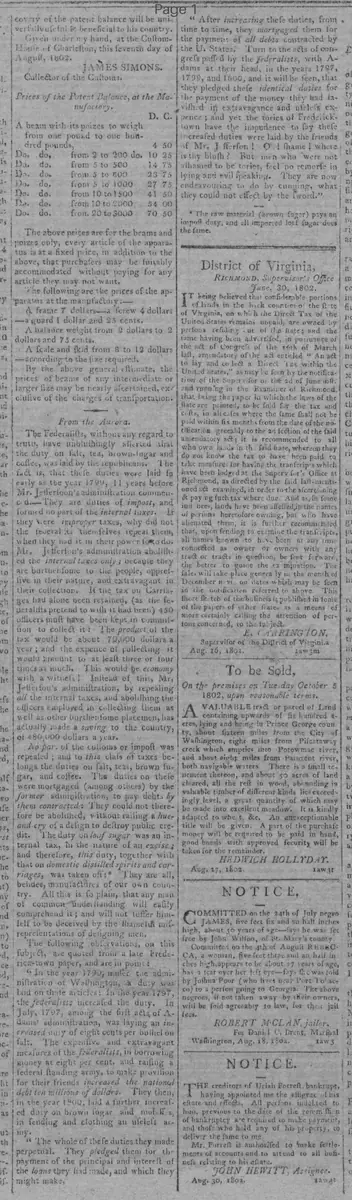
The Federalists, without any regard to truth, have unblushingly asserted that the duty on salt, tea, brown-sugar and coffee, was laid by the republicans. The fact is, that these duties were laid as early as the year 1797, 11 years before Mr. Jefferson's administration commenced. They are duties of impost, and formed no part of the internal taxes. If they were improper taxes, why did not the federalists themselves repeal them, when they had it in their power so to do.
Mr. Jefferson's administration abolished the internal taxes only; because they are burthensome to the people, oppressive in their nature, and extravagant in their collection. If the tax on carriages had alone been retained, (as the federalists pretend to wish it had been) 450 officers must have been kept in commission to collect it: The product of the tax would be about 70,000 dollars a year; and the expense of collecting it would amount to at least three or four times as much. This would be economy with a vengeance! Instead of this, Mr. Jefferson's administration, by repealing all the internal taxes, and abolishing the officers employed in collecting them as well as other burthensome placemen, has actually made a saving to the country, of 480,000 dollars a year.
No part of the customs or impost was repealed; and to this class of taxes belongs the duties on salt, teas, brown sugar, and coffee. The duties on these were mortgaged (among others) by the former administration, to pay debts by them contracted: They could not therefore be abolished, without raising a hue-and-cry of a design to destroy public credit. The duty on loaf sugar was an internal tax, in the nature of an excise; and therefore, this duty, together with that on domestic distilled spirits and carriages, was taken off:* They are all, besides, manufactures of our own country. All this is so plain, that any man of common understanding will easily comprehend it; and will not suffer himself to be deceived by the shameful mis-representations of designing men.
The following observations, on this subject, are quoted from a late Frederick-town paper, and are in point:
"In the year 1790, under the administration of Washington, a duty was laid on those articles: In the year 1797, the federalists increased the duty. In July, 1797, among the first acts of Adams' administration, was laying an increased duty of eight cents per bushel on salt. The expensive and extravagant measures of the federalists, in borrowing money at eight per cent. and raising a federal standing army, to make provision for their friends increased the national debt ten millions of dollars. They then, in the year 1798, laid a further increased duty on brown sugar and molasses, in enduing and clothing an useless army."
"The whole of these duties they made perpetual. They pledged them for the payment of the principal and interest of the loans they had made, and which they might make,"
"After increasing these duties, from time to time, they mortgaged them for the payment of all debts contracted by the U. States. Turn to the acts of congress passed by the federalists, with Adams at their head, in the years 1797, 1799, and 1800, and it will be seen, that they pledged these identical duties for the payment of the money they had lavished in extravagance and useless expense; and yet the tories of Frederick-town have the impudence to say these increased duties were laid by the friends of Mr. Jefferson! O! shame! where is thy blush? But men who were not ashamed to be tories, feel no remorse in lying and evil speaking. They are now endeavouring to do by cunning, what they could not effect by the sword."
"The raw material (brown sugar) pays an impost duty, and all imported loaf sugar does the same."
The Federalists, without any regard to truth, have unblushingly asserted that the duty on salt, tea, brown-sugar and coffee, was laid by the republicans. The fact is, that these duties were laid as early as the year 1797, 11 years before Mr. Jefferson's administration commenced. They are duties of impost, and formed no part of the internal taxes. If they were improper taxes, why did not the federalists themselves repeal them, when they had it in their power so to do.
Mr. Jefferson's administration abolished the internal taxes only; because they are burthensome to the people, oppressive in their nature, and extravagant in their collection. If the tax on carriages had alone been retained, (as the federalists pretend to wish it had been) 450 officers must have been kept in commission to collect it: The product of the tax would be about 70,000 dollars a year; and the expense of collecting it would amount to at least three or four times as much. This would be economy with a vengeance! Instead of this, Mr. Jefferson's administration, by repealing all the internal taxes, and abolishing the officers employed in collecting them as well as other burthensome placemen, has actually made a saving to the country, of 480,000 dollars a year.
No part of the customs or impost was repealed; and to this class of taxes belongs the duties on salt, teas, brown sugar, and coffee. The duties on these were mortgaged (among others) by the former administration, to pay debts by them contracted: They could not therefore be abolished, without raising a hue-and-cry of a design to destroy public credit. The duty on loaf sugar was an internal tax, in the nature of an excise; and therefore, this duty, together with that on domestic distilled spirits and carriages, was taken off:* They are all, besides, manufactures of our own country. All this is so plain, that any man of common understanding will easily comprehend it; and will not suffer himself to be deceived by the shameful mis-representations of designing men.
The following observations, on this subject, are quoted from a late Frederick-town paper, and are in point:
"In the year 1790, under the administration of Washington, a duty was laid on those articles: In the year 1797, the federalists increased the duty. In July, 1797, among the first acts of Adams' administration, was laying an increased duty of eight cents per bushel on salt. The expensive and extravagant measures of the federalists, in borrowing money at eight per cent. and raising a federal standing army, to make provision for their friends increased the national debt ten millions of dollars. They then, in the year 1798, laid a further increased duty on brown sugar and molasses, in enduing and clothing an useless army."
"The whole of these duties they made perpetual. They pledged them for the payment of the principal and interest of the loans they had made, and which they might make,"
"After increasing these duties, from time to time, they mortgaged them for the payment of all debts contracted by the U. States. Turn to the acts of congress passed by the federalists, with Adams at their head, in the years 1797, 1799, and 1800, and it will be seen, that they pledged these identical duties for the payment of the money they had lavished in extravagance and useless expense; and yet the tories of Frederick-town have the impudence to say these increased duties were laid by the friends of Mr. Jefferson! O! shame! where is thy blush? But men who were not ashamed to be tories, feel no remorse in lying and evil speaking. They are now endeavouring to do by cunning, what they could not effect by the sword."
"The raw material (brown sugar) pays an impost duty, and all imported loaf sugar does the same."
What sub-type of article is it?
Taxation
Partisan Politics
Economic Policy
What keywords are associated?
Impost Duties
Internal Taxes
Tax Repeal
Jefferson Administration
Federalist Accusations
Public Debt
Economic Savings
What entities or persons were involved?
Mr. Jefferson
Federalists
Republicans
Adams
Washington
Editorial Details
Primary Topic
Defense Of Jefferson's Tax Policies Against Federalist Accusations
Stance / Tone
Pro Republican, Anti Federalist
Key Figures
Mr. Jefferson
Federalists
Republicans
Adams
Washington
Key Arguments
Duties On Salt, Tea, Brown Sugar, And Coffee Were Imposts Laid In 1797, Before Jefferson's Administration.
Jefferson Abolished Only Internal Taxes, Which Were Burdensome And Costly To Collect.
Abolishing Internal Taxes Saved $480,000 Annually By Eliminating Officers And Placemen.
Federalists Increased These Duties In 1797 1800 And Mortgaged Them For Debts From Extravagant Measures.
No Customs Or Impost Duties Were Repealed By Jefferson To Avoid Undermining Public Credit.
Duty On Loaf Sugar Was An Internal Excise Tax And Was Repealed Along With Others On Domestic Products.