Thank you for visiting SNEWPapers!
Sign up free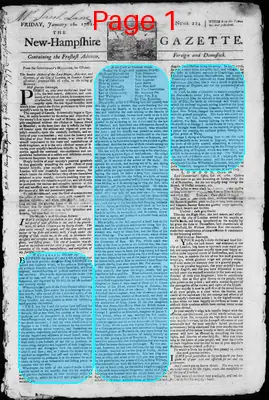
The New Hampshire Gazette
Portsmouth, Rockingham County, New Hampshire
What is this article about?
King George II died suddenly at Kensington Palace on October 25, 1760, aged 77, after 34 years of reign. His grandson George III was proclaimed king, swore oaths, and issued a declaration pledging to promote the kingdoms' glory, preserve the constitution, and seek peace amid war. Details include the circumstances of death and biographical notes on the royal line.
Merged-components note: These components form a continuous narrative about the death of King George II and the accession of George III, with text flowing directly from one to the next across reading orders 2, 3, and 4.
Clipping
OCR Quality
Full Text
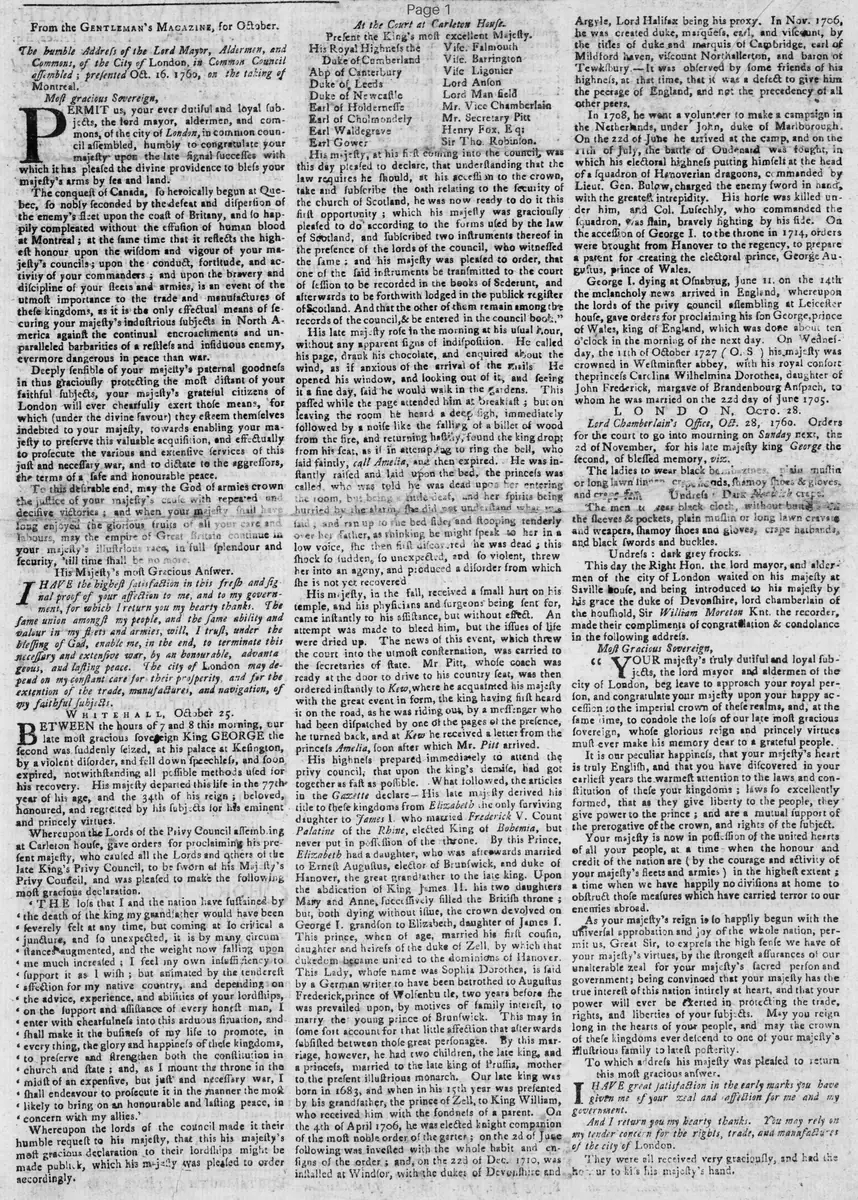
Between the hours of 7 and 8 this morning, our late most gracious sovereign King GEORGE the Second was suddenly seized, at his palace at Kensington, by a violent disorder, and fell down speechless, and soon expired, notwithstanding all possible methods used for his recovery. His Majesty departed this life in the 77th year of his age, and the 34th of his reign; beloved, honoured, and regretted by his subjects for his eminent and princely virtues.
Whereupon the Lords of the Privy Council assembling at Carlton House, gave orders for proclaiming his present Majesty, who caused all the Lords and others of the late King's Privy Council, to be sworn as his Majesty's Privy Council, and was pleased to make the following most gracious declaration.
The loss that I and the nation have sustained by the death of the King my grandfather would have been severely felt at any time, but coming at so critical a juncture, and so unexpected, it is by many circumstances augmented, and the weight now falling upon me much increased; I feel my own insufficiency to support it as I wish; but animated by the tenderest affection which I have for my people, I enter with cheerfulness into this arduous situation, and shall make it the business of my life to promote, in every thing, the glory and happiness of these kingdoms, to preserve and strengthen both the constitution in church and state: and, as I mount the throne in the midst of an expensive, but just and necessary war, I shall make it my constant endeavour to bring on an honourable and lasting peace, in concert with my allies.
Whereupon the Lords of the Council made it their humble request to his Majesty, that this his Majesty's most gracious declaration to their Lordships might be made public, which his Majesty was pleased to order accordingly.
At the Court at Carlton House.
Present the King's most excellent Majesty.
His Royal Highness the
Duke of Cumberland
Visc. Falmouth
Visc. Barrington
Abp of Canterbury
Visc Ligonier
Duke Of Leeds
Lord Anson
Duke of Newcastle
Lord Mansfield
Earl of Holdernesse
Mr. Vice Chamberlain
Earl of Cholmondeley
Mr. Secretary Pitt
Earl Waldegrave
Henry Fox, Esq;
Earl Gower
Sir Tho. Robinson.
His Majesty, at his first coming into the council, was this day pleased to declare, that understanding that the law requires he should, at his accession to the crown, take and subscribe the oath relating to the security of the church of Scotland, he was now ready to do it this first opportunity; which his Majesty was graciously pleased to do according to the forms used by the law of Scotland, and subscribed two instruments thereof in the presence of the Lords of the Council, who witnessed the same: and his Majesty was pleased to order, that one of the said instruments be transmitted to the court of session to be recorded in the books of Sederunt, and afterwards to be forthwith lodged in the publick register of Scotland. And that the other of them remain among the records of the council, & be entered in the council book.
His late Majesty rose in the morning at his usual hour, without any apparent signs of indisposition. He called his page, drank his chocolate, and enquired about the wind, as if anxious of the arrival of the mails. He opened his window, and looking out of it, and seeing it a fine day, said he would walk in the gardens. This passed while the page attended him at breakfast; but on leaving the room he heard a deep sigh, immediately followed by a noise like the falling of a billet of wood from the fire, and returning hastily, found the King dropt from his seat, as if in attempting to ring the bell, who said faintly, call Amelia, and then expired. He was instantly raised and laid upon the bed, the Princess was called, who was told he was dead upon her entering the room, but being something deaf, and her spirits being hurried by the alarm, she did not understand what was said; and ran up to the bed side, and stooping tenderly over her father, as thinking he might speak to her in a low voice, she then first discovered he was dead: this shock so sudden, so unexpected, and so violent, threw her into an agony, and produced a disorder from which she is not yet recovered.
His Majesty, in the fall, received a small hurt on his temple, and his physicians and surgeons being sent for, came instantly to his assistance, but without effect. An attempt was made to bleed him, but the issues of life were dried up. The news of this event, which threw the court into the utmost consternation, was carried to the Secretaries of State. Mr Pitt, whose coach was ready at the door to drive to his country seat, was then ordered instantly to Kew, where he acquainted his Majesty with the great event in form, the King having just heard it on the road, as he was riding out, by a messenger who had been dispatched by one of the pages of the presence, he turned back, and at Kew he received a letter from the Princess Amelia, soon after which Mr. Pitt arrived.
His Highness prepared immediately to attend the privy council; that upon the King's demise, had got together as fast as possible. What followed, the articles in the Gazette declare. His late Majesty derived his title to these kingdoms from Elizabeth the only surviving daughter to James I. who married Frederick V. Count Palatine of the Rhine, elected King of Bohemia, but never put in possession of the throne. By this Prince, Elizabeth had a daughter, who was afterwards married to Ernest Augustus, elector of Brunswick, and duke of Hanover, the great grandfather to the late King. Upon the abdication of King James II. his two daughters Mary and Anne, successively filled the British throne; but, both dying without issue, the crown devolved on George I. grandson to Elizabeth, daughter of James I.
This Prince, when of age, married his first cousin, daughter and heiress of the Duke of Zell, by which that dukedom became united to the dominions of Hanover. This Lady, whose name was Sophia Dorothea, is said by a German writer to have been betrothed to Augustus Frederick, prince of Wolfenbuttel, two years before he was prevailed upon, by motives of family interest, to marry the young prince of Brunswick. This may in some sort account for that little affection that afterwards subsisted between those great personages. By this marriage, however, she had two children, the late King, and a Princess, married to the late King of Prussia, mother to the present illustrious monarch. Our late King was born in 1683, and when in his 15th year was presented by his grandfather, the prince of Zell, to King William, who received him with the fondness of a parent. On the 4th of April 1706, he was elected knight companion of the most noble order of the garter; on the 2d of June following was invested with the whole habit and ensigns of the order; and, on the 22d of Dec. 1710, was installed at Windsor, with the dukes of Devonshire and
Argyle, Lord Halifax being his proxy. In Nov. 1706, he was created duke, marquis, earl, and viscount, by the titles of duke and marquis of Cambridge, earl of Milford Haven, viscount Northallerton, and baron of Tewksbury. It was observed by some friends of his Highness, at that time, that it was a defect to give him the peerage of England, and not the precedency of all other peers.
In 1708, he went a volunteer to make a campaign in the Netherlands, under John, duke of Marlborough. On the 22d of June he arrived at the camp, and on the 11th of July, the battle of Oudenarde was fought, in which his electoral highness putting himself at the head of a squadron of Hanoverian dragoons, commanded by Lieut. Gen. Bulow, charged the enemy sword in hand, with the greatest intrepidity. His horse was killed under him, and Col. Lusechly, who commanded the squadron, was slain, bravely fighting by his side. On the accession of George I. to the throne in 1714, orders were brought from Hanover to the regency, to prepare a patent for creating the electoral prince, George Augustus, prince of Wales.
George I. dying at Osnabrug, June 11, on the 14th the melancholy news arrived in England, whereupon the Lords of the Privy Council assembling at Leicester House, gave orders for proclaiming his son George, prince of Wales, king of England, which was done about ten o'clock in the morning of the next day. On Wednesday, the 11th of October 1727 (O. S.) his Majesty was crowned in Westminster Abbey, with his royal consort the Princess Caroline Wilhelmina Dorothea, daughter of John Frederick, margrave of Brandenburg Anspach, to whom he was married on the 22d day of June 1705.
What sub-type of article is it?
What keywords are associated?
What entities or persons were involved?
Where did it happen?
Foreign News Details
Primary Location
Kensington
Event Date
October 25
Key Persons
Outcome
king george ii expired suddenly; george iii proclaimed king, sworn in, and issued declaration on peace and constitution.
Event Details
King George II seized by violent disorder at Kensington Palace between 7 and 8 a.m., fell speechless, and died despite efforts. Privy Council proclaimed George III, who swore council members, took oath for Church of Scotland, and declared commitment to kingdoms' glory, constitution, and peace. Details of death scene, Princess Amelia's reaction, and historical royal lineage provided.