Thank you for visiting SNEWPapers!
Sign up free
Letter to Editor
January 18, 1797
Gazette Of The United States, & Philadelphia Daily Advertiser
Philadelphia, Philadelphia County, Pennsylvania
What is this article about?
Letter to Mr. Fenno in the Gazette of the United States arguing that citizens possess a natural right to expatriate without societal consent, as it is not surrendered in the social compact or U.S. Constitution. Critiques Mr. Loccenius's views and references Vattel, Grotius, and Puffendorf.
Clipping
OCR Quality
95%
Excellent
Full Text
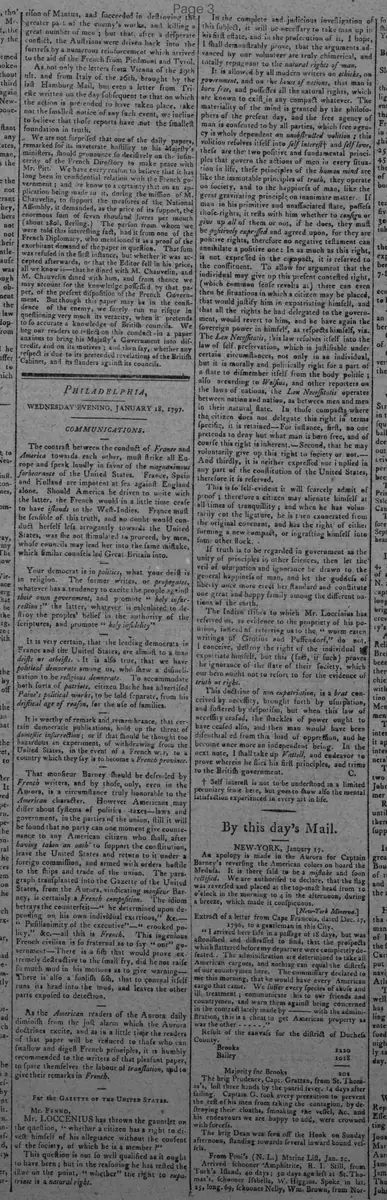
For the Gazette of the United States.
Mr. FENNO,
Mr. LOCCENIUS has thrown the gauntlet on the question, " whether a citizen has a right to divest himself of his allegiance without the consent of the society, of which he is a member ?"
This question is not so well qualified as it ought to have been; but in the reasoning he has rested the issue on the point, " whether" the right to expatriate is a natural right.
In the complete and judicious investigation of this subject, it will be necessary to take man up in his first estate, and in the prosecution of it, I hope, I shall demonstrably prove, that the arguments advanced by our volunteer are truly chimerical, and totally repugnant to the natural rights of man.
It is allowed by all modern writers on ethics, on government, and on the laws of nations, that man is born free, and possesses all the natural rights, which are known to exist in any compact whatever. The materiality of the mind is granted by the philosophers of the present day, and the free agency of man is consented to by all parties, which free agency is wholly dependent on unobstructed volition; this volition resolves itself into self interest and self love, these are the two positive and fundamental principles that govern the actions of men in every situation in life, these principles of the human mind are like the immutable principles of truth, they operate on society, and to the happiness of man, like the great gravitating principle on inanimate matter. If man in his primitive and unassociated state, possesses those rights, it rests with him whether to consign or give up all of them or not, if he does, they must be positively expressed and agreed upon, for they are positive rights, therefore no negative testament can annihilate a positive one: In as much as this right, is not expressed in the compact, it is reserved to the constituent. To allow for argument that the individual may give up this present contested right, (which common sense revolts at) there can even then be situations in which a citizen may be placed, that would justify him in expatriating himself, and that all the rights he had delegated to the government, would revert to him, and he have again the sovereign power in himself, as respects himself, viz. The Lex Necessitatis, this law resolves itself into the law of self. preservation, which is justifiable under certain circumstances, not only in an individual, but it is morally and politically right for a part of a state to dismember itself from the body politic ; also according to Vattel, and other reporters on the laws of nations, the Lex Necessitatis operates between nation and nation, as between men and men in their natural state. In those compacts where the citizen does not delegate this right in terms specific, it is retained-For instance, first, no one pretends to deny but what man is born free, and of course this right is inherent. -Second, that he may voluntarily give up this right to society or not.- And thirdly, it is neither expressed nor implied in any part of the constitution of the United States, therefore it is reserved.
This is so self-evident it will scarcely admit of proof ; therefore a citizen may alienate himself at all times of tranquillity; and when he has voluntarily cut the ligature, he is then exonerated from the original covenant, and has the right of either forming a new compact, or ingrafting himself into some other stock.
If truth is to be regarded in government as the unity of principles in other sciences, then let the veil of usurpation and ignorance be drawn to the general happiness of man, and let the goddess of liberty once more erect her standard and constitute one great and happy family among the different nations of the earth.
The Indian tribes to which Mr. Loccenius has referred us, as evidence to the propriety of his position, instead of referring us to the " worm eaten writings of Grotius and Puffendorf," do not, I conceive, destroy the right of the individual to expatriate himself, but this (fact, if such) proves the ignorance of the state of their society, which our hero ought not to resort to for the evidence of truth or right.
This doctrine of non expatriation, is a brat conceived by necessity, brought forth by usurpation, and fostered by despotism, but when this law of necessity ceased, the shackles of power ought to have ceased also, and then man would have been disenthralled from this load of oppression, and he become once more an independent being. In the next note, I shall take up Vattel, and endeavor to prove wherein he flies his first principles, and trims to the British government.
C.
Self interest is not to be understood in a limited pecuniary sense here, but goes to shew also the mental satisfaction experienced in every art in life.
Mr. FENNO,
Mr. LOCCENIUS has thrown the gauntlet on the question, " whether a citizen has a right to divest himself of his allegiance without the consent of the society, of which he is a member ?"
This question is not so well qualified as it ought to have been; but in the reasoning he has rested the issue on the point, " whether" the right to expatriate is a natural right.
In the complete and judicious investigation of this subject, it will be necessary to take man up in his first estate, and in the prosecution of it, I hope, I shall demonstrably prove, that the arguments advanced by our volunteer are truly chimerical, and totally repugnant to the natural rights of man.
It is allowed by all modern writers on ethics, on government, and on the laws of nations, that man is born free, and possesses all the natural rights, which are known to exist in any compact whatever. The materiality of the mind is granted by the philosophers of the present day, and the free agency of man is consented to by all parties, which free agency is wholly dependent on unobstructed volition; this volition resolves itself into self interest and self love, these are the two positive and fundamental principles that govern the actions of men in every situation in life, these principles of the human mind are like the immutable principles of truth, they operate on society, and to the happiness of man, like the great gravitating principle on inanimate matter. If man in his primitive and unassociated state, possesses those rights, it rests with him whether to consign or give up all of them or not, if he does, they must be positively expressed and agreed upon, for they are positive rights, therefore no negative testament can annihilate a positive one: In as much as this right, is not expressed in the compact, it is reserved to the constituent. To allow for argument that the individual may give up this present contested right, (which common sense revolts at) there can even then be situations in which a citizen may be placed, that would justify him in expatriating himself, and that all the rights he had delegated to the government, would revert to him, and he have again the sovereign power in himself, as respects himself, viz. The Lex Necessitatis, this law resolves itself into the law of self. preservation, which is justifiable under certain circumstances, not only in an individual, but it is morally and politically right for a part of a state to dismember itself from the body politic ; also according to Vattel, and other reporters on the laws of nations, the Lex Necessitatis operates between nation and nation, as between men and men in their natural state. In those compacts where the citizen does not delegate this right in terms specific, it is retained-For instance, first, no one pretends to deny but what man is born free, and of course this right is inherent. -Second, that he may voluntarily give up this right to society or not.- And thirdly, it is neither expressed nor implied in any part of the constitution of the United States, therefore it is reserved.
This is so self-evident it will scarcely admit of proof ; therefore a citizen may alienate himself at all times of tranquillity; and when he has voluntarily cut the ligature, he is then exonerated from the original covenant, and has the right of either forming a new compact, or ingrafting himself into some other stock.
If truth is to be regarded in government as the unity of principles in other sciences, then let the veil of usurpation and ignorance be drawn to the general happiness of man, and let the goddess of liberty once more erect her standard and constitute one great and happy family among the different nations of the earth.
The Indian tribes to which Mr. Loccenius has referred us, as evidence to the propriety of his position, instead of referring us to the " worm eaten writings of Grotius and Puffendorf," do not, I conceive, destroy the right of the individual to expatriate himself, but this (fact, if such) proves the ignorance of the state of their society, which our hero ought not to resort to for the evidence of truth or right.
This doctrine of non expatriation, is a brat conceived by necessity, brought forth by usurpation, and fostered by despotism, but when this law of necessity ceased, the shackles of power ought to have ceased also, and then man would have been disenthralled from this load of oppression, and he become once more an independent being. In the next note, I shall take up Vattel, and endeavor to prove wherein he flies his first principles, and trims to the British government.
C.
Self interest is not to be understood in a limited pecuniary sense here, but goes to shew also the mental satisfaction experienced in every art in life.
What sub-type of article is it?
Persuasive
Philosophical
Political
What themes does it cover?
Constitutional Rights
Politics
Morality
What keywords are associated?
Expatriation
Natural Rights
Social Compact
Us Constitution
Vattel
Self Preservation
Allegiance
What entities or persons were involved?
C.
Mr. Fenno
Letter to Editor Details
Author
C.
Recipient
Mr. Fenno
Main Argument
citizens have a natural right to expatriate themselves without the consent of society, as this right is inherent, not explicitly surrendered in the social compact or u.s. constitution, and can be justified under the lex necessitatis for self-preservation.
Notable Details
References Vattel, Grotius, And Puffendorf
Critiques Mr. Loccenius's Arguments
Discusses Lex Necessitatis And Self Preservation
Mentions Indian Tribes As Evidence Of Societal Ignorance