Thank you for visiting SNEWPapers!
Sign up free
Republican Herald
Providence, Providence County, Rhode Island
What is this article about?
Burrington Anthony recounts his role in the Rhode Island suffrage movement, detailing a mission to Washington with Mr. Pearce, meetings with President Tyler and Daniel Webster advocating amicable settlement, and subsequent negotiations in New York and Providence for a compromise involving a Supreme Court case on the People's Constitution's validity, leading to assurances for Gov. Dorr's safety.
Merged-components note: These are parts of the same letter to the editor by Burrington Anthony, including the attached note; merge for completeness.
Clipping
OCR Quality
Full Text
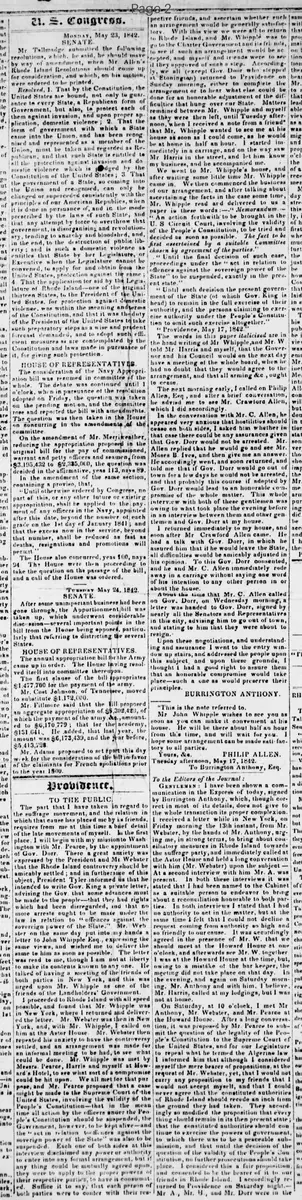
TO THE PUBLIC
The part that I have taken in regard to the suffrage movement, and the relation in which that cause has placed me by its friends, requires from me at this time a brief detail of the late movements of myself. In the first place, I will begin with my mission to Washington with Mr. Pearce, by the appointment of Gov. Dorr. There a great anxiety was expressed by the President and Mr. Webster that the Rhode Island controversy should be amicably settled; and in furtherance of this object, President Tyler informed us that he intended to write Gov. King a private letter, advising the Gov. that some advances must be made to the people—that they had rights which had been disregarded, and that no more arrests ought to be made under the law in relation to "offences against the sovereign power of the State." Mr. Webster on the same day put into my hands a letter to John Whipple Esq., expressing the same views, and wished me to deliver the same to him as soon as possible. The letter was read to me, though I am not at liberty to make its contents known to any one. He talked of having a meeting of the friends of both parties in New York, and this was urged upon Mr. Whipple as one of the friends of the Landholders' Government.
I proceeded to Rhode Island with all speed possible, and found that Mr. Whipple was in New York, where I returned and delivered the letter. Mr. Webster was then in New York, and, with Mr. Whipple, I called on him at the Astor House. Mr. Webster then repeated his anxiety to have the controversy settled, and an arrangement was made for an informal meeting to be had, to see what could be done. Mr. Whipple was met by Messrs. Pearce, Harris and myself at Howard's Hotel, to see what sort of a compromise could be hit upon. We all met for that purpose, and Mr. Pearce proposed that a case might be made to the Supreme Court of the United States, involving the validity of the People's Constitution—that in the meantime all action by the officers under the People's Constitution should be suspended, the Government, however, to be kept alive—and the "act in relation to offences against the sovereign power of the State" was also to be suspended. Each one of both sides at this interview disclaimed any power or authority to enter into any formal arrangement, but if anything could be mutually agreed upon, they were to apply to the proper powers of their respective parties, to have it consummated—that such person of
pective friends, and ascertain whether such an arrangement would be generally satisfactory. With this view we were to return to Rhode Island, and Mr. Whipple was to go to the Charter Government and its friends, to see if such an arrangement would be accepted, and myself and friends were to see if they approved of such a step. Accordingly, we all (except Gov. Dorr who stepped at Eoningian) returned to Providence on Sunday morning, either to complete the arrangement or to hear what else could be done for an honorable adjustment of the difficulties that hung over our State. Matters remained between Mr. Whipple and myself as they were then left, until Tuesday afternoon, when I received a note from a friend* that Mr. Whipple wanted to see me at his house as soon as I could come, as he would be at home in half an hour. I started immediately in a carriage, and on the way saw Mr. Harris in the street, and let him know my business, and he accompanied me.
We went to Mr. Whipple's house, and after waiting some little time Mr. Whipple came in. We then commenced the business of our arrangement, and after talking about ascertaining the facts in the case some time, Mr. Whipple read and delivered to us a paper in these words:—"Memorandum.—An action forthwith to be brought in the U. S. Circuit Court, involving the validity of the People's Constitution, to be tried and decided as soon as possible. The fact to be first ascertained by a suitable Committee chosen by agreement of the parties. Until the final decision of such case, proceedings under the "act in relation to offences against the sovereign power of the State" to be suspended, exactly in the present state. Until such decision the present government of the State (of which Gov. King is head) to remain in the full exercise of their authority, and the persons claiming to exercise authority under the People's Constitution to omit such exercise altogether. Providence, May 17, 1842."
The words in this paper italicised are in the hand writing of Mr. Whipple, and Mr. W. told Mr. Harris and myself, that the Governor and his Council would on the next day have a meeting of the whole board, when he had no doubt that they would agree to the arrangement, and that all arming &c., ought to cease.
The next morning early, I called on Philip Allen, Esq., and after a brief conversation he advised me to see Mr. Crawford Allen, which I did accordingly.
In the conversation with Mr. C. Allen, he appeared very anxious that hostilities should cease on both sides, I asked him whether in that case there could be any assurances given that Gov. Dorr would not be arrested. Mr. Allen replied that he would go and see Mr. Moses B. Ives, and then give me an answer. He accordingly went, and soon returned, and told me that if Gov. Dorr would go out of town for a few days he would not be arrested, and that probably this course if adopted by Gov. Dorr would lead to an honorable compromise of the whole matter. This whole interview with both of these gentlemen was owing to what took place the evening before in an interview between them and other gentlemen and Gov. Dorr at my house.
I returned immediately to my house, and soon after Mr. Crawford Allen came. He had a talk with Gov. Dorr, in which he assured him that if he would leave the State, all difficulties would be amicably adjusted in his opinion. To this Gov. Dorr consented, and he and Mr. C. Allen immediately rode away in a carriage without saying one word of his intention to any other person in or about the house.
About the time that Mr. C. Allen called on Gov. Dorr, on Wednesday morning, a letter was handed to Gov. Dorr, signed by nearly all the Senators and Representatives in this city, advising him to go out of town, and stating to him that they were about to resign.
Upon these negotiations, and understanding and assurance I went to the entry window up stairs, and addressed the people upon this subject, and upon these grounds, I thought I had a good right to assure them that an honorable compromise would take place—such a one as would preserve their principles.
BURRINGTON ANTHONY.
*This is the note referred to.
Mr. John Whipple wishes to see you as soon as you can make it convenient at his house. He will be there about half an hour from this time, and will wait for you. I hope some arrangement can be made satisfactory to all parties.
Yours, &c.
PHILIP ALLEN.
Tuesday afternoon, May 17, 1842.
To Burrington Anthony, Esq.
What sub-type of article is it?
What themes does it cover?
What keywords are associated?
What entities or persons were involved?
Letter to Editor Details
Author
Burrington Anthony
Recipient
To The Public
Main Argument
burrington anthony details his efforts in negotiating an amicable settlement to the rhode island suffrage controversy, involving federal intervention and a proposed supreme court case on the people's constitution, to preserve rights and avoid further conflict.
Notable Details