Thank you for visiting SNEWPapers!
Sign up free
Alexandria Daily Advertiser
Alexandria, Virginia
What is this article about?
Debate in the US House of Representatives on April 5 over amending the secret journal to include President Jefferson's December 6 message, lifting secrecy injunctions on proceedings related to Spanish negotiations for the Floridas, and concerns about French influence on Spain.
Merged-components note: These components form a continuous narrative report of the congressional debate on Spanish affairs, with sequential reading orders across pages; relabeled to 'story' as it is a full narrative article on national politics.
Clippings
1 of 2
OCR Quality
Full Text
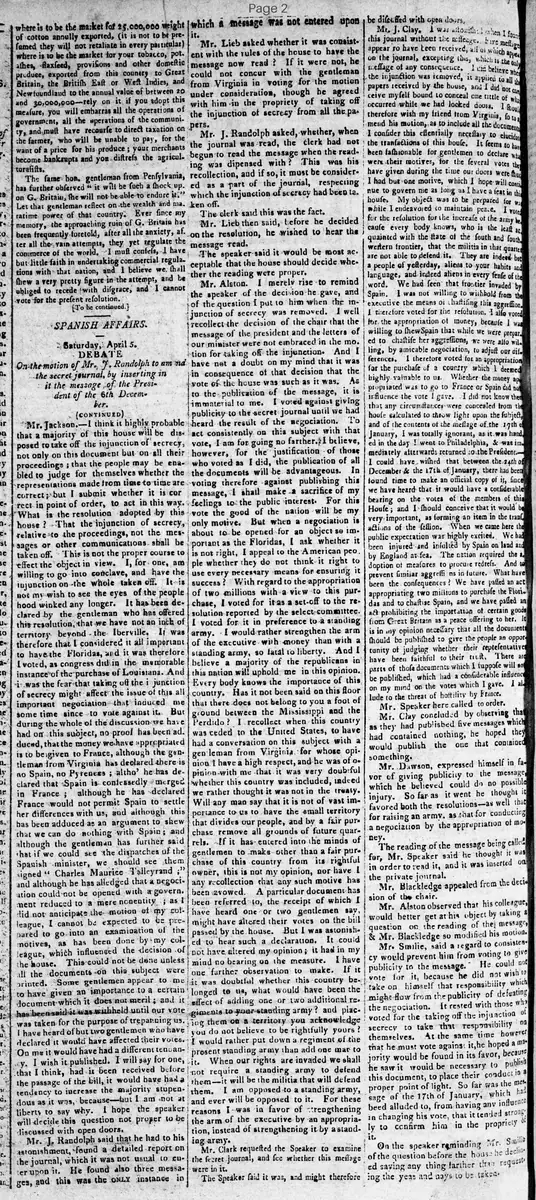
- Saturday, April 5.
DEBATE
On the motion of Mr. F. Randolph to amend the secret journal, by inserting in it the message of the President of the 6th December.
(Continued)
Mr. Jackson.—I think it highly probable that a majority of this house will be disposed to take off the injunction of secrecy, not only on this document but on all their proceedings; that the people may be enabled to judge for themselves whether the representations made from time to time are correct; but I submit whether it is correct in point of order, to act in this way. What is the resolution adopted by this house? That the injunction of secrecy, relative to the proceedings, not the messages or other communications, shall be taken off. This is not the proper course to effect the object in view. I, for one, am willing to go into conclave, and have the injunction on the whole taken off. It is not my wish to see the eyes of the people hoodwinked any longer. It has been declared by the gentleman who has offered this resolution, that we have not an inch of territory beyond the Iberville. It was therefore that I considered it all important to have the Floridas, and it was therefore I voted, as congress did in the memorable instance of the purchase of Louisiana. And it was the fear that taking off the injunction of secrecy might affect the issue of this all important negotiation that induced me some time since to vote against it. But during the whole of the discussion we have had on this subject, no proof has been adduced, that the money we have appropriated is to be given to France, although the gentleman from Virginia has declared there is no Spain, no Pyrenees; altho' he has declared that Spain is confessedly merged in France; although he has declared France would not permit Spain to settle her differences with us, and although this has been adduced as an argument to show that we can do nothing with Spain; and although the gentleman has further said that if we could see the dispatches of the Spanish minister, we should see them signed "Charles Maurice Talleyrand:" and although he has alleged that a negotiation could not be opened with a government reduced to a mere nonentity; as I did not anticipate the motion of my colleague, I cannot be expected to be prepared to go into an examination of the league, which influenced the decision of the house. This could not be done unless all the documents on this subject were printed. Some gentlemen appear to me to have given an importance to a certain document which it does not merit; and it has been said it was withheld until our vote was taken for the purpose of trepanning us. I have heard of but two gentlemen who have declared it would have affected their votes. On me it would have had a different tendency. I wish it published. I will say for one, that I think, had it been received before the passage of the bill, it would have had a tendency to increase the majority stupendous as it was, because—but I am not at liberty to say why. I hope the speaker will decide this question not proper to be discussed with open doors.
Mr. I. Randolph said that he had to his astonishment, found a detailed report on the journal, which it was not usual to enter upon it. He found also three messages, and this was the only instance in which a message was not entered upon it.
Mr. Lieb asked whether it was consistent with the rules of the house to have the message now read? If it were not, he could not concur with the gentleman from Virginia in voting for the motion under consideration, though he agreed with him in the propriety of taking off the injunction of secrecy from all the papers.
Mr. I. Randolph asked, whether, when the journal was read, the clerk had not begun to read the message when the reading was dispensed with? This was his recollection, and if so, it must be considered as a part of the journal, respecting which the injunction of secrecy had been taken off.
The clerk said this was the fact.
Mr. Lieb then said, before he decided on the resolution, he wished to hear the message read.
The speaker said it would be most acceptable that the house should decide whether the reading were proper.
Mr. Alston. I merely rise to remind the speaker of the decision he gave, and of the question I put to him when the injunction of secrecy was removed. I well recollect the decision of the chair that the message of the president and the letters of our minister were not embraced in the motion for taking off the injunction. And I have not a doubt on my mind that it was in consequence of that decision that the vote of the house was such as it was. As to the publication of the message, it is immaterial to me. I voted against giving publicity to the secret journal until we had heard the result of the negotiation. To act consistently on this subject with that vote, I am for going no farther. I believe, however, for the justification of those who voted as I did, the publication of all the documents will be advantageous. In voting therefore against publishing this message, I shall make a sacrifice of my feelings to the public interest. For this vote the good of the nation will be my only motive. But when a negotiation is about to be opened for an object so important as the Floridas, I ask whether it is not right, I appeal to the American people whether they do not think it right to use every necessary means for ensuring its success? With regard to the appropriation of two millions with a view to this purchase, I voted for it as a set-off to the resolution reported by the select committee. I voted for it in preference to a standing army. I would rather strengthen the arm of the executive with money than with a standing army, so fatal to liberty. And I believe a majority of the republicans in this nation will uphold me in this opinion. Every body knows the importance of this country. Has it not been said on this floor that there does not belong to you a foot of ground between the Mississippi and the Perdido? I recollect when this country was ceded to the United States, to have had a conversation on this subject with a gentleman from Virginia, for whose opinion I have a high respect, and he was of opinion with me that it was very doubtful whether this country was included, indeed we rather thought it was not in the treaty. Will any man say that it is not of vast importance to us to have the small territory that divides our people, and by a fair purchase remove all grounds of future quarrels. If it has entered into the minds of gentlemen to make other than a fair purchase of this country from its rightful owner, this is not my opinion, nor have I any recollection that any such motive has been avowed. A particular document has been referred to, the receipt of which I have heard one or two gentlemen say, might have altered their votes on the bill passed by the house. But I was astonished to hear such a declaration. It could not have altered my opinion; it had in my mind no bearing on the measure. I have one farther observation to make. If it was doubtful whether this country belonged to us, what would have been the effect of adding one or two additional regiments to your standing army? and placing them on a territory you acknowledge you do not believe to be rightfully yours? I would rather put down a regiment of the present standing army than add one man to it. When our rights are invaded we shall not require a standing army to defend them—it will be the militia that will defend them. I am opposed to a standing army, and ever will be opposed to it. For these reasons I was in favor of strengthening the arm of the executive by an appropriation, instead of strengthening it by a standing army.
Mr. Clark requested the Speaker to examine the secret journal, and see whether this message were in it.
The Speaker said it was, and might therefore be discussed with open doors.
Mr. J. Clay. I was also with him when I formed this journal without the message. Like messages appear to have been received, all of which appear on the journal, excepting this, which is the only message of any consequence. I did believe when the injunction was removed, it applied to all papers received by the house, and I did not conceive myself bound to conceal one tittle of what occurred while we had locked doors. I would therefore wish my friend from Virginia, so far to amend his motion, as to include all the documents. I consider this essentially necessary to elucidate the transactions of this house. It seems to have been fashionable for gentlemen to declare what were their motives, for the several votes they have given during the time our doors were shut. I had but one motive, which I hope will continue to govern me as long as I have a seat in this house. My object was to be prepared for war while I endeavored to maintain peace. I voted for the resolution for the increase of the army because every body knows, who is the least acquainted with the state of the south and southwestern frontier, that the militia in that quarter are not able to defend it. They are indeed but a people of yesterday, aliens to your habits and language, and indeed aliens in every sense of the word. We had seen that frontier invaded by Spain. I was not willing to withhold from the executive the means of chastising this aggression. I therefore voted for the resolution. I also voted for the appropriation of money, because I was willing to show Spain that while we were prepared to chastise her aggressions, we were also willing, by amicable negotiation, to adjust our differences. I therefore voted for an appropriation for the purchase of a country which I deemed highly valuable to us. Whether the money appropriated was to go to France or Spain did not influence the vote I gave. I did not know there that any circumstances were concealed from the house calculated to throw light upon the subject and of the contents of the message of the 17th of January, I was totally ignorant, as it was handed in the day I went to Philadelphia, & was immediately afterwards returned to the President. I could have wished that between the 24th of December & the 17th of January, there had been found time to make an official copy of it, since we have heard that it would have a considerable bearing on the votes of the members of this House; and I should conceive that it would be very important, as forming an item in the transactions of the session. When we came here the public expectation was highly excited. We had been injured and insulted by Spain on land and by England at sea. The nation required the adoption of measures to procure redress. And to prevent similar aggressions in future. What have been the consequences? We have passed an act appropriating two millions to purchase the Floridas and to chastise Spain, and we have passed an act prohibiting the importation of certain goods from Great Britain as a peace offering to her. It is in my opinion necessary that all the documents should be published to give the people an opportunity of judging whether their representatives have been faithful to their trust. There are parts of those documents which I suppose will not be published, which had a considerable influence on my mind on the votes which I gave. I allude to the threat of hostility by France.
Mr. Clay concluded by observing that as they had published five messages which had contained nothing, he hoped they would publish the one that contained something.
Mr. Speaker here called to order.
Mr. Dawson, expressed himself in favor of giving publicity to the message which he believed could do no possible injury. So far as it went he thought it favorable both the resolutions—as well that for raising an army as that for conducting a negotiation by the appropriation of money.
The reading of the message being called for, Mr. Speaker said he thought it was in order to read it, and it was inserted on the private journal.
Mr. Blackledge appealed from the decision of the chair.
Mr. Alston observed that his colleague would better get at his object by taking a question on the reading of the message, & Mr. Blackledge so modified his motion.
Mr. Smilie, said a regard to consistency would prevent him from voting to give publicity to the message. He could not take on himself that responsibility which might grow from the publicity of defeating the negotiation. It rested with those who voted for the taking off the injunction of secrecy to take that responsibility on themselves. At the same time however he hoped a majority would be found in its favor, because he saw it would be necessary to publish this document, to place their conduct in a proper point of light. So far was the message of the 17th of January, which had been alluded to, from having any influence in changing his vote, that it tended strongly to confirm him in the propriety of it.
On the speaker reminding Mr. Smilie of the question before the house: he declined saying any thing farther than requesting the yeas and nays to be taken.
Mr. Elmer said if he understood the decision of the Speaker, the motion of the gentleman from Virginia was altogether useless. He had understood from a former decision that the journal did not include the message, but other gentlemen appeared to have considered it in another way. He was perfectly willing that it should be published, and he did not think any ill could arise from it. For reasons already assigned by other gentlemen, he had been against taking off the injunction of secrecy at this time. He should therefore vote against every question of this kind.
Mr. Jackson. Is it not competent, Mr. Speaker, to any member of this house to demand an official copy of the message? You have decided it to be part of the journal, ordered it to be made public, and now it is said it shall not be read, because the reading it will give it publicity. I am not now prepared to make a motion, which I shall do at some future time, unless anticipated by some other gentleman, that the president be requested to communicate to the house all the papers heretofore communicated from him, with a view to giving them publicity. I hope however that the message will now be read in order to give it publicity. I wish on all occasions to give publicity to my conduct, as well in conclave as when these doors are open.
I will take this occasion to express my sense of the insinuation made the other day, in a debate on the Yazoo question, which I am told applied to me—I was charged with deserting my seat through fear of voting upon it. I will candidly profess that in the year before the last, I declared I considered it for the interest of the country that those claims should be compromised; but that finding gentlemen in whom I had confidence of the opinion that such a measure would tend to sanction a scene of nefarious swindling, I was induced to say that I would not again vote on it; and I was the more induced to do this from the existence of certain claims called Indiana claims, which hover over the head of my constituents, and in consequence of the resuscitation of which, lands have been sold at one fourth of their value. I was willing to think that the opinion I had formed on this subject was not correct. But when at the last session the gentleman from Virginia charged all who voted for the compromise with corruption, and threatened them with the vengeance of the people, and declared that no member from Virginia who voted for it should be re-elected, I was driven from the ground I had taken, and thus borne down by the impetuous eloquence of the gentleman, I thought it became me not to shrink from the vote I had given. The reasons on which I acted went before the people, who re-elected me by a greater majority than I ever had before received. I cannot therefore be considered as having shrunk from the vote for this reason. As an individual, I care not for the decision on these claims, but as a judge I wish it to be equitable. My colleague knows I refused by my vote to give leave to the gentleman from Maryland to be excused. Having given this vote I went to the other side of the house, to ask a gentleman from North Carolina to spend a social evening with me. I will not attempt to scan the feelings of that mind that discovers unworthy feelings in every man who holds different opinions from itself. I thank God that my feelings are not of this cast. It is my desire to avoid acting on cases which have a tendency to excite malignant feelings; but I will never shrink from a performance of my duty in this house or elsewhere at any sacrifice.
Mr. Blackledge said he was astonished at the turn which this debate had taken. The question is this—shall a certain paper heretofore secret, be made public? And the chair has decided that this very paper is already public. Let the question then be decided which way it may, the paper goes to the public. My object is to get a vote which shall decide whether this question shall be debated with closed doors or in public.
Mr. Speaker said it was in order to appeal from his decision.
Mr. Blackledge then said he would appeal from that decision.
After some further conversation, Mr. Blackledge withdrew his motion, which was renewed by Mr. J. Clay.
The Speaker then said the reading of the message of the President of the 6th of December is called for; the Speaker has decided that that document is part of the journal ordered to be published, and may be read. From this decision an appeal is made to the House, on which appeal there can be no debate.
When, without taking a question, two successive motions were made to adjourn, the last of which prevailed.
What sub-type of article is it?
What themes does it cover?
What keywords are associated?
What entities or persons were involved?
Where did it happen?
Story Details
Key Persons
Location
Us House Of Representatives
Event Date
Saturday, April 5
Story Details
Members debate amending the secret journal to insert the President's December 6 message and lifting secrecy on proceedings related to Spanish negotiations for the Floridas, discussing French influence, appropriations, standing army, and publication for public judgment.