Thank you for visiting SNEWPapers!
Sign up free
Editorial
May 18, 1795
Gazette Of The United States And Daily Evening Advertiser
Philadelphia, Philadelphia County, Pennsylvania
What is this article about?
Aurora editorial analyzes factional divisions in Paris during the French Revolution, criticizes leaders like Tallien and Freron for profligacy, highlights Abbe Sieyes' influential role in the Committee of Public Safety, and expresses skepticism about a rumored execution of Barrere and Billaud on March 11.
Clipping
OCR Quality
82%
Good
Full Text
PHILADELPHIA, May 18.
From the Aurora.
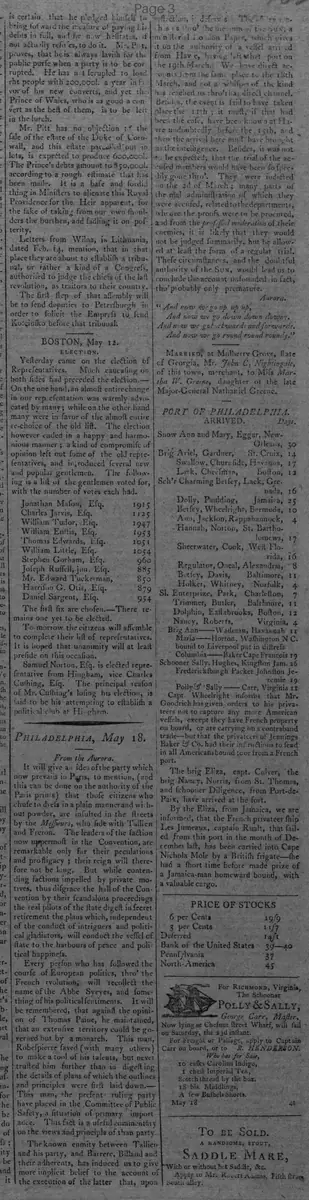
It will give an idea of the party which now prevails in Paris, to mention, (and this can be done on the authority of the Paris prints) that those citizens who choose to dress in a plain manner and without powder, are insulted in the streets by the Messieurs, who side with Tallien and Freron. The leaders of the faction now uppermost in the Convention, are remarkable only for their peculations and profligacy; their reign will therefore not be long. But while contending factions impelled by private motives, thus disgrace the hall of the Convention by their scandalous proceedings the real pilots of the state digest in secret retirement the plans which, independent of the conduct of intriguers and political gladiators, will conduct the vessel of state to the harbours of peace and political happiness. Every person who has followed the course of European politics, thro' the French revolution, will recollect the name of the Abbe Sieyes, and something of his political sentiments. It will be remembered, that against the opinion of Thomas Paine, he maintained, that an extensive territory could be governed but by a monarch. This man, Robespierre saved (with many others) to make a tool of his talents, but never trusted him further than in digesting the details of plans of which the outlines and principles were laid down. This man, the present ruling party have placed in the Committee of Public Safety, a situation of primary importance. This fact is a useful commentary on the views and principle of that party. The known enmity between Tallien and his party, and Barrere, Billaud and their adherents, has induced us to give more implicit belief to the account of the execution of the latter than, upon reflection. In days. The account is from the Sun, a ministerial London Paper, which gives it on the authority of a vessel arrived from Havre, having left that port on the 19th March. We have direct accounts from the same place to the 13th March, and not a whisper of the kind has reached us thro'the direct channel. Besides, the event is said to have taken place the 11th; it must, if that had been the case, have been known at Havre undoubtedly before the 15th, and then the arrival here must have brought us the intelligence. Besides, it was not to be expected, that the trial of the accused members would have been so speedily gone thro'. They were indicted on the 2d of March; many parts of the mal administration of which they were accused, related to the departments, where the proofs were to be procured, and from the professed moderation of their enemies, it is likely that they would not be judged summarily, but be allowed at least the form of a regular trial. These circumstances, and the doubtful authority of the Sun, would lead us to conclude the account unfounded in fact, tho'probably only premature.
Aurora.
From the Aurora.
It will give an idea of the party which now prevails in Paris, to mention, (and this can be done on the authority of the Paris prints) that those citizens who choose to dress in a plain manner and without powder, are insulted in the streets by the Messieurs, who side with Tallien and Freron. The leaders of the faction now uppermost in the Convention, are remarkable only for their peculations and profligacy; their reign will therefore not be long. But while contending factions impelled by private motives, thus disgrace the hall of the Convention by their scandalous proceedings the real pilots of the state digest in secret retirement the plans which, independent of the conduct of intriguers and political gladiators, will conduct the vessel of state to the harbours of peace and political happiness. Every person who has followed the course of European politics, thro' the French revolution, will recollect the name of the Abbe Sieyes, and something of his political sentiments. It will be remembered, that against the opinion of Thomas Paine, he maintained, that an extensive territory could be governed but by a monarch. This man, Robespierre saved (with many others) to make a tool of his talents, but never trusted him further than in digesting the details of plans of which the outlines and principles were laid down. This man, the present ruling party have placed in the Committee of Public Safety, a situation of primary importance. This fact is a useful commentary on the views and principle of that party. The known enmity between Tallien and his party, and Barrere, Billaud and their adherents, has induced us to give more implicit belief to the account of the execution of the latter than, upon reflection. In days. The account is from the Sun, a ministerial London Paper, which gives it on the authority of a vessel arrived from Havre, having left that port on the 19th March. We have direct accounts from the same place to the 13th March, and not a whisper of the kind has reached us thro'the direct channel. Besides, the event is said to have taken place the 11th; it must, if that had been the case, have been known at Havre undoubtedly before the 15th, and then the arrival here must have brought us the intelligence. Besides, it was not to be expected, that the trial of the accused members would have been so speedily gone thro'. They were indicted on the 2d of March; many parts of the mal administration of which they were accused, related to the departments, where the proofs were to be procured, and from the professed moderation of their enemies, it is likely that they would not be judged summarily, but be allowed at least the form of a regular trial. These circumstances, and the doubtful authority of the Sun, would lead us to conclude the account unfounded in fact, tho'probably only premature.
Aurora.
What sub-type of article is it?
Foreign Affairs
Partisan Politics
What keywords are associated?
French Revolution
Paris Factions
Abbe Sieyes
Committee Of Public Safety
Tallien Freron
Execution Rumor
Barrere Billaud
What entities or persons were involved?
Tallien
Freron
Abbe Sieyes
Robespierre
Thomas Paine
Barrere
Billaud
Committee Of Public Safety
French Convention
Editorial Details
Primary Topic
Factional Strife In The French Convention And Abbe Sieyes' Role
Stance / Tone
Critical Of Current Factions, Optimistic About Underlying State Guidance, Skeptical Of Execution Rumors
Key Figures
Tallien
Freron
Abbe Sieyes
Robespierre
Thomas Paine
Barrere
Billaud
Committee Of Public Safety
French Convention
Key Arguments
Current Leaders In Paris Convention Are Profligate And Their Rule Will Be Short Lived.
Abbe Sieyes, Advocate Of Monarchical Governance For Large Territories, Now Holds Key Position In Committee Of Public Safety.
Reported Execution Of Barrere And Billaud On March 11 Is Likely Unfounded Or Premature, Given Timeline And Lack Of Direct Confirmation.
Factions Disgrace The Convention While True Statesmen Plan In Secret For Peace.