Thank you for visiting SNEWPapers!
Sign up free
The Brooksville Journal
Brooksville, Hernando County, Florida
What is this article about?
The Athabasca tar sands in northeastern Alberta, Canada, hold vast oil reserves estimated at up to 250 billion barrels, far exceeding global proved reserves, but extraction remains uneconomical until cheaper methods are developed or current sources deplete.
Clipping
OCR Quality
Full Text
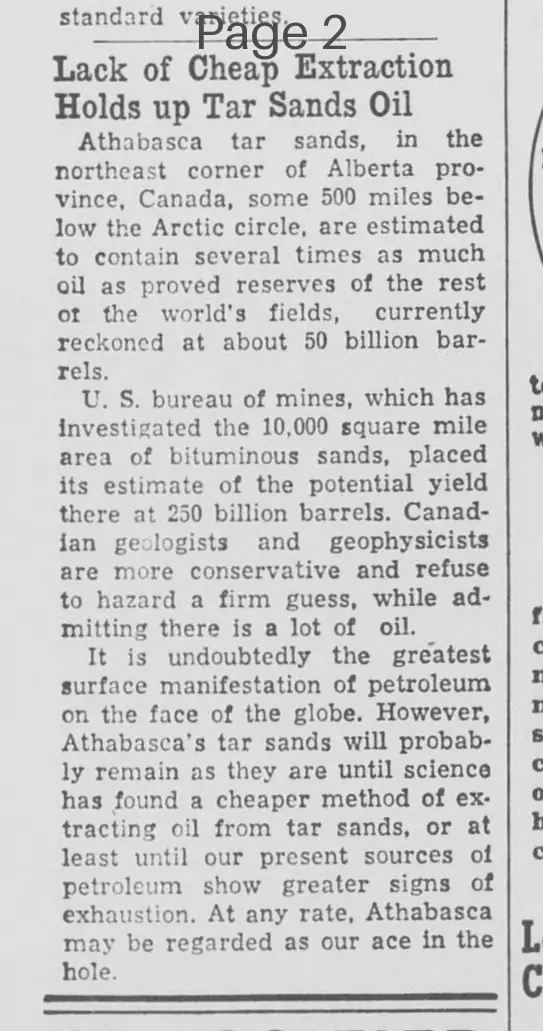
Athabasca tar sands, in the northeast corner of Alberta province, Canada, some 500 miles below the Arctic circle, are estimated to contain several times as much oil as proved reserves of the rest of the world's fields, currently reckoned at about 50 billion barrels.
U. S. bureau of mines, which has investigated the 10,000 square mile area of bituminous sands, placed its estimate of the potential yield there at 250 billion barrels. Canadian geologists and geophysicists are more conservative and refuse to hazard a firm guess, while admitting there is a lot of oil.
It is undoubtedly the greatest surface manifestation of petroleum on the face of the globe. However, Athabasca's tar sands will probably remain as they are until science has found a cheaper method of extracting oil from tar sands, or at least until our present sources of petroleum show greater signs of exhaustion. At any rate, Athabasca may be regarded as our ace in the hole.
What sub-type of article is it?
What themes does it cover?
What keywords are associated?
Where did it happen?
Story Details
Location
Athabasca Tar Sands, Northeast Corner Of Alberta Province, Canada
Story Details
Vast oil reserves in Athabasca tar sands estimated at several times global proved reserves of 50 billion barrels, with U.S. Bureau of Mines estimating 250 billion barrels; Canadian experts more conservative. Greatest surface petroleum manifestation, but extraction uneconomical until cheaper methods found or current sources exhaust.