Thank you for visiting SNEWPapers!
Sign up free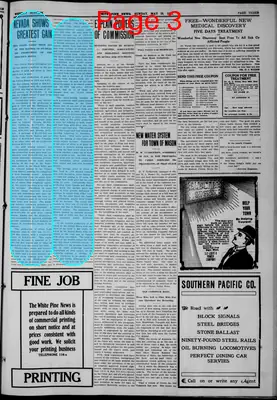
White Pine News Weekly Mining Review
East Ely, Ely, White Pine County, Nevada
What is this article about?
US Geological Survey reports record 1909 gold output of 4.8M ounces ($99.7M), Nevada leading with $4.7M gain; silver up to 54.7M ounces ($28.5M), Utah top gainer. Mining prosperous despite some setbacks.
Clipping
OCR Quality
Full Text
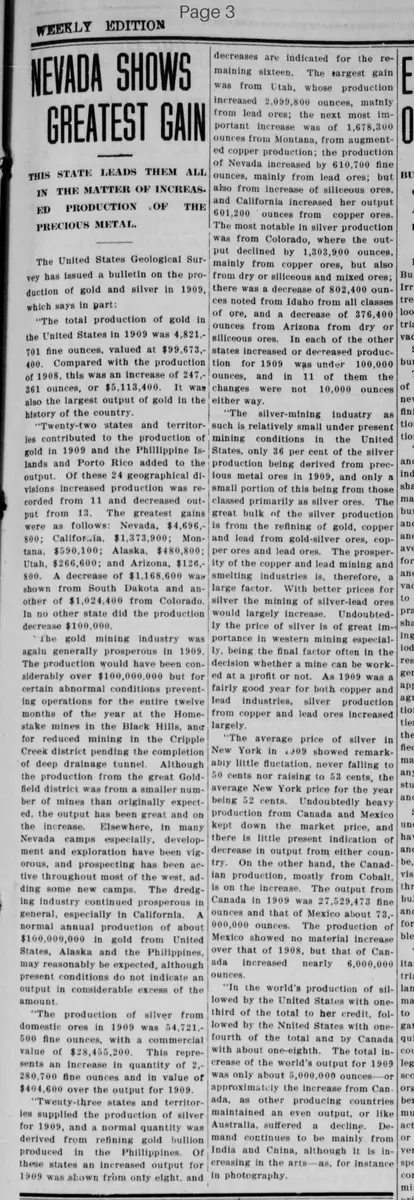
NEVADA SHOWS GREATEST GAIN
THIS STATE LEADS THEM ALL IN THE MATTER OF INCREASED PRODUCTION OF THE PRECIOUS METAL.
The United States Geological Survey has issued a bulletin on the production of gold and silver in 1909, which says in part:
"The total production of gold in the United States in 1909 was 4,821,701 fine ounces, valued at $99,673,400. Compared with the production of 1908, this was an increase of 247,361 ounces, or $5,113,400. It was also the largest output of gold in the history of the country.
"Twenty-two states and territories contributed to the production of gold in 1909 and the Philippine Islands and Porto Rico added to the output. Of these 24 geographical divisions increased production was recorded from 11 and decreased output from 13. The greatest gains were as follows: Nevada, $4,696,800; California, $1,373,900; Montana, $590,100; Alaska, $480,800; Utah, $266,600; and Arizona, $126,800. A decrease of $1,168,600 was shown from South Dakota and another of $1,024,400 from Colorado. In no other state did the production decrease $100,000.
The gold mining industry was again generally prosperous in 1909. The production would have been considerably over $100,000,000 but for certain abnormal conditions preventing operations for the entire twelve months of the year at the Homestake mines in the Black Hills, and for reduced mining in the Cripple Creek district pending the completion of deep drainage tunnel. Although the production from the great Goldfield district was from a smaller number of mines than originally expected, the output has been great and on the increase. Elsewhere, in many Nevada camps especially, development and exploration have been vigorous, and prospecting has been active throughout most of the west, adding some new camps. The dredging industry continued prosperous in general, especially in California. A normal annual production of about $100,000,000 in gold from United States, Alaska and the Philippines may reasonably be expected, although present conditions do not indicate an output in considerable excess of the amount.
"The production of silver from domestic ores in 1909 was 54,721,500 fine ounces, with a commercial value of $28,455,200. This represents an increase in quantity of 2,280,700 fine ounces and in value of $404,600 over the output for 1908.
"Twenty-three states and territories supplied the production of silver for 1909, and a normal quantity was derived from refining gold bullion produced in the Philippines. Of these states an increased output for 1909 was shown from only eight, and decreases are indicated for the remaining sixteen. The largest gain was from Utah, whose production increased 2,099,800 ounces, mainly from lead ores; the next most important increase was of 1,678,300 ounces from Montana, from augmented copper production; the production of Nevada increased by 610,700 fine ounces, mainly from lead ores; but also from increase of siliceous ores, and California increased her output 601,200 ounces from copper ores. The most notable decrease in silver production was from Colorado, where the output declined by 1,303,900 ounces, mainly from copper ores, but also from dry or siliceous and mixed ores; there was a decrease of 802,400 ounces noted from Idaho from all classes of ore, and a decrease of 376,400 ounces from Arizona from dry or siliceous ores. In each of the other states increased or decreased production for 1909 was under 100,000 ounces, and in 11 of them the changes were not 10,000 ounces either way.
"The silver-mining industry as such is relatively small under present mining conditions in the United States, only 36 per cent of the silver production being derived from precious metal ores in 1909, and only a small portion of this being from those classed primarily as silver ores. The great bulk of the silver production is from the refining of gold, copper and lead from gold-silver ores, copper ores and lead ores. The prosperity of the copper and lead mining and smelting industries is, therefore, a large factor. With better prices for silver the mining of silver-lead ores would largely increase. Undoubtedly the price of silver is of great importance in western mining especially, being the final factor often in the decision whether a mine can be worked at a profit or not. As 1909 was a fairly good year for both copper and lead industries, silver production from copper and lead ores increased largely.
"The average price of silver in New York in 1909 showed remarkably little fluctuation, never falling to 50 cents nor rising to 53 cents, the average New York price for the year being 52 cents. Undoubtedly heavy production from Canada and Mexico kept down the market price, and there is little present indication of decrease in output from either country. On the other hand, the Canadian production, mostly from Cobalt, is on the increase. The output from Canada in 1909 was 27,529,473 fine ounces and that of Mexico about 73,000,000 ounces. The production of Mexico showed no material increase over that of 1908, but that of Canada increased nearly 6,000,000 ounces.
"In the world's production of silver Mexico leads with one-third of the total to her credit, followed by the United States with one-fourth of the total and by Canada with about one-eighth. The total increase of the world's output for 1909 was only about 5,000,000 ounces—or approximately the increase from Canada, as other producing countries maintained an even output, or like Australia, suffered a decline. Demand continues to be mainly from India and China, although it is increasing in the arts—as, for instance in photography."
What sub-type of article is it?
What keywords are associated?
Where did it happen?
Domestic News Details
Primary Location
Nevada
Event Date
1909
Outcome
gold production increased by 247,361 ounces to 4,821,701 fine ounces valued at $99,673,400; nevada gained $4,696,800. silver production increased by 2,280,700 fine ounces to 54,721,500 fine ounces valued at $28,455,200; utah gained 2,099,800 ounces.
Event Details
The United States Geological Survey reported record gold production in 1909 across 22 states and territories, plus Philippines and Porto Rico, with increases in 11 areas led by Nevada. Silver production from 23 states and territories showed increases in 8, led by Utah, mainly from lead ores. The mining industry was prosperous, with expectations of normal $100M annual gold output. Silver market influenced by Canada and Mexico production.