Thank you for visiting SNEWPapers!
Sign up free
Story
May 12, 1875
Watertown Republican
Watertown, Jefferson County, Dodge County, Wisconsin
What is this article about?
Henrietta Robinson, the 'Veiled Murderess,' convicted in 1854 in Troy for poisoning a saloon-keeper and relative, faces conditional release after 15 years under new state law, but remains in Auburn insane asylum due to insanity. Originally sentenced to hang, commuted to life in Sing Sing.
Clipping
OCR Quality
98%
Excellent
Full Text
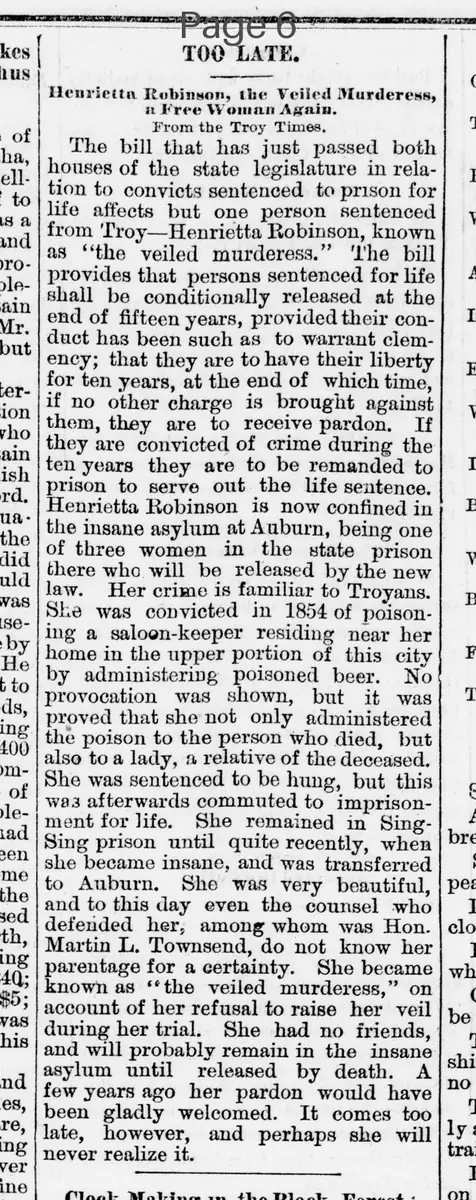
TOO LATE.
Henrietta Robinson, the Veiled Murderess, a Free Woman Again.
—From the Troy Times.
The bill that has just passed both houses of the state legislature in relation to convicts sentenced to prison for life affects but one person sentenced from Troy—Henrietta Robinson, known as "the veiled murderess." The bill provides that persons sentenced for life shall be conditionally released at the end of fifteen years, provided their conduct has been such as to warrant clemency; that they are to have their liberty for ten years, at the end of which time, if no other charge is brought against them, they are to receive pardon. If they are convicted of crime during the ten years they are to be remanded to prison to serve out the life sentence.
Henrietta Robinson is now confined in the insane asylum at Auburn, being one of three women in the state prison there who will be released by the new law. Her crime is familiar to Troyans. She was convicted in 1854 of poisoning a saloon-keeper residing near her home in the upper portion of this city by administering poisoned beer. No provocation was shown, but it was proved that she not only administered the poison to the person who died, but also to a lady, a relative of the deceased. She was sentenced to be hung, but this was afterwards commuted to imprisonment for life. She remained in Sing Sing prison until quite recently, when she became insane, and was transferred to Auburn. She was very beautiful, and to this day even the counsel who defended her, among whom was Hon. Martin L. Townsend, do not know her parentage for a certainty. She became known as the "veiled murderess," on account of her refusal to raise her veil during her trial. She had no friends, and will probably remain in the insane asylum until released by death. A few years ago her pardon would have been gladly welcomed. It comes too late, however, and perhaps she will never realize it.
Henrietta Robinson, the Veiled Murderess, a Free Woman Again.
—From the Troy Times.
The bill that has just passed both houses of the state legislature in relation to convicts sentenced to prison for life affects but one person sentenced from Troy—Henrietta Robinson, known as "the veiled murderess." The bill provides that persons sentenced for life shall be conditionally released at the end of fifteen years, provided their conduct has been such as to warrant clemency; that they are to have their liberty for ten years, at the end of which time, if no other charge is brought against them, they are to receive pardon. If they are convicted of crime during the ten years they are to be remanded to prison to serve out the life sentence.
Henrietta Robinson is now confined in the insane asylum at Auburn, being one of three women in the state prison there who will be released by the new law. Her crime is familiar to Troyans. She was convicted in 1854 of poisoning a saloon-keeper residing near her home in the upper portion of this city by administering poisoned beer. No provocation was shown, but it was proved that she not only administered the poison to the person who died, but also to a lady, a relative of the deceased. She was sentenced to be hung, but this was afterwards commuted to imprisonment for life. She remained in Sing Sing prison until quite recently, when she became insane, and was transferred to Auburn. She was very beautiful, and to this day even the counsel who defended her, among whom was Hon. Martin L. Townsend, do not know her parentage for a certainty. She became known as the "veiled murderess," on account of her refusal to raise her veil during her trial. She had no friends, and will probably remain in the insane asylum until released by death. A few years ago her pardon would have been gladly welcomed. It comes too late, however, and perhaps she will never realize it.
What sub-type of article is it?
Crime Story
Biography
Historical Event
What themes does it cover?
Crime Punishment
Justice
Misfortune
What keywords are associated?
Veiled Murderess
Poisoning Crime
Life Sentence
Conditional Release
Insane Asylum
Troy Conviction
What entities or persons were involved?
Henrietta Robinson
Hon. Martin L. Townsend
Where did it happen?
Troy
Story Details
Key Persons
Henrietta Robinson
Hon. Martin L. Townsend
Location
Troy
Event Date
1854
Story Details
Henrietta Robinson convicted in 1854 for poisoning a saloon-keeper and his relative with poisoned beer; sentenced to hang, commuted to life imprisonment; transferred to Auburn asylum after insanity; new law allows conditional release after 15 years, but too late for her.