Thank you for visiting SNEWPapers!
Sign up free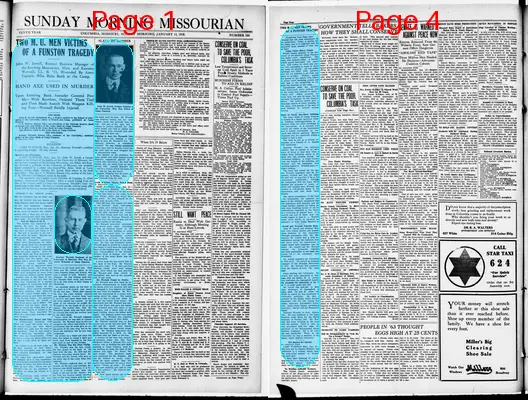
The Evening Missourian
Columbia, Boone County, Missouri
What is this article about?
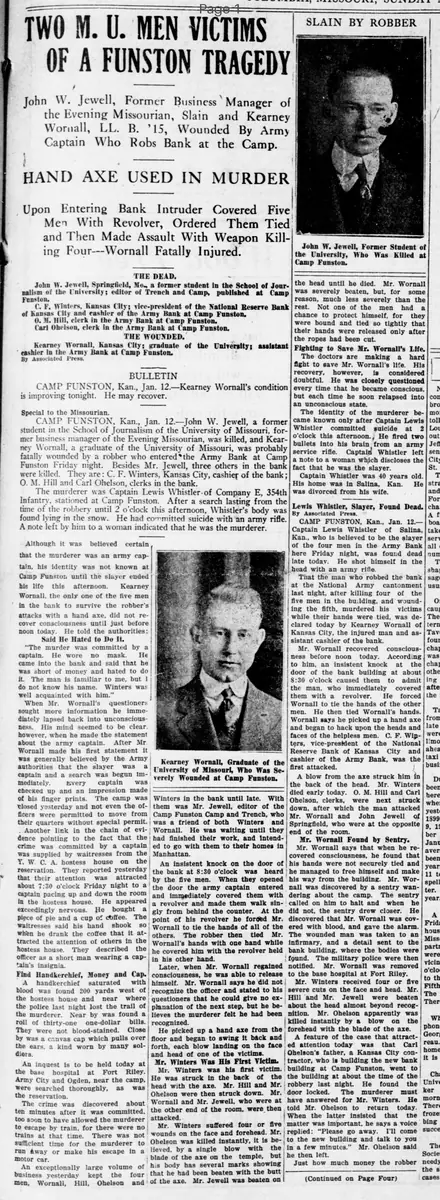
Army Captain Lewis Whistler robbed the Camp Funston Army Bank on Friday night, January 11, 1918, killing four men—John W. Jewell, C. F. Winters, O. M. Hill, and Carl Ohelson—with a hand axe after tying them up, and wounding Kearney Wornall, who survived. Whistler later committed suicide.
Merged-components note: Merged the main story on the Funston tragedy with its accompanying image (spatial overlap in bounding boxes) and continuation from page 4.
Clippings
1 of 2
OCR Quality
Full Text
VICTIMS
OF A FUNSTON
TRAGEDY
John W. Jewell, Former Business Manager
of
the Evening Missourian, Slain and Kearney
Wornall,
LL. B. '15, Wounded By Army
Captain
Who
Robs Bank at the Camp.
HAND
AXE
USED
IN
MURDER
Upon
Entering
Bank
Intruder
Covered
Five
Men With
Revolver,
Ordered Them Tied
and Then
Made Assault With Weapon Kill-
ing Four---Wornall Fatally Injured.
THE DEAD.
John W. Jewell, Springfield, Mo., a former student in the School of Journalism of the University; editor of Trench and Camp, published at Camp
Funston.
C. F. Winters, Kansas City; vice-president of the National Reserve Bank
of Kansas City and cashier of the Army Bank at Camp Funston.
O. M. Hill, clerk in the Army Bank at Camp Funston.
Carl Ohelson, clerk in the Army Bank at Camp Funston.
THE WOUNDED.
Kearney Wornall, Kansas City; graduate of the University; assistant
cashier in the Army Bank at Camp Funston.
By
Associated Press.
BULLETIN
CAMP FUNSTON, Kan., Jan. 12.-Kearney Wornall's condition
is improving tonight. He may recover.
Special to the Missourian.
CAMP FUNSTON, Kan., Jan. 12.-John W. Jewell, a former
student in the School of Journalism of the University of Missouri, for-
mer business manager of the Evening Missourian, was killed, and Kear-
ey Wornall, a graduate of the University of Missouri, was probably
fatally wounded by a robber who entered the Army Bank at Camp
Funston Friday night. Besides Mr. Jewell, three others in the bank
were killed. They are: C. F. Winters, Kansas City, cashier of the bank;
O. M. Hill and Carl Ohelson, clerks in the bank.
The murderer was Captain Lewis Whistler of Company E, 354th
Infantry, stationed at Camp Funston. After a search lasting from the
time of the robbery until 2 o'clock this afternoon, Whistler's body was
found lying in the snow. He had committed suicide with an army rifle.
A note left by him to a woman indicated that he was the murderer.
Although it was believed certain
that the murderer was an army cap-
tain, his identity was not known at
Camp Funston until the slayer ended
his life
this
afternoon.
Kearney
Wornall, the only one of the five men
in the bank to survive the robber's
attacks with a hand axe, did not re-
cover consciousness until just before
noon today. He told the authorities:
Said He Hated to Do It.
"The murder was committed by a
captain. He wore
no
mask.
He
came into the bank and said that he
was short of money and hated to do
it. The man is familiar to me, but I
do not know his name.
Winters was
well acquainted with him."
When Mr.
Wornall's
questioners
sought more information he imme-
diately lapsed back into unconscious-
ness.
His mind seemed to be clear
however, when he made the statement
about the army captain.
After Mr
Wornall made his first statement it
was generally believed by the Army
authorities that the slayer
was
a
captain and a search was begun im-
mediately.
Every
captain
was
checked up and an impression made
of his finger prints.
The camp was
closed yesterday and not even the of-
ficers were permitted to move from
their quarters without special permit.
Winters in the bank until late.
With
them was Mr. Jewell, editor of the
Camp and Trench, who
was a friend of both Winters and
Wornall. He was waiting until they
had finished their work, and intend-
ed to go with them to their homes in
Manhattan.
Y. W. C. A. hostess
house
on
the
reservation. They reported yesterday
that their attention
was
attracted
by the five men.
When they opened
the door the army captain entered
An insistent knock on the door of
the bank at 8:30 o'clock was heard
about 7:30 o'clock Friday night to a
captain pacing up and down the room
in the hostess house.
He appeared
exceedingly nervous.
He
bought a
piece of pie and a cup of coffee. The
waitresses said his hand
shook so
when he drank the coffee that it at-
traced the attention of others in the
hostess house.
At the
point of his revolver he forced Mr.
Wornall to tie the hands of all of the
others.
The robber then tied Mr.
Wornall's hands with one hand while
he covered him with the revolver held
in his other hand.
They
described
the
officer as a short man wearing a cap-
tain's insignia.
Later, when Mr. Wornall regained
consciousness, he was able to release
himself. Mr. Wornall says he did not
recognize the officer and stated to his
questioners that he could give no ex-
planation of the next step, but he be-
lieves the murderer felt he had been
recognized.
A
handkerchief
saturated
with
blood was found 200 yards west of
the hostess house and
near where
the police last night lost the trail of
the murderer.
Near by was found a
roll of thirty-one one-dollar bills.
They were not blood-stained. Close
by was a canvas cap which pulls over
the ears, a kind worn by many sol-
diers.
He picked up a hand axe from the
floor and began to swing it back and
forth, each blow landing on the face
and head of one of the victims.
An inquest is to be held today at
the base
hospital
at
Fort
Riley.
Mr. Winters was his first victim.
Army City and Ogden, near the camp,
were searched thoroughly, as was
the reservation.
He was struck in the back of the
head with the axe. Mr. Hill and Mr.
Ohelson were then struck down. Mr.
Wornall and Mr. Jewell, who were at
the other end of the room, were then
attacked.
The crime was
discovered about
ten minutes after it was committed,
too soon to have allowed the murderer
to escape by train, for there were no
trains at that time.
There was not
sufficient time
for the murderer to
run away
or make his escape in a
motor car.
Mr. Winters suffered four or five
wounds on the face and forehead. Mr.
Ohelson was killed instantly, it is be-
lieved, by a single
blow
with the
blade of the axe on the temple,
but
his body has several marks showing
that he had been beaten with the butt
of the axe. Mr. Jewell was beaten on
the head until he died.
Mr. Wornall
was severely beaten, but, for
some
reason, much less severely than the
rest. Not one of the
men
had
a
chance to protect himself, for
they
were bound and tied so tightly that
their hands were released only after
the ropes had been cut.
Fighting to Save Mr. Wornall's Life.
The doctors are making
a
hard
fight to save Mr. Wornall's life. His
recovery,
however,
is
considered
doubtful. He was closely questioned
every time that he became conscious,
but each time he soon relapsed into
an unconscious state.
The identity of the murderer be-
came known only after Captain Lewis
Whistler committed
suicide
at 2
o'clock this afternoon. He fired two
bullets into his brain from an army
service rifle.
Captain Whistler left
a note to a woman which discloses the
fact that he was the slayer.
Captain Whistler was 40 years old.
His home was in Salina, Kan. He
was divorced from his wife.
Lewis Whistler, Slayer, Found Dead.
By Associated Press.
CAMP FUNSTON, Kan., Jan. 12.-
Captain Lewis Whistler
of Salina,
Kan., who is believed to be the slayer
of the four men in the Army Bank
here Friday
night, was found dead
late today.
He shot himself in the
head with an army rifle.
That the man who robbed the bank
at the National
Army
cantonment
last night, after killing four of
the
five men in the building, and wound-
ing the fifth, murdered his
victims
while their hands were tied, was de-
clared today by Kearney Wornall of
Kansas City, the injured man and as-
sistant cashier of the bank.
Mr. Wornall recovered
conscious-
ness before noon
today.
According
to him, an insistent knock at
the
door of the bank building at about
8:30 o'clock caused them
to
admit
the man, who immediately
covered
them with a
revolver.
He
forced
Wornall to tie the hands of the other
men.
He then tied Wornall's hands.
Wornall says he picked up a hand axe
and began to hack upon the heads and
faces of the helpless men. C. F. Win-
tes, vice-president of the National
Reserve Bank of Kansas City
and
cashier of the Army Bank, was the
first attacked.
A blow from the axe struck him in
the back of the head. Mr. Winters
died early today. O. M. Hill and Carl
Ohelson, clerks,
were
next
struck
down, after which the man attacked
Mr. Wornall and John Jewell
of
Springfield, who were at the opposite
end of the room.
Mr. Wornall Found by Sentry.
Mr. Wornall says that when he re-
covered consciousness, he found that
his hands were not securely tied and
he managed to free himself and make
his way from the building. Mr. Wor-
nall was discovered by a sentry wan-
dering about the camp.
The sentry
called on him to halt and when
he
did not, the sentry drew closer. He
discovered that Mr. Wornall was cov-
ered with blood, and gave the alarm.
The wounded man was taken to an
infirmary, and a detail sent to the
bank building, where the bodies were
found. The military police were then
notified. Mr. Wornall was removed
to the base hospital at Fort Riley.
Mr. Winters received four or five
severe cuts on the face and head. Mr.
Hill and Mr.
Jewell
were
beaten
about the head almost beyond recog-
nition.
Mr. Ohelson apparently was
killed instantly by a
blow
on
the
forehead with the blade of the axe.
A feature of the case that attract-
ed attention today
was
that
Carl
Ohelson's father, a Kansas City con-
tractor, who is building the new bank
building at Camp Funston, went to
the building at about the time of the
robbery last night.
He
found
the
door locked.
The
murderer
must
have answered for Mr. Winters.
He
told Mr. Ohelson to
return
today.
When the latter insisted
that
the
matter was important, he says a voice
replied: "Please go away.
I'll come
to the new building and talk to you
in a few minutes.
Mr. Ohelson said
he then left.
Just how much money the robber
(Continued on Page Four)
TWO M. U. MEN VICTIMS
OF A FUNSTON TRAGEDY
(Continued from Page One)
obtained has not been announced by the authorities. Today is payday for the camp, and it is supposed that an unusually large amount of cash was on hand.
Within twenty minutes of the discovery of the murders Camp Funston was under strict regulations. The camp was isolated today. A heavily armed guard surrounds the entire area, with orders to shoot any person who attempted to enter or leave the camp by stealth. All the public buildings are filled with laborers, who are not allowed to go from one place to another.
Military guards are posted at the depots with orders to arrest every incoming person and take him to the authorities to explain his business at the camp.
Immediately after the murders were discovered, every military unit in the camp was ordered to make a "check roll," which accounts for every man, not only by name, but by personal recognition by his superior officer. The military police gave a thorough search of every building in the camp, with guards at the door of each building to prevent anyone leaving.
Bank in Small, One-Story Building,
The Army Bank at Camp Funston is housed in a small, one-story wooden building, indistinguishable at a distance from the other buildings of the cantonment. It is situated well toward the center of the cantonment and is closely surrounded by barracks and officers' quarters. Several thousand men are quartered within a radius of half a mile.
The bank is run as a private enterprise, as a branch of a Kansas City institution. Kearney Wornall, the assistant cashier, was in charge of an office force of three or four men when a visitor from Columbia called at the bank late one evening during the Christmas holidays. A rough counter runs the length of the building, and Wornall and his assistants were working behind it. Wornall wore civilian's clothes.
The bank had closed for the day, but Wornall explained that he frequently worked late into the night. He said that he expected to be at the cantonment indefinitely. Through his connection with the bank, which handles the accounts of many officers and enlisted men, Wornall had become a well-known figure in the cantonment, and had made many friends.
The whole atmosphere of the bank—its informality, the apparent absence of the ordinary safeguards that one associates with banking, and the rough wooden counter on which the men were handling money of all denominations—appealed to the visitor as a reversion to pioneer days. It is exactly the sort of bank that one would expect to find in a Western boom town—which, in outward appearance, is what Camp Funston is.
Jewell and Wornall Popular Here.
John W. Jewell and Kearney Wornall were widely known and popular when students in the University. Through association with the Missourian, Mr. Jewell had a wide acquaintance among the business men, and many were the expressions of regret heard here yesterday over his death. Mr. Jewell and Mr. Wornall entered the University together and their association in the same fraternity led to an unusually close friendship.
Mr. Jewell attended the University in 1913-14-15. He served as business manager of the Evening Missourian in 1915. Mr. Wornall was graduated from the School of Law the same year.
Since leaving the University, Mr. Jewell had been associated in business with his father, H. S. Jewell who publishes the Springfield Leader. He accepted the editorship of the Y. M. C. A. army paper last fall.
Mr. Jewell was married to Miss Jean McGregor of Springfield in June, 1916. He was 25 years old. While in school he was prominent in University activities. He was a member of the Sigma Alpha Epsilon fraternity, Chi Chi Chi, Kappa Tau Alpha, honorary journalistic fraternity; Alpha Delta Sigma, advertising fraternity; Matrix and the Missourian board.
Kearney Wornall is from Kansas City. He was assistant in the Camp Funston Army Bank for the Huttig interests of Kansas City. Mr. Wornall had been working in the bank only six months. Prior to this he was associated with the legal department of the Metropolitan Street Railway Company. He is 26 years old and unmarried. When in the University he was a member of the Sigma Alpha Epsilon fraternity.
His Reason for Suicide
By Associated Press.
CAMP FUNSTON, Kan., Jan. 12.—The note left by Captain Whistler was addressed to a woman, whose name the authorities decline to divulge. The note said:
"I have been thinking of committing suicide for a long time, but never had a good reason. Yesterday went out and made myself a reason."
What sub-type of article is it?
What themes does it cover?
What keywords are associated?
What entities or persons were involved?
Where did it happen?
Story Details
Key Persons
Location
Camp Funston, Kan.
Event Date
Friday Night, Jan. 11, 1918 (Reported Jan. 12)
Story Details
Army Captain Lewis Whistler entered the Army Bank at Camp Funston, tied up five men with a revolver, then killed four—John W. Jewell, C. F. Winters, O. M. Hill, and Carl Ohelson—using a hand axe, and wounded Kearney Wornall. Whistler committed suicide the next day, leaving a note confessing.