Thank you for visiting SNEWPapers!
Sign up free
The National Intelligencer And Washington Advertiser
Washington, District Of Columbia
What is this article about?
David Ramsay's oration celebrates the 1804 cession of Louisiana to the US, highlighting its vast natural resources, strategic benefits, promotion of commerce, security from foreign threats, and opportunities for expansion, unity, and civilizing Native Americans under American governance.
Merged-components note: The second component is a direct textual continuation of the oration on the cession of Louisiana, indicated by the matching narrative flow and '(To be continued.)'; relabel from 'story' to 'literary' as it is a published oration.
Clippings
1 of 2
OCR Quality
Full Text
ON THE
CESSION OF
LOUISIANA
TO THE
UNITED STATES,
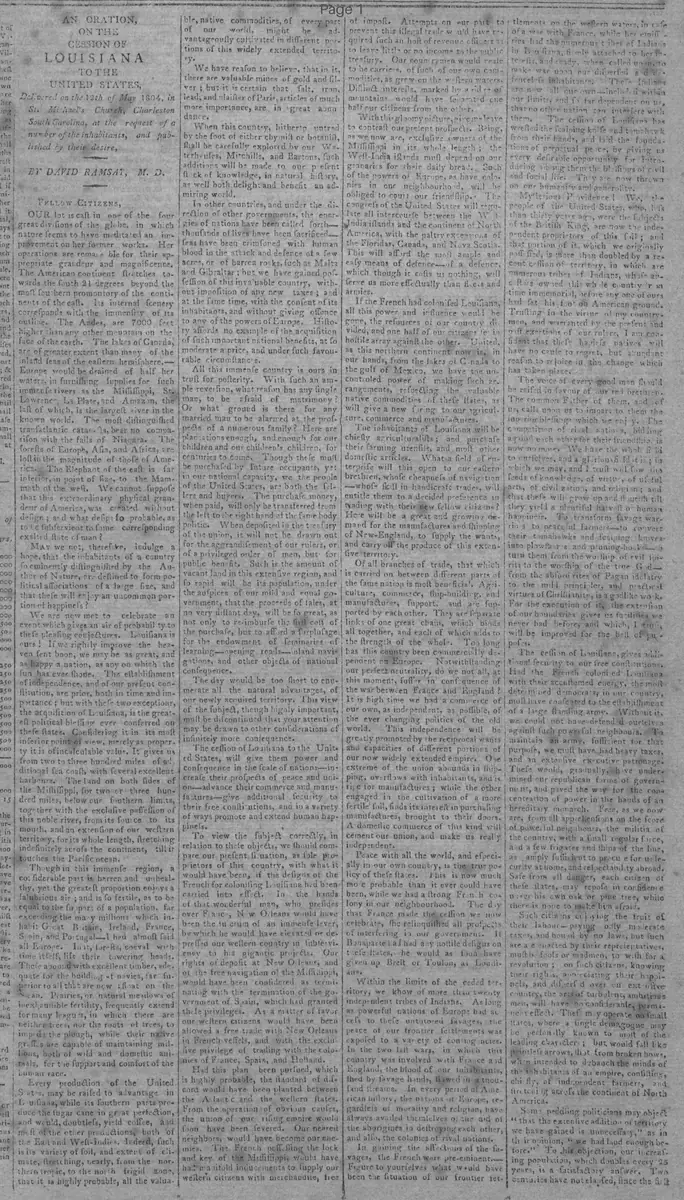
Delivered on the 12th of May 1804, in St. Michael's Church, Charleston, South Carolina, at the request of a number of the inhabitants, and published by their desire,
By DAVID RAMSAY, M. D.
FELLOW CITIZENS,
OUR lot is cast in one of the four great divisions of the globe, in which nature seems to have meditated an improvement on her former works. Her operations are remarkable for their appropriate grandeur and magnificence. The American continent stretches towards the south 21 degrees beyond the most southern promontory of the continents of the east. Its internal scenery corresponds with the immensity of its outline. The Andes, are 7000 feet higher than any other mountain on the face of the earth. The lakes of Canada, are of greater extent than many of the inland seas of the eastern hemisphere. Europe would be drained of half her waters, in furnishing supplies for such immense rivers as the Mississippi, St. Lawrence, La Plate, and Amazon, the last of which, is the largest river in the known world. The most distinguished tranatlantic cataracts, bear no comparison with the falls of Niagara. The forests of Europe, Asia, and Africa, are lost in the magnitude of those of America. The Elephant of the east is far inferior, in point of size, to the Mammoth of the west. We cannot suppose that this extraordinary physical grandeur of America, was created without design; and what design so probable, as to be subservient to some corresponding exalted state of man?
May we not, therefore, indulge a hope, that the inhabitants of a country so eminently distinguished by the Author of Nature, are destined to form political associations of a large size, and that these will enjoy an uncommon portion of happiness?
We are now met to celebrate an event which gives an air of probability to these pleasing conjectures. Louisiana is ours! If we rightly improve the heaven sent boon, we may be as great, and as happy a nation, as any on which the sun has ever shone. The establishment of independence, and of our present constitution, are prior, both in time and importance; but with these two exceptions, the acquisition of Louisiana, is the greatest political blessing ever conferred on these states. Considering it in its most inferior point of view, merely as property it is of incalculable value. It gives us from two to three hundred miles of additional sea coast, with several excellent harbours. The land on both sides of the Mississippi, for two or three hundred miles, below our southern limits, together with the exclusive possession of this noble river, from its source to its mouth, and an extension of our western territory, for its whole length, stretching indefinitely across the continent, till it touches the Pacific ocean.
Though in this immense region, a considerable part is barren and unhealthy, yet the greatest proportion enjoys a salubrious air: and is so fertile, as to be equal to the support of a population, far exceeding the many millions which inhabit Great Britain, Ireland, France, Spain, and Portugal together almost all Europe. In it, forests, coeval with time itself, lift their towering heads. These abound with excellent timber, adequate for the building of navies, far superior to all that are now afloat on the ocean. Prairies, or natural meadows of inexhaustible fertility, frequently extend for many leagues, in which there are neither trees, nor the roots of trees, to impede the plough, while their native grasses are capable of maintaining millions, both of wild and domestic animals, for the support and comfort of the human race.
Every production of the United States, may be raised to advantage in Louisiana, while its southern parts produce the sugar cane in great perfection, and would, doubtless, yield coffee, and most of the other productions, both of the East and West-Indies. Indeed, such is its variety of soil, and extent of climate, stretching, nearly, from the northern tropic, to the north frigid zone, that it is highly probable, all the valuable native commodities, of every part of our world, might be advantageously cultivated in different portions of this widely extended territory.
We have reason to believe, that in it, there are valuable mines of gold and silver: but it is certain that salt, iron, lead, and plaster of Paris, articles of much more importance, are in great abundance.
When this country, hitherto untrod by the foot of either chemist or botanist, shall be carefully explored by our Waterhouses, Mitchills, and Bartons, such additions will be made to our present stock of knowledge, in natural history, as will both delight and benefit an admiring world.
In other countries, and under the direction of other governments, the energies of nations have been called forth— thousands of lives have been sacrificed— seas have been crimsoned with human blood in the attack and defence of a few acres, or of barren rocks, such as Malta and Gibraltar: but we have gained possession of this invaluable country, without imposition of any new taxes; and at the same time, with the consent of its inhabitants, and without giving offence to any of the powers of Europe. History affords no example of the acquisition of such important national benefits, at so moderate a price, and under such favourable circumstances.
All this immense country is ours in trust for posterity. With such an ample reversion, what reason has any single man, to be afraid of matrimony? Or what ground is there for any married man to be alarmed at the prospects of a numerous family? Here are plantations enough, and enough for our children and our children's children, for centuries to come. Though these must be purchased by future occupants, yet in our national capacity, we the people of the United States, are both the sellers and buyers. The purchase money, when paid, will only be transferred from the left to the right hand of the same body politic. When deposited in the treasury of the union, it will not be drawn out for the aggrandizement of our rulers, or of a privileged order of men, but for public benefit. Such is the amount of vacant land in this extensive region, and so rapid will be its population, under the auspices of our mild and equal government, that the proceeds of sales, at no very distant day, will be so great, as not only to reimburse the first cost of the purchase, but to afford a surplusage for the endowment of seminaries of learning—opening roads—internal navigations, and other objects of national consequence.
The day would be too short to enumerate all the natural advantages, of our newly acquired territory. This view of the subject, though highly important, must be discontinued that your attention may be drawn to other considerations of infinitely more consequence.
The cession of Louisiana to the United States, will give them power and consequence in the scale of nations—increase their prospects of peace and union—advance their commerce and manufactures—give additional security to their free constitutions, and in a variety of ways promote and extend human happiness.
To view the subject correctly, in relation to these objects, we should compare our present situation, as sole proprietors of this country, with what it would have been, if the designs of the French for colonising Louisiana had been carried into effect. In the hands of that wonderful man, who presides over France, New Orleans would have been the fulcrum of an immense lever, by which he would have elevated or depressed our western country in subserviency to his gigantic projects. Our rights of deposit at New Orleans, and of the free navigation of the Mississippi, would have been considered as terminating with the termination of the government of Spain, which had granted these privileges. As a matter of favor our western citizens would have been allowed a free trade with New Orleans in French vessels, and with the exclusive privilege of trading with the colonies of France, Spain, and Holland.
Had this plan been pursued, which is highly probable, the standard of discord would have been planted between the Atlantic and the western states. From the operation of obvious causes, the union of our rising empire would soon have been severed. Our nearest neighbors, would have become our enemies. The French possessing the lock and key of the Mississippi, would have had manifold inducements to supply our western citizens with merchandise, free of impost. Attempts on our part to prevent this illegal trade would have required such an host of revenue officers as to leave little or no income to the public treasury. Our countrymen would relapse to be carriers, of such of our own commodities, as grew on the western waters. Distinct interests, marked by a rid river or mountain, would have enurated one half our citizens from the other.
With this gloomy picture, give me leave to contrast our present prospects. Being, as we now are, exclusive owners of the Mississippi in its whole length; the West-India islands must depend on our granaries for their daily bread. Such of the powers of Europe, as have colonies in our neighbourhood, will be obliged to court our friendship. The congress of the United States will regulate all intercourse between the West India islands and the continent of North America, with the paltry possessions of the Floridas, Canada, and Nova Scotia. This will afford the most ample and easy means of defence—of a defence, which though it costs us nothing, will serve us more effectually than fleets and armies.
If the French had colonised Louisiana, all this power and influence would be gone, the resources of our country divided, and one half of our citizens leagued in hostile array against the other. United, as this northern continent now is, in our hands, from the lakes of Canada to the gulf of Mexico, we have the uncontrolled power of making such arrangements, respecting the valuable native commodities of these states, as will give a new spring to our agriculture, commerce and manufactures.
The inhabitants of Louisiana will be chiefly agriculturalists; and purchase their farming utensils, and most other domestic articles. What a field of enterprise will this open to our eastern brethren, whose skill in handicraft trades, will entitle them to a decided preference in trading with their new fellow citizens? Here will be a great and growing demand for the manufactures and shipping of New-England, to supply the wants, and carry off the produce of this extensive territory.
Of all branches of trade, that which is carried on between different parts of the same nation is most beneficial. Agriculture, commerce, ship-building, and manufacture, support, and are supported by each other. They are separate links of one great chain, which binds all together, and each of which adds to the strength of the whole. Too long has this country been commercially dependent on Europe. Notwithstanding our perfect neutrality, do we not all, at this moment, suffer in consequence of the war between France and England?
It is high time we had a commerce of our own, as independent, as possible, of the ever changing politics of the old world. This independence will be greatly promoted by the reciprocal wants and capacities of different portions of our now widely extended empire. One extreme of the union abounds in shipping, overflows with inhabitants, and is ripe for manufactures; while the other engaged in the cultivation of a more fertile soil, finds its interest in purchasing manufactures, brought to their doors.
A domestic commerce of this kind will cement our union, and make us really independent.
Peace with all the world, and especially in our own country, is the true policy of these states. This is now much more probable than it ever could have been, while we had a strong French Colony in our neighbourhood. The day that France made the cession we now celebrate, she relinquished all prospects of interfering in our government. If Bonaparte had any hostile designs on these states, he would as soon have given up Brest or Toulon, as Louisiana.
Within the limits of the ceded territory, we know of more than twenty independent tribes of Indians. As long as powerful nations of Europe had access to these untutored savages, the peace of our frontier settlements was exposed to a variety of contingencies. In the two last wars, in which this country was involved with France and England, the blood of our inhabitants, shed by savage hands, flowed in a thousand streams. In every period of American history, the nations of Europe, regardless of morality and religion, have always availed themselves of the aid of the aborigines in destroying each other, and also, the colonies of rival nations.
In gaining the affections of the savages, the French were pre-eminent. Figure to yourselves what would have been the situation of our frontier settlements on the western waters, in case of a war with France, while her emissaries had the numerous tribes of Indians in Louisiana, firmly attached to her interests, and ready, when called upon, to make war upon our divided and defenceless inhabitants. There. Indians are now all our own—included within our limits, and so far dependent on us, that no other nation can interfere with them. The cession of Louisiana has wrestled the scalping knife and tomahawk from their hands, and laid the foundations of perpetual peace, by giving us every desirable opportunity for introducing among them the best things of civil and social life. They are now thrown on our humanity and generosity.
Mysterious Providence! We, the people of the United States, who, less than thirty years ago, were the subjects of the British King, are now the independent proprietors of this soil: and that portion of it, which we originally possessed, is more than doubled by a recent cession of territory, in which are numerous tribes of Indians, who are its avowed tillers; the whole Country from time immemorial, scarce any one of ours had set his foot on American ground.
Trusting in the virtue of my countrymen, and warranted by the present and past exertions of our rulers, I am confident that these harmless natives will have no cause to regret, but abundant reason to rejoice in the change which has taken place.
The voice of every good man should be raised in favour of our red brethren. The common Father of them, and of us, calls upon us to impart to them the superior blessings which we enjoy. The competition of rival nations, bidding against each other for their friendship, is now no more. We have the whole field to ourselves, and a glorious field it is; in which we may, and I trust will sow the seeds of knowledge of virtue, of useful arts, of civilization, and religion; and that they will grow up and flourish till they yield a plentiful harvest of human happiness. To transform savage warriors to peaceful farmers—to convert their tomahawks and scalping knives— into plowshares and pruning-hooks— to turn them from the worship of evil spirits to the worship of the true God— from the absurd rites of Pagan idolatry to the mild principles, and practical virtues of Christianity, is a godlike work. For the execution of it, the extension of our boundaries gives us facilities we never had before, and which, I trust will be improved for the best of purposes.
The cession of Louisiana, gives additional security to our free constitutions. Had the French colonised Louisiana with their accustomed energy, the most determined democrats, in our country, must have consented to the establishment of a large standing army. Without it, we could not have defended ourselves against such powerful neighbours. To maintain an army, sufficient for that purpose, we must have had heavy taxes, and an extensive executive patronage. These would, gradually, have undermined our republican forms of government, and paved the way for the concentration of power in the hands of an hereditary monarch. Free, as we now are, from all apprehensions on the score of powerful neighbours, the militia of the country, with a small regular force, and a few frigates and ships of the line, as amply sufficient to procure for us security at home, and respectability abroad.
Safe from all danger, each citizen of these states, may repose in confidence under his own oak or pine tree, while there is none to make him afraid. Such citizens enjoying the fruit of their labour— paying only moderate taxes, and bound by no laws, but such as are enacted by their representatives, must be fools or madmen, to wish for a revolution; on such citizens, knowing their rights, appreciating their happiness, and dispersed over our extensive country, the arts of turbulent, ambitious men, will have no considerable, permanent effect. They may operate on small states, where a single demagogue may be personally known to most of the leading characters; but would fall like pointless arrows, shot from broken bows, when intended to debauch the minds of the inhabitants of an empire, consisting, chiefly, of independent farmers, and stretching across the continent of North America.
Some paddling politicians may object 'that the extensive addition of territory we have gained is unnecessary,' as in their opinion, 'we had land enough before.' To this objection, our increasing population, which doubles every 25 years, is a satisfactory answer. Two centuries have not elapsed, since the
permanent settlements were made in British America. One at Jamestown in one thousand six hundred and seven, by one hundred and ten persons, and the other at Plymouth, in one thousand six hundred and twenty, by one hundred and one persons. From these two germs, has sprung the present population of the United States, amounting in one hundred and nine years to five millions. Much of this increase, we acknowledge, was owing to emigration from foreign countries; but we have a right to expect much more from the same quarter, on account of the present high ground on which our country stands. If the inhabitants of the old world, ventured to the new, when we were dependent colonies--liable to be implicated in the wars of Europe, and exposed to the immediate hostilities of powerful nations of Indians, we may expect a much greater number of them to join us, in our present situation, when we are independent states--detached from Europe, and free from all apprehensions on account of hostile neighbours, either civilized or savage. The address of our extended empire to the old world, now is: "come unto me all ye that are heavy laden and I will give you rest." Thousands, and tens of thousands, will obey the call, and joining their interests with ours, make emigration a more plentiful source of supply than it ever was in any preceding period of our history.
(To be continued.)
What sub-type of article is it?
What themes does it cover?
What keywords are associated?
What entities or persons were involved?
Literary Details
Title
An Oration, On The Cession Of Louisiana To The United States
Author
By David Ramsay, M. D.
Subject
Delivered On The 12th Of May 1804, In St. Michael's Church, Charleston, South Carolina, At The Request Of A Number Of The Inhabitants, And Published By Their Desire
Form / Style
Public Oration In Prose
Key Lines