Thank you for visiting SNEWPapers!
Sign up free
Vermont Watchman And State Journal
Montpelier, Washington County, Vermont
What is this article about?
Daniel Webster's 1837 speech criticizes President Jackson's executive overreach in interfering with the Bank of the United States, removing deposits, and issuing the Specie Circular, arguing these actions disrupted the currency, defied Congress, and caused economic distress, advocating for repeal and constitutional governance.
Merged-components note: Continuation of Mr. Webster's speech across pages, forming a single coherent editorial.
Clippings
1 of 2
OCR Quality
Full Text
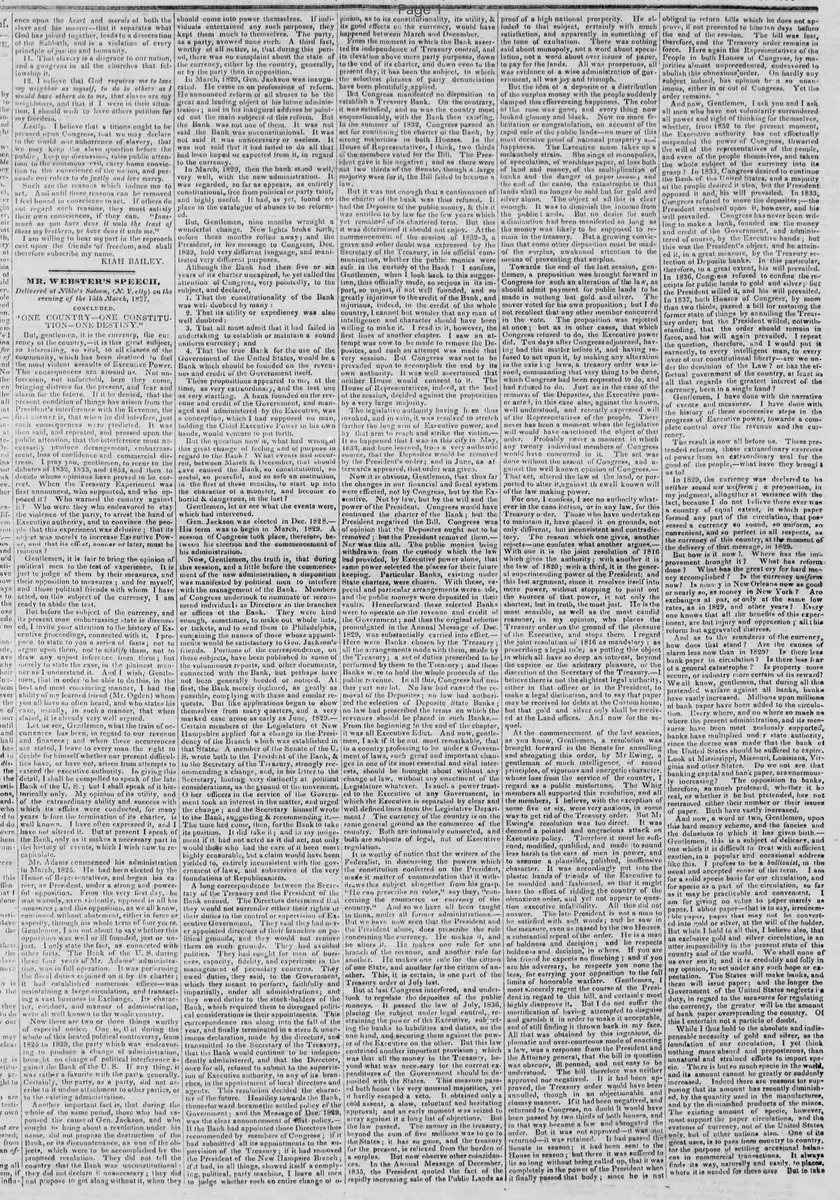
Delivered at Vauxhall Garden, (N. Y. city) on the evening of the 15th March, 1837.
CONCLUDED.
"ONE COUNTRY--ONE CONSTITUTION--ONE DESTINY."
But, gentlemen, it is the currency, the currency of the country,--it is this great subject, so interesting, so vital, to all classes of the community, which has been destined to feel the most violent assaults of Executive Power. The consequences are around us. Not unforeseen, not unforetold, here they come, bringing distress for the present, and fear and alarm for the future. If it be denied, that the present condition of things has arisen from the President's interference with the Revenue, the first answer is, that when he did interfere, just such consequences were predicted. It was then said, and repeated, and pressed upon the public attention, that the interference must necessarily produce derangement, embarrassment, loss of confidence and commercial distress. I pray you, gentlemen, to recur to the debates of 1832, 1833, and 1834, and then to decide whose opinions have proved to be correct. When the Treasury Experiment was first announced, who supported, and who opposed it? Who warned the country against it? Who were they who endeavored to stay the violence of the party, to arrest the hand of Executive authority, and to convince the people that this experiment was delusive; that its object was merely to increase Executive Power, and that its effect, sooner or later, must be ruinous?
Gentlemen, it is fair to bring the opinion of political men to the test of experience. It is just to judge of them by their measures, and their opposition to measures; and for myself, and those political friends with whom I have acted, on this subject of the currency, I am ready to abide the test.
But before the subject of the currency, and its present most embarrassing state is discussed, I invite your attention to the history of Executive proceedings, connected with it. I propose to state to you a series of facts; not to argue upon them, not to misify them, not to draw any unjust inference from them; but merely to state the case, in the plainest manner as I understand it. And I wish, Gentlemen, that in order to be able to do this, in the best and most convincing manner, I had the ability of my learned friend (Mr. Ogden) whom you all have so often heard, and who states his case, usually, in such a manner, that when stated, it is already very well argued.
Let us see, Gentlemen, what the train of occurrences has been, in regard to our revenue and finances; and when these occurrences are stated, I leave to every man the right to decide for himself whether our present difficulties have, or have not, arisen from attempts to extend the executive authority. In giving this detail, I shall be compelled to speak of the late Bank of the U. S.: but I shall speak of it historically only. My opinion of its utility, and of the extraordinary ability and success with which its affairs were conducted, for many years before the termination of its charter, is well known. I have often expressed it, and I have not altered it. But at present I speak of the Bank, only as it makes a necessary part in the history of events, which I wish now to recapitulate.
Mr. Adams commenced his administration in March, 1825. He had been elected by the House of Representatives, and began his career, as President, under a strong and powerful opposition. From the very first day, he was warmly, even violently, opposed in all his measures; and this opposition, as we all know, continued without abatement, either in force or asperity, through his whole term of four years.
Gentlemen, I am not about to say whether this opposition was well or ill founded, just or unjust. I only state the fact, as connected with other facts. The Bank of the U. S. during these four years of Mr. Adams' administration, was in full operation. It was performing the fiscal duties enjoined on it by its charter; it had established numerous offices--was maintaining a large circulation, and transacting a vast business in Exchange. Its character, conduct, and manner of administration, were all well known to the whole country.
Now there are two or three things worthy of especial notice. One is, that during the whole of this heated political controversy, from 1825 to 1829, the party which was endeavoring to produce a change of administration, brought no charge of political interference against the Bank of the U. S. If any thing, it was rather a favorite with the party generally. Certainly, the party, as a party, did not ascribe to it undue attachment to other parties, or to the existing administration.
Another important fact is, that during the whole of the same period, those who had espoused the cause of Gen. Jackson, and who sought to bring about a revolution under his name, did not propose the destruction of the Bank, or its discountenance, as one of the objects, which were to be accomplished by the proposed revolution. They did not tell the country that the Bank was unconstitutional; they did not declare it unnecessary; they did not propose to get along without it, when they should come into power themselves. If individuals entertained any such purposes, they kept them much to themselves. The party, as a party, avowed none such. A third fact, worthy of all notice, is, that during this period, there was no complaint about the state of the currency, either by the country, generally, or by the party then in opposition.
In March, 1829, Gen. Jackson was inaugurated. He came in on professions of reform. He announced reform of all abuses to be the great and leading object of his future administration; and in his inaugural address he pointed out the main subjects of this reform. But the Bank was not one of them. It was not said the Bank was unconstitutional. It was not said it was unnecessary or useless. It was not said that it had failed to do all that had been hoped or expected from it, in regard to the currency.
In March, 1829, then the bank stood well, very well, with the new administration. It was regarded, so far as appears, as entirely constitutional, free from political or party taint, and highly useful. It had, as yet, found no place in the catalogue of abuses to be reformed.
But, Gentlemen, nine months wrought a wonderful change. New lights broke forth, before these months rolled away; and the President, in his message to Congress, Dec. 1829, held very different language, and manifested very different purposes.
Although the Bank had then five or six years of its charter unexpired, he yet called the attention of Congress, very pointedly, to the subject, and declared,
1. That the constitutionality of the Bank was well doubted by many;
2. That its utility or expediency was also well doubted;
3. That all must admit that it had failed in undertaking to establish or maintain a sound uniform currency; and
4. That the true Bank for the use of the Government of the United States, would be a Bank which should be founded on the revenues and credit of the Government itself.
These propositions appeared to me, at the time, as very extraordinary, and the last one as very startling. A bank founded on the revenue and credit of the Government, and managed and administered by the Executive, was a conception, which I had supposed no man, holding the Chief Executive Power in his own hands, would venture to put forth.
But the question now is, what had wrought this great change of feeling and of purpose in regard to the Bank? What events had occurred, between March and December, that should have caused the Bank, so constitutional, so useful, so peaceful, and so safe an institution, in the first of these months, to start up into the character of a monster, and become so horrid and dangerous, in the last?
Gentlemen, let us see what the events were, which had intervened.
Gen. Jackson was elected in Dec. 1828.--His term was to begin in March, 1829. A session of Congress took place, therefore, between his election and the commencement of his administration.
Now, Gentlemen, the truth is, that during this session, and a little before the commencement of the new administration, a disposition was manifested by political men to interfere with the management of the Bank. Members of Congress undertook to nominate or recommend individuals as Directors in the branches or offices of the Bank. They were kind enough, sometimes, to make out whole lists, or tickets, and to send them to Philadelphia, containing the names of those whose appointments would be satisfactory to Gen. Jackson's friends. Portions of the correspondence, on these subjects, have been published in some of the voluminous reports, and other documents, connected with the Bank, but perhaps have not been generally heeded or noticed. At first, the Bank merely declined, as gently as possible, complying with these and similar requests. But like applications began to show themselves from many quarters, and a very marked case arose as early as June, 1829.--Certain members of the Legislature of New Hampshire applied for a change in the Presidency of the Branch which was established in that State. A member of the Senate of the U. S. wrote both to the President of the Bank, and to the Secretary of the Treasury, strongly recommending a change, and, in his letter to the Secretary, hinting very distinctly at political considerations, as the ground of the movement. Other officers in the service of the Government took an interest in the matter, and urged the change; and the Secretary himself wrote to the Bank, suggesting and recommending it.--The time had come, then, for the Bank to take its position. It did take it; and in my judgment if it had not acted as it did act, not only would those who had the care of it been most highly censurable, but a claim would have been yielded to, entirely inconsistent with the government of laws, and subversive of the very foundations of Republicanism.
A long correspondence between the Secretary of the Treasury and the President of the Bank ensued. The Directors determined that they would not surrender either their rights or their duties to the control or supervision of Executive Government. They said they had never appointed directors of their branches on political grounds, and they would not remove them on such grounds. They had avoided politics. They had sought for men of business, capacity, fidelity, and experience in the management of pecuniary concerns. They owed duties, they said, to the Government, which they meant to perform, faithfully and impartially, under all administrations; and they owed duties to the stock-holders of the Bank, which required them to disregard political considerations in their appointments. This correspondence ran along into the fall of the year, and finally terminated in a stern and unanimous declaration, made by the directors, and transmitted to the Secretary of the Treasury, that the Bank would continue to be independently administered, and that the Directors, once for all, refused to submit to the supervision of Executive authority, in any of its branches, in the appointment of local directors and agents. This resolution decided the character of the future. Hostility towards the Bank, thenceforward became the settled policy of the Government; and the Message of Dec. 1829, was the clear announcement of that policy.--If the Bank had appointed those Directors thus recommended by members of Congress; if it had submitted all its appointments to the supervision of the Treasury; if it had removed the President of the New Hampshire Branch; if it had, in all things, showed itself a complying, political, party machine, I leave all men to judge whether such an entire change of opinion, as to its constitutionality, its utility, and its good effects on the currency, would have happened between March and December.
From the moment in which the Bank asserted its independence of Treasury control, and its elevation above mere party purposes, down to the end of its charter, and down even to the present day, it has been the subject, to which the selectest phrases of party denunciation have been plentifully applied.
But Congress manifested no disposition to establish a Treasury Bank. On the contrary, it was satisfied, and so was the country most unquestionably, with the Bank then existing. In the summer of 1832, Congress passed an act for continuing the charter of the Bank, by strong majorities in both Houses. In the House of Representatives, I think, two thirds of the members voted for the Bill. The President gave it his negative; and as there were not two thirds of the Senate, though a large majority were for it, the Bill failed to become a law.
But it was not enough that a continuance of the charter of the bank was thus refused. It had the Deposit of the public money, and this it was entitled to by law for the few years which yet remained of its chartered term. But this it was determined it should not enjoy. At the commencement of the session of 1832-3, a grave and sober doubt was expressed by the Secretary of the Treasury, in his official communication, whether the public monies were safe in the custody of the Bank! I confess, Gentlemen, when I look back to this suggestion, thus officially made, so serious in its import, so unjust, if not well founded, and so greatly injurious to the credit of the Bank, and injurious, indeed, to the credit of the whole country, I cannot but wonder that any man of intelligence and character should have been willing to make it. I read in it, however, the first lines of another chapter. I saw an attempt was now to be made to remove the Deposites, and such an attempt was made that very session. But Congress was not to be prevailed upon to accomplish the end by its own authority. It was well ascertained that neither House would consent to it. The House of Representatives, indeed, at the heel of the session, decided against the proposition by a very large majority.
The legislative authority having been thus invoked, and in vain, it was resolved to stretch farther the long arm of Executive power, and by that arm to reach and strike the victim.--It so happened that I was in this city in May, 1833, and here learned, from a very authentic source, that the Deposites would be removed by the President's order; and in June, as afterwards appeared, that order was given.
Now it is obvious, Gentlemen, that thus far the changes in our financial and fiscal system were effected, not by Congress, but by the Executive. Not by law, but by the will and the power of the President. Congress would have continued the charter of the Bank; but the President negatived the Bill. Congress was of opinion that the Deposites ought not to be removed; but the President removed them.--Nor was this all. The public monies being withdrawn, from the custody which the law had provided, by Executive power alone, that same power selected the places for their future keeping. Particular Banks, existing under State charters, were chosen. With these, especial and particular arrangements were made, and the public moneys were deposited in their vaults. Henceforward these selected Banks were to operate on the revenue and credit of the Government; and thus the original scheme promulgated in the Annual Message of Dec. 1829, was substantially carried into effect.--Here were Banks chosen by the Treasury; all the arrangements made with them, made by the Treasury; a set of duties prescribed to be performed by them to the Treasury; and these Banks were to hold the whole proceeds of the public revenue. In all this, Congress had neither part nor lot. No law had caused the removal of the Deposites; no law had authorized the selection of Deposite State Banks; no law had prescribed the terms on which the revenues should be placed in such Banks.--From the beginning to the end of the chapter, it was all Executive Edict. And now, gentlemen, I ask if it be not most remarkable, that in a country professing to be under a Government of laws, such great and important changes in one of its most essential and vital interests, should be brought about without any change of law, without any enactment of the Legislature whatever. Is such a power trusted to the Executive of any Government, in which the Executive is separated by clear and well defined lines from the Legislative Department? The currency of the country is on the same general ground as the commerce of the country. Both are intimately connected, and both are subjects of legal, not of Executive regulation.
It is worthy of notice that the writers of the Federalist, in discussing the powers which the constitution conferred on the President, made it matter of commendation that it withdraws this subject altogether from his grasp. "He can prescribe no rules," say they, "concerning the commerce or currency of the country." And so we have all been taught to think, under all former administrations.--But we have now seen that the President and the President alone, does prescribe the rule concerning the currency. He makes it, and he alters it. He makes one rule for one branch of the revenue, and another rule for another. He makes one rule for the citizen of one State, and another for the citizen of another. This, it is certain, is one part of the Treasury order of July last.
But at last Congress interfered, and undertook to regulate the deposites of the public moneys. It passed the law of July, 1836, placing the subject under legal control, restraining the power of the Executive, subjecting the banks to liabilities and duties, on the one hand, and securing them against the power of the Executive on the other. But this law contained another important provision; which was that all the money in the Treasury, beyond what was necessary for the current expenditures of the Government should be deposited with the States. This measure passed both houses by very unusual majorities, yet it hardly escaped a veto. It obtained only a cold assent, a slow, reluctant and hesitating approval; and an early moment was seized to array against it a long list of objections. But the law passed. The money in the treasury, beyond the sum of five millions was to go to the States; it has so gone, and the treasury for the present, is relieved from the burden of a surplus. But now observe other coincidences. In the Annual Message of December 1835, the President quoted the fact of the rapidly increasing sale of the Public Lands as proof of a high national prosperity. He alluded to that subject, certainly with much satisfaction, and apparently in something of the tone of exultation. There was nothing said about monopoly, not a word about speculation, not a word about over issues of paper to pay for the lands. All was prosperous, all was evidence of a wise administration of government, all was joy and triumph.
But the idea of a deposite or a distribution of the surplus money with the people suddenly damped this effervescing happiness. The color of the rose was gone, and every thing now looked gloomy and black. Now no more felicitation or congratulation, on account of the rapid sale of the public lands--no more of this most decisive proof of national prosperity and happiness. The Executive muse takes up a melancholy strain. She sings of monopolies, of speculation, of worthless paper, of loss both of land and money, of the multiplication of banks and the danger of paper issue; and at the end of the canto, the catastrophe is that lands shall no longer be sold but for gold and silver alone. The object of all this is clear enough. It was to diminish the income from the public lands. But no desire for such a diminution had been manifested so long as the money was likely to be supposed to remain in the treasury. But a growing conviction that some other disposition must be made of the surplus, awakened attention to the means of preventing that surplus.
Towards the end of the last session, gentlemen, a proposition was brought forward in Congress for such an alteration of the law, as should admit payment for public lands to be made in nothing but gold and silver. The mover voted for his own proposition; but I do not recollect that any other member concurred in the vote. The proposition was rejected at once; but as in other cases, that which Congress refused to do, the Executive power did. Ten days after Congress adjourned, having had this matter before it, and having refused to act upon it, by making any alteration in the existing laws, a treasury order was issued, commanding that very thing to be done, which Congress had been requested to do, and had refused to do. Just as in the case of the removal of the Deposites, the Executive power acted, in this case also, against the known, well understood, and recently expressed will of the Representatives of the people. There never has been a moment when the legislative will would have sanctioned the object of that order. Probably never a moment in which any twenty individual members of Congress would have concurred in it. The act was done without the assent of Congress, and against the well known opinion of Congress.--That act, altered the law of the land, or purported to alter it, against the well known will of the law making power.
For one, I confess, I see no authority whatever in the constitution, or in any law, for this Treasury order. Those who have undertaken to maintain it, have placed it on grounds, not only different, but inconsistent and contradictory. The reason which one gives, another rejects--one confutes what another argues.--With one it is the joint resolution of 1816 which gives the authority; with another it is the law of 1820; with a third, it is the general superintending power of the President; and this last argument, since it resolves itself into mere power, without stopping to point out the sources of that power, is not only the shortest, but in truth, the most just. He is the most sensible, as well as the most candid reasoner, in my opinion, who places the Treasury order on the ground of the pleasure of the Executive, and stops there. I regard the joint resolution of 1816 as mandatory; as prescribing a legal rule; as putting this object in which all have so deep an interest, beyond the caprice or the arbitrary pleasure, or the discretion of the Secretary of the Treasury.--I believe there is not the slightest legal authority, either in that officer or in the President, to make a legal distinction, and to say that paper may be received for duties at the Custom house, but that gold and silver only shall be received at the Land offices. And now for the sequel.
At the commencement of the last session, as you know, Gentlemen, a resolution was brought forward in the Senate for annulling and abrogating this order, by Mr. Ewing, a gentleman of much intelligence, of sound principles, of vigorous and energetic character, whose loss from the service of the country, I regard as a public misfortune. The Whig members all supported this resolution, and all the members, I believe, with the exception of some five or six, were very anxious, in some way to get rid of the Treasury order. But Mr. Ewing's resolution was too direct. It was deemed a pointed and ungracious attack on Executive policy. Therefore it must be softened, modified, qualified, and made to sound less harsh to the ears of men in power, and to assume a plausible, polished, inoffensive character. It was accordingly put into the plastic hands of friends of the Executive to be moulded and fashioned, so that it might have the effect of ridding the country of the obnoxious order, and yet not appear to question executive infallibility. All this did not answer. The late President is not a man to be satisfied with soft words; and he saw in the measure, even as passed by the two Houses, a substantial repeal of the order. He is a man of boldness and decision; and he respects boldness and decision, in others. If you are his friend he expects no flinching; and if you are his adversary, he respects you none the less, for carrying your opposition to the full limits of honorable warfare. Gentlemen, I most sincerely regret the course of the President in regard to this bill, and certainly most highly disapprove it. But I do not suffer the mortification of having attempted to disguise and garnish it in order to make it acceptable, and of still finding it thrown back in my face. All that was obtained by this ingenious, diplomatic and over-courteous mode of enacting a law, was a response from the President and the Attorney general, that the bill in question was obscure, ill penned, and not easy to be understood. The bill therefore was neither approved nor negatived. If it had been approved, the Treasury order would have been annulled, though in an objectionable and clumsy manner. If it had been negatived, and returned to Congress, no doubt it would have been passed by two thirds of both houses, and in that way become a law and abrogated the order. But it was not approved--it was not returned--it was retained. It had passed the Senate in season; it had been sent to the House in season; but there it was suffered to lie so long without being called up, that it was completely in the power of the President when it finally passed that body; since he is not obliged to return bills which he does not approve, if not presented to him ten days before the end of the session.
The bill was lost, therefore, and the Treasury order remains in force. Here again the Representatives of the People in both Houses of Congress, by majorities almost unprecedented, endeavored to abolish this obnoxious order. On hardly any subject indeed, has opinion been so unanimous, either in or out of Congress. Yet the order remains.
And now, Gentlemen, I ask you and I ask all men who have not voluntarily surrendered all power and right of thinking for themselves, whether, from 1832 to the present moment, the Executive authority has not effectually suspended the power of Congress, thwarted the will of the representatives of the people, and even of the people themselves, and taken the whole subject of the currency into its grasp? In 1833, Congress desired to continue the Bank of the United States, and a majority of the people desired it also, but the President opposed it and, his will prevailed. In 1833, Congress refused to move the deposites; the President resolved upon it, however, and his will prevailed. Congress has never been willing to make a bank, founded on the money and credit of the Government, and administered of course, by the Executive hands; but this was the President's object, and he attained it, in a great measure, by the Treasury selection of Deposite banks. In this particular, therefore, to a great extent, his will prevailed. In 1836, Congress refused to confine the receipts for public lands to gold and silver; but the President willed it, and his will prevailed. In 1837, both Houses of Congress, by more than two thirds, passed a bill for restoring the former state of things by annulling the Treasury order; but the President willed, notwithstanding, that the order should remain in force, and his will again prevailed. I repeat the question, therefore, and I would put it earnestly, to every intelligent man, to every lover of our constitutional liberty--are we under the dominion of the Law? or has the effectual government of the country, at least in all that regards the greatest interest of the currency, been in a single hand?
Gentlemen, I have done with the narrative of events and measures. I have done with the history of these successive steps in the progress of Executive power, towards a complete control over the revenue and the currency.
The result is now all before us. These pretended reforms, those extraordinary exercises of power from an extraordinary zeal for the good of the people,--what have they brought us to?
In 1829, the currency was declared to be neither sound nor uniform; a proposition, in my judgment, altogether at variance with the fact, because I do not believe there ever was a country of equal extent, in which paper formed any part of the circulation, that possessed a currency so sound, so uniform, so convenient, and so perfect in all respects, as the currency of this country, at the moment of the delivery of that message, in 1829.
But how is it now? Where has the improvement brought it? What has reform done? What has the great cry for hard money accomplished? Is the currency uniform now? Is money in New Orleans now as good or nearly so, as money in New York? Are exchanges at par, or only at the same low rates, as in 1829, and other years? Every one knows that all the benefits of this experiment, are but injury and oppression; all this reform but aggravated distress.
And as to the soundness of the currency, how does that stand? Are the causes of alarm less now than in 1829? Is there less bank paper in circulation? Is there less fear of a general catastrophe? Is property more secure, or industry more certain of its reward? We all know, gentlemen, that during all this pretended warfare against all banks, banks have vastly increased. Millions upon millions of bank paper have been added to the circulation. Every where, and no where so much as where the present administration, and its measures have been most zealously supported, banks have multiplied under state authority, since the decree was made that the bank of the United States should be suffered to expire. Look at Mississippi, Missouri, Louisiana, Virginia and other States, Do we not see that banking capital and banks paper, are enormously increasing? The opposition to banks, therefore, so much professed, whether it be real, or whether it be but pretended, has not restrained either their number or their issues of paper. Both have vastly increased.
And now, a word or two, Gentlemen, upon this hard money scheme, and the fancies and the delusions to which it has given birth.--Gentlemen, this is a subject of delicacy, and one which it is difficult to treat with sufficient caution, in a popular and occasional address like this. I profess to be a bullionist, in the usual and accepted sense of the term. I am for a solid specie basis for our circulation, and for specie as a part of the circulation, so far as it may be practicable and convenient. I am for giving no value to paper merely as paper. I abhor paper--that is to say, irredeemable paper, paper that may not be converted into gold or silver, at the will of the holder. But while I hold to all this, I believe also, that an exclusive gold and silver circulation, is an utter impossibility in the present state of this country and of the world. We shall none of us ever see it; and it is credulity and folly in my opinion, to act under any such hope or expectation. The States will make banks, and these will issue paper; and the longer the Government of the United States neglects its duty, in regard to the measures for regulating the currency, the greater will be the amount of bank paper overspreading the country. Of this I entertain not a particle of doubt.
While I thus hold to the absolute and indispensable necessity of gold and silver, as the foundation of our circulation, I yet think nothing more absurd and preposterous, than unnatural and strained efforts to import specie. There is but so much specie in the world, and its amount cannot be greatly or suddenly increased. Indeed there are reasons for supposing that its amount has recently diminished, by the quantity used in the manufactures, and by the diminished products of the mines. The existing amount of specie, however, must support the paper circulations, and the systems of currency, not of the United States only, but of other nations also. One of its great uses, is to pass from country to country, for the purpose of settling occasional balances in commercial transactions. It always finds its way, naturally and easily, to places, where it is needed for these uses. But to take
extraordinary pains to bring it, where the course of trade does not bring it, where the state of debt and credit does not require it to be, and then endeavor, by other regulations, Treasury orders, accumulations at the mint, and other contrivances, there to retain it, is a course of policy, bordering, as it appears to me, on political insanity. It is boasted that we have seventy five or eighty millions of specie now in the country. But what more senseless—what more absurd than this boast, if there is a balance against us abroad, of which payment is desired, sooner than remittances of our own products are likely to make that payment?—What is more miserable than to boast of having that which is not ours,—which belongs to others, and which the convenience of others, and our own convenience, also, requires that they should possess? If Boston were in debt to New York, would it be wise in Boston, instead of paying its debts, to contrive all possible means of obtaining specie from the New York Banks, and hoarding it at home? And yet this is, as I think, precisely as sensible as the course, which the Government of the United States, at present pursues. We have without a doubt, a great amount of specie in the country, but it does not answer its accustomed end—it does not perform its proper duty.—It neither goes abroad to settle balances against us, and thereby quiet those who have demands upon us; nor is it so disposed at home, as to sustain the circulation to the extent which the circumstances of the times require. A great part of it is in the Western Banks, in the Land Office, on the roads through the Wilderness, on the passages over the Lakes, from the Land Offices to the Deposite banks, and from the Deposite banks back to the Land Offices. Another portion is in the hands of buyers and sellers of specie; of men in the West who sell Land Office money to the new settlers for a high premium. Another portion, again, is kept in private hands, to be used when circumstances shall tempt to the purchase of lands. And, Gentlemen, I am inclined to think, so loud has been the cry about hard money, and so sweeping the denunciation of all paper, that private holding, or hoarding, prevails to some extent, in different parts of the country. Those eighty millions of specie, therefore, really do us little good. We are weaker, in our circulation, I have no doubt, our credit is feebler, money is scarcer with us, at this moment, than if twenty millions of this specie were shipped to Europe, and general confidence thereby restored.
Gentlemen, I will not say that some degree of pressure might not have come upon us, if the Treasury order had not been issued. I will not say that there has not been over-trading, and over-production, and a too great expansion of Bank circulation. This may all be so, and the last mentioned evil, it was easy to foresee, was likely to happen when the United States discontinued their own Bank. But what I do say is, that acting upon the state of things, as it actually existed, and is now actually existing, the Treasury order has been and now is productive of great distress. It acts upon a state of things, which gives extraordinary force to its stroke, and extraordinary point to its sting. It arrests specie, when the free use and circulation of specie are most important;—it cripples the banks, at a moment when the banks, more than ever, need all their means. It makes the merchant unable to remit, when remittance is necessary for his own credit, and for the general adjustment of commercial balances. I am not now discussing the general question whether prices must not come down, and adjust themselves, anew, to the amount of bullion existing in Europe and America. I am dealing only with the measures of our own government on the subject of the currency, and I insist that these measures have been most unfortunate, and most ruinous on the ordinary means of our circulation, at home, and our ability of remittance abroad.
Their effects, too, by deranging and misplacing the specie, which is in the country, are most disastrous on domestic exchanges. Let him who has lent an ear to all these promises of a more uniform currency, see how he can now sell his draft on New Orleans or Mobile. Let the northern manufacturers and mechanics, those who have sold the products of their labor to the South, and heretofore realized the prices, with little loss of exchange, let them try present facilities. Let them see what reform of the currency has done for them. Let them inquire whether, in this respect, their condition is better or worse than it was five or six years ago.
Gentlemen, I hold this disturbance of the measure of value, and the means of payment, and exchanges—this derangement, and if I may say so—this violation of the currency, to be one of the most unpardonable of political faults. He who tampers with the currency, robs labor of its bread. He panders, indeed, to greedy capital, which is keen-sighted and may shift for itself; but he beggars labor, which is honest, unsuspecting, and too busy with the present to calculate on the future.—The prosperity of the working class, lives, moves, and has its being in established credit, and a steady medium of payment. All sudden changes destroy it. Honest industry never comes in for any part of the spoils in that scramble, which takes place when the currency of the country is disordered. Did wild schemes and projects ever benefit the industrious class? Did irredeemable paper ever benefit the industrious? Did violent fluctuations ever do good to him, who depends on his daily labor for his daily bread? Certainly, never. All these things may gratify greediness for sudden gain, or the rashness of daring speculation; but they can bring nothing but injury and distress to the homes of patient industry and honest labor. Who are they that profit by the present state of things? They are not the many, but the few. They are speculators, brokers, dealers in money, and lenders of money at exorbitant interest. "Small capitalists are crushed, and their means, being dispersed, as usual, in various parts of the country, and this miserable policy having destroyed exchanges, they have no longer either money or credit. And all classes of labor partake and must partake in the same calamity. And what consolation for all this, is it, that the public lands are paid for in specie? That whatever embarrassment and distress pervade the country, the western wilderness is thickly sprinkled over with eagles and dollars? That gold goes weekly from Milwaukie and Chicago to Detroit, and back again from Detroit to Milwaukie and Chicago, and performs similar feats of egress and regress, in many other instances in the western States? It is remarkable enough that with all this sacrifice of general convenience, with all this sky-rending clamor for government payments in specie, government, after all, never gets a dollar. So far as I know, the government of the United States, have not now a specie dollar in the world. If they have, where is it? The gold and silver collected at the Land Offices is sent to the Deposite banks, it is there placed to the credit of the government, and thereby becomes the property of the bank.—The whole revenues of the government, therefore, after all, consists in mere bank credits; that very sort of security which the friends of the administration have so much denounced.
Remember, Gentlemen, in the midst of this deafening din against all banks, that if it shall create such a panic or such alarm, as shall shut up the banks, it will shut up the Treasury of the U. S. also.
Gentlemen, I would not willingly be a prophet of ill. I most devoutly wish to see a better state of things; and I believe the repeal of the treasury order would tend, very much, to bring about that better state of things.—And I am of opinion, Gentlemen, that the order will be repealed. I think it must be repealed. I think the East, West, North and South will demand its repeal. But Gentlemen, I feel it my duty to say, that if I should be disappointed in this expectation, I see no immediate relief to the distresses of the community. I greatly fear even that the worst is not yet.—I look for severer distresses: for extreme difficulties in exchange; for greater inconveniences in remittances, and for a sudden fall in prices. Our condition is one which is not to be tampered with, and the repeal of the treasury order, being something which the Government can do, and which will do good, the public voice is right—in demanding that repeal. It is true, if repealed now, the relief will come late. Nevertheless its repeal or abrogation is a thing to be insisted on, and pursued, till it shall be accomplished. This Executive control over the currency, this power of discriminating, by treasury order, between one man's debt and another man's debt, is a thing not to be endured in a free country; and it should be the constant, persisting demand of all true Whigs,—"rescind the illegal treasury order, restore the rule of the law, place all branches of the revenue on the same grounds, as to the means of payment, make men's rights equal, and leave the Government of the country, where the constitution leaves it, in the hands of the Representatives of the People in Congress."
This point should never be surrendered or compromised. Whatever is established, let it be equal, and let it be legal.—Let men know, to-day, what money may be requested of them to-morrow. Let the rule be open and public, on the pages of the Statute Book, not a secret in the Executive breast.
Gentlemen, in the session which has now just closed, I have done my utmost to effect a direct and immediate repeal of the treasury order. I have voted for a bill, anticipating a payment of the French and Neapolitan indemnities, by an advance from the treasury. I have voted with great satisfaction for the restoration of duties on goods destroyed in the great conflagration in this city. I have voted for a deposite with the States, of the surplus which may be in the treasury at the end of the year. All these measures have failed; and it is for you and your fellow-citizens throughout the country, to decide whether the public interest would, or would not, have been promoted by their success. But I find, Gentlemen, that I am committing an unpardonable trespass on your indulgent patience. I will pursue these remarks no farther, And yet I cannot persuade myself to take leave of you, without reminding you, with the utmost deference and respect, of the important part assigned to you in the political concerns of your country, and of the great influence of your opinions, your example, and your efforts, upon the general prosperity and happiness.
Whigs of New York! Patriotic citizens of this great Metropolis! Lovers of Constitutional Liberty, bound by interest, and by affection to the Institutions of the country, Americans in heart and in principle!—You are ready, I am sure, to fulfill all the duties imposed upon you by your situation, and demanded of you by your country. You have a central position—your city is the point from which intelligence emanates, and spreads in all directions, over the whole land. Every hour carries reports of your sentiments and opinions to the verge of the Union. You cannot escape the responsibility which circumstances have thrown around you. You must live and act on a broad and conspicuous theatre, either for good or for evil, to your country. You cannot shrink away from public duties—you cannot obscure yourselves or bury your talents. In the common welfare, in the common prosperity, in the common glory of Americans, you have a stake of value, not to be calculated. You have an interest in the preservation of the Union, of the Constitution, and of the true principles of the Government, which no man can estimate. You act for yourselves, and for the generations that are to come after you; and those who, ages hence, shall bear your names and partake your blood, will feel in their political and social condition, the consequences of the manner in which you discharge your political duties.
Having fulfilled then, on your part and on mine, though feebly and imperfectly on mine, the offices of kindness and mutual regard, required by this occasion, shall we not use it to a higher and nobler purpose? Shall we not by this friendly meeting, refresh our patriotism, rekindle our love of Constitutional Liberty, and strengthen our resolutions of public duty? Shall we not, in all honesty and sincerity, with pure and disinterested love of country, as Americans, looking back to the renown of our ancestors, and looking forward to the interests of our posterity, here, to-night, pledge our mutual faith to hold on to the last, to our professed principles, to the doctrines of true liberty, and to the Constitution of the Country, let who will prove true, or who will prove recreant? Whigs of New York! I meet you in advance, and give you my pledge, for my own performance of those duties, without qualification and without reserve,—whether in public life or in private life, in the Capitol or at home. I mean never to desert them. I mean never to forget that I have a country, to which I am bound by a thousand ties; and the stone which is to lie on the ground that shall cover me, shall not bear the name of a son ungrateful to his native land.
What sub-type of article is it?
What keywords are associated?
What entities or persons were involved?
Editorial Details
Primary Topic
Critique Of Executive Interference In Currency And Banking Under Jackson
Stance / Tone
Strongly Critical Of Jackson's Policies And Executive Overreach
Key Figures
Key Arguments