Thank you for visiting SNEWPapers!
Sign up free
Letter to Editor
January 31, 1831
Daily Richmond Whig
Richmond, Virginia
What is this article about?
A Virginia resident writes to critique the proposed judiciary reform by the state legislature, opposing the assignment of only one judge per circuit due to risks of delay, error, and public distrust. Advocates for two judges per circuit to ensure efficient and reliable justice, arguing the expense is justified over a defective system.
Clipping
OCR Quality
88%
Good
Full Text
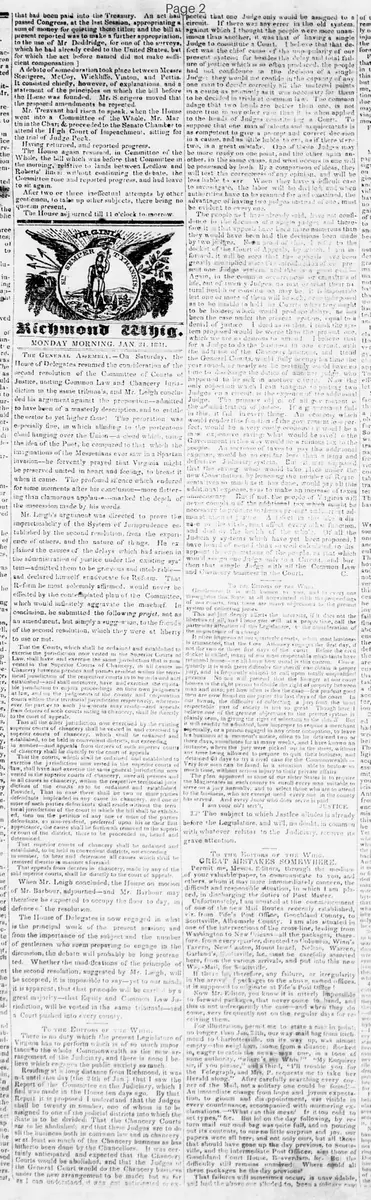
To The Editors of The Whig.
There is no duty which the present Legislature of Virginia has to perform which is of so much importance to the whole Commonwealth as the new arrangement of the Judiciary, and there is none I believe which concerns the public anxiety so much.
Residing at a long distance from Richmond, it was not until this day (the 21st of Jan.) that I saw the Report of the Committee on the Judiciary, which I find was made in the House ten days ago. By that Report it is proposed I understand that the Judges shall be twenty in number, one of whom is to be assigned to one of the judicial districts into which the State is to be divided: That the Chancery Courts are to be abolished; and that those Judges are to do all the business both in common law and in chancery or at least so much of the Chancery business as has hitherto been done by the Chancellors. It was certainly anticipated and expected that the Chancery Courts would be abolished, and that the Judges of the General Court would do the Chancery business under the new arrangement to be made: but as far as I can understand was not anticipated or expected that one Judge only would be assigned to a circuit. If there was any error in the old system, against which I thought the people were more unanimous than another, it was that of having a single Judge to constitute a Court. I believe that that defect was the chief cause of the unpopularity of our present system; for besides the delay and total failure of justice which is so often produced, the people had not confidence in the decision of a single Judge: they would not confide in the capacity of any one man to decide correctly all the material points in a cause as promptly as it was necessary for them to be decided in trials at common law. The common adage that two heads are better than one, is not more true in any other case than it is when applied to the heads of Judges constituting a Court. To suppose that one man of talents and acquirements is as competent to give a prompt and correct decision in a cause, and as little liable to err, as if there were two, is a great mistake. One of these Judges may be more ready on one point, and the other upon another, in the same cause, and what occurs to one will be possessed by both. By a comparison of ideas, they will test the correctness of any opinion, and will be less liable to err. When they have a difficult case to investigate, the labor will be divided; and when authorities have to be scanned for and examined, the advantage of having two judges instead of one, must be evident to every one.
The people as well have already said, have not confidence in the decision of a single judge: and therefore it is that appeals have been more numerous than they would have been had the decisions been made by two judges. Nor am I told, I refer to the docket of the Court of Appeals, by which, I am informed, it will be seen that the appeals have been greatly multiplied since the introduction of the present one Judge system, and the same thing I am told is the case in the General Court.
Again, in the common occurrences or casualties of life, out of twenty Judges to make what their natural health or constitution may be it is impossible but one or more of them will be sick, or otherwise disposed as to be unable to hold the Courts when they ought to be holden; which would produce delays, as has been the case under the present system, equal to a denial of justice I dread as to this. I think the system proposed would be worse than the present one, which we are so desirous to amend I believe that for a Judge to do the business in one circuit, with the addition of the Chancery business, and to aid the General Courts, would fully occupy his time the year round, or nearly so: he certainly would have no time to discharge the duties of another judge who happened to be sick in another circuit. Now the only objection which I can urge against putting two Judges on a circuit, is the expense of the additional Judge. The primary object of all government—the administration of justice. If a government fails in this, it fails in every thing. An economy which would render this function of the government imperfect, would be a very costly economy: it would be a most expensive saving: what would be saved to the Government in this way would be a ruinous tax to the people. An increase of taxes to pay the additional expense, would be an evil far less than a lame and defective Judiciary system. But we may say that the saving which would take place under the new Constitution, by lessening the number of Representatives so much as it has done, would pay off this additional expense, so as to make an increase of taxes unnecessary.
But if not, the people of Virginia will never complain of the additional tax which might be necessary to procure to themselves a more perfect and adequate administration of justice A disease in the heart, like a disorganization in the body politic, would affect every other function, and destroy the health of the whole. Of all the Judiciary systems which have yet been proposed, I have heard or read I think so well calculated to disappoint the expectations of the people, as that which would assign one Judge only to a Circuit, and burden that single Judge with all the Common Law and Chancery business in the Court.
C.
There is no duty which the present Legislature of Virginia has to perform which is of so much importance to the whole Commonwealth as the new arrangement of the Judiciary, and there is none I believe which concerns the public anxiety so much.
Residing at a long distance from Richmond, it was not until this day (the 21st of Jan.) that I saw the Report of the Committee on the Judiciary, which I find was made in the House ten days ago. By that Report it is proposed I understand that the Judges shall be twenty in number, one of whom is to be assigned to one of the judicial districts into which the State is to be divided: That the Chancery Courts are to be abolished; and that those Judges are to do all the business both in common law and in chancery or at least so much of the Chancery business as has hitherto been done by the Chancellors. It was certainly anticipated and expected that the Chancery Courts would be abolished, and that the Judges of the General Court would do the Chancery business under the new arrangement to be made: but as far as I can understand was not anticipated or expected that one Judge only would be assigned to a circuit. If there was any error in the old system, against which I thought the people were more unanimous than another, it was that of having a single Judge to constitute a Court. I believe that that defect was the chief cause of the unpopularity of our present system; for besides the delay and total failure of justice which is so often produced, the people had not confidence in the decision of a single Judge: they would not confide in the capacity of any one man to decide correctly all the material points in a cause as promptly as it was necessary for them to be decided in trials at common law. The common adage that two heads are better than one, is not more true in any other case than it is when applied to the heads of Judges constituting a Court. To suppose that one man of talents and acquirements is as competent to give a prompt and correct decision in a cause, and as little liable to err, as if there were two, is a great mistake. One of these Judges may be more ready on one point, and the other upon another, in the same cause, and what occurs to one will be possessed by both. By a comparison of ideas, they will test the correctness of any opinion, and will be less liable to err. When they have a difficult case to investigate, the labor will be divided; and when authorities have to be scanned for and examined, the advantage of having two judges instead of one, must be evident to every one.
The people as well have already said, have not confidence in the decision of a single judge: and therefore it is that appeals have been more numerous than they would have been had the decisions been made by two judges. Nor am I told, I refer to the docket of the Court of Appeals, by which, I am informed, it will be seen that the appeals have been greatly multiplied since the introduction of the present one Judge system, and the same thing I am told is the case in the General Court.
Again, in the common occurrences or casualties of life, out of twenty Judges to make what their natural health or constitution may be it is impossible but one or more of them will be sick, or otherwise disposed as to be unable to hold the Courts when they ought to be holden; which would produce delays, as has been the case under the present system, equal to a denial of justice I dread as to this. I think the system proposed would be worse than the present one, which we are so desirous to amend I believe that for a Judge to do the business in one circuit, with the addition of the Chancery business, and to aid the General Courts, would fully occupy his time the year round, or nearly so: he certainly would have no time to discharge the duties of another judge who happened to be sick in another circuit. Now the only objection which I can urge against putting two Judges on a circuit, is the expense of the additional Judge. The primary object of all government—the administration of justice. If a government fails in this, it fails in every thing. An economy which would render this function of the government imperfect, would be a very costly economy: it would be a most expensive saving: what would be saved to the Government in this way would be a ruinous tax to the people. An increase of taxes to pay the additional expense, would be an evil far less than a lame and defective Judiciary system. But we may say that the saving which would take place under the new Constitution, by lessening the number of Representatives so much as it has done, would pay off this additional expense, so as to make an increase of taxes unnecessary.
But if not, the people of Virginia will never complain of the additional tax which might be necessary to procure to themselves a more perfect and adequate administration of justice A disease in the heart, like a disorganization in the body politic, would affect every other function, and destroy the health of the whole. Of all the Judiciary systems which have yet been proposed, I have heard or read I think so well calculated to disappoint the expectations of the people, as that which would assign one Judge only to a Circuit, and burden that single Judge with all the Common Law and Chancery business in the Court.
C.
What sub-type of article is it?
Persuasive
Political
Informative
What themes does it cover?
Politics
Constitutional Rights
What keywords are associated?
Judiciary Reform
Virginia Legislature
Single Judge Circuit
Chancery Courts
Judicial Delays
Public Confidence
Two Judges
Administration Of Justice
What entities or persons were involved?
C.
To The Editors Of The Whig.
Letter to Editor Details
Author
C.
Recipient
To The Editors Of The Whig.
Main Argument
the proposed judiciary reform assigning only one judge per circuit will lead to delays, errors, and lack of public confidence in decisions; two judges per circuit are necessary for prompt and accurate justice, and the added expense is preferable to a defective system.
Notable Details
References The Adage 'Two Heads Are Better Than One'
Cites Increased Appeals Under Single Judge System
Mentions Abolition Of Chancery Courts
Argues That Savings From Reduced Representatives Could Offset Costs