Thank you for visiting SNEWPapers!
Sign up free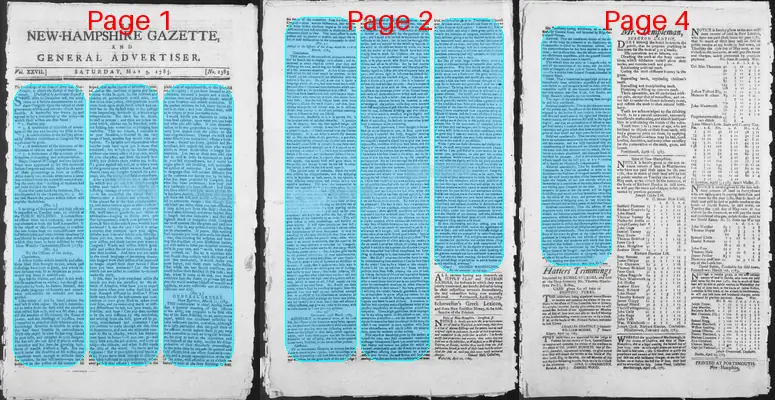
The New Hampshire Gazette And General Advertiser
Portsmouth, Exeter, Rockingham County, New Hampshire
What is this article about?
In March 1783 at New Windsor, Continental Army officers, aggrieved by unpaid wages and broken promises, receive anonymous addresses urging resistance against Congress. Washington counters with a speech emphasizing loyalty, trust in Congress, and patriotism, leading to resolutions rejecting mutiny and affirming confidence in justice.
Merged-components note: This is a single narrative article about the Newburgh Addresses and army grievances in 1783, continuing directly from page 1 to 2 and then to page 4 after intervening content on page 3, as indicated by textual flow and the 'For the remainder see page' at the end of page 2.
Clippings
1 of 3
OCR Quality
Full Text
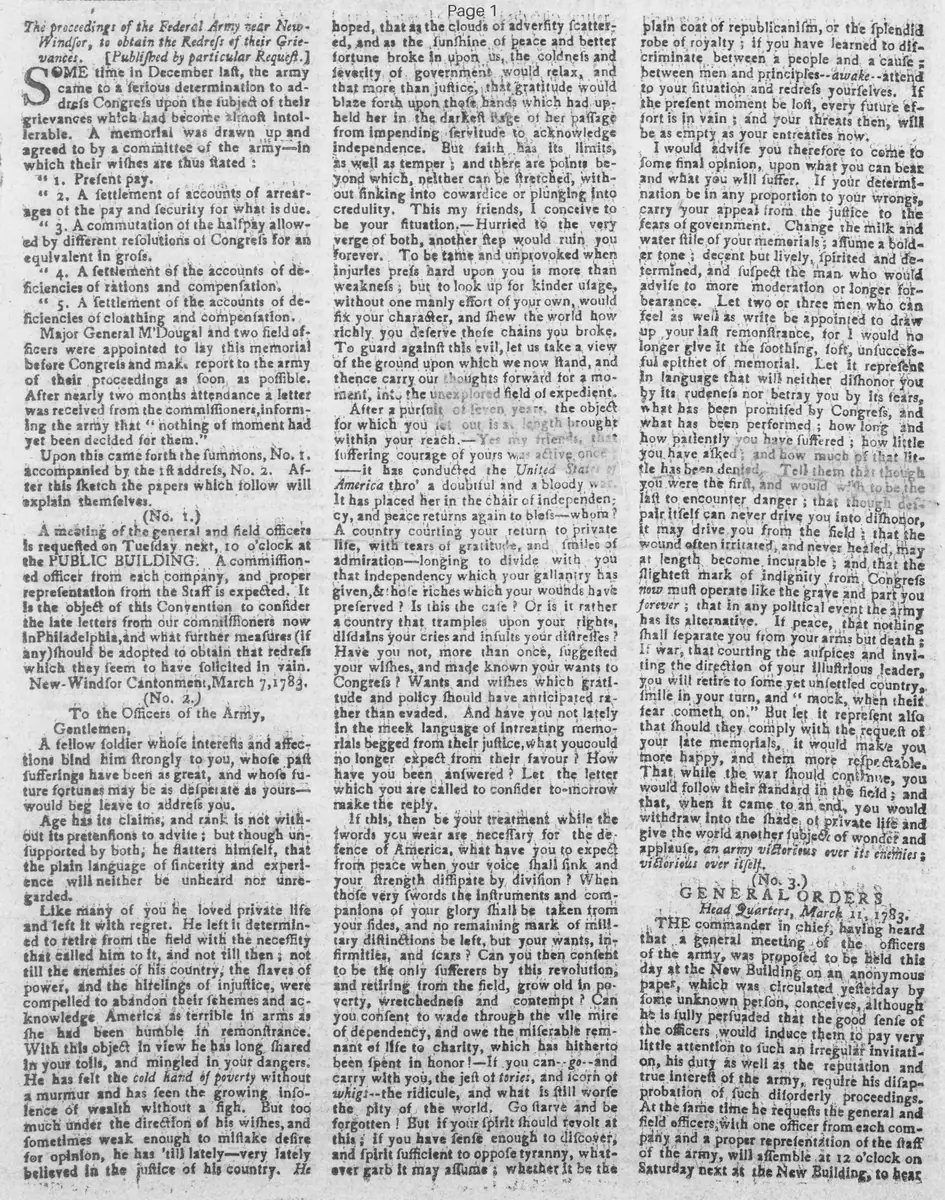
1. Present pay.
2. A settlement of accounts of arrearages of the pay and security for what is due.
3. A commutation of the half-pay allowed by different resolutions of Congress for an equivalent in gross.
4. A settlement of the accounts of deficiencies of rations and compensation.
5. A settlement of the accounts of deficiencies of clothing and compensation.
Major General M'Dougal and two field officers were appointed to lay this memorial before Congress and make report to the army of their proceedings as soon as possible. After nearly two months attendance a letter was received from the commissioners informing the army that "nothing of moment had yet been decided for them."
Upon this came forth the summons. No. 1. accompanied by the first address. No. 2. After this sketch the papers which follow will explain themselves.
(No. 1.)
A meeting of the general and field officers is requested on Tuesday next. at 11 o'clock at the PUBLIC BUILDING: A commissioned officer from each company. and proper representation from the Staff is expected. It is the object of this Convention to consider the late letters from our commissioners now in Philadelphia. and what further measures (if any) should be adopted to obtain that redress which they seem to have solicited in vain.
New-Windsor Cantonment, March 7,1783.
(No. 2.)
To the Officers of the Army,
Gentlemen,
A fellow soldier whose interests and affections bind him strongly to you. whose past sufferings have been as great. and whose future fortunes may be as desperate as yours--would be leave to address you.
Age has its claims; and rank is not without its pretensions to advise ; but though unsupported by both; he flatters himself, that the plain language of sincerity and experience will neither be unheard nor unregarded.
Like many of you he loved private life and left it with regret. He left it determined to retire from the field with the necessity that called him to it, and not till then ; not till the enemies of his country, the slaves of power, and the hirelings of injustice, were compelled to abandon their schemes and acknowledge, America as terrible in arms as she had been humble in remonstrance.
With this object in view he has long shared in your toils, and mingled in your dangers. He has felt the cold hand of poverty without a murmur and has seen the growing insolence of wealth without a sigh. But too much under the direction of his wishes. and sometimes weak enough to mistake desire for opinion, he has till lately very lately believed in the justice of his country. He hoped, that as the clouds of adversity scattered, and as the sunshine of peace and better fortune broke in upon us, the coldness and severity of government would relax. and that more than justice: that gratitude would blaze forth upon those hands which had upheld her in the dark stage of her passage from impending servitude to acknowledge independence. But faith has its limits, as well as temper ; and there are points beyond which, neither can be stretched. without sinking into cowardice or plunging into credulity. This my friends, I conceive to be your situation.--Hurried to the very verge of both. another step would ruin you forever. To be tame and unprovoked when injuries press hard upon you is more than weakness ; but to look up for kinder usage, without one manly effort of your own, would fix your character. and shew the world how richly you deserve those chains you broke. To guard against this evil, let us take a view of the ground upon which we now stand, and thence carry our thoughts forward for a moment. into the unexplored field of expedient. After a pursuit of even years. the object for which you set out is at length brought within your reach.--Yes my friends. that suffering courage of yours was active once --it has conducted the United States of America thro' a doubtful and a bloody war. It has placed her in the chair of independency, and peace returns again to bless--whom ? A country courting your return to private life. with tears of gratitude. and smiles of admiration-longing to divide with you that independency which your gallantry has given,&those riches which your wounds have preserved ? Is this the case ? Or is it rather a country that tramples upon your rights, disdains your cries and insults your distresses ? Have you not. more than once. suggested your wishes, and made known your wants to Congress ? Wants and wishes which gratitude and policy should have anticipated rather than evaded. And have you not lately in the meek language of intreating memorials begged from their justice. what you could no longer expect from their favour ? How have you been. answered ? Let the letter which you are called to consider to-morrow make the reply. If this, then be your treatment while the swords you wear are necessary for the defence of America, what have you to expect from peace when your voice shall sink and your strength dissipate by division ? When those very swords the instruments and companions of your glory shall be taken from your sides, and no remaining mark of military distinctions be left. but your wants. infirmities. and scars ? Can you then consent to be the only sufferers by this revolution, and retiring from the field, grow old in poverty, wretchedness and contempt ? Can you consent to wade through the vile mire of dependency, and owe the miserable remnant of life to charity. which has hitherto been spent in honor!-If you can-- go--and carry with you, the jest of tories, and scorn of whigs--the ridicule. and what is still worse the pity of. the world. Go starve and be forgotten ! But if your spirit should revolt at this ; if you have one enough to discover. and spirit sufficient to oppose tyranny, whatever garb it may assume ; whether it be the reverse of the plain coat of republicanism, or the splendid robe of royalty ; if you have learned to discriminate between a people and. a cause - between men and principles--awake--attend to your situation and redress yourselves. If the present moment be lost, every future effort is in vain ; and your threats then. will be as empty as your entreaties now. I would advise you therefore to come to some final opinion, upon what you can bear and what you will suffer. If your determination be in any proportion to your wrongs. carry your appeal from the justice to the fears of government. Change the milk and water style of your memorials; assume a bolder tone ; decent but lively. spirited and determined, and suspect the man who would advise to more moderation or longer forbearance. Let two or three men who can feel as well as write be appointed to draw up your last remonstrance, for I would no longer give it the soothing. soft. unsuccessful epithet of memorial. Let it represent in language that will neither dishonour you by its rudeness nor betray you by its fears, what has been promised by Congress. and what has been performed ; how long and how patiently you have suffered : how little you have asked; and how much of that little has been denied. Tell them that though you were the first, and would wish to be,the last to encounter danger ; that though despair itself can never drive you into dishonour. it may drive you from the field : that the wound often irritated, and never healed, may at length become, incurable ; and, that the slightest mark of indignity from. Congress now must operate like the grave and part you forever ; that in any political event the army has its alternative. If peace, that nothing shall separate you from your arms but death ; If war. that courting the auspices and inviting the direction of your illustrious leader. you will retire to some yet unsettled country and claim a portion of it in your turn, and "mock, their fear cometh, on." But let it represent also that should they comply with the request of your late memorials,.. it would make you more happy. and them more respectable. That, while the war should continue, you would follow their standard in the field : and that. when it came to an end, you would withdraw into the shade, of private life and give the world another subject of wonder and applause, an army victorious over its enemies; victorious over itself.
(No. 3.)
GENERAL ORDERS
Head Quarters, March 11. 1783.
THE commander in chief, having heard that a general meeting of the. officers of the army, was proposed to be held this day at the New Building on an anonymous paper, which was circulated yesterday by some unknown person, conceives, although he is fully persuaded that the good sense of the officers , would induce them to pay very little attention to such an irregular invitation, his duty as well as the reputation and true interest of the army, require his disapprobation of, such disorderly. proceedings. At the same time he requests this general and field officers.with one officer from each company and a proper representation of the staff of the army. will assemble , at 12 o'clock on Saturday next at the New Building, to hear
The report of the committee from the army from Congress—after mature deliberation, they will devise what further measures ought to be adopted as most rational and best calculated to obtain the just and important object in view. The entire officer in rank present will be pleased to preside, and report the result of their deliberations to the commander in chief.
(No. 4.)
Address to the Officers of the Army. dated the 11th of March, 1783.
Gentlemen,
The author of the late address, anxious to deserve, though he should fail to engage, your esteem; and determined at every risque to unfold your duty and discharge his own, would beg the further indulgence of a few moments attention. Aware of the coyness with which his last letter would be received, he felt himself neither disappointed nor displeased with the caution it has met. He well knew that it spoke a language which, till now, had been heard but in whispers, and that it contained some sentiments which confidence itself would have breathed with diffidence. But their lives have been short & their observations imperfect indeed, who have yet to learn, that alarms have been false: - that the best designs have often been obliged to assume the worst aspect; and that, synonymous as surprise and disaster may be in military phrase, they convey in moral and political meaning, ideas as different as they are distinct.
Suspicion, detestable as it is in private life, is the loveliest trait of political character. It prompts us to enquiry, bars the door against design, and opens every avenue to truth. It was the first to oppose a tyrant here, and still stands centinel over the liberties of America. With this belief it would illy become me to stifle the voice of this guardian; a guardian, who authorised by circumstance digested into proofs, has herself given birth to the address you have read, and now goes forth amongst you with a request to all, that it may be treated fairly; that it may be considered before it be abused, and condemned before it be tortured; convinced that, in a search after error, truth will appear, that apathy itself will grow warm in the pursuit, and though it may be the last to adopt her advice, it will be the first to act upon it.
The general order of yesterday, which the weak may mistake for disapprobation, and the designing dare to represent as such, wears, in my opinion, a very different complexion, and carries in it a very opposite tendency. Till now, the commander in chief has regarded the steps you have taken for redress with good wishes alone. His official silence has authorised your meeting; and his private opinion and approbation. Had he disliked the object in view, would not the same sense of duty which forbade you from meeting on the third day of the week, have forbidden you from meeting on the seventh? Is not the same to act held up for your ridisculous? and has it not pressed the seal of office, and taken all the solemnity of an order? This will give system to your proceedings, and stability to your resolves. It will ripen speculation into fact; and while it adds to the unanimity it cannot lessen the independency of your sentiments. It may be necessary to add upon this subject, that, from the injunction with which the general orders close, every man is at liberty to conclude, that the report to be made to head-quarters is intended for Congress.
Hence will arise another motive for that energy which has been recommended: - For, can you give the lie to the pathetic descriptions of your representatives, or the more alarming predictions of your friends? To such as make a want of signature an objection to opinions, I reply, that it matters very little who is the author of sentiments which grow out of feelings, and apply to your wants; that in this instance, diffidence suggested what experience enjoins; and that while I move on the high road of argument and advice, which is open to all, I shall remain the sole confident of my own secret. But, should the time come, when it shall be necessary to depart from this general line, and hold up any individual amongst you, as an object of the resentment or contempt of the rest, I thus publicily pledge my honor as a soldier, and my veracity as a man, that I then will assume a visible signature, and give my name to the army, with as little reserve as I now give my opinions.
(No. 5.)
Cantonment, 15th March, 1783.
AGREEABLE to the general order, of the 11th inst. the officers of the American army being convened, his excellency the commander in chief was pleased to open the meeting with the following address to them on the subject of their being called together; which, with some other papers was left for the consideration of the assembly, the hon. major-general Gates being President as the senior officer present.
Gentlemen,
BY an anonymous summons, an attempt has been made to convene you together, how inconsistent with the rules of propriety: and how subversive of all order and discipline, let the good sense of the army judge!
In this moment of this commencement, another anonymous production was put into circulation, addressed more to the feelings and passions than to the reason and judgment of the army. The author of the piece is intitled to much credit for the goodness of his pen; and I could wish he had as much credit for the rectitude of his heart; for, as men see through difficulties, and are induced by the reflecting faculties of the mind, to use different means to attain the same end, the author of the piece should have had more charity than to mark with suspicion, the man who should recommend moderation and longer forbearance, or in other words, who should not think as he thinks, and act as he advises. But he had another plan in view, in which candour and liberality of sentiment, regard to justice and love of country have no part; and he was right to insinuate the darkest suspicions to effect the blackest designs. That the address is drawn with great art; that it is intended to answer the most insidious purposes; that it is intended to impress the mind with an idea, of premeditated injustice in the sovereign power of the United States, and rouse all those resentments which must unavoidably flow from such a belief; that the dark mover of this scheme, whoever he may be, intended to take advantage of the passion, while they were warmed with the recollection of past distresses, without giving time for cool, deliberate thinking, and that composure of mind which is necessary to give dignity and stability to measures, is rendered too obvious, by the mode of conducting the business, to need other proof than a reference to the proceedings.
Thus much, gentlemen, I have thought it incumbent on me to observe to you, to show upon what principles I opposed the hasty, irregular meeting which was proposed to be held on Tuesday last, and not because I wanted a disposition to give you every opportunity, consistent with your own honor, and the dignity of the army, to make known your grievances. If my conduct heretofore, has not evinced to you, that I have been a faithful friend to the army, my declaration of it at this time would be equally unavailing and improper. But as I was amongst the first who embarked in the cause of our common country; as I have never left your side one moment, but when called from you on public duty; as I have been the constant companion and witness of your distresses, and not amongst the last to feel and acknowledge your merits; as I have ever considered my own military reputation as inseparably connected with that of the army; and my heart has ever expanded with joy, when I heard its praise, and my indignation has risen, when the mouth of detraction has been opened against it, it can scarcely be supposed, at this late stage of the war, that I am indifferent to its interests. But how are they to be promoted? The way is plain, says the anonymous addresser.—"If war continues, remove into the unsettled country; there establish yourselves and leave an ungrateful country to defend itself."— But whom are they to defend? Our wives, our children, our farms, and other property which we have left behind us? or, in this state of hostile separation, are we to take the two first, (the latter cannot be removed) to perish in a wilderness with hunger, cold, and nakedness? "If peace takes place never sheath your swords," says he, "until you have obtained full and ample justice." This dreadful alternative of either deserting our country in the extremest hour of her distress, or turning our arms against it, which is the apparent object, unless Congress can be compelled into instant compliance, has something so shocking in it, that humanity revolts at the idea. My God! what can this writer have in view, by recommending such measures? Can he be a friend to the army? Can he be a friend to this country? Rather is he not an insidious foe? Some emissary, perhaps, from New York, plotting the ruin of both, by sowing the seeds of discord and separation between the civil and military powers of the continent? And what a compliment does he pay to our understandings, when he recommends measures, in either alternative impracticable in their nature? But here, gentlemen, I will drop the curtain, because, gentlemen, it would be as imprudent in me to assign my real reasons for this opinion, as it would be insulting your conception to suppose you stood in need of them. A moment's reflection will convince every dispassionate mind of the physical impossibility of carrying either project into execution. There might gentlemen, be an impropriety in my taking notice, in this address to you, of an anonymous production—but the manner in which the performance has been introduced to the army, the effect it was intended to have, together with some other circumstances, will amply justify my observations, upon the tendency of that writing
With respect to the advice given by the author, to suspect the man, who shall recommend moderation and longer forbearance, I spurn it, as every man regards that liberty and reveres the justice for which we contend, undoubtedly must: for if men are to be precluded from offering their sentiments on a matter, which may involve the most serious and important consequences, that can invite the consideration of mankind, reason is of no use to us. The freedom of speech may be taken away, and dumb and silent we may be led like sheep to the slaughter, I cannot in justice to my own belief, and what I have great reason to believe is the intention of Congress, conclude this address; without giving it as my decided opinion, that, that honorable body, entertain exalted sentiments of the services of the army, and from full conviction of its merits and sufferings, will do it complete justice; that their endeavours to discover and establish its rights have been unwearied, and will not cease till they have succeeded. I have not a doubt.
But like all other large bodies where there is a variety of different interests to reconcile, their deliberations are slow. Why then should we distrust them? And in consequence of that distrust, adopt measures, which would cast a shade over that glory which has been so justly acquired, and tarnish the reputation of an army which has been celebrated through all Europe for its fortitude and patriotism? And for what is this done? To bring the object we seek for nearer? No, most certainly in my opinion, it will cast it at a greater distance. For myself, and I take no merit in giving the assurance; being induced to it from principles of gratitude, veracity and justice, a grateful sense of the confidence you have ever placed in me, a recollection of the cheerful assistance and prompt obedience I have experienced from you under every vicissitude of fortune, and the sincere affection I feel for an army I have so long had the honor to command, will oblige me to declare in this public and solemn manner, that in the attainment of complete justice for all your toils and dangers, and in the gratification of every wish, so far as may be done consistently with the great duty I owe my country, and those powers I am bound to respect, you may freely command my services to the utmost of my abilities.
While I give you these assurances and pledge myself in the most unequivocal manner to exert whatever ability I am possessed of in your favour, let me request you, gentlemen, on your part not to take any measures, which viewed in the calm light of reason will lessen the dignity and fully the glory you have hitherto maintained.—Let me request you to rely on the plighted faith of your country & place a full confidence in the purity of the intentions of Congress, that previous to your dissolution, as an army. they will cause all your accounts to be fairly liquidated as directed in the resolutions which were published to you two days ago, and that they will adopt the most effectual measures in their power to render ample justice to you for your faithful and meritorious services. And let me conjure you in the name of our common country as you value your own sacred honor, as you respect the sacred rights of humanity,& as you regard the military and national character of America, to express your utmost horror and detestation of the man, who wishes, under any specious pretences, to overturn the liberties of our country, and who wickedly attempts to open the flood gates of civil discord, and deluge our rising empire with blood.
By thus determining and thus acting, you will pursue the plain and direct road to the attainment of your wishes; you will defeat the insidious designs of our enemies, who are compelled to resort from open force to secret artifice. You will give one more proof of unexampled patriotism and patient virtue, rising superior to the pressure of the most complicated sufferings; and you will, by the dignity of your conduct, afford occasion for posterity to say, when speaking of the glorious example you have exhibited to mankind, -"had this day been wanting, the world had never seen the last stage of perfection to which human nature is capable of attaining."
(COPY) GEORGE WASHINGTON:
For the remainder see page.
The Excellency having withdrawn, on a motion made by General Knox, and seconded by Brigadier-General Putnam,
Resolved, That the unanimous thanks of the officers of the army be presented to his Excellency the Commander in Chief for his excellent address, and the communications he has been pleased to make to them: and to assure him, that the officers reciprocate his affectionate expressions, with the greatest sincerity of which the human heart is capable.
The address from the army to Congress—the report of the committee of the army, and the resolutions of Congress of the 27th of January, being read—
On a motion from General Putnam, seconded by General Hand,
Voted, That a committee be appointed to draw up immediately some resolutions expressive of the business before us, and to report in half an hour, that this committee consist of one General, one Field-officer, and one captain, that Gen. Knox, Col. Brooks, and Capt. Howard, compose the said committee.
The report of the committee having been brought in and fully considered,
Resolved unanimously, That at the commencement of the present war, the officers of the American army engaged in the service of their country, from the purest love and attachment to the rights and liberties of human nature, which motives still exist in the highest degree; and that no circumstances of distress or danger shall induce a conduct that may tend to sully the reputation and glory which they have acquired, at the price of their blood and eight years faithful services.
Resolved unanimously, That the army continues to have an unshaken confidence in the virtue of Congress and this country, and are fully convinced that the representatives of America will not disband or disperse the army until their accounts are liquidated, the balances accurately ascertained, and adequate funds established for payment. And in this arrangement the officers expect that the half pay, or a commutation of it, should be efficaciously comprehended.
Resolved unanimously, That his Excellency the Commander in Chief be requested to write to his Excellency the President of Congress earnestly entreating the most speedy decision of that honorable body; upon the subjects of our late address, which was forwarded by a committee of the army, some of whom are waiting upon Congress for the result. In the alternative of peace or war the event will be highly satisfactory, and would produce immediate tranquility in the minds of the army, and prevent any farther machinations of designing men, to sow discord between the civil and military power of the United States.
Resolved unanimously, That the officers of the American army view with abhorrence and reject with disdain, the infamous propositions contained in a late anonymous address to the officers of the army, and resent with indignation the secret attempts of some unknown person to collect the officers together in a manner totally subversive of all discipline and good order:
Resolved unanimously, That the thanks of the officers of the army be given to the committee who prosecuted to Congress the late address of the army, for the wisdom and prudence with which they have conducted that business; that a copy of the proceedings of this day be transmitted by the President to Major-General McDougall; and that he be requested to continue his solicitations at Congress, until the objects of his mission are accomplished:
The meeting was then dissolved.
Horatio Gates, Maj. Gen. President.
What sub-type of article is it?
What themes does it cover?
What keywords are associated?
What entities or persons were involved?
Where did it happen?
Story Details
Key Persons
Location
New Windsor Cantonment
Event Date
March 1783
Story Details
Continental Army officers submit a memorial to Congress for pay and benefits but receive no resolution. Anonymous addresses urge bolder action against Congress. Washington issues orders for a proper meeting, delivers a speech denouncing the anonymous calls as insidious, pledges support, and urges trust in Congress. Officers pass resolutions affirming loyalty, confidence in Congress, and rejection of the anonymous propositions.