Thank you for visiting SNEWPapers!

Sign up free
Page thumbnail for American Telegraph
Foreign News June 6, 1851

American Telegraph

Washington, District Of Columbia

What is this article about?

John Bigelow's 1850 book on Jamaica highlights post-emancipation growth, with 1844 census showing 377,438 population (mostly blacks and browns). Blacks gaining voting rights and assembly seats; predicts Jamaica joining the US, with strong NY trade ties.

Clipping
OCR Quality

98% Excellent

Full Text

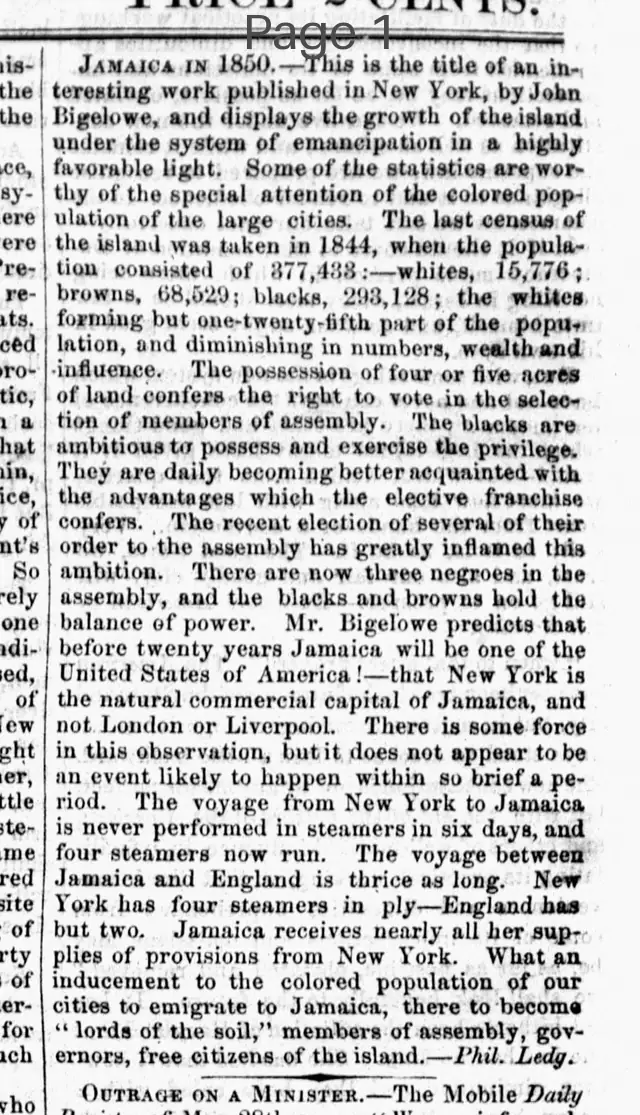
JAMAICA IN 1850.—This is the title of an interesting work published in New York, by John Bigelow, and displays the growth of the island under the system of emancipation in a highly favorable light. Some of the statistics are worthy of the special attention of the colored population of the large cities. The last census of the island was taken in 1844, when the population consisted of 377,438:—whites, 15,776; browns, 68,529; blacks, 293,128; the whites forming but one-twenty-fifth part of the population, and diminishing in numbers, wealth and influence. The possession of four or five acres of land confers the right to vote in the selection of members of assembly. The blacks are ambitious to possess and exercise the privilege. They are daily becoming better acquainted with the advantages which the elective franchise confers. The recent election of several of their order to the assembly has greatly inflamed this ambition. There are now three negroes in the assembly, and the blacks and browns hold the balance of power. Mr. Bigelow predicts that before twenty years Jamaica will be one of the United States of America!—that New York is the natural commercial capital of Jamaica, and not London or Liverpool. There is some force in this observation, but it does not appear to be an event likely to happen within so brief a period. The voyage from New York to Jamaica is never performed in steamers in six days, and four steamers now run. The voyage between Jamaica and England is thrice as long. New York has four steamers in play—England has but two. Jamaica receives nearly all her supplies of provisions from New York. What an inducement to the colored population of our cities to emigrate to Jamaica, there to become "lords of the soil," members of assembly, governors, free citizens of the island.—Phil. Ledg.

What sub-type of article is it?

Colonial Affairs Political Economic

What keywords are associated?

Jamaica Emancipation Population Census Assembly Elections Negro Members Us Annexation New York Trade

What entities or persons were involved?

John Bigelow

Where did it happen?

Jamaica

Foreign News Details

Primary Location

Jamaica

Event Date

1850

Key Persons

John Bigelow

Outcome

blacks and browns hold balance of power in assembly; three negroes elected; prediction of jamaica becoming one of the united states within 20 years.

Event Details

Book by John Bigelow details Jamaica's progress under emancipation. 1844 census: 377,438 population (whites 15,776; browns 68,529; blacks 293,128). Whites diminishing. Land ownership enables voting; blacks ambitious for franchise. Recent elections of negroes to assembly. Strong trade with New York over England.

Are you sure?