Thank you for visiting SNEWPapers!
Sign up free
Literary
December 22, 1871
Springfield Weekly Republican
Springfield, Hampden County, Massachusetts
What is this article about?
A 19th-century newspaper column reviews books including Homo versus Darwin, August and Elias by Jacob Abbott, and Curtius's History of Greece; discusses January issues of Atlantic and Galaxy magazines featuring Hawthorne, Longfellow, Holmes, and others; and notes on author Joaquin Miller and a satirical book on Prussian minister von Muhler.
Clipping
OCR Quality
95%
Excellent
Full Text
BOOKS. AUTHORS AND ART.
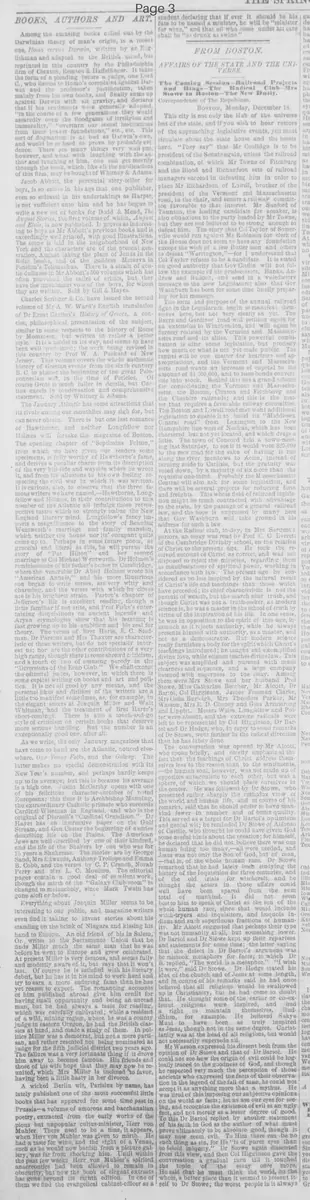
Among the amusing books called out by the Darwinian theory of man's origin, is a recent one, Homo versus Darwin, written by an Englishman and adapted to the British mind, but reprinted in this country by the Philadelphia firm of Claxton, Remsen & Haffelfinger. It takes the form of a pleading before a judge, one Lord C., who listens to Homo's complaint against Darwin and the professor's justification, taken mainly from his own books, and finally sums up against Darwin with all gravity, and declares that if his sentiments were generally adopted, "in the course of a few generations they would assuredly open the floodgates of irreligion and immorality, overturn our social institutions from their lowest foundations," etc., etc. This sort of dogmatism is as bad as Darwin's own, and would be as hard to prove by probable evidence. There are many things very well put, however, and what with laughing with the author and laughing at him, one can get merrily through the book, which, like all the publications of this firm, may be bought of Whitney & Adams.
Jacob Abbott, the perennial story-teller for boys, is so active in his age that one publisher, even so colossal in his undertakings as Harper, is not sufficient unto him and he has begun to write a new set of books for Dodd & Mead, The August Stories, the first volume of which, August and Elias, is now published. It proves as interesting to boys as Mr. Abbott's previous books and is exceedingly well printed, with good illustrations. The scene is laid in the neighborhood of New York and the characters are of the present generation, August taking the place of Jonas in the Rollo books, and of the goddess Minerva in Fenelon's Telemachus. There is a strain of gentle dullness in Mr. Abbott's 500 volumes which has often provoked the satire of critics, but they have the unanimous voice of the boys, for whom they are written. Sold by Gill & Hayes.
Charles Scribner & Co. have issued the second volume of Mr. A. W. Ward's English translation of Dr. Ernst Curtius's History of Greece, a concise, philosophical presentation of the subject, similar in some respects to the history of Rome by Mommsen, but written in rather a better style. It is a model in its way, and seems to have been well translated; the work being revised in this country by Prof. W. A. Packard of New Jersey. This volume covers the whole authentic history of Grecian events from the sixth century B. C. to almost the beginning of the great Peloponnesian war in the time of Pericles. Of course Grote is much fuller in details, but Curtius excels in condensation and comprehensive statement. Sold by Whitney & Adams.
The January Atlantic has some attractions that its rivals among our monthlies may sigh for, but can never obtain. There is but one last romance of Hawthorne, and neither Longfellow nor Holmes will forsake the magazine of Boston. The opening chapter of "Septimius Felton," from which we have given our readers some specimens, is fully worthy of Hawthorne's fame, and derives a peculiar charm from its description of the very hill side and wayside where he wrote it, and from its allusions to his own feelings respecting the civil war in which it was written. It is curious, also, to observe that the three famous writers we have named,—Hawthorne, Longfellow and Holmes, in their contributions to this number of the Atlantic all indulge those retrospective tastes which so strongly imbue the New England literary mind. Longfellow's fancy imparts a magnificence to the story of Benning Wentworth's marriage and family mansion, which neither the house nor its occupant quite came up to. Perhaps in some future poem, as graceful and literal as this, he will pursue the story of Pat Hilton and her second marriage to Col. Michael Wentworth. Dr. Holmes's reminiscences of his father's house in Cambridge, where the venerable Dr. Abiel Holmes wrote his "American Annals," and his more illustrious son began to write verses, are very witty and charming, and the verses with which he closes are in his brightest strain. Parton's chapter of Jefferson's life is excellent reading, though a little familiar if not trite, and Prof. Fiske's entertaining disquisitions on ancient legends and Aryan etymologies show that his learning is fast growing up to his ambition and his zeal for theory. The verses of Bret Harte, E. C. Stedman, Dr. Parsons and Mrs. Thaxter are characteristic of those writers, but do not specially interest us; nor are the other contributions of a very high range, though there is some shrewd criticism, and a touch or two of amusing parody in the "Diversions of the Echo Club." We shall except the editorial pages, however, in which there is some capital writing on books and art and politics. It is not all good by any means, and the personal likes and dislikes of the writers are a little too manifest sometimes, as, for example, in the elegant sneers at Joaquin Miller and Walt Whitman, and the treatment of Bret Harte's shortcomings. There is also a touch-and-go style of criticism on certain books that deserve more serious handling. But the number is an exceptionally good one, after all.
As we write, the only January magazines that have come to hand are the Atlantic, noticed elsewhere, Our Young Folks, and the Galaxy. The latter makes no special demonstration with its New Year's number, and perhaps hardly keeps up to its average; but this is because its average is a high one. Justin McCarthy opens with one of his felicitous character-sketches of noted Europeans; this time it is Archbishop Manning, the extraordinary Catholic primate who succeeds Cardinal Wiseman in England, and who is the original of Disraeli's "Cardinal Grandison." Dr. Hayes has an instructive paper on the Gulf Stream, and Gen. Custer the beginning of a series describing life on the Plains. The American Jews are well described by one of their kindred, and the life of the Shakers by one who was for 15 years a Shakeress. The stories are by George Sand, Mrs. Edwards, Anthony Trollope and Emma B. Cobb, and the verses by C. P. Cranch, Norah Perry and Mrs. L. C. Moulton. The editorial pages contain a good deal of excellent work, though the mirth of the "Galaxy Club room" is changed to melancholy, since Mark Twain has gone aloft or below.
Everything about Joaquin Miller seems to be interesting to our public, and magazine writers even find it taking to invent stories about his standing on the brink of Niagara and kissing his hand to Europe. An old friend of his in Salem, Or., writes to the Sacramento Union that he finds Miller much the same man that he was before he went to Europe and grew celebrated. At present Miller is very famous, and seems fully and modestly aware of it, but says that it won't last. Of course he is satisfied with his literary debut, but he has it in his mind to work hard and try to earn a more enduring fame than he has yet reason to expect. The romancing accounts of him published abroad give him credit for having small opportunity and being an unread man, but he had always a taste for reading, which was carefully cultivated; while a resident of a wild, mining region, where he was a county judge in eastern Oregon, he had the British classics at hand, and made a study of them. In politics Miller was a democrat, but not a mere partisan, and rather resented not being nominated as judge for the fifth judicial district two years ago. The failure was a very fortunate thing if it drove him away to become famous. His friends and those of his wife hope that they may now be reunited, which Mrs. Miller is inclined to favor, having been a little hasty in her divorce.
A wicked Berlin wit, Parisius by name, has lately published one of the most successful little books that has appeared for some time past in Prussia—a volume of amorous and bacchanalian poetry, extracted from the early works of the pious but unpopular cultus-minister, Herr von Muhler. There used to be a time, it appears, when Herr von Muhler was given to mirth. He had a taste for wine, and the sight of a Venus, such as he would now banish from a picture gallery, was far from shocking him. Until within the past few weeks Herr von Muhler's spirited anacreontics had been allowed to remain in obscurity, but now the book of elegant extracts has gone beyond its eighth edition. In one of them we find the evangelical cabinet-officer as a student declaring that if ever it should be his fate to be named a minister, he will be "minister for wine," and that all who come under his care shall be "as drunk as swine."
Among the amusing books called out by the Darwinian theory of man's origin, is a recent one, Homo versus Darwin, written by an Englishman and adapted to the British mind, but reprinted in this country by the Philadelphia firm of Claxton, Remsen & Haffelfinger. It takes the form of a pleading before a judge, one Lord C., who listens to Homo's complaint against Darwin and the professor's justification, taken mainly from his own books, and finally sums up against Darwin with all gravity, and declares that if his sentiments were generally adopted, "in the course of a few generations they would assuredly open the floodgates of irreligion and immorality, overturn our social institutions from their lowest foundations," etc., etc. This sort of dogmatism is as bad as Darwin's own, and would be as hard to prove by probable evidence. There are many things very well put, however, and what with laughing with the author and laughing at him, one can get merrily through the book, which, like all the publications of this firm, may be bought of Whitney & Adams.
Jacob Abbott, the perennial story-teller for boys, is so active in his age that one publisher, even so colossal in his undertakings as Harper, is not sufficient unto him and he has begun to write a new set of books for Dodd & Mead, The August Stories, the first volume of which, August and Elias, is now published. It proves as interesting to boys as Mr. Abbott's previous books and is exceedingly well printed, with good illustrations. The scene is laid in the neighborhood of New York and the characters are of the present generation, August taking the place of Jonas in the Rollo books, and of the goddess Minerva in Fenelon's Telemachus. There is a strain of gentle dullness in Mr. Abbott's 500 volumes which has often provoked the satire of critics, but they have the unanimous voice of the boys, for whom they are written. Sold by Gill & Hayes.
Charles Scribner & Co. have issued the second volume of Mr. A. W. Ward's English translation of Dr. Ernst Curtius's History of Greece, a concise, philosophical presentation of the subject, similar in some respects to the history of Rome by Mommsen, but written in rather a better style. It is a model in its way, and seems to have been well translated; the work being revised in this country by Prof. W. A. Packard of New Jersey. This volume covers the whole authentic history of Grecian events from the sixth century B. C. to almost the beginning of the great Peloponnesian war in the time of Pericles. Of course Grote is much fuller in details, but Curtius excels in condensation and comprehensive statement. Sold by Whitney & Adams.
The January Atlantic has some attractions that its rivals among our monthlies may sigh for, but can never obtain. There is but one last romance of Hawthorne, and neither Longfellow nor Holmes will forsake the magazine of Boston. The opening chapter of "Septimius Felton," from which we have given our readers some specimens, is fully worthy of Hawthorne's fame, and derives a peculiar charm from its description of the very hill side and wayside where he wrote it, and from its allusions to his own feelings respecting the civil war in which it was written. It is curious, also, to observe that the three famous writers we have named,—Hawthorne, Longfellow and Holmes, in their contributions to this number of the Atlantic all indulge those retrospective tastes which so strongly imbue the New England literary mind. Longfellow's fancy imparts a magnificence to the story of Benning Wentworth's marriage and family mansion, which neither the house nor its occupant quite came up to. Perhaps in some future poem, as graceful and literal as this, he will pursue the story of Pat Hilton and her second marriage to Col. Michael Wentworth. Dr. Holmes's reminiscences of his father's house in Cambridge, where the venerable Dr. Abiel Holmes wrote his "American Annals," and his more illustrious son began to write verses, are very witty and charming, and the verses with which he closes are in his brightest strain. Parton's chapter of Jefferson's life is excellent reading, though a little familiar if not trite, and Prof. Fiske's entertaining disquisitions on ancient legends and Aryan etymologies show that his learning is fast growing up to his ambition and his zeal for theory. The verses of Bret Harte, E. C. Stedman, Dr. Parsons and Mrs. Thaxter are characteristic of those writers, but do not specially interest us; nor are the other contributions of a very high range, though there is some shrewd criticism, and a touch or two of amusing parody in the "Diversions of the Echo Club." We shall except the editorial pages, however, in which there is some capital writing on books and art and politics. It is not all good by any means, and the personal likes and dislikes of the writers are a little too manifest sometimes, as, for example, in the elegant sneers at Joaquin Miller and Walt Whitman, and the treatment of Bret Harte's shortcomings. There is also a touch-and-go style of criticism on certain books that deserve more serious handling. But the number is an exceptionally good one, after all.
As we write, the only January magazines that have come to hand are the Atlantic, noticed elsewhere, Our Young Folks, and the Galaxy. The latter makes no special demonstration with its New Year's number, and perhaps hardly keeps up to its average; but this is because its average is a high one. Justin McCarthy opens with one of his felicitous character-sketches of noted Europeans; this time it is Archbishop Manning, the extraordinary Catholic primate who succeeds Cardinal Wiseman in England, and who is the original of Disraeli's "Cardinal Grandison." Dr. Hayes has an instructive paper on the Gulf Stream, and Gen. Custer the beginning of a series describing life on the Plains. The American Jews are well described by one of their kindred, and the life of the Shakers by one who was for 15 years a Shakeress. The stories are by George Sand, Mrs. Edwards, Anthony Trollope and Emma B. Cobb, and the verses by C. P. Cranch, Norah Perry and Mrs. L. C. Moulton. The editorial pages contain a good deal of excellent work, though the mirth of the "Galaxy Club room" is changed to melancholy, since Mark Twain has gone aloft or below.
Everything about Joaquin Miller seems to be interesting to our public, and magazine writers even find it taking to invent stories about his standing on the brink of Niagara and kissing his hand to Europe. An old friend of his in Salem, Or., writes to the Sacramento Union that he finds Miller much the same man that he was before he went to Europe and grew celebrated. At present Miller is very famous, and seems fully and modestly aware of it, but says that it won't last. Of course he is satisfied with his literary debut, but he has it in his mind to work hard and try to earn a more enduring fame than he has yet reason to expect. The romancing accounts of him published abroad give him credit for having small opportunity and being an unread man, but he had always a taste for reading, which was carefully cultivated; while a resident of a wild, mining region, where he was a county judge in eastern Oregon, he had the British classics at hand, and made a study of them. In politics Miller was a democrat, but not a mere partisan, and rather resented not being nominated as judge for the fifth judicial district two years ago. The failure was a very fortunate thing if it drove him away to become famous. His friends and those of his wife hope that they may now be reunited, which Mrs. Miller is inclined to favor, having been a little hasty in her divorce.
A wicked Berlin wit, Parisius by name, has lately published one of the most successful little books that has appeared for some time past in Prussia—a volume of amorous and bacchanalian poetry, extracted from the early works of the pious but unpopular cultus-minister, Herr von Muhler. There used to be a time, it appears, when Herr von Muhler was given to mirth. He had a taste for wine, and the sight of a Venus, such as he would now banish from a picture gallery, was far from shocking him. Until within the past few weeks Herr von Muhler's spirited anacreontics had been allowed to remain in obscurity, but now the book of elegant extracts has gone beyond its eighth edition. In one of them we find the evangelical cabinet-officer as a student declaring that if ever it should be his fate to be named a minister, he will be "minister for wine," and that all who come under his care shall be "as drunk as swine."
What sub-type of article is it?
Essay
What keywords are associated?
Book Reviews
Darwin Theory
Jacob Abbott
History Of Greece
Atlantic Monthly
Joaquin Miller
Galaxy Magazine
Literary Details
Title
Books. Authors And Art.
Form / Style
Prose Review Of Books And Magazines
Key Lines
This Sort Of Dogmatism Is As Bad As Darwin's Own, And Would Be As Hard To Prove By Probable Evidence.
There Is A Strain Of Gentle Dullness In Mr. Abbott's 500 Volumes Which Has Often Provoked The Satire Of Critics, But They Have The Unanimous Voice Of The Boys, For Whom They Are Written.
The Opening Chapter Of "Septimius Felton," From Which We Have Given Our Readers Some Specimens, Is Fully Worthy Of Hawthorne's Fame, And Derives A Peculiar Charm From Its Description Of The Very Hill Side And Wayside Where He Wrote It, And From Its Allusions To His Own Feelings Respecting The Civil War In Which It Was Written.
Everything About Joaquin Miller Seems To Be Interesting To Our Public, And Magazine Writers Even Find It Taking To Invent Stories About His Standing On The Brink Of Niagara And Kissing His Hand To Europe.