Thank you for visiting SNEWPapers!
Sign up free
The Rhode Island American, And General Advertiser
Providence, Providence County, Rhode Island
What is this article about?
The Salem Register explains Colonel Lyman's Report on free people of color in Massachusetts, refuting claims of inconsistency with anti-slavery views. It describes the legislative acceptance without opposition and Mr. Sprague's motion to reconsider, emphasizing support for emancipation and equal rights.
Clipping
OCR Quality
Full Text
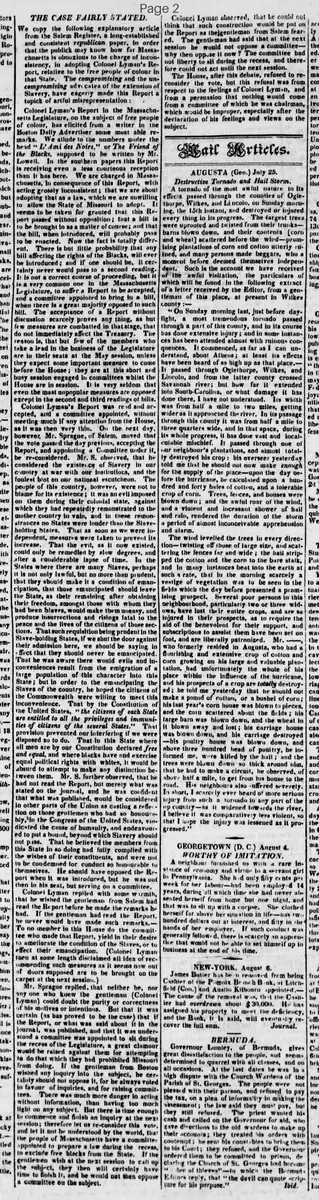
We copy the following explanatory article from the Salem Register, a long-established and consistent republican paper, in order that the public may know how far Massachusetts is obnoxious to the charge of inconsistency, in adopting Colonel Lyman's Report, relative to the free people of colour in that State. The compromising and the uncompromising advocates of the extension of Slavery, have eagerly made this Report a topic of artful misrepresentation:
Colonel Lyman's Report in the Massachusetts Legislature, on the subject of free people of colour, has elicited from a writer in the Boston Daily Advertiser some most able remarks. We allude to the numbers under the head "L'Ami des Noirs," or The Friend of the Blacks, supposed to be written by Mr. Lowell. In the southern papers this Report is receiving even a less courteous reception than it has here. We are charged in Massachusetts, in consequence of this Report, with acting grossly inconsistent; that we are about adopting that as a law, which we are unwilling to allow the State of Missouri to adopt. It seems to be taken for granted that this Report passed without opposition; that a bill is to be brought in as a matter of course; and that the bill, when introduced, will probably pass to be enacted. Now the fact is totally different. There is but little probability that any bill affecting the rights of the Blacks, will ever be introduced; and if one should be, it certainly never would pass to a second reading. It is not a correct course of proceeding, but it is a very common one in the Massachusetts Legislature, to suffer a Report to be accepted, and a committee appointed to bring in a bill, when there is a great majority opposed to such bill. The acceptance of a Report without discussion scarcely proves any thing, as but few measures are combatted in that stage, that do not immediately affect the Treasury. The reason is, that but few of the members who take a lead in the business of the Legislature are in their seats at the May session, unless they expect some important measure to come before the House; they are at this short and busy session engaged in committees whilst the House are in session. It is very seldom that even the most unpopular measures are opposed except in the second and third readings of bills.
Colonel Lyman's Report was read and accepted, and a committee appointed, without meeting much if any attention from the House, as it was then very thin. On the next day, however, Mr. Sprague, of Salem, moved that the vote passed the day previous, accepting the Report, and appointing a Committee under it, be re-considered. Mr. S. observed, that he considered the existence of Slavery in our country at war with our institutions, and the foulest blot on our national escutcheon. The people of this country, however, were not to blame for its existence; it was an evil imposed on them during their colonial state, against which they had repeatedly remonstrated to the mother country in vain, and in these remonstrances no States were louder than the Slave-holding States. That as soon as we were independent, measures were taken to prevent its increase. That the evil, as it now existed, could only be remedied by slow degrees, and after a considerable lapse of time. In the States where there are many Slaves, perhaps it is not only lawful, but no more than prudent, that they should make it a condition of emancipation, that those emancipated should leave the State, as their remaining after obtaining their freedom, amongst those with whom they had been Slaves, would make them uneasy, and produce insurrections and risings fatal to the peace and the lives of the citizens of those sections. That such requisition being prudent in the Slave-holding States, if we shut the door against their admission here, we should be saying in effect that they should never be emancipated. That he was aware there would evils and inconveniences result from the emigration of a large population of this character into this State; but in order to the emancipating the Slaves of the country, he hoped the citizens of the Commonwealth were willing to meet this inconvenience. That by the Constitution of The United States, "the citizens of each State are entitled to all the privileges and immunities of citizens of the several States." That provision prevented our interfering if we were disposed so to do. That in this State where all men are by our Constitution declared free and equal, and where blacks have and exercise equal political rights with whites, it would be absurd to attempt to make any distinction between them. Mr. S. further observed, that he had not read the Report, but merely what was stated on the journal, and he was confident that what was published, would be considered in other parts of the Union as casting a reflection on those gentlemen who had so honourably, in the Congress of the United States, vindicated the cause of humanity, and endeavoured to put a bound, beyond which Slavery should not pass. That he believed the members from this State in so doing had fully complied with the wishes of their constituents, and were not to be condemned for conduct so honourable to themselves. He should have opposed the Report when it was introduced, but he was not then in his seat, but serving on a committee.
Colonel Lyman replied with some warmth, that he wished the gentleman from Salem had read the Report before he made the remarks he had. If the gentleman had read the Report, he never would have made such remarks.—To no member in this House do the committee who made that Report, yield in their desire to ameliorate the condition of the Slaves, or to effect their emancipation. (Colonel Lyman then at some length disclaimed all idea of recommending such measures as it seems now out of doors supposed are to be brought on the carpet at the next session.)
Mr. Sprague replied, that neither he, nor any one who knew the gentleman (Colonel Lyman) could doubt the purity or correctness of his motives or intentions. But that it was certain (as has proved to be the case) that if the Report, or what was said about it in the journal, was published, and that it was understood a committee was appointed to sit during the recess of the Legislature, a great clamour would be raised against them for attempting to do that which they had prohibited Missouri from doing. If the gentleman from Boston wished any inquiry into the subject, he certainly should not oppose it, for he always voted in favour of inquiries, and for raising committees. There was much more danger in acting without information, than having too much light on any subject. But there is time enough to commence and finish an inquiry at the next session; therefore let us re-consider this vote, and let it not be understood by the world, that the people of Massachusetts have a committee appointed to prepare a law during the recess, to exclude free blacks from the State. If the gentlemen wish at the next session to call up the subject, they then will certainly have time to finish it, and he would not then oppose a committee on the subject.
Colonel Lyman observed, that he could not think that such construction would be put on the Report as the gentleman from Salem feared. The gentleman had said that at the next session he would not oppose a committee—why then oppose it now? The Committee had not liberty to sit during the recess, and therefore could not act until the next session.
The House, after this debate, refused to re-consider the vote, but this refusal was from respect to the feelings of Colonel Lyman, and from a persuasion that nothing would come from a committee of which he was chairman, which would be improper, especially after the declaration of his feelings and views on the subject.
What sub-type of article is it?
What themes does it cover?
What keywords are associated?
What entities or persons were involved?
Where did it happen?
Story Details
Key Persons
Location
Massachusetts Legislature
Event Date
May Session
Story Details
Explanatory article from Salem Register details the acceptance of Colonel Lyman's Report on free people of color in the Massachusetts Legislature, counters misrepresentations by pro-slavery advocates, and recounts the debate where Mr. Sprague moved to reconsider the vote, arguing against restrictions on free blacks to support emancipation, while Colonel Lyman defended the report's intentions.