Thank you for visiting SNEWPapers!
Sign up free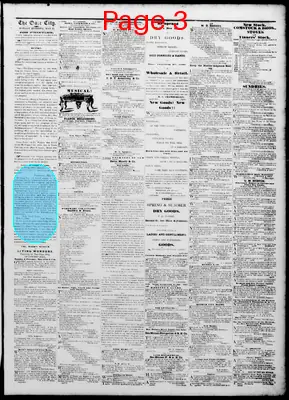
Story
May 26, 1856
The Daily Gate City
Keokuk, Lee County, Iowa
What is this article about?
Judge John McLean writes to Lewis Cass clarifying a misunderstanding, affirming Congress's constitutional power to prohibit slavery in territories via police power, aligning with Henry Clay's position that no authority exists to establish slavery there, thus invalidating Kansas slave laws.
Clipping
OCR Quality
98%
Excellent
Full Text
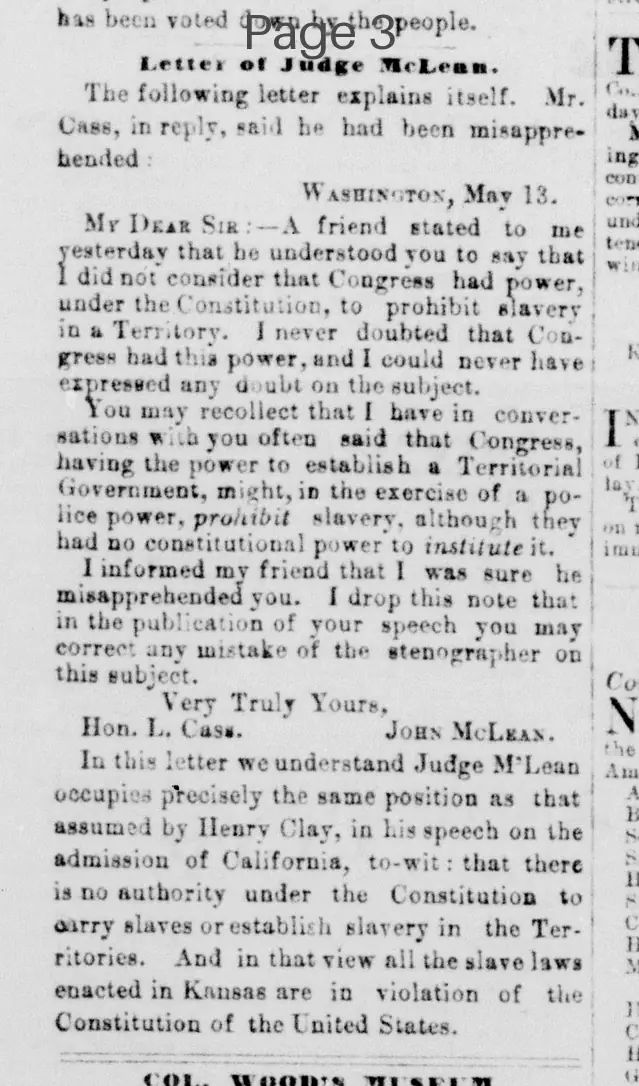
Letter of Judge McLean,
The following letter explains itself. Mr. Cass, in reply, said he had been misapprehended.
WASHINGTON, May 13.
Mr. Dear Sir:-A friend stated to me yesterday that he understood you to say that I did not consider that Congress had power, under the Constitution, to prohibit slavery in a Territory. I never doubted that Congress had this power, and I could never have expressed any doubt on the subject.
You may recollect that I have in conversations with you often said that Congress, having the power to establish a Territorial Government, might, in the exercise of a police power, prohibit slavery, although they had no constitutional power to institute it.
I informed my friend that I was sure he misapprehended you. I drop this note that in the publication of your speech you may correct any mistake of the stenographer on this subject.
Very Truly Yours,
Hon. L. Cass.
John McLean.
In this letter we understand Judge McLean occupies precisely the same position as that assumed by Henry Clay, in his speech on the admission of California, to-wit: that there is no authority under the Constitution to carry slaves or establish slavery in the Territories. And in that view all the slave laws enacted in Kansas are in violation of the Constitution of the United States.
The following letter explains itself. Mr. Cass, in reply, said he had been misapprehended.
WASHINGTON, May 13.
Mr. Dear Sir:-A friend stated to me yesterday that he understood you to say that I did not consider that Congress had power, under the Constitution, to prohibit slavery in a Territory. I never doubted that Congress had this power, and I could never have expressed any doubt on the subject.
You may recollect that I have in conversations with you often said that Congress, having the power to establish a Territorial Government, might, in the exercise of a police power, prohibit slavery, although they had no constitutional power to institute it.
I informed my friend that I was sure he misapprehended you. I drop this note that in the publication of your speech you may correct any mistake of the stenographer on this subject.
Very Truly Yours,
Hon. L. Cass.
John McLean.
In this letter we understand Judge McLean occupies precisely the same position as that assumed by Henry Clay, in his speech on the admission of California, to-wit: that there is no authority under the Constitution to carry slaves or establish slavery in the Territories. And in that view all the slave laws enacted in Kansas are in violation of the Constitution of the United States.
What sub-type of article is it?
Historical Event
What themes does it cover?
Justice
Moral Virtue
What keywords are associated?
Slavery Prohibition
Congressional Power
Territories
Kansas Slave Laws
Constitution Violation
What entities or persons were involved?
John Mclean
L. Cass
Henry Clay
Where did it happen?
Washington
Story Details
Key Persons
John Mclean
L. Cass
Henry Clay
Location
Washington
Event Date
May 13
Story Details
Judge McLean clarifies to Cass his view that Congress can prohibit slavery in territories using police power, though not establish it, mirroring Henry Clay's stance, making Kansas slave laws unconstitutional.