Thank you for visiting SNEWPapers!
Sign up free
Lancaster Daily Intelligencer
Lancaster, Lancaster County, Pennsylvania
What is this article about?
Democratic rally in Philadelphia's Horticultural Hall on Saturday night in October 1882, presided by Daniel Dougherty. Speakers including Malcolm Hay, Charles H. Lague, and George A. Jenks praised Robert E. Pattison for governor, criticized General Beaver, and read a supportive letter from Judge J.S. Black, emphasizing honest government and reform.
Merged-components note: These two components are sequential in reading order and content, forming a single continuous narrative article about the Democratic rally in Philadelphia, including speeches and Judge Black's letter.
Clipping
OCR Quality
Full Text
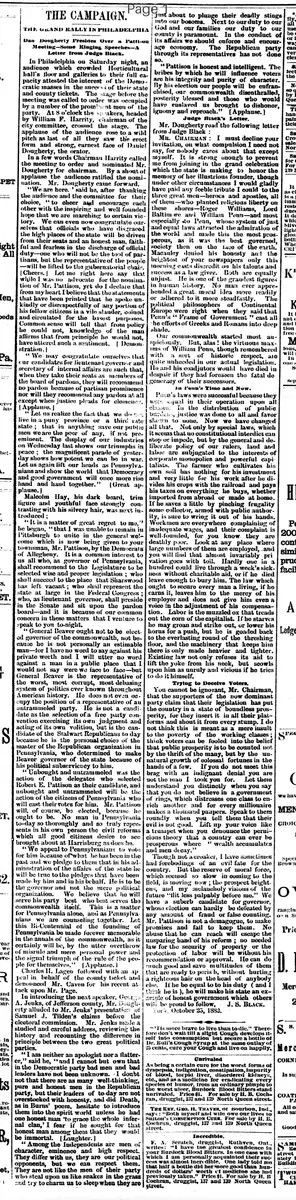
Dan Dougherty Presides Over a Rattle-ou Meeting-Some Ringing Speeches-A Letter from Judge Black.
In Philadelphia on Saturday night, an audience which crowded Horticultural hall's floor and galleries to their full capacity attested the interest of the Democratic masses in the success of their state and county tickets. The stage before the meeting was called to order was occupied by a number of the prominent men of the party. At 8 o'clock the speakers, headed by William F. Harrity, chairman of the city committee, crossed the stage. The applause of the audience rose to a wild pitch as last of all they saw the erect form and strong, earnest face of Daniel Dougherty, the orator.
In a few words Chairman Harrity called the meeting to order and nominated Mr. Dougherty for chairman. By a shout of applause the audience ratified the nomination. Mr. Dougherty came forward. "We are here,'' said he, after thanking the audience and the committee for their choice. "to cheer and encourage each other with the inspiring and well founded hope that we are marching to certain victory. We can even now congratulate ourselves that officials who have disgraced the high places of the state will be driven from their seats and an honest man, faithful and fearless in the discharge of official duty-one who will not be the tool of partisans, but the representative of the people-will be lifted to the gubernatorial chair. [Cheers.] Let me right here say that while I was no advocate for the nomination of Mr. Pattison, yet do I declare that from my heart I believe that the statements that have been printed that he spoke unkindly or disrespectfully of any portion of his fellow citizens is a vile slander, coined and circulated for the basest purposes. Common sense will tell that from policy he could not, knowledge of the man affirms that from principle he would not, have uttered such a sentiment. [Demonstration.]
"We may congratulate ourselves that our candidates for lieutenant governor and secretary of internal affairs are such that, when they take their seats as members of the board of pardons, they will recommend no pardon because of partisan prominence nor will they recommend any pardon at all except when justice pleads for clemency. [Applause.]
"Let us realize the fact that we do not live in a puny province or a third rate state; that in anything save our public money we are the peer of any, if not pre-eminent. The display of our industries on Wednesday last shows our triumphs in peace; the magnificent parade of yesterday shows how potent we can be in war. Let us again lift our heads as Pennsylvanians and show the world that Democracy and good government will once more rise hand in hand together." [Great applause.]
Malcolm Hay, his dark beard, trim figure and youthful face strongly contrasting with his silvery hair, was next introduced; "It is a matter of great regret to me," he began, "that I was unable to remain in Pittsburgh to unite in the general welcome which is now being given to your townsman, Mr. Pattison, by the Democrats of Allegheny. It is a common interest to us all who, as governor of Pennsylvania, shall recommend to the Legislature to be selected wise and proper legislation: who shall succeed to the place that Sharwood has left vacant; who shall represent the state at large in the Federal Congress; who, as lieutenant governor, shall preside in the Senate and sit upon the pardon board-and it is because of our common concern in these matters that I venture to speak to you to-night.
"General Beaver ought not to be elected governor of the commonwealth, not because he is not personally an estimable man-for I have no word to say against his private worth and I will utter no word against a man in a public place that I would not say were we face to face-but General Beaver is the representative of the worst, most corrupt, most debasing system of politics ever known throughout American history. He does not even occupy the position of a representative of an untrammeled party. He is not a candidate as the selection of a free party convention exercising its own judgment and acting of its own volition, but is the candidate of the Stalwart Republicans to-day because he is the personal choice of the master of the Republican organization in Pennsylvania, who determined to make Beaver governor of the state because of his political subserviency to him.
"Unbought and untrammeled was the action of the delegates who selected Robert E. Pattison as their candidate, and unbought and untrammeled will be the action of the citizens of Pennsylvania who will cast their votes for him. Mr. Pattison will, of course, be elected, because he ought to be. No man in Pennsylvania to-day so thoroughly and so truly represents in his own person the civil reforms which all good citizens desire to see brought about at Harrisburg as does he.
"We appeal to Pennsylvanians to vote for him because of what he has been in the past and we pledge to them that in his administration of the affairs of the state he will be true to the pledges that have been made by him and in his behalf. He is to be the governor and not the mere political organization. We believe that he will serve his party best who best serves the commonwealth itself. This is a matter for Pennsylvania alone, and as Pennsylvanians we are counseling together. Let this Bi-Centennial of the founding of Pennsylvania be made forever memorable in the annals of the commonwealth, as it certainly will be, by the utter overthrow of misrule and mere personal power and the signal triumph of the rule of the people for themselves." [Applause.]
Charles H. Lague followed with an appeal in behalf of the county ticket, and denounced Mr. Caven for his recent attack upon Mr. Page. In introducing the next speaker, George A. Jenks, of Jefferson county, Mr. Dougherty alluded to Mr. Jenks' presentation of Samuel J. Tilden's claims before the electoral commission. Mr. Jenks made a studied and careful address, reviewing the history and recounting the difference in principle between the two great political parties.
"I am neither an apologist nor a flatterer," said he, "and I cannot but own that in the Democratic party bad men and bad leaders have not been unknown. I doubt not that there are as many well-thinking, pure and honest men in the Republican party, but their leaders of to-day are not overstocked with honesty, and did Death, as in Burns' poem, hesitate to introduce them into the spirit world unless he had one honest man 'to grace the whole infernal clan,' I fear if he sought for that honest man among them that they would be immortal. [Laughter.]
"Among the Independents are men of character, eminence and high respect. They differ with us, they are our political opponents, but we can respect them. They are not like the men of their party who steal upon us like snakes in the grass and try to charm us to sleep when they are just about to plunge their deadly stings into our bosoms. Next to our duty to our God and our families our duty to our country is paramount. In the conduct of its affairs we should enforce and encourage economy. The Republican party through its representatives has not done so. Pattison is honest and intelligent. The bribes by which he will influence voters are his integrity and purity of character. By his election our people will be enfranchised, our commonwealth disenthralled, posterity blessed and those who would have enslaved us brought to dishonor, ignominy and reproach." [Applause.]
Judge Black's Letter,
Mr. Dougherty read the following letter from Judge Black:
MR. CHAIRMAN: I must decline your invitation, on what compulsion I need not say, for nobody cares about that except myself. It is strong enough to prevent me from joining in the grand celebration which the state is making to honor the memory of her illustrious founder, though under other circumstances I would gladly have paid any feeble tribute I could to the three great men-heroes and apostles, all of them—who planted religious liberty on these shores—Roger Williams, Lord Baltimore and William Penn—and most especially to Penn, whose system of just and equal laws attracted the admiration of the world and made this the most prosperous, as it was the best governed, society then on the face of the earth. Macauley denied his honesty and the brightest of your newspapers only this morning casts discredit on his talents and success as a law giver. Both are equally unjust. He is one of the grandest figures in human history. No man ever apprehended a great moral idea more readily or adhered to it more steadfastly. The political philosophers of Continental Europe were right when they said that Penn's "Frame of Government" cast all the efforts of Greeks and Romans into deep shade.
Our commonwealth started most auspiciously. But, alas! the virtuous maxims of William Penn, though remembered with a sort of historic respect, are quite unheeded in our actual legislation. He and his coadjutors would have died in despair if they had foreseen the fatal degeneracy of their successors.
In Penn's Time and Now.
Penn's laws were successful because they were equal in their operation upon all classes. In the distribution of public burdens, justice was done to all and favor shown to none. Now we have changed all that. Not only by special laws, which it seems that no constitutional interdict can stay or impede, but by the general and deliberate policy of our rulers, land and labor are subjugated to the interests of corporate monopolies and powerful capitalists. The farmer who cultivates his own soil has nothing for his investment and very little for his work after he divides his crops with the railroad and pays his taxes on everything he buys, whether imported from abroad or made at home. If he saves a little by pinching frugality some collector, armed with public authority, is sure to wring it out of his hands. Workmen are everywhere complaining of inadequate wages, and their complaint is well-founded, for you know they are deathly poor. Look at any place where large numbers of them are employed, and you will find that almost invariably privation goes with toil. Hardly one in a hundred could live through a week's sickness without charitable aid, or if he died leave enough to bury him. The law which ought to secure every man a living, if he earns it, leaves him to the mercy of his employer and does not give him even a voice in the adjustment of his compensation. Labor is the muzzled ox that treads out the corn of the capitalist. If he starves he may groan and strike out, or lower his horns for a push, but he is goaded back to the everlasting round of the threshing floor, and the machinery that keeps him there is only made heavier and tighter. Existing law not only refuses its aid to lift the yoke from his neck, but scowls upon him as unruly and vicious if he tries to do it himself.
Trying to Deceive Voters,
You cannot be ignorant, Mr. Chairman, that the supporters of the now dominant party claim that their legislation has put the country in a state of boundless prosperity, for they insert it in all their platforms and shout it from every stump. I do not think this is meant as a mere insult to the poverty of the working classes; I think voters can be fooled into the belief that public prosperity is to be counted not by the thrift of the many, but by the unnatural growth of colossal fortunes in the hands of a few. If you do not meet this brag with an indignant denial you are not the man I took you for. Let them understand you distinctly when you say that you do not believe in a government of rings, which distresses one class to enrich another and for every millionaire makes a thousand paupers. Speak to them roundly when you tell them that their evil is not good. Lift up your voice like a trumpet when you denounce the pernicious theory that a country can ever be prosperous where "wealth accumulates and men decay."
Though not a croaker, I have sometimes had forebodings of an evil fate for the country. But the reserve of moral force, which seemed so slow in coming to the rescue, is moving now: the prospect brightens, and my melancholy visions of the future "flit less palpably before me." We have a superb candidate for governor, whose election can hardly be defeated by any amount of fraud or false counting. Mr. Pattison is not a demagogue, to make promises and fail to keep them. No abuse that he can reach will escape the unsparing hand of his reform; no needed law for the security of property or the protection of labor will be without his recommendation or approval. He can do much good and save multitudes of them that are ready to perish, without hurting a righteous hair on the head of anybody else. If he be equal to his duty (and I think he is), he will make his state an example of honest government which others will be proud to follow,
J. S. BLACK,
York, October 25, 1882.
What sub-type of article is it?
What themes does it cover?
What keywords are associated?
What entities or persons were involved?
Where did it happen?
Story Details
Key Persons
Location
Philadelphia, Horticultural Hall
Event Date
Saturday Night, October 1882
Story Details
Democratic rally supporting state ticket led by Robert E. Pattison for governor. Daniel Dougherty presides and speaks on victory and honesty. Malcolm Hay criticizes Beaver as tool of corruption. George A. Jenks contrasts parties and praises Pattison's integrity. Letter from Judge Black endorses Pattison and laments current governance versus Penn's ideals.