Thank you for visiting SNEWPapers!
Sign up free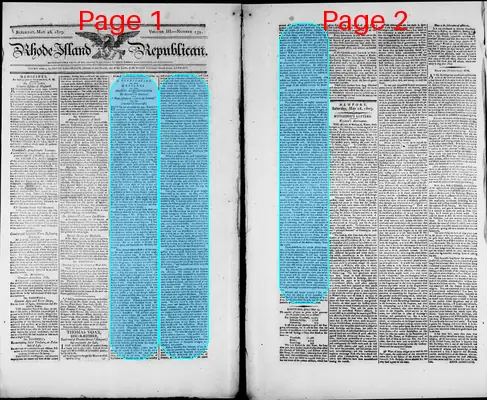
Rhode Island Republican
Newport, Newport County, Rhode Island
What is this article about?
This editorial, part III by Algernon Sidney, defends the U.S. administration's measures on the Louisiana cession to France, arguing against preemptive war, highlighting the benefits of peace, the futility of French colonial threats, the strength of the Union, and America's inevitable growth and separation of colonies from Europe.
Merged-components note: Merged continuation of the editorial 'A VINDICATION OF THE MEASURES OF THE PRESENT ADMINISTRATION' across pages 1 and 2.
Clippings
1 of 2
OCR Quality
Full Text
A VINDICATION
OF THE
MEASURES
OF THE
PRESENT ADMINISTRATION.
By ALGERNON SIDNEY.
" Where Liberty is-there is my Country."
No. III.
[Concluded from our last.]
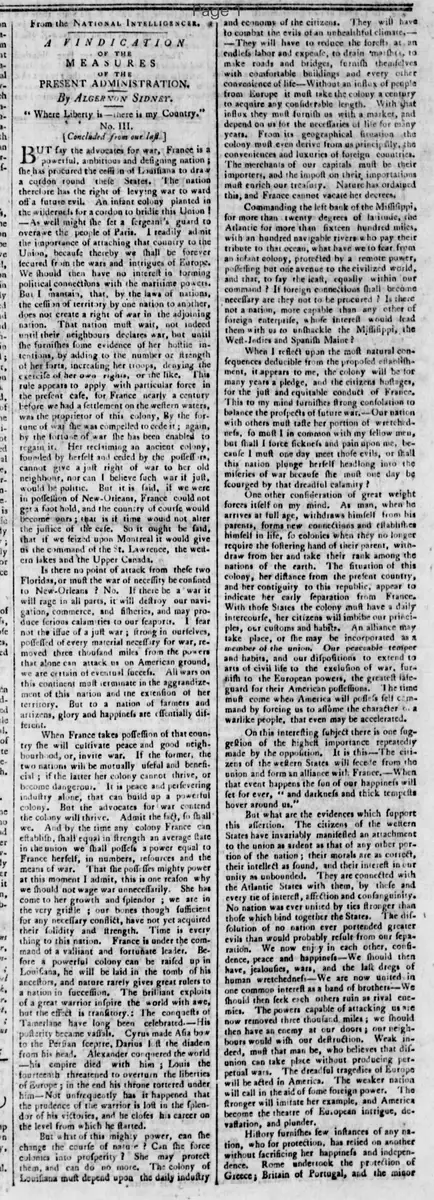
BUT as the advocates for war insist
that she has procured the cession of Louisiana to draw
a cordon round these States. The nation
therefore has the right of levying war to ward
off a future evil. An infant colony planted in
the wilderness for a cordon to bridle this Union!
--As well might She set a serjeant's guard to
overawe the people of Paris. I readily admit
the importance of attaching that country to the
Union, because thereby we shall be forever
secured from the wars and intrigues of Europe.
We should then have no interest in forming
political connections with the maritime powers.
But I maintain, that, by the laws of nations,
the cession of territory by one nation to another,
does not create a right of war in the adjoining
nation. That nation must wait, not indeed
until their neighbour declares war, but until
she furnishes some evidence of her hostile in-
tentions, by adding to the number or strength
of her forts, increasing her troops, destroying the
exercise of her own rights, or the like. This
rule appears to apply with particular force in
the present case, for France nearly a century
before we had a settlement on the western waters,
was the proprietor of this colony. By the for-
tune of war she was compelled to cede it; again,
by the fortune of war she has been enabled to
regain it. Her reclaiming an ancient colony,
founded by herself and ceded by the possessors,
cannot give a just right of war to her old
neighbour, nor can I believe such war if just,
would be politic. But it is said, if we were
in possession of New-Orleans, France could not
get a foot hold, and the country of course would
become ours; that is if time would not alter
the justice of the case. So it ought be said,
that if we seized upon Montreal it would give
us the command of the St. Lawrence, the west-
tern lakes and the Upper Canada.
Is there no point of attack from these two
Floridas, or must the war of necessity be confined
to New-Orleans? No. If there be a war it
will rage in all parts, it will destroy our navi-
gation, commerce, and fisheries, and may pro-
duce serious calamities to our seaports. I fear
not the issue of a just war; strong in ourselves,
possessed of every material necessary for war, re-
moved three thousand miles from the powers
that alone can attack us on American ground,
we are certain of eventual success. All wars on
this continent must terminate in the aggrandize-
ment of this nation and the extension of her
territory. But to a nation of farmers and
artizans, glory and happiness are essentially dif-
ferent.
When France takes possession of that coun-
try she will cultivate peace and good neigh-
bourhood, or invite war. If the former, the
two nations will be mutually useful and benefi-
cial; if the latter her colony cannot thrive, or
become dangerous. It is peace and persevering
industry alone, that can build up a powerful
colony. But the advocates for war contend
the colony will thrive. Admit the fact, so shall
we. And by the time any colony France can
establish, shall equal in strength an average state
in the union we shall possess a power equal to
France herself, in numbers, resources and the
means of war. That she possesses mighty power
at this moment I admit, this is one reason why
we should not wage war unnecessarily. She has
come to her growth and splendor; we are in
the very gristle; our bones though sufficient
for any necessary conflict, have not yet acquired
their solidity and strength. Time is every
thing to this nation. France is under the com-
mand of a valiant and fortunate leader. Be-
fore a powerful colony can be raised up in
Louisiana, he will be laid in the tomb of his
ancestors, and nature rarely gives great rulers to
a nation in succession. The brilliant exploits
of a great warrior inspire the world with awe,
but the effect is transitory. The conquests of
Tamerlane have long been celebrated. His
posterity became vassal. Cyrus made Asia bow
to the Persian sceptre, Darius lost the diadem
from his head. Alexander conquered the world-
his empire died with him: Louis the
fourteenth threatened to overturn the liberties
of Europe; in the end his throne tottered under
him. Not unfrequently has it happened that
the prudence of the warrior is lost in the splen-
dor of his victories, and he closes his career on
the level from which he started.
But what of this mighty power, can she
change the course of nature? Can she force
colonies into prosperity? She may protect
them, and can do no more. The colony of
Louisiana must depend upon the daily industry
and economy of the citizens. They will have
to combat the evils of an unhealthful climate.-
--They will have to reduce the forests at an
endless labor and expense, to drain marshes, to
make roads and bridges, furnish themselves
with comfortable buildings and every other
convenience of life. Without an influx of people
from Europe it most take the colony a century
to acquire any considerable strength. With that
influx they most furnish us with a market, and
depend on us for the necessaries of life for many
years. From its geographical situation the
colony must even derive from us principally the
conveniences and luxuries of foreign countries.
The merchants of our capitals must be their
importers, and the impost on their importations
must enrich our treasury. Nature has ordained
this, and France cannot vacate her decrees.
Commanding the left bank of the Mississippi.
for more than twenty degrees of latitude, the
Atlantic for more than sixteen hundred miles,
with an hundred navigable rivers who pay their
tribute to that ocean, what have we to fear from
an infant colony, protected by a remote power,
possessing but one avenue to the civilized world,
and that, to say the least, equally within our
command? If foreign connections shall become
necessary are they not to be procured? Is there
not a nation, more capable than any other of
foreign enterprize, whose interest would lead
them with us to unthackle the Mississippi, the
West-Indies and Spanish Maine?
When I reflect upon the most natural con-
sequences deducible from the proposed establish-
ment, it appears to me, the colony will be for
many years a pledge, and the citizens hostages,
for the just and equitable conduct of France.
This to my mind furnishes strong consolation to
balance the prospects of future war. Our nation
with others must taste her portion of wretched-
ness. We most in common with my fellow men,
but shall I force sickness and pain upon me, be-
cause I must one day meet those evils, or Shall
this nation plunge herself headlong into the
miseries of war because she must one day be
scourged by that dreadful calamity?
One other consideration of great weight
forces itself on my mind. As man, when he
arrives at full age, withdraws himself from his
parents, forms new connections and establishes
himself in life. So colonies when they no longer
require the fostering hand of their parent, with-
draw from her and take their rank among the
nations of the earth. The situation of this
colony, her distance from the parent country,
and her contiguity to this republic, appear to
indicate her early separation from France.
With those States the colony must have a daily
intercourse, her citizens will imbibe our princi-
ples, our customs and habits. An alliance may
take place, or she may be incorporated as a
member of the union. Our peaceable temper
and habits, and our dispositions to extend to
arts of civil life to the exclusion of war. fur-
nish to the European powers, the greatest safe-
guard for their American possessions. The time
must come when America will possess herself com-
mand by forcing us to assume the character of
a warlike people, that even may be accelerated.
On this interesting subject there is one sug-
gestion of the highest importance repeatedly
made by the opposition. It is this--The citi-
zens of the western States will secede from the
union and form an alliance with France.—When
that event happens the sun of our happiness will
set for ever, "and darkness and thick tempests
hover around us."
But what are the evidences which support
this assertion. The citizens of the western
States have invariably manifested an attachment
to the union so ardent as that of any other por-
tion of the nation; their morals are as correct,
their intellect as sound, and their interest in our
unity as unbounded. They are connected with
the Atlantic States with them, by ties and
every tie of interest, affection and consanguinity.
No nation was ever united by ties stronger than
those which bind together the States. The dis-
solution of no nation ever portended greater
Evils than would probably result from our sepa-
ration. We now enjoy in each other, confi-
dence, peace and happiness. We should then
have, jealousies, wars, and the last dregs of
human wretchedness. We are now united in
one common interest as a band of brothers--We
should then seek each others ruin as rival ene-
mies. The power capable of attacking us are
now removed three thousand miles; we should
then have an enemy at our doors; our neigh-
bours would wish our destruction. Weak in-
need, most that man be, who believes that dis-
union can take place without producing per-
petual wars. The dreadful tragedies of Europe
will be acted in America. The weaker nation
will call in the aid of some foreign power. The
stronger will imitate her example, and America
become the theatre of European intrigue, de-
vasation, and plunder.
History furnishes few instances of any na-
tion, who for protection, has relied on another
without sacrificing her happiness and indepen-
dence. Rome undertook the protection of
Greece; Britain of Portugal, and the minor
Powers of India; France of Holland and Switzerland; and King of Poland and Lithuania.
Will the people of these States, instructed as they are by the experience of ages, destroy the ark of their safety, and descend from the high eminence of liberty and independence, to the humble condition of dependents and vassals of the powers of Europe? Will the people of the western country prefer the friendship and protection of France, to their own independence, and a lasting connection with the Atlantic States? Will they elect a friend abroad and an enemy at home, in preference to a friend at home, with the chance of an enemy abroad?
A variety of other arguments in favor of the perpetuity of the union, present themselves on a moment's consideration. By dissolving the union and establishing separate governments, the expenses of the people will of necessity be doubled, inasmuch as there will be, instead of one, the support of two governments.
The Atlantic States, particularly the eastern and middle, are nearly replete with population. Their rising generations require the wide range of the western country for settlements.
In many of these States there is a surplus capital; in time of general peace the boundless field for action, and enterprise presented in that country, offers the principal, if not the sole object worthy of attention.
The eastern States are highly commercial and deeply interested in navigation; their own and the nation's prosperity require their devotion to these pursuits. To them the freights of the rich and increasing products of the Mississippi and her thousand tributary streams, is of the first importance. Before an age passes away the fine timbers, the sail cloths and the cordage of that country, will become necessary for this navigation; from that river will be annually distributed a greater variety of, and more value in the products of agriculture, than ever the Volga, the Danube, or the Rhine, in the most fortunate year bestowed on the people of Europe.
From these and from the southern States the exports are essentially different from those of the regions of the west. No jealousy or competition in interest can arise between them; all will contribute but by different means, to the general welfare of the nation. Nor can it be believed that the competition, which in a limited degree may exist between that country and the middle States, can ever create one unfriendly sentiment. No consideration could induce the middle States to a separation. They extend into that country; from it is derived no inconsiderable share of importance. Their geographical situation, and their connections with the people, afford them the best chance to secure to themselves its commerce, which at this time they enjoy almost exclusively. Advantages will ever be derived from that commerce much more important than any evils which can arise from a competition in the articles of export. Neither can we forget, that trade is constantly seeking a level, and when the market becomes overstocked with any article, it is neglected, and others resorted to which promise a better profit.
The interests of the western people are equally evident. Their infant country required the aid of her elder sisters. The emigration of our youth and the introduction of our capital are essential to her prosperity and increasing importance. Not less so are our commerce and navigation. Secluded from every portion of the ocean, it is impossible for that country ever to become a commercial or maritime power.
While the Atlantic states possess every advantage for assuming that character, the people of the western country will always require the aid of our commerce and maritime strength, to supply their wants, and vend their products, and preserve their free intercourse with the Atlantic.
Without the aid of the Atlantic States, it will for ever be in the power of a maritime nation to control the navigation of the Mississippi, and exclude the products of the western country from the world.
Upon these states, the people of that country, under any circumstances, will principally depend for the manufactures, elegancies & luxuries of other countries. Should they separate from them by the impost levied on the goods they will consume, they will forever contribute to the maintenance of our wealth and power, while they will wholly exclude themselves from participating in any of the benefits resulting from the revenue. Once established to a distinct and separate government, their only resort for revenue will be direct taxation; now the impost which they must continue to pay, is equal to the necessities of government, and relieves them from every other contribution.
With men regarding their own or their country's interest, this single consideration must be conclusive.
Beloved and happy country! He who made thee the asylum of the oppressed, and established in thy bosom the sanctuary of freedom, has so diversified his gifts and blended the interests of all, as to make thee immortal.
What sub-type of article is it?
What keywords are associated?
What entities or persons were involved?
Editorial Details
Primary Topic
Vindication Of Administration's Measures On Louisiana Cession To France
Stance / Tone
Strongly Supportive Of Peaceful Policy And Union Preservation, Anti Preemptive War
Key Figures
Key Arguments