Thank you for visiting SNEWPapers!
Sign up free
The Freeman's Journal, Or, New Hampshire Gazette
Portsmouth, Rockingham County, New Hampshire
What is this article about?
Report of a House of Lords debate on May 30 in London, discussing conciliation with rebellious American colonies amid war fears involving France. Speakers including Archbishop of York, Duke of Grafton, and others debated government policies, American independence aims, and French interference. Motion for conciliation defeated 99-28.
Merged-components note: These two components continue the same House of Lords debate from London on the American situation, with sequential reading orders across pages 2 and 3; merging into a single coherent foreign news article.
Clippings
1 of 2
OCR Quality
Full Text
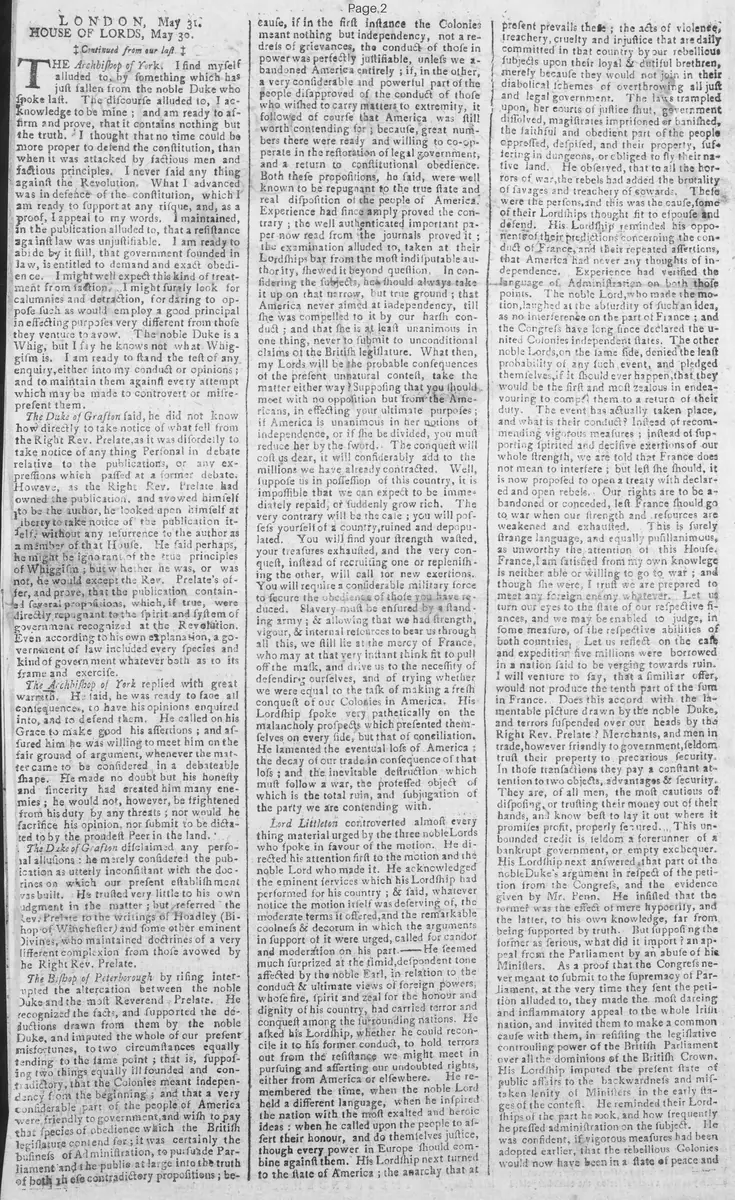
HOUSE OF LORDS, May 30.
Continued from our last.
The Archbishop of York. I find myself just fallen from the noble Duke who alluded to, by something which has spoke last. The discourse alluded to, I acknowledge to be mine; and am ready to affirm and prove, that it contains nothing but the truth. I thought that no time could be more proper to defend the constitution, than when it was attacked by factious men and factious principles. I never said any thing against the Revolution. What I advanced was in defence of the constitution, which I am ready to support at any risque, and, as a proof, I appeal to my words. I maintained, in the publication alluded to, that a resistance against law was unjustifiable. I am ready to abide by it still, that government founded in law, is entitled to demand and exact obedience. I might well expect this kind of treatment from faction. I might surely look for calumnies and detraction, for daring to oppose such as would employ a good principle in effecting purposes very different from those they venture to avow. The noble Duke is a Whig, but I say he knows not what Whiggism is. I am ready to stand the test of any enquiry, either into my conduct or opinions; and to maintain them against every attempt which may be made to controvert or misrepresent them.
The Duke of Grafton said, he did not know how directly to take notice of what fell from the Right Rev. Prelate, as it was disorderly to take notice of any thing personal in debate relative to the publications, or any expressions which passed at a former debate: However, as the Right Rev. Prelate had owned the publication, and avowed himself to be the author, he looked upon himself at liberty to take notice of the publication itself, without any reference to the author as a member of that House. He said perhaps, he might be ignorant of the true principles of Whiggism; but whether he was, or was not, he would accept the Rev. Prelate's offer, and prove, that the publication contained several propositions, which, if true, were directly repugnant to the spirit and system of government recognized at the Revolution. Even according to his own explanation, a government of law included every species and kind of government whatever both as to its frame and exercise.
The Archbishop of York replied with great warmth. He said, he was ready to face all consequences, to have his opinions enquired into, and to defend them. He called on his Grace to make good his assertions: and assured him he was willing to meet him on the fair ground of argument, whenever the matter came to be considered in a debatable shape. He made no doubt but his honesty and sincerity had created him many enemies: he would not, however, be frightened from his duty by any threats; nor would he sacrifice his opinion, nor submit to be dictated to by the proudest Peer in the land.
The Duke of Grafton disclaimed any personal allusions: he merely considered the publication as utterly inconsistent with the doctrines on which our present establishment was built. He trusted very little to his own judgment in the matter; but referred the Rev. Prelate to the writings of Hoadley (Bishop of Winchester) and some other eminent divines, who maintained doctrines of a very different complexion from those avowed by the Right Rev. Prelate.
The Bishop of Peterborough by rising interrupted the altercation between the noble Duke and the most Reverend, Prelate. He recognized the facts, and supported the deductions drawn from them by the noble Duke, and imputed the whole of our present misfortunes, to two circumstances equally tending to the same point; that is, supposing two things equally ill founded and contradictory, that the Colonies meant independency from the beginning; and that a very considerable part of the people of America were friendly to government, and wish to pay that species of obedience which the British legislature contend for; it was certainly the business of Administration, to persuade Parliament and the public at large into the truth of both these contradictory propositions; because, if in the first instance the Colonies meant nothing but independency, not a redress of grievances, the conduct of those in power was perfectly justifiable, unless we abandoned America entirely; if, in the other, a very considerable and powerful part of the people disapproved of the conduct of those who wished to carry matters to extremity, it followed of course that America was still worth contending for; because, great numbers there were ready and willing to co-operate in the restoration of legal government, and a return to constitutional obedience. Both these propositions, he said, were well known to be repugnant to the true state and real disposition of the people of America. Experience had since amply proved the contrary; the well authenticated important paper now read from the journals proved it; the examination alluded to, taken at their Lordships bar from the most indisputable authority, shewed it beyond question. In considering the subjects, he should always take it up on that narrow, but true ground; that America never aimed at independency, till she was compelled to it by our harsh conduct: and that he is at least unanimous in one thing, never to submit to unconditional claims of the British legislature. What then, my Lords will be the probable consequences of the present unnatural contest, take the matter either way? Supposing that you should meet with no opposition but from the Americans, in effecting your ultimate purposes: if America is unanimous in her notions of independence, or if she be divided, you must reduce her by the sword. The conquest will cost us dear. it will considerably add to the millions we have already contracted. Well, suppose us in possession of this country, it is impossible that we can expect to be immediately repaid, or suddenly grow rich. The very contrary will be the case; you will possess yourself of a country, ruined and depopulated. You will find your strength wasted, your treasures exhausted, and the very conquest, instead of recruiting one or replenishing the other, will call for new exertions. You will require a considerable military force to secure the obedience of those you have reduced. Slavery must be ensured by a standing army; & allowing that we had strength, vigour, & internal resources to bear us through all this. we still lie at the mercy of France, who may at that very instant think fit to pull off the mask, and drive us to the necessity of defending ourselves, and of trying whether we were equal to the task of making a fresh conquest of our Colonies in America. His Lordship spoke very pathetically on the melancholy prospects which presented themselves on every side, but that of conciliation. He lamented the eventual loss of America; the decay of our trade in consequence of that loss; and the inevitable destruction which must follow a war, the professed object of which is the total ruin, and subjugation of the party we are contending with.
Lord Littleton controverted almost every thing material urged by the three noble Lords who spoke in favour of the motion. He directed his attention first to the motion and the noble Lord who made it. He acknowledged the eminent services which his Lordship had performed for his country; & said, whatever notice the motion itself was deserving of, the moderate terms it offered, and the remarkable coolness & decorum in which the arguments in support of it were urged, called for candor and moderation on his part.-- He seemed much surprised at the timid, despondent tone affected by the noble Earl, in relation to the conduct & ultimate views of foreign powers, whose fire, spirit and zeal for the honour and dignity of his country, had carried terror and conquest among the surrounding nations. He asked his Lordship, whether he could reconcile it to his former conduct, to hold terrors out from the resistance we might meet in pursuing and asserting our undoubted rights, either from America or elsewhere. He remembered the time, when the noble Lord held a different language, when he inspired the nation with the most exalted and heroic ideas: when he called upon the people to assert their honour, and do themselves justice, though every power in Europe should combine against them. His Lordship next turned to the state of America; the anarchy that at present prevails there: the acts of violence, treachery, cruelty and injustice that are daily committed in that country by our rebellious subjects upon their loyal & dutiful brethren, merely because they would not join in their diabolical schemes of overthrowing all just and legal government. The laws trampled upon, her courts of justice shut, government dissolved, magistrates imprisoned or banished, the faithful and obedient part of the people oppressed, despised, and their property, suffering in dungeons, or obliged to fly their native land. He observed, that to all the horrors of war, the rebels had added the brutality of savages and treachery of cowards. These were the persons, and this was the cause, some of their Lordships thought fit to espouse and defend. His Lordship reminded his opponents of their predictions concerning the conduct of France, and their repeated assertions, that America had never any thoughts of independency. Experience had verified the language of Administration on both those points. The noble Lord, who made the motion, laughed at the absurdity of such an idea, as no interference on the part of France; and the Congress have long since declared the united Colonies independent states. The other noble Lords, on the same side, denied the least probability of any such event, and pledged themselves, if it should ever happen, that they would be the first and most zealous in endeavouring to compel them to a return of their duty. The event has actually taken place, and what is their conduct? Instead of recommending vigorous measures: instead of supporting spirited and decisive exertions of our whole strength, we are told that France does not mean to interfere: but lest she should, it is now proposed to open a treaty with declared and open rebels. Our rights are to be abandoned or conceded, lest France should go to war when our strength and resources are weakened and exhausted. This is surely strange language, and equally pusillanimous, as unworthy the attention of this House. France, I am satisfied from my own knowledge is neither able or willing to go to war; and though she were, I trust we are prepared to meet any foreign enemy whatever. Let us turn our eyes to the state of our respective finances, and we may be enabled to judge, in some measure, of the respective abilities of both countries. Let us reflect on the ease and expedition five millions were borrowed in a nation said to be verging towards ruin. I will venture to say, that a similar offer, would not produce the tenth part of the sum in France. Does this accord with the lamentable picture drawn by the noble Duke, and terrors suspended over our heads by the Right Rev. Prelate? Merchants, and men in trade, however friendly to government, seldom trust their property to precarious security. In those transactions they pay a constant attention to two objects, advantages & security. They are, of all men, the most cautious of disposing, or trusting their money out of their hands, and know best to lay it out where it promises profit, properly secured. This unbounded credit is seldom a forerunner of a bankrupt government, or empty exchequer. His Lordship next answered that part of the noble Duke's argument in respect of the petition from the Congress, and the evidence given by Mr. Penn. He insisted that the former was the effect of mere hypocrisy, and the latter, to his own knowledge, far from being supported by truth. But supposing the former as serious, what did it import? an appeal from the Parliament by an abuse of his Ministers. As a proof that the Congress never meant to submit to the supremacy of Parliament, at the very time they sent the petition alluded to, they made the most daring and inflammatory appeal to the whole Irish nation, and invited them to make a common cause with them, in resisting the legislative controuling power of the British Parliament over all the dominions of the British Crown. His Lordship imputed the present state of public affairs to the backwardness and mistaken lenity of Ministers in the early stages of the contest. He reminded their Lordships of the part he took, and how frequently he pressed administration on the subject. He was confident, if vigorous measures had been adopted earlier, that the rebellious Colonies would now have been in a state of peace and obedience; and repeated. he said, what he had frequently said before, that lenity by its consequences, caused often greater acts of cruelty, than those which were at the time distinguished from no account of their harshness. His Lordship spoke of the severe usage Col. Campbell had suffered in an American dungeon, which led him again to repeat his charge of cruelty and timidity. He allowed that a trade was carried on by the rebels to some ports in France, but denied that it received any countenance or protection from that Court. They were private transactions, he said, which it would be difficult to prevent, and which had no origin but the spirit of mercantile adventure and motives of profit. His Lordship took great pains to shew that the measures of Government were popular: and to point out the abilities of the Minister, who had so judiciously planned taxes, that would severely be felt, and yet would be so very productive. He spoke of the country gentlemen, as supporting the present war almost unanimously; passed great encomiums on their consequence and integrity: and affirmed, that while measures were thus strongly supported and approved of, both within & without doors, but such decisive and respectable majorities, we had every reason not only to expect an happy issue to the present rebellion, but that if we should be interrupted by any power whatever, that we were both able to defend ourselves, and make our enemies repent of their rashness. He observed on what fell from the noble Earl who spoke second in the debate (Lord Gower) relative to the loyal and dutiful disposition of great numbers of people in America, where they were free to declare their sentiments and not under the tyranny and despotism arising from anarchy & military government: he was certain that it was so, and he had himself lately received a letter to that purpose from a person on the spot; and many others of a like tenor, giving an account of the great numbers who came in under the proclamation, in order to claim the protection of the British government, or to offer their services in aiding to extinguish rebellion.
The Duke of Manchester opposes his speech, with observing on a passage in that of the noble Earl who spoke second (Lord Gower) what passed in a message between Generals Howe and Washington, to prove that independence alone was the grand object of the American rebellion; & that the treaty broke up merely because, at the first preliminary Mr. Washington and the Congress refused to treat, unless the United Colonies should be considered as independent states. His Grace insisted that this circumstance proved nothing; the Congress were well aware that the Commissioners had no powers, but they were willing to try whether, though they were armed with no parliamentary powers, they might not be charged with private instructions. When the persons entrusted with the affair discovered the Commissioners had neither powers nor instructions; and no terms, but those of unconditional submission to offer, they treated all propositions of that nature with indignation, and retained their offensive sentiments & resolutions as a matter of necessity. He censured the conduct of Administration, for holding out the idea of a commission, and afterwards holding it back, till America had taken the decided part she did: and observed with concern that France had acquired very singular advantages in trade and navigation, since the commencement of the present civil war; and would continue to reap many more, as long as it should last. He pursued the ideas of the Right Rev. Prelate who spoke on the same side, by proving that in proportion as we grew weak or exhausted, from a waste of blood and treasure, France would recruit in every source, which might enable her to carry on a most vigorous war. He observed, that the noble Lord who spoke last had treated the commercial communication, now carrying on between France and the British colonies, as a mere desultory, underhand trade, prosecuted by a few inconsiderable enterprising individuals. He denied that to be the fact: he had the best & most authentic authority to assure their Lordships; &.if called upon, was willing to prove it, that it was a regular, open & extensive commerce, daily increasing. He had a list in his possession of several of the ships, and nature and value of the cargoes, the naval and military stores, with several other circumstances of a similar and corroborative nature. It was no trade carried on by connivance, in the dark, or in a corner, but in open day. If that was the case, he appealed to their Lordships, if there was one of them who, satisfied of the facts, did not think such a commerce, such a barter of commodities, in which a supply of military stores was included, was not treating the Colonies as an independent power, in the first instance; and was it not a breach of neutrality in the next, allowing the independency of America to be a fact not disputable. His Grace attributed, as well as the noble Duke and Rev. Prelate, the declaration of independency to have arose chiefly from the contempt and neglect with which their petition to the King had been treated by parliament; from repeated refusals of redress in any form, or through any channel: and to the inflammatory addresses presented to the Throne, previous to the session of Parliament in 1775. His Lordship pressed the propriety of the motion on several grounds; and predicted the happiest effects, should it be agreed to. It was not pretended that the present campaign would be decisive: indeed the contrary was already acknowledged. Taking the motion in that light, as neither prolonging the war, nor defeating the objects of the campaign, he begged leave to assure their Lordships, that an account of the success of this motion, reaching America, would more effectually tend to stop the further effusion of blood, and an attainment of what we were entitled to demand. or ought to wish to obtain, than any advantages we could possibly derive from the most successful exertion of our arms.
Lord Littleton spoke against the motion, and turned the tables on the Duke of Grafton, respecting the petition brought by Mr. Penn, which he deemed a mere trick of the Congress, full of fallacy, and which it was evident had not its foundation in sincerity, as at the very same time that it arrived here, the Congress had sent a petition to Ireland, in which they openly avowed their own rebellious principles, and endeavoured to seduce that kingdom from its loyalty.
Lord Camden spoke for near an hour in support of the motion; his Lordship ended his speech with this remarkable expression: "so fully am I convinced of the propriety of the present motion, and of the necessity, the absolute, necessity, of an immediate Reconciliation, that I am for Peace with America, and War with all the World beside."
Lord Shelburne asked, if France was serious in her assurance of amity towards the country, why she had received Mr. Dean and Dr. Franklin with so much cordiality, and why he did not send them away from Paris?
The Earl of Mansfield said, the present motion was offered by the noble Earl as a means of conciliation, & that he should object to it, because he thought it was no means of conciliation. He then with his wonted clearness went into an examination of the measures pursued by Government since the origin of the dispute, and overturned that part of Lord Camden's argument (in which he had said that every act was a fresh cause of misfortune to the country) by shewing that every act of the British legislature (which America professedly contemned, and the authority which he denied) passed against America for the last three years, was caused by some daring conduct of the rebels. His Lordship afterwards directed the motion, and not only shewed that it was neither uniform or complete, but most amply justified the propriety of giving it his negative.
Lord Abingdon said a few words which could not be distinctly heard, and upon the question being put the House divided, when the numbers were Not Contents 76, Proxies 23; Contents 26, Proxies 2.
What sub-type of article is it?
What keywords are associated?
What entities or persons were involved?
Where did it happen?
Foreign News Details
Primary Location
America
Event Date
May 30
Key Persons
Outcome
the house divided, with not contents 76 + proxies 23 (99 total), contents 26 + proxies 2 (28 total); motion defeated.
Event Details
Debate in the House of Lords on a motion for conciliation with the American colonies. Speakers debated a publication by the Archbishop of York, American intentions for independence, French trade and potential interference, government policies, and the costs of war. Supporters argued for reconciliation to avoid ruin; opponents defended vigorous measures against rebellion.