Thank you for visiting SNEWPapers!
Sign up free
Editorial
March 2, 1814
Virginia Argus
Richmond, Virginia
What is this article about?
The Virginia Argus editorial denounces Robert Goodloe Harper's speech at Annapolis, which claimed the southern American Revolution stemmed from debtors avoiding British payments. It refutes this, highlighting southern patriotism, northern origins of resistance, and heroic figures, while accusing Harper of Tory leanings amid the War of 1812.
Clipping
OCR Quality
95%
Excellent
Full Text
VIRGINIA ARGUS.
RICHMOND:
Wednesday, March 2, 1814.
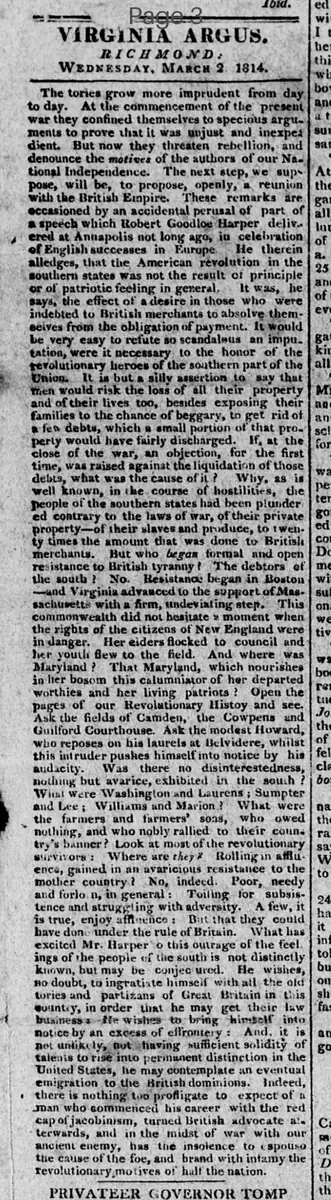
The tories grow more imprudent from day to day. At the commencement of the present war they confined themselves to specious arguments to prove that it was unjust and inexpedient. But now they threaten rebellion, and denounce the motives of the authors of our National Independence. The next step, we suppose, will be, to propose, openly, a reunion with the British Empire. These remarks are occasioned by an accidental perusal of part of a speech which Robert Goodloe Harper delivered at Annapolis not long ago, in celebration of English successes in Europe. He therein alledges, that the American revolution in the southern states was not the result of principle or of patriotic feeling in general. It was, he says, the effect of a desire in those who were indebted to British merchants to absolve themselves from the obligation of payment. It would be very easy to refute so scandalous an imputation, were it necessary to the honor of the revolutionary heroes of the southern part of the Union. It is but a silly assertion to say that men would risk the loss of all their property and of their lives too, besides exposing their families to the chance of beggary, to get rid of a few debts, which a small portion of that property would have fairly discharged. If, at the close of the war, an objection, for the first time, was raised against the liquidation of those debts, what was the cause of it? Why, as is well known, in the course of hostilities, the people of the southern states had been plundered contrary to the laws of war, of their private property—of their slaves and produce, to twenty times the amount that was due to British merchants. But who began formal and open resistance to British tyranny? The debtors of the south! No. Resistance began in Boston—and Virginia advanced to the support of Massachusetts with a firm, undeviating step. This commonwealth did not hesitate a moment when the rights of the citizens of New England were in danger. Her elders flocked to council and her youth flew to the field. And where was Maryland? That Maryland, which nourishes in her bosom this calumniator of her departed worthies and her living patriots? Open the pages of our Revolutionary History and see. Ask the fields of Camden, the Cowpens and Guilford Courthouse. Ask the modest Howard, who reposes on his laurels at Belvidere, whilst this intruder pushes himself into notice by his audacity. Was there no disinterestedness, nothing but avarice, exhibited in the south? What! Were Washington and Laurens; Sumter and Lee; Williams and Marion? What were the farmers and farmers' sons, who owed nothing, and who nobly rallied to their country's banner? Look at most of the revolutionary survivors: Where are they? Rolling in affluence, gained in an avaricious resistance to the mother country? No, indeed. Poor, needy and forlorn, in general: Toiling for subsistence and struggling with adversity. A few, it is true, enjoy affluence: But that they could have done under the rule of Britain. What has excited Mr. Harper to this outrage of the feelings of the people of the south is not distinctly known, but may be conjectured. He wishes, no doubt, to ingratiate himself with all the old tories and partizans of Great Britain in this country, in order that he may get their law business—he wishes to bring himself into notice by an excess of effrontery: And, it is not unlikely, not having sufficient solidity of talents to rise into permanent distinction in the United States, he may contemplate an eventual emigration to the British dominions. Indeed, there is nothing too profligate to expect of a man who commenced his career with the red cap of Jacobinism, turned British advocate afterwards, and in the midst of war with our ancient enemy, has the insolence to espouse the cause of the foe, and brand with infamy the revolutionary motives of half the nation.
RICHMOND:
Wednesday, March 2, 1814.
The tories grow more imprudent from day to day. At the commencement of the present war they confined themselves to specious arguments to prove that it was unjust and inexpedient. But now they threaten rebellion, and denounce the motives of the authors of our National Independence. The next step, we suppose, will be, to propose, openly, a reunion with the British Empire. These remarks are occasioned by an accidental perusal of part of a speech which Robert Goodloe Harper delivered at Annapolis not long ago, in celebration of English successes in Europe. He therein alledges, that the American revolution in the southern states was not the result of principle or of patriotic feeling in general. It was, he says, the effect of a desire in those who were indebted to British merchants to absolve themselves from the obligation of payment. It would be very easy to refute so scandalous an imputation, were it necessary to the honor of the revolutionary heroes of the southern part of the Union. It is but a silly assertion to say that men would risk the loss of all their property and of their lives too, besides exposing their families to the chance of beggary, to get rid of a few debts, which a small portion of that property would have fairly discharged. If, at the close of the war, an objection, for the first time, was raised against the liquidation of those debts, what was the cause of it? Why, as is well known, in the course of hostilities, the people of the southern states had been plundered contrary to the laws of war, of their private property—of their slaves and produce, to twenty times the amount that was due to British merchants. But who began formal and open resistance to British tyranny? The debtors of the south! No. Resistance began in Boston—and Virginia advanced to the support of Massachusetts with a firm, undeviating step. This commonwealth did not hesitate a moment when the rights of the citizens of New England were in danger. Her elders flocked to council and her youth flew to the field. And where was Maryland? That Maryland, which nourishes in her bosom this calumniator of her departed worthies and her living patriots? Open the pages of our Revolutionary History and see. Ask the fields of Camden, the Cowpens and Guilford Courthouse. Ask the modest Howard, who reposes on his laurels at Belvidere, whilst this intruder pushes himself into notice by his audacity. Was there no disinterestedness, nothing but avarice, exhibited in the south? What! Were Washington and Laurens; Sumter and Lee; Williams and Marion? What were the farmers and farmers' sons, who owed nothing, and who nobly rallied to their country's banner? Look at most of the revolutionary survivors: Where are they? Rolling in affluence, gained in an avaricious resistance to the mother country? No, indeed. Poor, needy and forlorn, in general: Toiling for subsistence and struggling with adversity. A few, it is true, enjoy affluence: But that they could have done under the rule of Britain. What has excited Mr. Harper to this outrage of the feelings of the people of the south is not distinctly known, but may be conjectured. He wishes, no doubt, to ingratiate himself with all the old tories and partizans of Great Britain in this country, in order that he may get their law business—he wishes to bring himself into notice by an excess of effrontery: And, it is not unlikely, not having sufficient solidity of talents to rise into permanent distinction in the United States, he may contemplate an eventual emigration to the British dominions. Indeed, there is nothing too profligate to expect of a man who commenced his career with the red cap of Jacobinism, turned British advocate afterwards, and in the midst of war with our ancient enemy, has the insolence to espouse the cause of the foe, and brand with infamy the revolutionary motives of half the nation.
What sub-type of article is it?
Partisan Politics
War Or Peace
What keywords are associated?
Tories
Robert Goodloe Harper
American Revolution
Southern Patriots
War Of 1812
British Tyranny
Debt Imputation
What entities or persons were involved?
Robert Goodloe Harper
Tories
British Empire
Washington
Laurens
Sumter
Lee
Williams
Marion
Howard
Virginia
Maryland
Massachusetts
Boston
Editorial Details
Primary Topic
Critique Of Robert Goodloe Harper's Speech On Southern Revolutionary Motives
Stance / Tone
Strongly Anti Tory And Pro Southern Patriotic
Key Figures
Robert Goodloe Harper
Tories
British Empire
Washington
Laurens
Sumter
Lee
Williams
Marion
Howard
Virginia
Maryland
Massachusetts
Boston
Key Arguments
Tories Now Threaten Rebellion And Denounce Revolutionary Motives
Southern Revolution Not Due To Debt Avoidance But Principle
Resistance Began In Boston, Virginia Supported Massachusetts
Southern States Plundered By British Far Exceeding Debts
Revolutionary Heroes Like Washington And Marion Showed Disinterested Patriotism
Most Southern Revolutionaries Ended Poor, Not Affluent From Avarice
Harper Seeks Favor With Tories For Business And Possible Emigration