Thank you for visiting SNEWPapers!
Sign up free
Story
January 26, 1891
The Beatrice Daily Express
Beatrice, Gage County, Nebraska
What is this article about?
Discussion on London's fire risks, contrasting with Chicago's fate, highlighting historical Great Fire of 1666, shift to brick buildings, and ongoing issues with inadequate fire brigade equipment compared to Pittsburgh.
Clipping
OCR Quality
95%
Excellent
Full Text
LONDON FIRE PERILS.
A Portion of the Metropolis Inadequately Protected Against Fire.
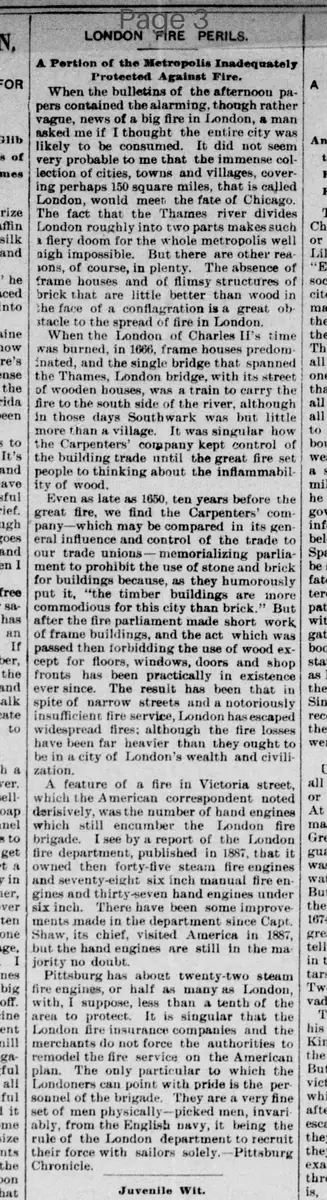
When the bulletins of the afternoon papers contained the alarming, though rather vague, news of a big fire in London, a man asked me if I thought the entire city was likely to be consumed. It did not seem very probable to me that the immense collection of cities, towns and villages, covering perhaps 150 square miles, that is called London, would meet the fate of Chicago. The fact that the Thames river divides London roughly into two parts makes such a fiery doom for the whole metropolis well nigh impossible. But there are other reasons, of course, in plenty. The absence of frame houses and of flimsy structures of brick that are little better than wood in the face of a conflagration is a great obstacle to the spread of fire in London. When the London of Charles II's time was burned, in 1666, frame houses predominated, and the single bridge that spanned the Thames, London bridge, with its street of wooden houses, was a train to carry the fire to the south side of the river, although in those days Southwark was but little more than a village. It was singular how the Carpenters' company kept control of the building trade until the great fire set people to thinking about the inflammability of wood. Even as late as 1650, ten years before the great fire, we find the Carpenters' company-which may be compared in its general influence and control of the trade to our trade unions-memorializing parliament to prohibit the use of stone and brick for buildings because, as they humorously put it, "the timber buildings are more commodious for this city than brick." But after the fire parliament made short work of frame buildings, and the act which was passed then forbidding the use of wood except for floors, windows, doors and shop fronts has been practically in existence ever since. The result has been that in spite of narrow streets and a notoriously insufficient fire service, London has escaped widespread fires; although the fire losses have been far heavier than they ought to be in a city of London's wealth and civilization. A feature of a fire in Victoria street, which the American correspondent noted derisively, was the number of hand engines which still encumber the London fire brigade. I see by a report of the London fire department, published in 1887, that it owned then forty-five steam fire engines and seventy-eight six inch manual fire engines and thirty-seven hand engines under six inch. There have been some improvements made in the department since Capt. Shaw, its chief, visited America in 1887, but the hand engines are still in the majority no doubt. Pittsburg has about twenty-two steam fire engines, or half as many as London, with, I suppose, less than a tenth of the area to protect. It is singular that the London fire insurance companies and the merchants do not force the authorities to remodel the fire service on the American plan. The only particular to which the Londoners can point with pride is the personnel of the brigade. They are a very fine set of men physically-picked men, invariably, from the English navy, it being the rule of the London department to recruit their force with sailors solely.-Pittsburg Chronicle.
A Portion of the Metropolis Inadequately Protected Against Fire.
When the bulletins of the afternoon papers contained the alarming, though rather vague, news of a big fire in London, a man asked me if I thought the entire city was likely to be consumed. It did not seem very probable to me that the immense collection of cities, towns and villages, covering perhaps 150 square miles, that is called London, would meet the fate of Chicago. The fact that the Thames river divides London roughly into two parts makes such a fiery doom for the whole metropolis well nigh impossible. But there are other reasons, of course, in plenty. The absence of frame houses and of flimsy structures of brick that are little better than wood in the face of a conflagration is a great obstacle to the spread of fire in London. When the London of Charles II's time was burned, in 1666, frame houses predominated, and the single bridge that spanned the Thames, London bridge, with its street of wooden houses, was a train to carry the fire to the south side of the river, although in those days Southwark was but little more than a village. It was singular how the Carpenters' company kept control of the building trade until the great fire set people to thinking about the inflammability of wood. Even as late as 1650, ten years before the great fire, we find the Carpenters' company-which may be compared in its general influence and control of the trade to our trade unions-memorializing parliament to prohibit the use of stone and brick for buildings because, as they humorously put it, "the timber buildings are more commodious for this city than brick." But after the fire parliament made short work of frame buildings, and the act which was passed then forbidding the use of wood except for floors, windows, doors and shop fronts has been practically in existence ever since. The result has been that in spite of narrow streets and a notoriously insufficient fire service, London has escaped widespread fires; although the fire losses have been far heavier than they ought to be in a city of London's wealth and civilization. A feature of a fire in Victoria street, which the American correspondent noted derisively, was the number of hand engines which still encumber the London fire brigade. I see by a report of the London fire department, published in 1887, that it owned then forty-five steam fire engines and seventy-eight six inch manual fire engines and thirty-seven hand engines under six inch. There have been some improvements made in the department since Capt. Shaw, its chief, visited America in 1887, but the hand engines are still in the majority no doubt. Pittsburg has about twenty-two steam fire engines, or half as many as London, with, I suppose, less than a tenth of the area to protect. It is singular that the London fire insurance companies and the merchants do not force the authorities to remodel the fire service on the American plan. The only particular to which the Londoners can point with pride is the personnel of the brigade. They are a very fine set of men physically-picked men, invariably, from the English navy, it being the rule of the London department to recruit their force with sailors solely.-Pittsburg Chronicle.
What sub-type of article is it?
Historical Event
Curiosity
Disaster
What themes does it cover?
Catastrophe
Misfortune
Triumph
What keywords are associated?
London Fire
Great Fire 1666
Building Regulations
Fire Brigade
Hand Engines
Pittsburgh Comparison
What entities or persons were involved?
Charles Ii
Capt. Shaw
Carpenters' Company
Where did it happen?
London
Story Details
Key Persons
Charles Ii
Capt. Shaw
Carpenters' Company
Location
London
Event Date
1666
Story Details
Article explains London's relative fire safety due to post-1666 Great Fire regulations banning wooden frames, contrasts with Chicago's vulnerability, and critiques outdated fire brigade equipment versus Pittsburgh's, praising brigade personnel from navy.