Thank you for visiting SNEWPapers!
Sign up free
River Falls Journal
River Falls, Saint Croix County, Pierce County, Wisconsin
What is this article about?
In San Francisco, 19-year-old Edward Bittenbender shoots and kills his 20-year-old brother George after a quarrel over money, striking him first. Family history includes mother's insanity and father's suicide. Coroner's inquest held, suggesting hereditary madness for scientific study.
Clipping
OCR Quality
Full Text
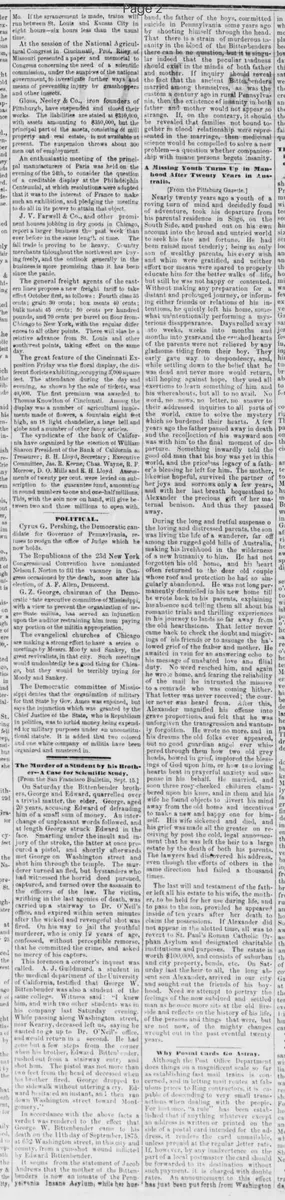
[From the San Francisco Bulletin, Sept. 15.]
On Saturday the Bittenbender brothers, George and Edward, quarrelled over a trivial matter, the elder, George, aged 20 years, accusing Edward of defrauding him of a small sum of money. An interchange of unpleasant words followed, and at length George struck Edward in the face. Smarting under the insult and injury of the stroke, the latter at once procured a pistol, and shortly afterwards met George on Washington street and shot him through the temple. The murderer turned and fled, but bystanders who had witnessed the horrid deed pursued, captured, and turned over the assassin to the officers of the law. The victim, writhing in the last agonies of death, was carried up a stairway to Dr. O'Neil's office, and expired within seven minutes after the wicked and revengeful shot was fired. On his way to jail the youthful murderer, who is only 19 years of age, confessed, without perceptible remorse, that he committed the crime, and asked no mercy of his captors.
This forenoon a coroner's inquest was called. A. J. Guildmurd, a student in the medical department of the University of California, testified that George W. Bittenbender was also a student of the same college. Witness said: "I knew him, and with two other students was in his company last Saturday evening. While passing along Washington street, near Kearny, deceased left us, saying he wanted to go up to Dr. O'Neil's office, and would return in a second. He had gone but a few steps from the corner when his brother, Edward Bittenbender, rushed out from a stairway entrance and shot him. The pistol was not more than two feet from the head of deceased when his brother fired. George dropped to the sidewalk without uttering a cry. Edward hesitated an instant, and then ran down Washington street toward Montgomery."
In accordance with the above facts a verdict was rendered to the effect that George W. Bittenbender came to his death on the 11th day of September, 1875, at No. Washington street, in this city and county, from a gun-shot wound inflicted by Edward Bittenbender.
It seems from the statement of Jacob Andrews that the mother of the Bittenbenders is now an inmate of the Pennsylvania Insane Asylum, while her husband, the father of the boys, committed suicide in Pennsylvania some years ago by shooting himself through the head.
That there is a strain of murderous insanity in the blood of the Bittenbenders there can be no question, but it is singular indeed that the peculiar madness should exist in the minds of both father and mother. If inquiry should reveal the fact that the ancient Bittenbenders married among themselves, as was the custom a century ago in rural Pennsylvania, then the existence of insanity in both father and mother would not appear so strange. If, on the contrary, it should be revealed that families not bound together in blood relationship were represented in the marriage, then medical science would be compelled to solve a new problem-a question whether companionship with insane persons begets insanity.
What sub-type of article is it?
What themes does it cover?
What keywords are associated?
What entities or persons were involved?
Where did it happen?
Story Details
Key Persons
Location
Washington Street, San Francisco
Event Date
September 11, 1875
Story Details
Brothers George and Edward Bittenbender quarrel over money; George strikes Edward, who then shoots him dead on Washington street. Edward captured and confesses. Coroner's inquest confirms gunshot wound as cause. Family history reveals mother's insanity and father's suicide, suggesting hereditary murderous madness for scientific inquiry.