Thank you for visiting SNEWPapers!
Sign up free
New York Daily Tribune
New York, New York County, New York
What is this article about?
Detailed letter from Liverpool dated July 7, 1843, describing the Polytechnic Exhibition at the Liverpool Collegiate Institution, featuring machinery, art, autographs, antiquities, paintings, and other exhibits, with comparisons to American achievements and notes on local history including the slave trade.
Clipping
OCR Quality
Full Text
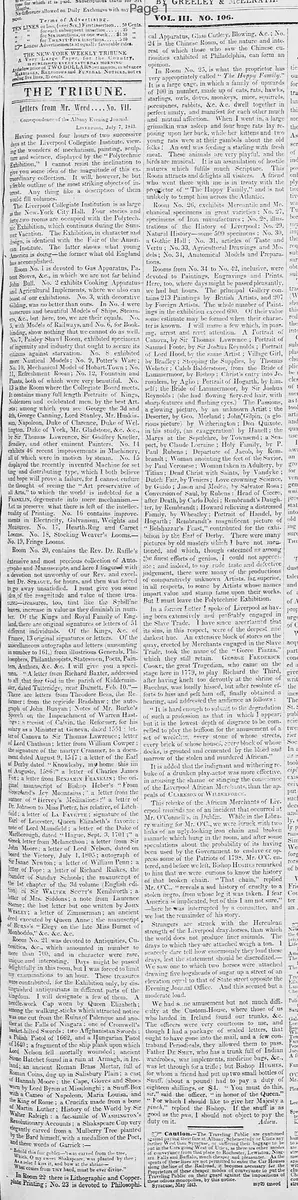
Letters from Mr. Weed....No. VII.
Correspondence of the Albany Evening Journal.
LIVERPOOL, July 7, 1843.
Having passed four hours of two successive days at the Liverpool Collegiate Institute, viewing the wonders of mechanism, painting, sculpture and science, displayed by the "Polytechnic Exhibition," I cannot resist the inclination to give you some idea of the magnitude of this extraordinary collection. It will, however, be but a feeble outline of the most striking objects of interest. Anything like a description of them would fill volumes.
The Liverpool Collegiate Institution is as large as the New-York City Hall. Four stories and forty-two rooms are occupied with the Polytechnic Exhibition, which continues during the Summer Vacation. The Exhibition, in character and design, is identical with the Fair of the American Institute. The latter shows what young America is doing—the former what old England has accomplished.
Room No. I is devoted to Gas Apparatus, Patent Stoves, &c., in which we are not far behind John Bull. No. 2 exhibits Cooking Apparatus and Agricultural Implements, where we also can boast of our exhibitions. No. 3, with decorative Gilding, was no better than ours. In No. 4 were numerous and beautiful Models of Ships, Steamers, &c., but here, too, we are their equals. No. 5, with Models of Railways, and No. 6, for Book-binding, show nothing that we cannot do as well.
No. 7, Paisley Shawl Room, exhibited specimens of ingenuity and industry that ought to secure its citizens against starvation. No. 8 exhibited more Nautical Models; No. 9, Potter's Ware; No. 10, Mechanical Model of Hobart Town; No. 11, Refreshment Room; No. 12, Fountain and Plants, both of which were very beautiful. No. 13 is the Room where the Collegiate Board meets. It contains many full length Portraits of Kings, Noblemen and celebrated men, by the best Artists; among which you see George the 3d and 4th, George Canning, Lord Stanley, Mr. Huskisson, Napoleon, Duke of Clarence, Duke of Wellington, Duke of York, Mr. Gladstone, &c. &c., by Sir Thomas Lawrence, Sir Godfrey Kneller, Bradley, and other eminent Painters. No. 14 exhibits 46 recent improvements in Machinery, all of which were in motion by steam. No. 15 displayed the recently invented Machine for setting and distributing type, which I both believe and hope will prove a failure, for I cannot endure the thought of seeing the "Art preservative of all Arts," to which the world is indebted for a Franklin, degenerate into mere mechanism.
Let us preserve what there is left of the intellectuality of Printing. No. 16 contains improvements in Electricity, Galvanism, Weights and Measures. No. 17, Hearth-Rug and Carpet Looms. No. 18, Stocking Weaver's Looms. No. 19, Fringe Looms.
Room No. 20, contains the Rev. Dr. Raffles's extensive and most precious collection of Autographs and Manuscripts, and here I lingered with a devotion not unworthy of our Rev. and excellent Dr. Sprague, for hours, and then was forced to go away unsatisfied. I must give you some idea of the magnitude and value of these treasures—treasures, too, that like the Sybilline leaves, increase in value as they diminish in number. Of the Kings and Royal Family of England, there are original signatures or letters of 51 different individuals. Of the Kings, &c. of France, 13 original signatures or letters. Of the miscellaneous autographs and letters (amounting in number to 161,) from illustrious Generals, Philosophers, Philanthropists, Statesmen, Poets, Painters, Authors, &c. &c. I will give you a specimen. "A letter from Richard Baxter, addressed to all that fear God in the parish of Kidderminster, dated Tatteridge, near Barnett, Feb. 10."
There are letters from Theodore Beza, the Reformer: from the regicide Bradshaw: the autograph of John Bunyan; Notes of Mr. Burke's Speech on the Impeachment of Warren Hastings: a receipt of Calvin, the Reformer, for his salary as a Minister at Geneva, dated 1551: letter of Canova to Sir Thomas Lawrence; letter of Lord Chatham: letter from William Cowper; the signature of the martyr Cranmer, to a document dated August 9, 1547: a letter of the Earl of Derby dated "Knowlesby, my home this iiii of Auguste. 1556:" a letter of Charles James Fox; a letter from Benjamin Franklin; the original manuscript of Bishop Heber's "From Greenland's Icy Mountains;" a letter from the author of "Hervey's Meditations;" a letter of Dr. Johnson to Miss Porter, his relative, of Lichfield; a letter of La Favre; signature of the Earl of Leicester, Queen Elizabeth's favorite; note of Lord Mansfield: a letter of the Duke of Marlborough, dated "Hague, Sept. 3, 1701;" a Greek letter from Melancthon; a letter from Sir John Moore: a letter of Lord Nelson, dated on board the Victory, July 1, 1805; autograph of Sir Isaac Newton; a letter of William Penn: a letter of Pope: a letter of Richard Raikes, the founder of Sunday Schools; the manuscript of the 1st chapter of the 3d volume (English edition) of Sir Walter Scott's Kenilworth; a letter of Mrs. Siddons; a note from Laurence Sterne; the last letter but one written by John Wesley; a letter of Zimmerman; an ancient deed executed by Queen Anne: the manuscript of Burns's "Elegy on the late Miss Burnett of Monboddo," &c. &c. &c.
Room No. 21 was devoted to Antiquities, Curiosities, &c., which amounted in number to more than 700, and in character were rare, unique and interesting. Days might be passed delightfully in this room, but I was forced to limit my examinations to an hour. These treasures were contributed, for the Exhibition only, by distinguished antiquarians in different parts of the kingdom. I will designate a few of them. A needle-work Cap worn by Queen Elizabeth: among the walking-sticks which attracted notice was one cut from the Ruins of Palenque and another at the Falls of Niagara: one of Cromwell's basket hilted Swords: two Afghanistan Swords; a Polish Pistol of 1662, and a Hungarian Pistol of 1640: a fragment of the ship plank upon which Lord Nelson fell mortally wounded; ancient Stone Hatchet found in a ruin at Armagh, in Ireland; an ancient Roman Brass Mortar, full of Roman Coins, dug up in Salisbury Plain; a cast of Hannah More; the cap worn by Lord Byron at Missolonghi; a Snuff-Box with Cameo of Napoleon the King of Rome; a Crucifix made from a bone of Martin Luther; History of the World by Sir Walter Raleigh: a fac-simile of Washington's Revolutionary Accounts; Shakspeare Cup very elegantly carved from a Mulberry Tree planted by the Bard himself, with a medallion of the Poet, and these words of Garrick:--
"Behold this fair goblet—twas carved from the tree
Which, O my sweet Shakspeare, was planted by thee;
As ye kiss it and bow at the shrine—
What comes from my hand, must be ever divine."
In Room 22 there is Lithographic and Copper-plate Printing: No. 23 is devoted to Philosophical Apparatus, Glass Cutting, Blowing, &c.; No. 24 is the Chinese Room, of the nature and interest of which those who saw the Chinese curiosities exhibited at Philadelphia, can form an opinion.
In Room No. 25, is what the proprietor has very appropriately called "The Happy Family." It is a large cage, in which a family of upwards of 100 in number, made up of cats, rats, hawks, starlings, owls, doves, monkeys, mice, squirrels, porcupines, rabbits, &c. &c. dwell together in perfect amity, and manifest for each other much and mutual affection. When I went in, a large grimalkin was asleep and four huge rats lay reposing upon her back, while her kittens and two young rats were at their gambols about the old folks! An owl was feeding a starling with fresh meat. These animals are very playful, and the birds are musical. It is an assimilation of hostile natures which fulfils much Scripture. This Room attracts and delights all visitors. A friend who went there with me is in treaty with the proprietor of "The Happy Family," and is not unlikely to tempt him across the Atlantic.
Room No. 26, exhibits Mercantile and Mechanical specimens in great varieties: No. 27, specimens of Iron manufactures; No. 28, illustrations of the History of Liverpool; No. 29, Natural History—some 500 specimens: No. 30, a Gothic Hall: No. 31, articles of Taste and Vertu: No. 32, Agricultural Drawings and Models; No. 33, Agricultural Drawings and Models; No. 34, Anatomical Models and Preparations.
Rooms from No. 34 to No. 42, inclusive, were devoted to Paintings, Engravings and Prints. Here, too, where days might be passed pleasantly, we had but hours. "The principal Gallery contains 213 Paintings by British Artists, and 207 by Foreign Artists. The whole number of Paintings in the exhibition exceed 600. Of their value some estimate may be formed when their characters known. I will name a few which, in passing, arrest and rivet attention. A Portrait of Canova, by Sir Thomas Lawrence: Portrait of Samuel Foote, by Sir Joshua Reynolds; Portrait of Lord Hood, by the same Artist; Village Girl, by Bradley; Stopping the Supplies, by Thomas Webster: Caleb Balderstone, from the Bride of Lammermoor, by Bishop; Christ's entry into Jerusalem, by Aglio; Portrait of Hogarth, by himself: the Bride of Lammermoor, by Sir Joshua Reynolds; (she had flowing fiery-red hair, with sharp features and flashing eyes.)" The Passions, a glowing picture, by an unknown Artist; the Deserter, by Geo. Morland; John Gilpin, (a glorious picture) by Witherington; Don Quixote, in his study, (an exaggeration) by Handell: the Marys at the Sepulchre, by Townsend; a Sea-port, by Claude Lorraine; Holy Family, by P. Paul Rubens: Departure of Jacob, by Rembrandt; Woman anointing the feet of the Savior, by Paul Veronese: Woman taken in Adultery, by Titian; Dead Christ with Saints, by Vandyke; Dutch Fair, by Teniers; Love crowning Science, by Guido; Jason and Medea, by Salvator Rosa; Conversion of Saul, by Rubens: Head of Cicero, after Death, by Carlo Dolci: Rembrandt's Daughter, by Rembrandt; Howard relieving a distressed Family, by Wheatley: Portrait of Handel, by Hogarth; Rembrandt's magnificent picture of "Belshazzar's Feast," contributed for the exhibition by the Earl of Derby. There were many pictures by old masters which I have not mentioned, and which, though esteemed as among the finest efforts of genius, I could not appreciate; and indeed, to my rude taste and defective judgement, there were many of the productions of comparatively unknown Artists, far superior, in all respects, to some by Artists whose names impart value and stamp fame upon their works.
But I must leave the Polytechnic Exhibition.
In a former Letter I spoke of Liverpool as having been extensively and profitably engaged in the Slave Trade. I have since ascertained that its sins, in this respect, were of the deepest and darkest hue. An extensive block of stores on the quay, erected by Merchants engaged in the Slave Trade, took the name of the "Goree Piazza," which they still retain. GEORGE FREDERICK COOKE, the great Tragedian, who came on the stage here in 1779, to play Richard the Third, after having knelt too devoutly at the shrine of Bacchus, was loudly hissed. but after resolute efforts to hiss and pelt him off, finally obtained a hearing, and addressed the audience as follows:
"It is hard enough to submit to the degradation of such a profession as that in which I appear; but it is the lowest depth of disgrace to be compelled to play the buffoon for the amusement of a set of wretches, every stone of whose streets, every brick of whose houses, every block of whose docks, is grouted and cemented by the blood and marrow of the stolen and murdered African."
It is added that the indignant and withering rebuke of a drunken play-actor was more effective, in arousing the shame or stinging the conscience of the Liverpool African Merchants, than the appeals of CLARKSON or WILBERFORCE.
This rebuke of the African Merchants of Liverpool reminds me of an incident that occurred at Mr. O'Connell's, in Dublin. While in the Library waiting for Mr. O'C., we were struck with two links of an ugly-looking iron chain and broken manacle which hung in the room, and after some speculations about the probability of its having been used by the Government to enslave or oppress some of the Patriots of 1798, Mr. O'C. entered, and before we left, Bishop Hughes remarked to him that we were curious to know the history of that broken chain. "That chain," replied Mr. O'C., "reveals a sad history of cruelty to a stolen negro, from whose leg it was taken. I fear America is implicated, but of this I am not sure,"—here he was interrupted by a committee, and we lost the remainder of his story.
Strangers are struck with the Herculean strength of the Liverpool dray-horses, than which the world does not produce finer animals. The drays to which they are attached weigh a ton. I scarcely dare tell how enormously they load these drays, lest the statement should be discredited.—We saw one to which two horses were attached drawing five hogsheads of sugar up a street of an elevation equal to that of State street opposite the Evening Journal Office. And this seemed but a moderate load.
We had some amusement but not much difficulty at the Custom-House, where those of us who landed in Ireland found our trunks, &c. The officers were very courteous to me, and though I had a package of sealed letters, that ought to have gone into the mail, and a few contraband Periodicals, they allowed them to pass. Father De Suer, who has a trunk full of Indian wardrobes, war implements, medicine bags, &c., was let through for a trifle; but Bishop Hughes, for whom a friend had put up two small bottles of Snuff, (about a pound) had to pay a duty of eighteen shillings, or $4. "You must do this, sir," said the officer, "in honor of the Queen." "For which I should like to give her Majesty a pinch," replied the Bishop. If the snuff is as good as the pun, I should not object to pay the duty on it.
Adieu.
What sub-type of article is it?
What keywords are associated?
What entities or persons were involved?
Where did it happen?
Foreign News Details
Primary Location
Liverpool
Event Date
July 7, 1843
Key Persons
Event Details
The letter describes a visit to the Polytechnic Exhibition at the Liverpool Collegiate Institution, occupying 42 rooms with displays of machinery, models, autographs, antiquities, paintings, and other exhibits including the Happy Family cage. It compares British accomplishments to American ones and includes historical notes on Liverpool's slave trade involvement and actor George Frederick Cooke's rebuke to merchants.