Thank you for visiting SNEWPapers!
Sign up free
Alexandria Daily Advertiser
Alexandria, Virginia
What is this article about?
In Aaron Burr's 1807 treason trial in Virginia, prosecutor Mr. Wirt argues against a defense motion for a subpoena duces tecum to compel President Jefferson to produce a letter from Gen. Wilkinson and War Department orders, claiming their materiality to Burr's defense is unproven and could endanger national security.
Merged-components note: This is a continuation of the story on the trial of Colonel Aaron Burr, spanning pages 2 and 3, with sequential reading order and text flow indicating a single logical component.
Clippings
1 of 2
OCR Quality
Full Text
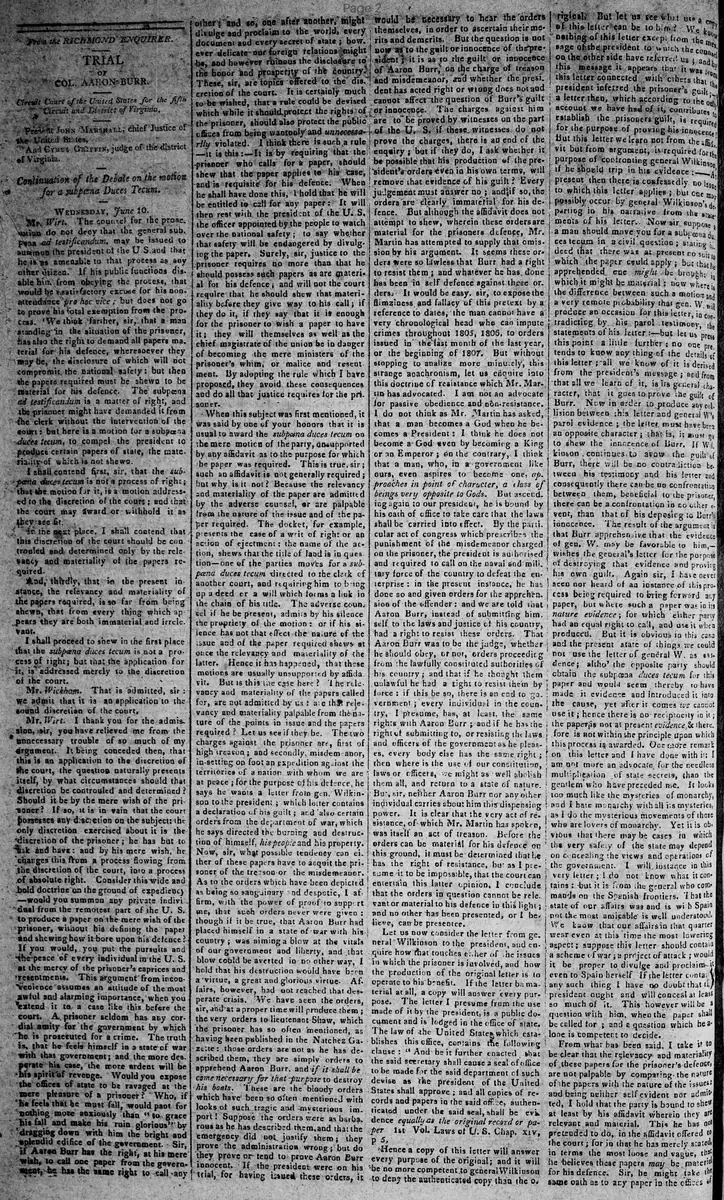
TRIAL
Of
COL. AARON BURR.
Circuit Court of the United States for the fifth
Circuit and District of Virginia.
Present John Marshall, Chief Justice of
the United States,
And Cyrus Griffin, Judge of the District
of Virginia.
Continuation of the Debate on the motion
for a subpoena Duces Tecum.
WEDNESDAY, June 10.
Mr. Wirt. The counsel for the prosecution
do not deny that the general subpoena
ad testificandum, may be issued to
summon the President of the U.S. and that
he is as amenable to that process as any
other citizen. If his public functions dis-
able him from obeying the process, that
would be satisfactory excuse for his non-
attendance pro hoc vice; but does not go
to prove his total exemption from the pro-
cess. We think further, sir, that a man
standing in the situation of the prisoner,
has also the right to demand all papers ma-
terial for his defence, wheresoever they
may be, the disclosure of which will not
compromit the national safety: but then
the papers required must be shown to be
material for his defence. The subpoena
ad testificandum is a matter of right, and
the prisoner might have demanded it from
the clerk without the intervention of the
court: but here is a motion for a subpoena
duces tecum, to compel the President to
produce certain papers of state, the mate-
riality of which is not shown.
I shall contend first, sir, that the sub-
poena duces tecum is not a process of right;
that the motion for it, is a motion address-
ed to the discretion of the court: and that
the court may award or withhold it as
they see fit.
In the next place, I shall contend that,
this discretion of the court should be con-
trolled and determined only by the rele-
vancy and materiality of the papers re-
quired.
And thirdly that in the present in-
stance, the relevancy and materiality of
the papers required, is so far from being
shown, that from every thing which ap-
pears they are both immaterial and irrele-
vant.
I shall proceed to show in the first place
that the subpoena duces tecum is not a pro-
cess of right; but that the application for
it, is addressed merely to the discretion
of the court.
Mr. Wickham. That is admitted, sir:
we admit that it is an application to the
sound discretion of the court,
Mr. Wirt. I thank you for the admis-
sion, sir, you have relieved me from the
unnecessary trouble of so much of my
argument. It being conceded then, that
this is an application to the discretion of
the court, the question naturally presents
itself, by what circumstances should that
discretion be controlled and determined?
Should it be by the mere wish of the pri-
soner? If so, it is in vain that the court
possesses any discretion on the subject: the
only discretion exercised about it is the
discretion of the prisoner; he has but to
ask and have: and by his mere wish, he
changes this from a process flowing from
the discretion of the court, into a process
of absolute right. Consider this wide and
bold doctrine on the ground of expediency
--would you summon any private indivi-
dual from the remotest part of the U. S.
to produce a paper on the mere wish of the
prisoner, without his describing the paper
and showing how it bore upon his defence?
If you would, you put the pursuits and
the peace of every individual in the U. S.
at the mercy of the prisoner's caprices and
resentments. This argument from incon-
venience assumes an attitude of the most
awful and alarming importance, when you
extend it to a case like this before the
court. A prisoner seldom has any cor-
dial amity for the government by which
he is prosecuted for a crime. The truth
is, that he feels himself in a state of war
with that government; and the more des-
perate his case, the more ardent will be
his spirit of revenge. Would you expose
the offices of state to be ravaged at the
mere pleasure of a prisoner? Who, if
he feels that he must fall, would pant for
nothing more anxiously than to grace
his fall and make his ruin glorious by
dragging down with him the bright and
splendid edifice of the government. Sir,
if Aaron Burr has the right, at his mere
wish, to call one paper from the govern-
ment, he has the same right to call any
other and so, one after another might
divulge and proclaim to the world, every
document and every secret of state; how-
ever delicate our foreign relations might
be and however ruinous the disclosure to
the honor and prosperity of the country.
These, sir, are topics offered to the dis-
cretion of the court. It is certainly much
to be wished that a rule could be devised
which while it should protect the rights of
the prisoner, should also protect the public
offices from being wantonly and unnecessa-
rily violated. I think there is such a rule
it is this -- It is by requiring that the
prisoner who calls for paper, should
shew that the paper applies to his case.
and is requisite for his defence. When
he shall have done this, I hold that he will
be entitled to call for any paper: It will
then rest with the President of the U. S.
the officer appointed by the people to watch
over the national safety; to say whether
that safety will be endangered by divulg-
ing the paper, Surely, sir, justice to the
prisoner requires no more than that he
should possess such papers as are materi-
al for his defence; and will not the court
require that he should shew that materi-
ality before they give way to his call; if
they do it, if they say that it is enough
for the prisoner to wish a paper to have
it; they will themselves as well as the
chief magistrate of the union be in danger
of becoming the mere ministers of the
prisoner's whim, or malice and resent-
ment. By adopting the rule which I have
proposed, they avoid these consequences
and do all that justice requires for the pri-
soner.
When this subject was first mentioned, it
was said by one of your honors that it is
usual to award the subpoena duces tecum on
the mere motion of the party, unsupported
by any affidavit as to the purpose for which
the paper was required. This is true, sir;
such an affidavit is not generally required;
but why is it not? Because the relevancy
and materiality of the paper are admitted
by the adverse counsel, or are palpable
from the nature of the issue and of the pa-
per required. The docket, for example,
presents the case of a writ of right or ap-
action of ejectment: the name of the ac-
tion, shews that the title of land is in ques-
tion--one of the parties moves for a sub-
poena duces tecum directed to the clerk of
another court, and requiring him to bring
up a deed or a will which forms a link in
the chain of his title. The adverse coun-
sel if he be present, admits by his silence
the propriety of the motion: or if his si-
lence has not that effect the nature of the
issue and of the paper required shews at
once the relevancy and materiality of the
latter. Hence it has happened, that these
motions are usually unsupported by affida-
vit. But is this the case here? The rele-
vancy and materiality of the papers called
for, are not admitted by us: are that rele-
vancy and materiality palpable from the na-
ture of the points in issue and the papers
required? Let us see if they be. The two
charges against the prisoner are, first of
high treason; and secondly, misdemeanor,
in setting on foot an expedition against the
territories of a nation with whom we are
at peace; for the purpose of his defence, he
says he wants a letter from Gen. Wilkin-
son to the President; which letter contains
a declaration of his guilt; and also certain
orders from the department of war, which
he says directed the burning and destruc-
tion of himself, his people and his property.
Now, sir, what possible tendency can ei-
ther of these papers have to acquit the pri-
soner of the treason or the misdemeanor.
As to the orders which have been depicted
as being so sanguinary and despotic, I af-
firm, with the power of proof to support
me, that such orders never were given:
though if it be true, that Aaron Burr had
placed himself in a state of war with his
country; was aiming a blow at the vitals
of our government and liberty, and that
blow could be averted in no other way, I
hold that his destruction would have been
a virtue, a great and glorious virtue. Af-
fairs, however, had not reached that des-
perate crisis. We have seen the orders,
sir, and at a proper time will produce them;
the very orders to Lieutenant Shaw, which
the prisoner has so often mentioned, as
having been published in the Natchez Ga-
sette: those orders are not as he has de-
scribed them, they are simply orders to
apprehend Aaron Burr, and if it shall be
come necessary for that purpose to destroy
his boats. These are the bloody orders
which have been so often mentioned with
looks of such tragic and mysterious im-
port! Suppose the orders were as barba-
r ous as he has described them, and that the
emergency did not justify them; they
prove the administration wrong; but do
they prove or tend to prove Aaron Burr
innocent. If the President were on his
trial, for having issued these orders, it
would be necessary to hear the orders
themselves, in order to ascertain their me-
r its and demerits. But the question is not
now as to the guilt or innocence of the Pre-
sident it is as to the guilt or innocence
of Aaron Burr on the charge of treason
and misdemeanor, and whether the Presi-
dent has acted right or wrong does not and
cannot affect the question of Burr's guilt
or innocence. The charges against him
are to be proved by witnesses on the part
of the U. S. if these witnesses do not
prove the charges, there is an end of the
enquiry; but if they do, I ask whether it
be possible that his production of the Pre-
sident's orders even in his own terms, will
remove that evidence of his guilt? Every
judgment must answer no; and if so, the
orders are clearly immaterial for his de-
fence. But although the affidavit does not
attempt to show, wherein these orders are
material for the prisoner's defence, Mr.
Martin has attempted to supply that omis-
sion by his argument. It seems these or-
ders were so lawless that Burr had a right
to resist them; and whatever he has done
has been in self defence against these or-
ders. It would be easy, sir, to expose the
flimsiness and fallacy of this pretext by a
reference to dates, the man cannot have a
very chronological head who can impute
crimes throughout 1805, 1806, to orders
issued in the last month of the last year,
or the beginning of 1807. But without
stopping to analyze more minutely, this
strange anachronism, let us enquire into
this doctrine of resistance which Mr. Mar-
tin has advocated. I am not an advocate
for passive obedience and non-resistance.
I do not think as Mr. Martin has asked,
that a man becomes a God when he be-
comes a President: I think he does not
become a God even by becoming a King
or an Emperor; on the contrary, I think
that a man, who, in a government like
ours, even aspires to become one, ap-
proaches in point of character, a class of
beings very opposite to Gods. But ascend-
ing again to our President, he is bound by
his oath of office to take care that the laws
shall be carried into effect. By the parti-
cular act of congress which prescribes the
punishment of the misdemeanor charged
on the prisoner, the President is authorized
and required to call on the naval and mili-
tary force of the country to defeat the en-
terprise: in the present instance, he has
done so and given orders for the apprehen-
sion of the offender: and we are told that
Aaron Burr, instead of submitting him-
self to the laws and justice of his country,
had a right to resist these orders. That
Aaron Burr was to be the judge, whether
he should obey, or not, orders proceeding
from the lawfully constituted authorities of
his country; and that if he thought them
unlawful he had a right to resist them by
force: if this be so, there is an end to go-
vernment; every individual in the coun-
try, I presume, has, at least, the same
rights with Aaron Burr; and if he has the
right of submitting to, or resisting the laws.
and officers of the government as he pleas-
es, every body else has the same right;
then where is the use of our constitution,
laws or officers, we might as well abolish
them all, and return to a state of nature.
But sir, neither Aaron Burr nor any other
individual carries about him this dispensing
power. It is clear that the very act of re-
sistance, of which Mr. Martin has spoken,
was itself an act of treason. Before the
orders can be material for his defence on
this ground, it must be determined that he
has the right of resistance, but as I pre-
sume it to be impossible, that the court can
entertain this latter opinion, I conclude
that the orders in question cannot be rele-
vant or material to his defence in this light;
and no other has been presented, or I be-
lieve can be presented.
Let us now consider the letter from Gen-
eral Wilkinson to the President, and en-
quire how that touches either of the issues
in which the prisoner is involved, and how
the production of the original letter is to
operate to his benefit. If the letter be ma-
terial at all, a copy will answer every pur-
pose. The letter I presume from the use
made of it by the President, is a public do-
cument and is lodged in the office of state.
The law of the United States which esta-
blishes this office, contains the following
clause: "And be it further enacted that
the said secretary shall cause a seal of office
to be made for the said department of such
device as the President of the United
States shall approve; and all copies of re-
cords and papers in the said office, authen-
ticated under the said seal, shall be evi-
dence equally as the original record or pa-
per 1st Vol. Laws of U. S. Chap. xiv,
p. 5.
Hence a copy of this letter will answer
every purpose of the original; and it will
be no more competent to General Wilkinson
to deny the authenticated copy than the o-
riginal. Let us see what use a copy
of this letter can be to him. We know
nothing of this letter except from the mes-
sage of the President to which the counsel
on the other side have referred us; and by
this message it appears that it was from
this letter connected with others that the
President inferred the prisoner's guilt;
a letter then, which according to the only
account we have had of it contributes to
establish the prisoner's guilt, is required
for the purpose of proving his innocence.
But this letter we learn not from the affi-
davit but from argument, is required for the
purpose of confronting General Wilkinson
if he should trip in his evidence: at pre-
sent then there is confessedly no issue to
which this letter applies; but one may
possibly occur by General Wilkinson's de-
parting in his narrative from the state-
ments of his letter. Now sir, suppose
a man should move you for a subpoena du-
ces tecum in a civil question; stating in-
deed that there was at present no issue to
which the paper could apply; but that he
apprehended one might be brought in
which it might be material: now where is
the difference between such a motion and
a very remote probability that Gen. W. will
produce an occasion for this letter, in con-
tradicting by his parol testimony, the
statements of his letter. But let us press
this point a little further: no one pre-
tends to know any thing of the details of
this letter; all we know of it is derived
from the President's message; and from
that all we learn of it, is its general cha-
racter, that it goes to prove the guilt of
Burr. Now in order to produce any col-
lision between this letter and General W's
parol evidence; the letter must have been
of an opposite character; that is, it must go
to shew the innocence of Burr. If Wil-
kinson continues to avow the guilt of
Burr, there will be no contradiction be-
tween his testimony and his letter and
consequently there can be no confrontation
between them, beneficial to the prisoner,
there can be a confrontation in no other e-
vent, than that of his deposing to Burr's
innocence. The result of the argument is
that Burr apprehensive that the evidence
of Gen. W. may be favorable to him,
wishes the General's letter for the purpose
of destroying that evidence and proving
his own guilt. Again sir, I have never
seen nor heard of an instance of this pro-
cess being required to bring forward any
paper, but where such a paper was in its
nature evidence; for which either party
had an equal right to call, and use it when
produced. But it is obvious in this case
and the present state of things we could
not use the letter of General W. as evi-
dence; although the opposite party should
obtain the subpoena duces tecum for this
paper and would seem thereby to have
made it evidence and introduced it into
the cause, yet after it comes we cannot
use it; hence there is no reciprocity in it;
the paper is not at present evidence & there-
fore is not within the principle upon which
this process is awarded. One more remark
on this letter and I have done with it: I
am not more an advocate for the needless
multiplication of state secrets, than the
gentlemen who have preceded me. It looks
too much like the mysteries of monarchy.
and I hate monarchy with all its mysteries,
as I do the mysterious movements of those
who are lovers of monarchy. Yet it is ob-
vious that there may be cases in which
the very safety of the state may depend
on concealing the views and operations of
the government. I will instance in this
very letter: I do not know what it con-
tains: but it is from the general who com-
mands on the Spanish frontiers. That the
state of our affairs was and is with Spain
not the most amicable is well understood.
We know that our affairs in that quarter
wear even at this time the most lowering
aspect; suppose this letter should contain
a scheme of war; a project of attack; would
it be proper to divulge and proclaim it
even to Spain herself. If the letter contain
any such thing I have no doubt that the
President ought and will conceal at least
so much of it. This however will be a
question with him, when the paper shall
be called for; and a question which he a-
lone is competent to decide.
From what has been said, I take it to
be clear that the relevancy and materiality
of these papers for the prisoner's defence,
are not palpable by comparing the nature
of the papers with the nature of the issues:
and being neither self evident nor admit-
ted, I hold that the party is bound to shew
at least by his affidavit wherein they are
relevant and material. This he has not
pretended to do, in the affidavit offered to
the court; for in that he has merely stated,
in terms the most loose and vague, that
he believes these papers may be material
for his defence. Sir, he might take the
same oath as to any paper in the offices of
State, without the possibility of proving
a conjecture; and whether he corroborates
him foresworn; for he swears merely to
it or not can never be decisively known to
any but himself. Will you lay open the
public offices to be ransacked by conjectu-
ral affidavits? Will you adopt a precedent
which will put it in the power of the ene-
mies of the government at any time and
place your offices with the worst of views
without the hazard of punishment, to ex-
and embarrass the officers themselves at their
have a fair trial. I wish him to possess
discretion? Sir, I wish the prisoner to
every atom of evidence which can contri-
bute to his acquittal. But these papers
issue; 'and still less calculated to do the
shewing by an affidavit at least some pro-
wise where can be the difficulty of his
prisoner any good. If he thinks other
the nature of those orders and that letter
bab lity of doing him service? If he knows
so well as to have ascertained to his own
satisfaction, that they may do him service.
where can be the harm of his setting out
in his affidavit the character of the papers,
and shewing how they may be brought to
bear upon his own case? when he shall
have done so, the court will have some.
thing for its discretion to act upon them at
present they have nothing but the prison-
er's faint conjecture, and the discretion
would appear to me not very sound which
would be determined by a consideration
like this.
I can see but one possible objection to
the particular affidavit which I require,
which is, that the prisoner would thereby
unmask his defence; but in the case of the
U S. vs. Smith, a particular affidavit was
required by judge Patterson, setting out
what it was expected to prove by the witne-
sses; and altho' it was objected to that
case, that by demanding such an affidavit
he compelled the accused to unmask his
defence, he nevertheless demanded the af-
fidavit- and in that case, as in this, al-
though the materiality of the evidence was
supported by some of the ablest advocates
on the continent, the court determined a-
gainst its materiality, and the cause went
on without it. - But in the present instance
an objection as to unmasking the defence
would be an objection merely of form
because the gentlemen have by their ar-
gument, in fact, taken off the mask, and
stated the manner in which they expect
this evidence to apply -we have exam-
ined their expectations and I hope found
them baseless.
I conclude, sir, that this is an application
to the discretion of the court--that justice to
the prisoner requires only, that he should
have all papers from the offices of state which
he shall shew to be material and relevant to
his-defence ; that he has not shewn them to
be so in this case and that, therefore, the
process should be withheld until he does shew
them to be so. I know of no other rule which,
while it will protect the rights of the prisoner
will also save the officers from needless, wan-
ton and wicked violation.
I cannot take my seat, sir, without express-
ing my deep and sincere sorrow at the policy
which the gentlemen in the defence have thot
it necessary to adopt. As to Mr. Martin I
should have been willing to impute this fervid
language to the sympathies and resentments
of that friendship which he has taken such fre-
quent occasions to express for the. prisoner
his " honorable friend" in the cause of friend-
ship I can pardon zeal even upon the point of
intemperance But the truth is, sir, that be-
fore Mr. Martin came to Richmond, this po-
licy was settled ; and on every question inci-
dentally brought before the court, we were
stunned with invectives against the administra-
tion. I appeal to your recollection, sir, whe-
ther this policy was not manifested even so
early as in those new and until now unheard
of challenges to the grand jury for favor ?
Whether that policy was not followed up with
increased spirit in the very first speeches
which were made in this case, those of Mr
Botts and Mr. Wickham on their previous
question suspending the attorney's motion to
commit ? Whether they have not seized with
avidity every subsequent occasion, and on eve-
ry mere question of abstract law before the
court, flew off at a tangent from the subject,
to launch into declamations against the go-
vernment exhibiting the prisoner continually
as a persecuted patriot a Russel or a Sidney
-bleeding under the scourge of a despot and
dying or virtue sake ! If there be any truth
in the charges against him, how different
were the purposes of his soul from those of a
Russel or a Sidney ! But I forbear to press
this subject ! I beg to know what gentlemen
can intend, expect or hope from these perpe-
tual philippics against the government ? Do
they flatter themselves that this court feel po-
litical prejudices which will supply the place
of argument and innocence on the part of the
prisoner ? Their conduct amounts to an insi-
nuation of the sort but I do not believe it
on the contrary, I feel the firm and
pleasing assurance that as to the court the
beam of their judgment will remain steady,
What sub-type of article is it?
What themes does it cover?
What keywords are associated?
What entities or persons were involved?
Where did it happen?
Story Details
Key Persons
Location
Circuit Court Of The United States For The Fifth Circuit And District Of Virginia
Event Date
Wednesday, June 10
Story Details
Prosecutor Mr. Wirt opposes the defense's motion for a subpoena duces tecum to the President for Gen. Wilkinson's letter and War Department orders, arguing they are immaterial to Burr's defense against treason and misdemeanor charges, emphasizing court discretion to protect state secrets and requiring proof of relevance via affidavit.