Thank you for visiting SNEWPapers!
Sign up free
Letter to Editor
May 15, 1830
Daily Richmond Whig
Richmond, Virginia
What is this article about?
Thomas W. White defends his revised edition of 'Algernon Sidney' against criticism from Enquirer editor Thomas Ritchie, accusing him of inconsistency for supporting Andrew Jackson despite the work's condemnation of his tyrannical acts and shifting opinions for popularity. White highlights Ritchie's errors and affirms his own consistent anti-Jackson stance.
Clipping
OCR Quality
95%
Excellent
Full Text
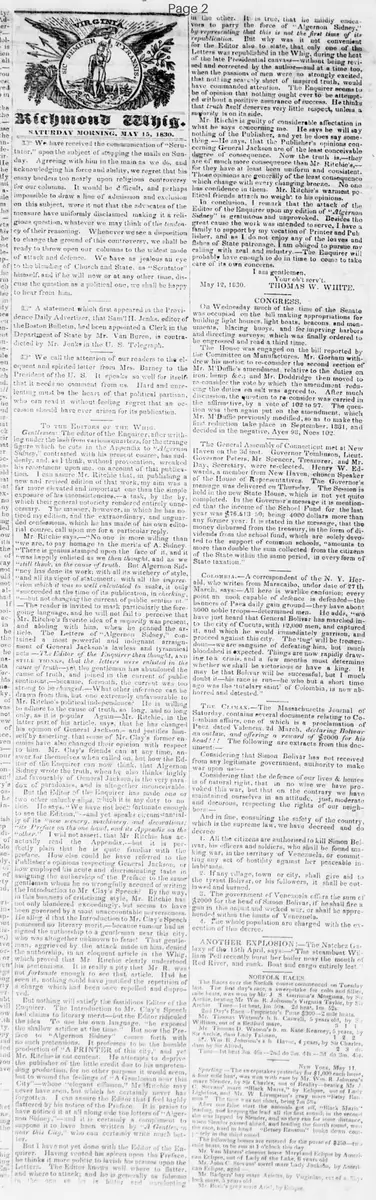
TO THE EDITORS OF THE WHIG.
Gentlemen: The editor of the Enquirer, after writhing under the lash from various quarters, for the strange figure which he cuts in the Appendix to "Algernon Sidney," contrasted with his present course, has suddenly, and, as I think, without provocation, wreaked his resentment upon me, on account of that publication. I can assure Mr. Ritchie that, in publishing a new and revised edition of that work, my aim was a far more elevated and important one than the simple exposure of his inconsistencies,—a task, by the by, which their general notoriety rendered entirely unnecessary. The manner, however, in which he has noticed my edition, and the extraordinary, and unguarded confessions, which he has made of his own editorial course, call upon me for a particular reply.
Mr. Ritchie says,—"No one is more willing than we are, to pay homage to the merits of A. Sidney. There is genius stamped upon the face of it, and it was happily enlisted as we then thought, and as we still think, in the cause of truth. But Algernon Sidney has done its work; with all its witchery of style, and all its vigor of statement; with all the impression which it was so well calculated to make, it only succeeded at the time of its publication, in checking, but not changing the current of public sentiment."
The reader is invited to mark particularly the foregoing language, and he will not fail to perceive that Mr. Ritchie's favorite idea of a majority was present, and abiding with him, when he penned the article. The Letters of "Algernon Sidney," contained a most powerful and indignant arraignment of General Jackson's lawless and tyrannical acts—The Editor of the Enquirer then thought, and still thinks, that the letters were enlisted in the cause of truth—yet the gentleman has abandoned the cause of truth, and joined in the current of public sentiment,—because, forsooth, the current was too strong to be changed.—What other inference can be drawn from this, but one extremely unfavourable to Mr. Ritchie's political independence? He is willing to adhere to the cause of truth, so long, and so long only, as it is popular.
Again—Mr. Ritchie, in the latter part of his article, says, that he has changed his opinion of General Jackson.—and justifies himself by asserting, that some of Mr. Clay's former enemies have also changed their opinion with respect to him. Mr. Clay's friends can at any time, answer for themselves when called on, but how the Editor of the Enquirer can now think, that Algernon Sidney wrote the truth, when by also thinks highly and favourably of General Jackson, is the very paradox of paradoxes, and is altogether inconceivable.
But the Editor of the Enquirer has made one or two other unlucky slips, which it is my duty to notice. He says. "We have not been fortunate enough to see the Edition,"—and yet speaks circumstantially of its "new scenery, machinery, and decorations; …its Preface on the one hand, and its Appendix on the other." I will not assert, that Mr. Ritchie has actually read the Appendix,—but it is perfectly plain that he is quite familiar with the preface. How else could he have referred to the Publisher's opinions respecting General Jackson, or how employed his acute and discriminating taste in assigning the authorship of the Preface to the same gentleman whom he so wrongfully accused of writing the Introduction to Mr. Clay's Speech? By the way, in this business of criticising style, Mr. Ritchie has not only blundered exceedingly, but seems to have been governed by a most unaccountable perverseness. He alleged that the Introduction to Mr. Clay's Speech possessed no literary merit,—because rumour had assigned the authorship to a gentleman near this city, who was altogether unknown to fame! That gentleman, aggrieved by the attack made on him, denied the authorship, in an eloquent article in the Whig, which proved that Mr. Ritchie clearly understood his pretensions. It is really a pity that Mr. R. was not fortunate enough to see that article. Had he seen it, nothing could have justified the repetition of a charge which had been once repelled and disproved.
But nothing will satisfy the fastidious Editor of the Enquirer. The Introduction to Mr. Clay's Speech had claims to literary merit—but the Editor ridiculed the idea. To use his own language, "he exposed the shallow artifice at the time."
But now the Preface to "Algernon Sidney" comes forth with no such pretensions. It professes to be the humble production of "A PRINTER of this city," and yet Mr. Ritchie is not content. He attempts to deprive the publisher of the little credit due to his unpretending production, for no other purpose it would seem, but to wound the feelings of "A Gentleman near this City"—whose "elegant effusion," Mr. Ritchie may never have seen, but which he certainly never has forgotten. I can assure the Editor that I feel highly flattered by his notice of the Preface. It is praise to have noticed it at all alongside the letters of "Algernon Sidney,"—and it is certainly a compliment to suppose it to have been written by "Gentlemen near this City," who can certainly write much better.
But I have not yet done with the Editor of the Enquirer. Having vented his spleen upon the Preface, he thinks it more politic to lavish his praise upon the Letters. The Editor knows well where to flatter, and where to attack; and he is generally as fulsome in the one end he is bitter and unrelenting in the other. It is true, that he mildly endeavors to parry the force of "Algernon Sidney," by representing that this is not the first time of its republication.
But why was it not convenient for the Editor also to state, that only one of the Letters was republished in the Whig, during the heat of the late Presidential canvass—without being revised and corrected by the author—and at a time too, when the passions of men were so strongly excited, that nothing scarcely short of inspired truth, would have commanded attention. The Enquirer seems to be of opinion that nothing ought ever to be attempted without a positive assurance of success. He thinks that truth itself deserves very little respect, unless a majority is on its side.
Mr. Ritchie is guilty of considerable affectation in what he says concerning me. He says he will say nothing of the Publisher, and yet he does say something.—He says, that the Publisher's opinions concerning General Jackson are of the least conceivable degree of consequence. Now the truth is,—they are of much more consequence than Mr. Ritchie's,—for they have at least been uniform and consistent. Those opinions are generally of the least consequence which change with every changing breeze. No one has confidence in them. Mr. Ritchie's warmest political friends attach no weight to his opinions.
In conclusion, I remark that the attack of the Editor of the Enquirer upon my edition of "Algernon Sidney" is gratuitous and unprovoked. Besides the great cause the work was intended to serve, I have a family to support by my vocation of Printer and Publisher, and as I do not enjoy any of the loaves and fishes of State patronage, I am obliged to pursue my calling with zeal and industry.—The Enquirer will probably have enough to do in these times to come to take care of its own concerns.
I am gentlemen,
Your ob't serv't.
THOMAS W. WHITE.
May 12, 1830.
Gentlemen: The editor of the Enquirer, after writhing under the lash from various quarters, for the strange figure which he cuts in the Appendix to "Algernon Sidney," contrasted with his present course, has suddenly, and, as I think, without provocation, wreaked his resentment upon me, on account of that publication. I can assure Mr. Ritchie that, in publishing a new and revised edition of that work, my aim was a far more elevated and important one than the simple exposure of his inconsistencies,—a task, by the by, which their general notoriety rendered entirely unnecessary. The manner, however, in which he has noticed my edition, and the extraordinary, and unguarded confessions, which he has made of his own editorial course, call upon me for a particular reply.
Mr. Ritchie says,—"No one is more willing than we are, to pay homage to the merits of A. Sidney. There is genius stamped upon the face of it, and it was happily enlisted as we then thought, and as we still think, in the cause of truth. But Algernon Sidney has done its work; with all its witchery of style, and all its vigor of statement; with all the impression which it was so well calculated to make, it only succeeded at the time of its publication, in checking, but not changing the current of public sentiment."
The reader is invited to mark particularly the foregoing language, and he will not fail to perceive that Mr. Ritchie's favorite idea of a majority was present, and abiding with him, when he penned the article. The Letters of "Algernon Sidney," contained a most powerful and indignant arraignment of General Jackson's lawless and tyrannical acts—The Editor of the Enquirer then thought, and still thinks, that the letters were enlisted in the cause of truth—yet the gentleman has abandoned the cause of truth, and joined in the current of public sentiment,—because, forsooth, the current was too strong to be changed.—What other inference can be drawn from this, but one extremely unfavourable to Mr. Ritchie's political independence? He is willing to adhere to the cause of truth, so long, and so long only, as it is popular.
Again—Mr. Ritchie, in the latter part of his article, says, that he has changed his opinion of General Jackson.—and justifies himself by asserting, that some of Mr. Clay's former enemies have also changed their opinion with respect to him. Mr. Clay's friends can at any time, answer for themselves when called on, but how the Editor of the Enquirer can now think, that Algernon Sidney wrote the truth, when by also thinks highly and favourably of General Jackson, is the very paradox of paradoxes, and is altogether inconceivable.
But the Editor of the Enquirer has made one or two other unlucky slips, which it is my duty to notice. He says. "We have not been fortunate enough to see the Edition,"—and yet speaks circumstantially of its "new scenery, machinery, and decorations; …its Preface on the one hand, and its Appendix on the other." I will not assert, that Mr. Ritchie has actually read the Appendix,—but it is perfectly plain that he is quite familiar with the preface. How else could he have referred to the Publisher's opinions respecting General Jackson, or how employed his acute and discriminating taste in assigning the authorship of the Preface to the same gentleman whom he so wrongfully accused of writing the Introduction to Mr. Clay's Speech? By the way, in this business of criticising style, Mr. Ritchie has not only blundered exceedingly, but seems to have been governed by a most unaccountable perverseness. He alleged that the Introduction to Mr. Clay's Speech possessed no literary merit,—because rumour had assigned the authorship to a gentleman near this city, who was altogether unknown to fame! That gentleman, aggrieved by the attack made on him, denied the authorship, in an eloquent article in the Whig, which proved that Mr. Ritchie clearly understood his pretensions. It is really a pity that Mr. R. was not fortunate enough to see that article. Had he seen it, nothing could have justified the repetition of a charge which had been once repelled and disproved.
But nothing will satisfy the fastidious Editor of the Enquirer. The Introduction to Mr. Clay's Speech had claims to literary merit—but the Editor ridiculed the idea. To use his own language, "he exposed the shallow artifice at the time."
But now the Preface to "Algernon Sidney" comes forth with no such pretensions. It professes to be the humble production of "A PRINTER of this city," and yet Mr. Ritchie is not content. He attempts to deprive the publisher of the little credit due to his unpretending production, for no other purpose it would seem, but to wound the feelings of "A Gentleman near this City"—whose "elegant effusion," Mr. Ritchie may never have seen, but which he certainly never has forgotten. I can assure the Editor that I feel highly flattered by his notice of the Preface. It is praise to have noticed it at all alongside the letters of "Algernon Sidney,"—and it is certainly a compliment to suppose it to have been written by "Gentlemen near this City," who can certainly write much better.
But I have not yet done with the Editor of the Enquirer. Having vented his spleen upon the Preface, he thinks it more politic to lavish his praise upon the Letters. The Editor knows well where to flatter, and where to attack; and he is generally as fulsome in the one end he is bitter and unrelenting in the other. It is true, that he mildly endeavors to parry the force of "Algernon Sidney," by representing that this is not the first time of its republication.
But why was it not convenient for the Editor also to state, that only one of the Letters was republished in the Whig, during the heat of the late Presidential canvass—without being revised and corrected by the author—and at a time too, when the passions of men were so strongly excited, that nothing scarcely short of inspired truth, would have commanded attention. The Enquirer seems to be of opinion that nothing ought ever to be attempted without a positive assurance of success. He thinks that truth itself deserves very little respect, unless a majority is on its side.
Mr. Ritchie is guilty of considerable affectation in what he says concerning me. He says he will say nothing of the Publisher, and yet he does say something.—He says, that the Publisher's opinions concerning General Jackson are of the least conceivable degree of consequence. Now the truth is,—they are of much more consequence than Mr. Ritchie's,—for they have at least been uniform and consistent. Those opinions are generally of the least consequence which change with every changing breeze. No one has confidence in them. Mr. Ritchie's warmest political friends attach no weight to his opinions.
In conclusion, I remark that the attack of the Editor of the Enquirer upon my edition of "Algernon Sidney" is gratuitous and unprovoked. Besides the great cause the work was intended to serve, I have a family to support by my vocation of Printer and Publisher, and as I do not enjoy any of the loaves and fishes of State patronage, I am obliged to pursue my calling with zeal and industry.—The Enquirer will probably have enough to do in these times to come to take care of its own concerns.
I am gentlemen,
Your ob't serv't.
THOMAS W. WHITE.
May 12, 1830.
What sub-type of article is it?
Persuasive
Political
Provocative
What themes does it cover?
Politics
What keywords are associated?
Algernon Sidney
Thomas Ritchie
Andrew Jackson
Henry Clay
Political Inconsistency
Editorial Criticism
Presidential Canvass
What entities or persons were involved?
Thomas W. White.
Editors Of The Whig
Letter to Editor Details
Author
Thomas W. White.
Recipient
Editors Of The Whig
Main Argument
white defends his edition of 'algernon sidney' against ritchie's unprovoked criticism, accusing ritchie of abandoning truth for popular sentiment in supporting jackson, highlighting ritchie's inconsistencies and errors in judgment.
Notable Details
Quotes Ritchie's Praise And Admission About 'Algernon Sidney'
References Jackson's Lawless Acts
Criticizes Ritchie's Changing Opinion On Jackson And Clay
Points Out Ritchie's Familiarity With Preface Despite Claiming Not To Have Seen The Edition
Defends Consistency Of His Own Opinions