Thank you for visiting SNEWPapers!
Sign up free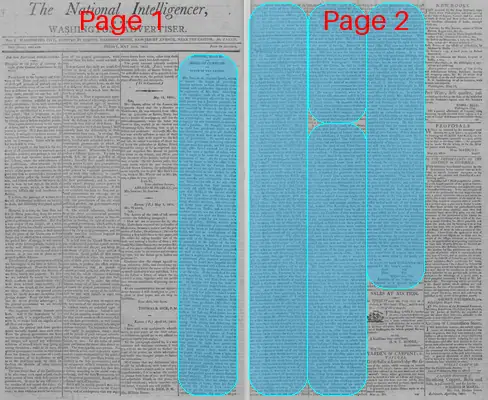
The National Intelligencer And Washington Advertiser
Washington, District Of Columbia
What is this article about?
In the House of Commons on March 25, Mr. Fox delivered a speech criticizing the war with France, foreign policy towards northern powers and Russia, the Irish situation, and calling for an inquiry into the state of the nation. Mr. Addington defended the new administration. Mr. Grey's motion for inquiry was defeated 103-291.
Merged-components note: Single continued report on the House of Commons debate on the state of the nation, split across multiple components due to page and column boundaries.
Clippings

1 of 2
OCR Quality
Full Text
HOUSE OF COMMONS
STATE OF THE NATION.
Mr. Fox, in an eloquent speech, which we lament the length of preceding speeches prevents us from detailing, commenced with considerable ingenuity upon the arguments of Mr. Pitt. Adverting to the expression made use of by the latter, that the principle assumed by the northern powers was a Jacobin principle, he observed, that he believed the principle was first broached by Frederick the Great of Prussia;—whether that monarch was Jacobin or not, he did know, but Frederick was a philosopher, and might therefore, perhaps, in the new vocabulary, be denominated a Jacobin. He thought, however, the right hon. gentleman might as well have denominated the principle Deistical, for the term would have as well suited as that of Jacobinical. He agreed with the right hon. gentleman in denying that free bottoms make free goods, nor did his hon. friend, (Mr. Grey) contend for the principle, but upon a question of policy, whether it ought to be made the ground of a declaration of war. At the period when he had the honor to hold the office of Secretary of State for the Foreign Department, and which the right hon. gentleman had characterized as one marked by rash measures, though he was only in office three months, and consequently there was very little time for rash or for any other measures during that short period, he certainly did advise his Majesty to negotiate with Russia in the manner alluded to by the right hon. gentleman, but he did it with the consent of the Cabinet, consisting of twelve members, who all concurred in the same advice. The principle then assumed by Russia, and now by the northern powers, was not admitted by the treaty entered into with the former power, it was merely yielded for the moment as a matter of policy. Having entered into some further justification of his conduct relative to the treaty he had negotiated with Russia, and into an investigation of the neutral question, in which he commented upon most of the statements of Mr. Pitt, he proceeded to the subject of the war—From the language he had heard from that side of the house he should have imagined we were at the close of a successful war, and that a negotiation had been confidently mentioned after repeated unsuccessful attempts, he should have supposed the last year had been marked with a series of brilliant successes: the contrary, was known to be the case. If the conduct of his majesty's ministers, said Mr. Fox, was such as it ought to be, why shrink from enquiry. He scarcely ever knew the house to refuse it, and until his majesty's late ministers, who had on all occasions opposed it, he knew very few instances indeed wherein his majesty's ministers were not foremost in recommending the measure. Will the right hon. gentleman (Mr. Pitt) say we have gained more by this war than the enemy? Will he say, that a few islands in the East and West-Indies are equivalent for having doubled the national debt? If the object of the war was the taking those islands, and destroying the power of Austria, his majesty's ex-ministers have completely succeeded; but if it were to bear down the power of France they have completely failed. If enquiry was agreed to, the house would not have what papers the right hon. gentleman (Mr. Dundas) pleased to take out of his left hand pocket; they would have the papers which could throw a light on the mode of conducting this disastrous war. Did not the disgraceful retreat from Holland demand inquiry, where we purchased our permission to depart by a surrender of 5000 troops? Did not the improper post pitched upon to attack Holland demand enquiry. Even after this ill-conducted expedition, after the troops were even months at home, when his Royal Highness the Duke of York was required to get the troops in readiness for another expedition, did not his Royal
Divisions require two months to do so.
Did not this waste of time demand inquiry? The weather he said was too cold to attend the army—too cold to get the officers and soldiers acquainted. How different was the conduct of Bonaparte during the same period: in winter he braved the cold of a German climate; and in summer he fought the winter by crossing the Alps, and thereby obtained that memorable battle of Marengo, which put a period to the war, and at the same time gave a final blow to the power of Austria.
Why, he asked, did we not aid the Emperor of Germany with an army in Italy; or did the Emperor of Germany despise every aid we could afford but our money.
He condemned our refusing to treat singly with Bonaparte, and said we were now reduced to the necessity of doing so after all the powers on the continent had withdrawn from the conflict; to the disgrace of England, she was left to shift for herself, and was reduced below the dignity of one of the most petty Princes in Germany, by not being consulted in one single article of a peace which involved the balance of power in Europe, in a much greater degree than any peace that had preceded it.
This disgrace this country never before experienced. What hopes of peace, he said, could be entertained while those men were in power who rejoiced at the failure of the treaty at Lisle? What could be expected from the negotiations of the Noble Lord who was so forward in recommending allies to march into Paris? With respect to the first Lord of the Admiralty, no man could possibly have the smallest objection to him. Of the present Chancellor of the Exchequer, he could only say, that the implicit confidence he placed in his Majesty's ministers, was of itself sufficient cause for considering him an improper person to conclude a peace with Bonaparte, who had been termed by them "The Champion of Jacobinism—the Gaudy Puppet of Folly." With what grace can they offer terms of peace, who are really the gaudy puppets moved by other hands.
With respect to the Catholics of Ireland, the right hon. gentleman has said he gave no pledges—but will he say, a hope was not held out to them that they would be benefited by the Union: he himself said "one of the benefits of the Union will be, we may give to the Catholics of Ireland, or deny to them what they required, with more safety." This he said was also the opinion of Lord Clare. The right hon. gentleman (Mr. Pitt) has told the house, he resigned because he could not follow his inclination and his judgment with respect to the Catholics of Ireland. To what, he said, was the house reduced, when it was told beneficial measures will not be resorted to, because they do not come recommended from the crown—that house that was supposed to speak the sentiments of the people uninfluenced by the crown. The right hon. gentleman has even denied the house the benefit of the information he possesses. From the same cause, I remember Mr. Burke, when an honorable member of this house refused to tell something beneficial to the country, said, that it was the only case in which torture could be justified. He'll keep it to himself (said Mr. Fox) let we Jacobins should agree; and we are to be left in the dark. I believe in the rights of man—I say, Sir, I believe in the original rights of man, and he who does not do so is not worthy the benefit of mankind.
I think a Catholic man and a Protestant man ought alike to have the original right of man. Are all benefits to be abandoned because the right hon. gentleman has not the sanction of some persons? I respect the monarchy of the country, but the monarch has nothing to do with the private opinions of any member of parliament; he is to choose his ministers, and to give or refuse his assent to measures. On the right hon. gentleman (Mr. Pitt's) declaration that he wished to have remained in power to see this contest, so nearly brought to an issue, concluded, he said he did not give him credit; but perhaps he might suppose the declaration likely to keep the door to restoration open. The right hon. gentleman cannot wish to treat with Bonaparte; he has merely withdrawn to let somebody else do so. He said when he thought his attendance in parliament could be of any benefit to the people, they should have it, and his best exertions with it, for the good of his country. Did the right hon. gentleman suppose, that because parliament had granted him its support during a war of eight or nine years, it was not to withdraw it when it saw its error? If he argued in this way, the parliament that put a period to the American war must have been the most guilty of parliaments, although it received the thanks of the country. In the year 1778 and 80, that house went into a committee on the state of the nation; since the accession of the House of Hanover.
enquiry has not been resisted by any administration with such exertion and effect as by the persons who are just gone out of office. The country ought to know the extent of its difficulties. Did Bonaparte hide the state of affairs from the people of France? When that great man came to the government, he drew forth the energy of the country by representing things at least as bad as they were. He (Mr. Fox) always recommended peace, when we were at the zenith of success. Bonaparte always followed his success by offers of peace. Did that, as was the argument in this country, weaken his resources, or the confidence of his army? Weak contemptible little arguments. When he looked at the Union, he said he could not but do so with regret, when he reflected on the persons with whom we were united, lest we may by the Connection be brought to the same degraded state. He contended that the mass of no country was averse to a good government—a sure proof that the government of Ireland was a bad one. He was not surprised, when he reflected on the bills that were passed in Ireland, that the consequences which did follow should follow. He thought the state of Ireland, where tortures were introduced, and the cruelties of Robespierre improved upon, demanded a strict enquiry. He had always spoken his feelings—the conduct of the government that produced the rebellion was a subject for enquiry.
A gentleman in the course of the debate had said, that Lord Fitzwilliam held out prospects to the people of Ireland that produced the rebellion; if he did so unauthorized, why not enquire? The Irish conspirators never had any intercourse with France until after the recall of Lord Fitzwilliam—until all hopes of a supportable government were vanished. "The protestant ascendancy produced it—all the remedies applied have failed—coercion has failed. I love the Irish nation—I know them well: I know many individuals of that country, and if any country has a characteristic, that country is marked for gratitude above all others. I would have a catholic to have as much power and as much influence in the empire as a protestant—this I call catholic emancipation. When you do not give them a right to become members of parliament, you give them nothing—while they are exempted from this house, they are not virtually represented." The ministers—the late and present ministers, he said, boasted of the flourishing state of our manufactures; he desired them to ask the members for Yorkshire if that was the case there; he knew it was not, but that many of the manufacturers were without bread, and obliged to seek aid from their parishes. As to that, one sixth of the whole country lived by parish aid, burdens on society—and many who contribute to this unhappy mass were scarcely able to maintain themselves and their families. Could it be contended the war, was not the cause of all this? Could it be contended the war was not the cause of the high price of bread, and of every other article of life. Even all peace could not cure, though it would relieve the people. He concluded by trusting the house would go into the enquiry.
The Chancellor of the exchequer (Mr. Addington) said, he could not consent to give a silent vote on the important subject before the house, yet he would not trouble the house any length of time. After what had been said, he observed, by his honorable friends, he should not find it necessary to do so. They had already so ably justified their own conduct, that it merely remained for him to remark on a few observations which fell from the hon. gentleman who preceded him; but before he did so, he begged leave to assure the house that the situation he had the honor to be called by his sovereign to fill was one which he was aware must be attended with difficulties, and to which he must sacrifice many of the domestic enjoyments of a husband and a father. The honor that house had done him in three successive parliaments in choosing him as their speaker, had left the most lasting impressions on his mind, and the situation in which their choice had placed him, he relinquished only from a sense of duty to his sovereign and his country. And he could not help regretting that the ostensible place he held in the present administration was likely to expose him to differ in opinion with many hon. gentlemen whose friendship he had a long time possessed. Mr. Addington, in adverting to his colleagues, and himself, said, it was by no means fair to prejudge them. He assured the hon. gentleman who accused them and him of acting under the directions and influence of his majesty's late ministers, that the charge was an unjust one. He wished the hon. gentleman to know, that however much he respected those right hon. gentlemen who have just gone out of office, he recognised no system but that which appeared best for the service of his sovereign.
A great deal had been said by those hon. gentlemen about his majesty's present ministers not possessing the confidence of the people; he trusted, however, that the conduct of that house and the country, would not bear the hon. gentleman out in his assertion. With respect to the northern confederacy, the principles laid down by his right honorable friend (Mr. Pitt) were not denied by the hon. gentleman; the code of maritime law is too clear to admit dispute. It is very true, as the hon. gentleman observed, that the king of Prussia did deny the justice of those laws, but he was afterwards induced to relinquish the principles he had espoused. The right of search, he said, should be ever exercised with lenity, and he still hoped the negociation with the Danes might succeed. But the right of search was all and all in this country. He trusted that though a heavy cloud might be suspended, yet firm and temperate conduct, would assuredly dispel it. In respect to the question of peace, Mr. Addington observed that his majesty's ministers were disposed and determined to take such steps as they conceived to be calculated for peace. No form of government in France should be an obstruction to negociation; and with this disposition on the part of the country, the success of the attempt would depend wholly on terms. He had no reason to suppose that the enemy were averse to negociation. But it would be in vain to talk of their sincerity, if they demanded terms that were inconsistent with the honor and security of this country. He disliked asperity of language towards any person, and was always concerned when it was used. He trusted a firm and temperate conduct, both towards France and neutral nations would soon dispel the clouds that hung over this country. With respect to Ireland, he observed, that he had no inclination to erect the standard of intolerance, yet at present he did not feel himself called upon to enter upon the subject of the Catholic expectations. Thus far he would say, that catholics and dissenters he looked upon as good subjects, and entitled to the protection of the house and the country. He contended, that the distresses of the country, and the high price of provisions, did not, as the hon. gentleman had asserted, arise out of the war; those distresses he said arose out of the seasons. The hon. gentleman, he said contended that the interference of that house had had no good effect on the price of provisions. For his part all he hoped for was answered, he was always persuaded the great good that would arise would be the increasing supplies and diminishing consumption, and who would say these two important ends were not answered? He denied that investigation was always the consequence of the measure being proposed in that house, as stated by the hon. gentleman; he instanced four cases, from the year 1740, to the commencement of the late administration, when committees of enquiry were either refused, or when voted by the house, not acted upon.
At length the house divided, when there appeared for Mr. Grey's motion
Ayes 103
Noes 291
Majority—188.
Exclusive of the Tellers.
(Adjourned at a quarter before five o'clock this morning.)
What sub-type of article is it?
What keywords are associated?
What entities or persons were involved?
Where did it happen?
Foreign News Details
Primary Location
London
Event Date
March 25
Key Persons
Outcome
mr. grey's motion for inquiry defeated: ayes 103, noes 291, majority 188.
Event Details
Debate in the House of Commons on the state of the nation, where Mr. Fox criticized past and present ministers' handling of the war with France, neutral rights of northern powers, Russian treaty, Irish Catholic issues, and economic distress, calling for an inquiry. Mr. Addington defended the new administration's policies on peace negotiations, maritime law, and Irish matters, attributing distress to seasons rather than war.