Thank you for visiting SNEWPapers!
Sign up free
The National Intelligencer And Washington Advertiser
Washington, District Of Columbia
What is this article about?
Washington City report on Boston newspapers' reactions to President Madison's August proclamation reinstating the non-intercourse law against Great Britain due to unfulfilled promises by British minister Erskine. Centinel and Gazette approve; Repertory and Palladium silent, but Repertory publishes a neutral article on U.S. foreign policy.
Clipping
OCR Quality
Full Text
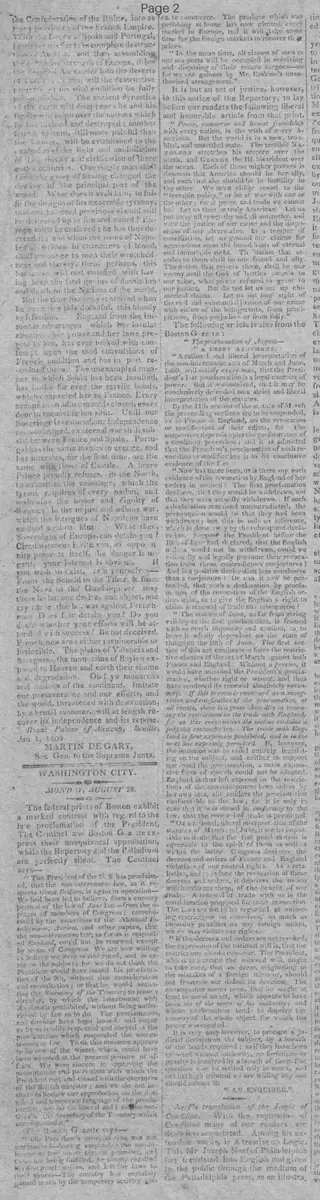
MONDAY, AUGUST 28.
The federal prints of Boston exhibit
a marked contrast with regard to the
late proclamation of the President.
The Centinel and Boston Gazette ex-
press their unequivocal approbation,
while the Repertory and the Palladium
are perfectly silent. The Centinel
says--.
"The President of the U. S. has proclaim-
ed, that the non-intercourse law, as it re-
spects Great Britain, is again in operation—
We had been led to believe, from a cursory
perusal of the law of June last—from the o-
pinion of members of Congress; corrobo-
rated by the assertions of the National In-
telligencer, Aurora, and other papers, that
the non-intercourse law, as far as it respected
England, could not be renewed except
by an act of Congress. We are now willing
to believe we were misinformed, and in er-
ror on the subject; for we do not think the
President would have issued his proclama-
tion of the 4th, without due consideration
and consultation; or that he would autho-
rize the Secretary of the Treasury to issue a
circular, by which the intercourse with
England is prohibited, without being autho-
rised by law so to do. The proclamation
and circular have been issued: and ought
to be as regularly respected and obeyed as the
proclamation which suspended the non-in-
tercourse law. To us this measure appears
to be one of the wisest which could have
been adopted at the present posture of af-
fairs. We were sincere in approving the
promptitude and patriotism with which the
President met and closed with the overtures
of the British minister; and we do not hesi-
tate to bestow our approbation on the dig-
nified and temperate language of the procla-
mation; and on the liberal and construe-
tion of the Secretary of the Treasury which
accompanied it."
The Boston Gazette says--
"The President's proclamation was not
unexpected. Having suspended the non-in-
tercourse law under certain promises, and
these not being fulfilled, he simply revoked
his first proclamation, and left the laws to
their course. The country has certainly
gained much by the temporary activity giv-
en to commerce. The produce which was
perishing at home has now glutted every
market in Europe, and it will take some
time for the foreign markets to recover their
prices.
"In the mean time, all classes of men in
our sea-ports will be occupied in receiving
and disposing of their return cargoes—so
far we are gainers by Mr. Erskine's unau-
thorised arrangement."
It is but an act of justice, however,
in this notice of the Repertory, to lay
before our readers the following liberal
and honorable article from that print.
"Peace, commerce and honest friendship
with every nation, is the wish of every A-
merican. But the world is in a new, trou-
bled, and unsettled state. The terrible Na-
poleon stretches his sceptre over the
earth, and George the III. his trident over
the ocean. Each of these mighty powers is
desirous that America should be her ally,
and each that she should be in hostility to
the other. We must either resort to the
"terrapin policy," or be at war with one or
the other; for it peace and trade we cannot
be. Let us then be truly American. Let us
put away all sympathy and all antipathy, and
view the justice of our cause and the disposi-
tion of our adversaries. In a temper of
conciliation, let us ground our claims for
aggressions upon the broad basis of eternal
and immutable right. The nation that ac-
cedes to them shall be our friend and ally.
The nation that rejects them, shall be our
enemy until the God of battles awards to
our valor, what power refused to grant to
our justice. But do not let us set up chi-
merical claims. Let us not lose sight of
the real and substantial justice of our cause
with either of the belligerents, from precipi-
tance, from prejudice or from folly.
The following article is also from the
Boston Gazette:
"The proclamation of August—
A SHORT ARGUMENT.
"A rational and liberal interpretation of
the non-intercourse acts of March and June,
1809, will satisfy every man, that the Presi-
dent's last proclamation is a legal exercise of
power. But it is conceived, that it may be
conclusively defended on a strict and literal
interpretation of the statutes.
By the 11th section of the statute of March
the preceding sections are to be suspended.
as to France or England, on the revocation
or modification of their edicts. &c. The
suspension depends upon the performance of
a condition precedent; and it is admitted
that the President's proclamation of such re-
vocation or modification is to be conclusive
evidence of the fact.
"Now has there been, or is there any such
evidence of the revocation by England of her
orders in council? The first proclamation
declares, that they would be withdrawn, not
that they were actually withdrawn. If such
a declaration remained uncontradicted, the
presumption would be that they had been
withdrawn; but this is only an inference,
which is done away by the subsequent decla-
ration. Suppose the President before the
10th of June had declared, that the English
orders would not be withdrawn, could we
rationally and legally presume their revoca-
tion from these contradictory conjectures?
And is a positive declaration less conclusive
than a conjecture? Or can it now be pre-
tended, that such a declaration by proclama-
tion of the revocation of the English orders,
exist, as to give the English a right to
claim a renewal of trade and intercourse?
"The statute of June, so far from giving
validity to the first proclamation, is framed
with so much ingenuity and caution, as to
leave it wholly dependent on the state of
things on the 10th of June. The first sec-
tion of this act continues in force the restric-
tive clauses of the act of March against both
France and England. Without a proviso, it
would have annulled the President's procla-
mation, whether right or wrong, and thus
have rendered its renewal absolutely neces-
sary. If this proviso is construed as a recog-
nition and ratification of the proclamation, at
all events, there is a gross absurdity in renew-
ing the restrictions on the trade with England;
for on this construction the section contains a
palpable contradiction. The trade with Eng-
land is first expressly prohibited, and is in the
next line expressly permitted. If, however,
the intention was to avoid entirely legisla-
ting on the subject, and neither to support
nor annul the proclamation, a more expres-
sive form of speech could not be adopted.
England is thus left exposed to the restric-
tions of the non-intercourse laws unless by
her own acts, she renders the proclamation
conformable to the law; for it is only in case
that it was issued in conformity to the
law, that the renewal of trade is permitted.
"On a rational, liberal interpretation of the
statutes of March and June, it seems impos-
sible to doubt that the last proclamation is
agreeable to the spirit of them as well as
within the letter. Congress declares the
decrees and orders of France and England
violations of our neutral rights. As a reta-
liation, and to induce the revocation of these
decrees and orders, it deprives the nation
which enforces them, of the benefit of our
trade. A renewal of trade with us is the
consideration proposed for their revocation.
The laws are not to be regarded as enforc-
ing restrictions on ourselves, so much as
imposing penalties on any foreign nation,
which may violate our rights.
"If the decrees and orders are not revoked,
the expression of the national will is, that the
restrictions should continue. The President,
who is to execute the national will, ought
to take care, that an error, originating in
the mistakes of a foreign minister, should
not frustrate nor defeat its decision. The
consequence seems to be, that he ought at
least to annul an act, which appears to have
been out of the scope of his authority; and
whose confirmation tends to deprive the
country of the whole object for which the
power was created.
It is very easy however, to procure a ju-
dicial decision on the subject, by a breach
of the bonds required; as if they have been
exacted without authority, no forfeiture or
penalty is incurred by a breach of them. The
question can be settled only in court, and
to that high tribunal we are willing any one
should submit it.
"AN ENQUIRER."
What sub-type of article is it?
What keywords are associated?
What entities or persons were involved?
Where did it happen?
Domestic News Details
Primary Location
Boston
Event Date
Monday, August 28
Key Persons
Event Details
Boston newspapers react to the President's proclamation reinstating the non-intercourse law against Great Britain after unfulfilled promises. The Centinel and Boston Gazette approve the measure and its legal basis. The Repertory remains silent but publishes an article advocating neutral U.S. policy toward belligerents. Detailed arguments on the legality of the proclamation under the acts of March and June 1809 are provided.