Thank you for visiting SNEWPapers!
Sign up free
Mexico Missouri Message
Mexico, Audrain County, Missouri
What is this article about?
Essay on the deep affection in united families, where members make sacrifices for each other, exemplified by a tragic anecdote of a daughter's unappreciated devotion leading to her loneliness, emphasizing family pride, loyalty, and moral virtues over individual desires.
Clipping
OCR Quality
Full Text
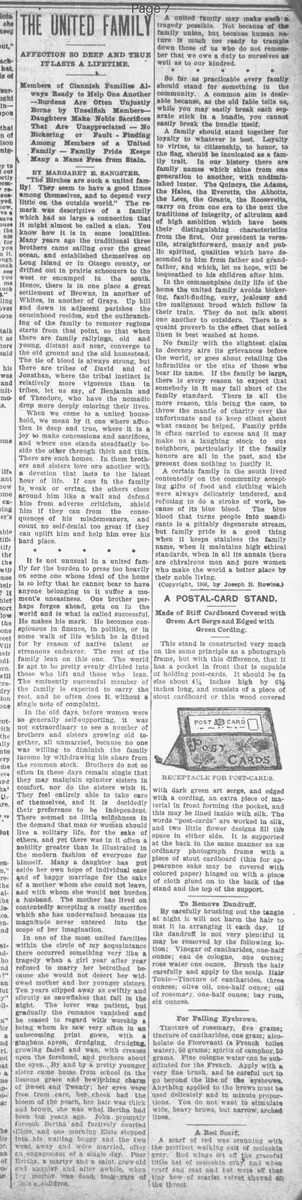
Members of Clannish Families Always Ready to Help One Another—Burdens Are Often Unjustly Borne by Unselfish Members—Daughters Make Noble Sacrifices That Are Unappreciated—No Bickering or Fault-Finding Among Members of a United Family—Family Pride Keeps Many a Name Free from Stain.
BY MARGARET E. SANGSTER.
"The Birches are such a united family! They seem to have a good time among themselves, and to depend very little on the outside world." The remark was descriptive of a family which had so large a connection that it might almost be called a clan. You know how it is in some localities.
Many years ago the traditional three brothers came sailing over the great ocean, and established themselves on Long Island or in Otsego county, or drifted out in prairie schooners to the west or encamped in the south.
Hence, there is in one place a great settlement of Browns, in another of Whites, in another of Grays. Up hill and down in adjacent parishes the cousinhood resides, and the outbranching of the family to remoter regions starts from that point, so that when there are family rallyings, old and young, distant and near, converge to the old ground and the old homestead.
The tie of blood is always strong, but there are tribes of David and of Jonathan, where the tribal instinct is relatively more vigorous than in tribes, let us say, of Benjamin and of Theodore, who have the nomadic drop more deeply coloring their lives.
When we come to a united household, we mean by it one where affection is deep and true, where it is a joy to make concessions and sacrifices, and where one stands steadfastly beside the other through thick and thin.
There are such homes. In them brothers and sisters love one another with a devotion that lasts to the latest hour of life. If one in the family is weak or erring, the others close around him like a wall and defend him from adverse criticism, shield him if they can from the consequences of his misdemeanors, and count no self-denial too great if they can uplift him and help him over his hard place.
It is not unusual in a united family for the burden to press too heavily on some one whose ideal of the home is so lofty that he cannot bear to have anyone belonging to it suffer a moment's uneasiness. One brother perhaps forges ahead, gets on in the world and is what is called successful.
He makes his mark. He becomes conspicuous in finance, in politics, or in some walk of life which he is fitted for by reason of native talent or strenuous endeavor. The rest of the family lean on this one. The world is apt to be pretty evenly divided into those who lift and those who lean.
The eminently successful member of the family is expected to carry the rest, and he often does it without a single note of complaint.
In the old days, before women were so generally self-supporting, it was not extraordinary to see a number of brothers and sisters growing old together, all unmarried, because no one was willing to diminish the family income by withdrawing his share from the common stock. Brothers do not so often in these days remain single that they may maintain spinster sisters in comfort, nor do the sisters wish it.
They feel entirely able to take care of themselves, and it is decidedly their preference to be independent.
There seemed no little selfishness in the demand that man or woman should live a solitary life, for the sake of others, and yet there was in it often a nobility greater than is illustrated in the modern fashion of everyone for himself. Many a daughter has put aside her own hope of individual ease and of happy marriage for the sake of a mother whom she could not leave, and with whom she would not burden a husband. The mother has lived on contentedly accepting a costly sacrifice which she has undervalued because its magnitude never entered into the scope of her imagination.
In one of the most united families within the circle of my acquaintance there occurred something very like a tragedy when a girl year after year refused to marry her betrothed because she would not desert her widowed mother and her younger sisters.
Ten years slipped away as swiftly and silently as snowflakes that fall in the night. The lover was patient, but gradually the romance vanished and he ceased to regard with worship a being whom he saw very often in an unbecoming print gown, with a gingham apron, drudging, drudging, growing faded and wan, with creases upon the forehead, and puckers about the eyes. By and by a pretty younger sister came home from school in the lissome grace and bewitching charm of Sweet and Twenty: her eyes were free from care, her cheek had the bloom of the peach, her hair was thick and brown, she was what Bertha had been ten years ago. John, promptly forsook Bertha and furtively courted Elsie, and one morning Elsie stepped into his waiting buggy and the two went away and were married, after an engagement of a single day. Poor Bertha, a martyr and a saint, grew old and angular and after awhile when her mother was dead, took care of Elsie's children.
A united family may make such tragedy possible. Not because of the family union, but because human nature is much too ready to trample down those of us who do not remember that we owe a duty to ourselves as well as to our kindred.
So far as practicable every family should stand for something in the community. A common aim is desirable because, as the old fable tells us, while you may easily break each separate stick in a bundle, you cannot easily break the bundle itself.
A family should stand together for loyalty to whatever is best. Loyalty to virtue, to citizenship, to honor, to the flag, should be inculcated as a family trait. In our history there are family names which shine from one generation to another, with undiminished luster. The Quincys, the Adams, the Hales, the Everetts, the Abbotts, the Lees, the Grants, the Roosevelts, carry on from one era to the next the traditions of integrity, of altruism and of high ambition which have been their distinguishing characteristics from the first. Our president is versatile, straightforward, manly and public spirited, qualities which have descended to him from father and grandfather, and which, let us hope, will be bequeathed to his children after him.
In the commonplace daily life of the home the united family avoids bickering, fault-finding, envy, jealousy and the malignant brood which follow in their train. They do not talk about one another to outsiders. There is a quaint proverb to the effect that soiled linen is best washed at home.
No family with the slightest claim to decency airs its grievances before the world, or goes about retailing the infirmities or the sins of those who bear its name. If the family be large, there is every reason to expect that somebody in it may fall short of the family standard. There is all the more reason, this being the case, to throw the mantle of charity over the unfortunate and to keep silent about what cannot be helped. Family pride is often carried to excess and it may make us a laughing stock to our neighbors, particularly if the family honors are all in the past, and the present does nothing to justify it.
A certain family in the south lived contentedly on the community accepting gifts of food and clothing which were always delicately tendered, and refusing to do a stroke of work, because of its blue blood. The blue blood that turns people into mendicants is a pitiably degenerate stream, but family pride is a good thing when it keeps stainless the family name, when it maintains high ethical standards, when in all its annals there are chivalrous men and pure women who make the world a better place by their noble living.
(Copyright, 1906, by Joseph B. Bowles.)
What sub-type of article is it?
What themes does it cover?
What keywords are associated?
What entities or persons were involved?
Where did it happen?
Story Details
Key Persons
Location
United States
Event Date
1906
Story Details
Essay praising united families' deep affections and sacrifices, illustrated by Bertha's decade-long refusal to marry to care for her mother and sisters, only for her fiancé John to marry her younger sister Elsie, leaving Bertha to raise their children after her mother's death; contrasts with historical virtuous families like the Adams and Roosevelts.