Thank you for visiting SNEWPapers!
Sign up free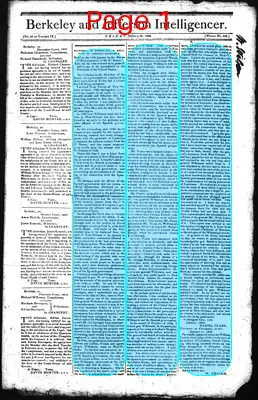
Story
January 29, 1808
Berkeley And Jefferson Intelligencer
Martinsburg, Berkeley County, Virginia
What is this article about?
Daniel Clark's 1808 sworn statement to the U.S. House details General James Wilkinson's secret arrangements with Spanish officials from 1787 onward to separate western U.S. territories, including pensions, money transfers, and failed plots.
Clipping
OCR Quality
98%
Excellent
Full Text
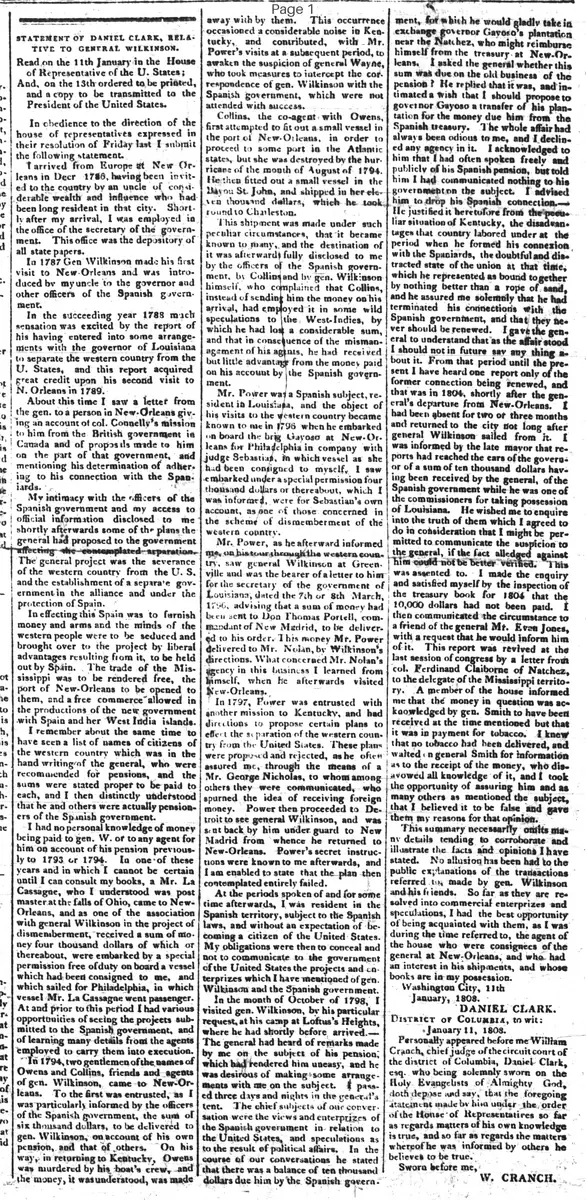
STATEMENT OF DANIEL CLARK, RELATIVE TO GENERAL WILKINSON.
Read on the 11th January in the House of Representatives of the U. States;
And, on the 13th ordered to be printed, and a copy to be transmitted to the President of the United States.
In obedience to the direction of the house of representatives expressed in their resolution of Friday last—I submit the following statement.
I arrived from Europe to New Orleans in Decr 1786, having been invited to the country by an uncle of considerable wealth and influence who had been long resident in that city. Shortly after my arrival, I was employed in the office of the secretary of the government.
This office was the depository of all state papers.
In 1787 Gen Wilkinson made his first visit to New-Orleans and was introduced by my uncle to the governor and other officers of the Spanish government.
In the succeeding year 1788 much sensation was excited by the report of his having entered into some arrangements with the governor of Louisiana to separate the western country from the U. States, and this report acquired great credit upon his second visit to N. Orleans in 1789.
About this time I saw a letter from the gen. to a person in New-Orleans giving an account of col. Connelly's mission to him from the British government in Canada and of proposals made to him on the part of that government, and mentioning his determination of adhering to his connection with the Spaniards.
My intimacy with the officers of the Spanish government and my access to official information disclosed to me shortly afterwards some of the plans the general had proposed to the government affecting the contemplated separation.
The general project was the severance of the western country from the U. S. and the establishment of a separate government in the alliance and under the protection of Spain.
In effecting this Spain was to furnish money and arms and the minds of the western people were to be seduced and brought over to the project by liberal advantages resulting from it, to be held out by Spain. The trade of the Mississippi was to be rendered free, the port of New-Orleans to be opened to them, and a free commerce allowed in the productions of the new government with Spain and her West India islands.
I remember about the same time to have seen a list of names of citizens of the western country which was in the hand writing of the general, who were recommended for pensions, and the sums were stated proper to be paid to each, and I then distinctly understood that he and others were actually pensioners of the Spanish government.
I had no personal knowledge of money being paid to gen. W. or to any agent for him on account of his pension previously to 1793, or 1794. In one of these years and in which I cannot be certain until I can consult my books, a Mr. La Cassagne, who I understood was post master at the falls of Ohio, came to New Orleans, and as one of the association with general Wilkinson in the project of dismemberment, received a sum of money four thousand dollars of which or thereabout, were embarked by a special permission free of duty on board a vessel which had been consigned to me, and which sailed for Philadelphia, in which vessel Mr. La Cassagne went passenger.
At and prior to this period I had various opportunities of seeing the projects submitted to the Spanish government, and of learning many details from the agents employed to carry them into execution.
In 1794, two gentlemen of the names of Owens and Collins, friends and agents of gen. Wilkinson, came to New-Orleans. To the first was entrusted, as I was particularly informed by the officers of the Spanish government, the sum of six thousand dollars, to be delivered to gen. Wilkinson, on account of his own pension, and that of others. On his way, in returning to Kentucky, Owens was murdered by his boat's crew and the money, it was understood, was made away with by them. This occurrence occasioned a considerable noise in Kentucky, and contributed, with Mr. Power's visits at a subsequent period, to awaken the suspicion of general Wayne, who took measures to intercept the correspondence of gen. Wilkinson with the Spanish government, which were not attended with success.
Collins, the co-agent, with Owens, first attempted to fit out a small vessel in the port of New-Orleans, in order to proceed to some port in the Atlantic states, but she was destroyed by the hurricane of the month of August of 1794. He then fitted out a small vessel in the Bayou St. John, and shipped in her eleven thousand dollars, which he took round to Charleston.
This shipment was made under such peculiar circumstances, that it became known to many, and the destination of it was afterwards fully disclosed to me by the officers of the Spanish government, by Collins and by gen. Wilkinson himself, who complained that Collins, instead of sending him the money on his arrival, had employed it in some wild speculations to the West-Indies, by which he had lost a considerable sum, and that in consequence of the mismanagement of his agents, he had received but little advantage from the money paid on his account by the Spanish government.
Mr. Power was a Spanish subject, resident in Louisiana, and the object of his visits to the western country became known to me in 1796 when he embarked on board the brig Gavoso at New-Orleans for Philadelphia in company with judge Sebastian, in which vessel as she had been consigned to myself, I saw embarked under a special permission four thousand dollars or thereabout, which I was informed, were for Sebastian's own account, as one of those concerned in the scheme of dismemberment of the western country.
Mr. Power, as he afterward informed me, on his tours through the western country, saw general Wilkinson at Greenville and was the bearer of a letter to him for the secretary of the government of Louisiana, dated the 7th or 8th March 1796, advising that a sum of money had been sent to Don Thomas Portell, commandant of New Madrid, to be delivered to his order. This money Mr. Power delivered to Mr. Nolan, by Wilkinson's directions. What concerned Mr. Nolan's agency in this business I learned from himself, when he afterwards visited New-Orleans.
In 1797, Power was entrusted with another mission to Kentucky, and had directions to propose certain plans to effect the separation of the western country from the United States. These plans were proposed and rejected, as he often assured me, through the means of a Mr. George Nicholas, to whom among others they were communicated, who spurned the idea of receiving foreign money. Power then proceeded to Detroit to see general Wilkinson, and was sent back by him under guard to New Madrid from whence he returned to New-Orleans. Power's secret instructions were known to me afterwards, and I am enabled to state that the plan then contemplated entirely failed.
At the periods spoken of and for some time afterwards, I was resident in the Spanish territory, subject to the Spanish laws, and without an expectation of becoming a citizen of the United States.
My obligations were then to conceal and not to communicate to the government of the United States the projects and enterprises which I have mentioned of gen. Wilkinson and the Spanish government.
In the month of October of 1798, I visited gen. Wilkinson, by his particular request, at his camp at Loftus's Heights, where he had shortly before, arrived.
The general had heard of remarks made by me on the subject of his pension, which had rendered him uneasy, and he was desirous of making some arrangements with me on the subject. Passed three days and nights in the general's tent. The chief subjects of our conversation were the views and enterprises of the Spanish government in relation to the United States, and speculations as to the result of political affairs. In the course of our conversations he stated that there was a balance of ten thousand dollars due him by the Spanish government, for which he would gladly take in exchange governor Gayoso's plantation near the Natchez, who might reimburse himself from the treasury at New-Orleans. I asked the general whether this sum was due on the old business of the pension? He replied that it was, and intimated a wish that I should propose to governor Gayoso a transfer of his plantation for the money due him from the Spanish treasury. The whole affair had always been odious to me, and I declined any agency in it. I acknowledged to him that I had often spoken freely and publicly of his Spanish pension, but told him I had communicated nothing to his government on the subject. I advised him to drop his Spanish connection.
He justified it heretofore from the peculiar situation of Kentucky, the disadvantages that country labored under at the period when he formed his connexion with the Spaniards, the doubtful and distracted state of the union at that time, which he represented as bound together by nothing better than a rope of sand, and he assured me solemnly that he had terminated his connections with the Spanish government, and that they never should be renewed. I gave the general to understand that as the affair stood I should not in future say any thing about it. From that period until the present I have heard one report only of the former connection being renewed, and that was in 1804, shortly after the general's departure from New-Orleans. I had been absent for two or three months and returned to the city not long after general Wilkinson sailed from it. I was informed by the late mayor that reports had reached the ears of the governor of a sum of ten thousand dollars having been received by the general, of the Spanish government while he was one of the commissioners for taking possession of Louisiana. He wished me to enquire into the truth of them which I agreed to do in consideration that I might be permitted to communicate the suspicion to the general, if the fact alledged against him could not be better verified. This was assented to. I made the enquiry and satisfied myself by the inspection of the treasury book for 1804 that the 10,000 dollars had not been paid. I then communicated the circumstance to a friend of the general Mr. Evan Jones, with a request that he would inform him of it. This report was revived at the last session of congress by a letter from col. Ferdinand Claiborne of Natchez, to the delegate of the Mississippi territory. A member of the house informed me that the money in question was acknowledged by gen. Smith to have been received at the time mentioned but that it was in payment for tobacco. I knew that no tobacco had been delivered, and waited on general Smith for information as to the receipt of the money, who disavowed all knowledge of it, and I took the opportunity of assuring him and as many others as mentioned the subject, that I believed it to be false and gave them my reasons for that opinion.
This summary necessarily omits many details tending to corroborate and illustrate the facts and opinions I have stated. No allusion has been had to the public explanations of the transactions referred to, made by gen. Wilkinson and his friends. So far as they are resolved into commercial enterprizes and speculations, I had the best opportunity of being acquainted with them, as I was during the time referred to, the agent of the house who were consignees of the general at New-Orleans, and who had an interest in his shipments, and whose books are in my possession.
Washington City, 11th January, 1808.
DANIEL CLARK.
District of Columbia, to wit:
January 11, 1808.
Personally appeared before me William Cranch, chief judge of the circuit court of the district of Columbia, Daniel Clark, esq. who being, solemnly sworn on the Holy Evangelists of Almighty God, doth depose and say, that the foregoing statement made by him under the order of the House of Representatives so far as regards matters of his own knowledge is true, and so far as regards the matters whereof he was informed by others he believes to be true.
Sworn before me,
W. CRANCH.
Read on the 11th January in the House of Representatives of the U. States;
And, on the 13th ordered to be printed, and a copy to be transmitted to the President of the United States.
In obedience to the direction of the house of representatives expressed in their resolution of Friday last—I submit the following statement.
I arrived from Europe to New Orleans in Decr 1786, having been invited to the country by an uncle of considerable wealth and influence who had been long resident in that city. Shortly after my arrival, I was employed in the office of the secretary of the government.
This office was the depository of all state papers.
In 1787 Gen Wilkinson made his first visit to New-Orleans and was introduced by my uncle to the governor and other officers of the Spanish government.
In the succeeding year 1788 much sensation was excited by the report of his having entered into some arrangements with the governor of Louisiana to separate the western country from the U. States, and this report acquired great credit upon his second visit to N. Orleans in 1789.
About this time I saw a letter from the gen. to a person in New-Orleans giving an account of col. Connelly's mission to him from the British government in Canada and of proposals made to him on the part of that government, and mentioning his determination of adhering to his connection with the Spaniards.
My intimacy with the officers of the Spanish government and my access to official information disclosed to me shortly afterwards some of the plans the general had proposed to the government affecting the contemplated separation.
The general project was the severance of the western country from the U. S. and the establishment of a separate government in the alliance and under the protection of Spain.
In effecting this Spain was to furnish money and arms and the minds of the western people were to be seduced and brought over to the project by liberal advantages resulting from it, to be held out by Spain. The trade of the Mississippi was to be rendered free, the port of New-Orleans to be opened to them, and a free commerce allowed in the productions of the new government with Spain and her West India islands.
I remember about the same time to have seen a list of names of citizens of the western country which was in the hand writing of the general, who were recommended for pensions, and the sums were stated proper to be paid to each, and I then distinctly understood that he and others were actually pensioners of the Spanish government.
I had no personal knowledge of money being paid to gen. W. or to any agent for him on account of his pension previously to 1793, or 1794. In one of these years and in which I cannot be certain until I can consult my books, a Mr. La Cassagne, who I understood was post master at the falls of Ohio, came to New Orleans, and as one of the association with general Wilkinson in the project of dismemberment, received a sum of money four thousand dollars of which or thereabout, were embarked by a special permission free of duty on board a vessel which had been consigned to me, and which sailed for Philadelphia, in which vessel Mr. La Cassagne went passenger.
At and prior to this period I had various opportunities of seeing the projects submitted to the Spanish government, and of learning many details from the agents employed to carry them into execution.
In 1794, two gentlemen of the names of Owens and Collins, friends and agents of gen. Wilkinson, came to New-Orleans. To the first was entrusted, as I was particularly informed by the officers of the Spanish government, the sum of six thousand dollars, to be delivered to gen. Wilkinson, on account of his own pension, and that of others. On his way, in returning to Kentucky, Owens was murdered by his boat's crew and the money, it was understood, was made away with by them. This occurrence occasioned a considerable noise in Kentucky, and contributed, with Mr. Power's visits at a subsequent period, to awaken the suspicion of general Wayne, who took measures to intercept the correspondence of gen. Wilkinson with the Spanish government, which were not attended with success.
Collins, the co-agent, with Owens, first attempted to fit out a small vessel in the port of New-Orleans, in order to proceed to some port in the Atlantic states, but she was destroyed by the hurricane of the month of August of 1794. He then fitted out a small vessel in the Bayou St. John, and shipped in her eleven thousand dollars, which he took round to Charleston.
This shipment was made under such peculiar circumstances, that it became known to many, and the destination of it was afterwards fully disclosed to me by the officers of the Spanish government, by Collins and by gen. Wilkinson himself, who complained that Collins, instead of sending him the money on his arrival, had employed it in some wild speculations to the West-Indies, by which he had lost a considerable sum, and that in consequence of the mismanagement of his agents, he had received but little advantage from the money paid on his account by the Spanish government.
Mr. Power was a Spanish subject, resident in Louisiana, and the object of his visits to the western country became known to me in 1796 when he embarked on board the brig Gavoso at New-Orleans for Philadelphia in company with judge Sebastian, in which vessel as she had been consigned to myself, I saw embarked under a special permission four thousand dollars or thereabout, which I was informed, were for Sebastian's own account, as one of those concerned in the scheme of dismemberment of the western country.
Mr. Power, as he afterward informed me, on his tours through the western country, saw general Wilkinson at Greenville and was the bearer of a letter to him for the secretary of the government of Louisiana, dated the 7th or 8th March 1796, advising that a sum of money had been sent to Don Thomas Portell, commandant of New Madrid, to be delivered to his order. This money Mr. Power delivered to Mr. Nolan, by Wilkinson's directions. What concerned Mr. Nolan's agency in this business I learned from himself, when he afterwards visited New-Orleans.
In 1797, Power was entrusted with another mission to Kentucky, and had directions to propose certain plans to effect the separation of the western country from the United States. These plans were proposed and rejected, as he often assured me, through the means of a Mr. George Nicholas, to whom among others they were communicated, who spurned the idea of receiving foreign money. Power then proceeded to Detroit to see general Wilkinson, and was sent back by him under guard to New Madrid from whence he returned to New-Orleans. Power's secret instructions were known to me afterwards, and I am enabled to state that the plan then contemplated entirely failed.
At the periods spoken of and for some time afterwards, I was resident in the Spanish territory, subject to the Spanish laws, and without an expectation of becoming a citizen of the United States.
My obligations were then to conceal and not to communicate to the government of the United States the projects and enterprises which I have mentioned of gen. Wilkinson and the Spanish government.
In the month of October of 1798, I visited gen. Wilkinson, by his particular request, at his camp at Loftus's Heights, where he had shortly before, arrived.
The general had heard of remarks made by me on the subject of his pension, which had rendered him uneasy, and he was desirous of making some arrangements with me on the subject. Passed three days and nights in the general's tent. The chief subjects of our conversation were the views and enterprises of the Spanish government in relation to the United States, and speculations as to the result of political affairs. In the course of our conversations he stated that there was a balance of ten thousand dollars due him by the Spanish government, for which he would gladly take in exchange governor Gayoso's plantation near the Natchez, who might reimburse himself from the treasury at New-Orleans. I asked the general whether this sum was due on the old business of the pension? He replied that it was, and intimated a wish that I should propose to governor Gayoso a transfer of his plantation for the money due him from the Spanish treasury. The whole affair had always been odious to me, and I declined any agency in it. I acknowledged to him that I had often spoken freely and publicly of his Spanish pension, but told him I had communicated nothing to his government on the subject. I advised him to drop his Spanish connection.
He justified it heretofore from the peculiar situation of Kentucky, the disadvantages that country labored under at the period when he formed his connexion with the Spaniards, the doubtful and distracted state of the union at that time, which he represented as bound together by nothing better than a rope of sand, and he assured me solemnly that he had terminated his connections with the Spanish government, and that they never should be renewed. I gave the general to understand that as the affair stood I should not in future say any thing about it. From that period until the present I have heard one report only of the former connection being renewed, and that was in 1804, shortly after the general's departure from New-Orleans. I had been absent for two or three months and returned to the city not long after general Wilkinson sailed from it. I was informed by the late mayor that reports had reached the ears of the governor of a sum of ten thousand dollars having been received by the general, of the Spanish government while he was one of the commissioners for taking possession of Louisiana. He wished me to enquire into the truth of them which I agreed to do in consideration that I might be permitted to communicate the suspicion to the general, if the fact alledged against him could not be better verified. This was assented to. I made the enquiry and satisfied myself by the inspection of the treasury book for 1804 that the 10,000 dollars had not been paid. I then communicated the circumstance to a friend of the general Mr. Evan Jones, with a request that he would inform him of it. This report was revived at the last session of congress by a letter from col. Ferdinand Claiborne of Natchez, to the delegate of the Mississippi territory. A member of the house informed me that the money in question was acknowledged by gen. Smith to have been received at the time mentioned but that it was in payment for tobacco. I knew that no tobacco had been delivered, and waited on general Smith for information as to the receipt of the money, who disavowed all knowledge of it, and I took the opportunity of assuring him and as many others as mentioned the subject, that I believed it to be false and gave them my reasons for that opinion.
This summary necessarily omits many details tending to corroborate and illustrate the facts and opinions I have stated. No allusion has been had to the public explanations of the transactions referred to, made by gen. Wilkinson and his friends. So far as they are resolved into commercial enterprizes and speculations, I had the best opportunity of being acquainted with them, as I was during the time referred to, the agent of the house who were consignees of the general at New-Orleans, and who had an interest in his shipments, and whose books are in my possession.
Washington City, 11th January, 1808.
DANIEL CLARK.
District of Columbia, to wit:
January 11, 1808.
Personally appeared before me William Cranch, chief judge of the circuit court of the district of Columbia, Daniel Clark, esq. who being, solemnly sworn on the Holy Evangelists of Almighty God, doth depose and say, that the foregoing statement made by him under the order of the House of Representatives so far as regards matters of his own knowledge is true, and so far as regards the matters whereof he was informed by others he believes to be true.
Sworn before me,
W. CRANCH.
What sub-type of article is it?
Historical Event
Biography
Crime Story
What themes does it cover?
Betrayal
Deception
Crime Punishment
What keywords are associated?
General Wilkinson
Spanish Pension
Western Separation
Treason Plot
Daniel Clark
New Orleans
Money Transfer
What entities or persons were involved?
Daniel Clark
General Wilkinson
Where did it happen?
New Orleans, Louisiana; Western Territories Of The United States
Story Details
Key Persons
Daniel Clark
General Wilkinson
Location
New Orleans, Louisiana; Western Territories Of The United States
Event Date
1786 1808
Story Details
Daniel Clark details his firsthand and informed knowledge of General Wilkinson's secret pacts with Spanish officials to detach western U.S. states, involving pensions, agent money transfers, and failed separation schemes up to 1804, culminating in Clark's 1808 testimony.