Thank you for visiting SNEWPapers!
Sign up free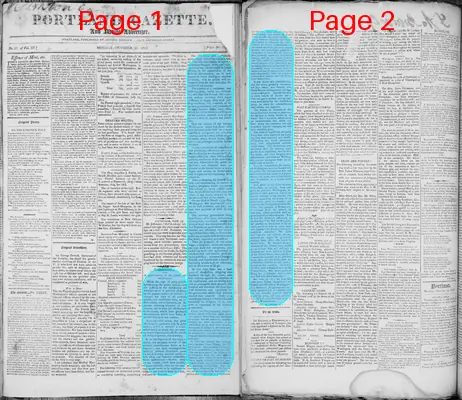
Portland Gazette, And Maine Advertiser
Portland, Cumberland County, Maine
What is this article about?
This editorial reviews early U.S. administrations, praising George Washington's leadership in forming the federal government, achieving prosperity, and maintaining neutrality amid foreign pressures. It criticizes Anti-Federalists for bitter opposition, slander, and attempts to undermine the administration and Constitution.
Merged-components note: Cross-page continuation of the editorial 'A cursory review of the several Administrations,' ending with 'TO BE CONTINUED' on page 2; merge into single coherent component.
Clippings
1 of 2
OCR Quality
Full Text
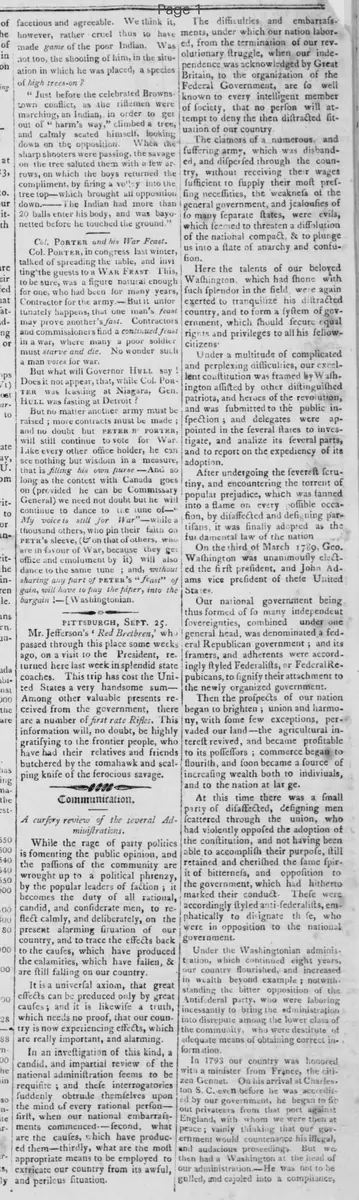
A cursory review of the several Administrations.
While the rage of party politics is fomenting the public opinion, and the passions of the community are wrought up to a political phrenzy, by the popular leaders of faction; it becomes the duty of all rational, candid, and considerate men, to reflect calmly, and deliberately, on the present alarming situation of our country, and to trace the effects back to the causes, which have produced the calamities, which have fallen, & are still falling on our country.
It is a universal axiom, that great effects can be produced only by great causes; and it is likewise a truth, which needs no proof, that our country is now experiencing effects, which are really important, and alarming.
In an investigation of this kind, a candid, and impartial review of the national administration seems to be requisite; and these interrogatories suddenly obtrude themselves upon the mind of every rational person—first, when our national embarrassments commenced—second, what are the causes, which have produced them—thirdly, what are the most appropriate means to be employed to extricate our country from its awful, and perilous situation.
The difficulties and embarrassments, under which our nation labored, from the termination of our revolutionary struggle, when our independence was acknowledged by Great Britain, to the organization of the Federal Government, are so well known to every intelligent member of society, that no person will attempt to deny the then distracted situation of our country.
The clamors of a numerous, and suffering army, which was disbanded, and dispersed through the country, without receiving their wages sufficient to supply their most pressing necessities, the weakness of the general government, and jealousies of so many separate states, were evils, which seemed to threaten a dissolution of the national compact, & to plunge us into a state of anarchy and confusion.
Here the talents of our beloved Washington, which had shone with such splendor in the field were again exerted to tranquilize his distracted country, and to form a system of government, which should secure equal rights and privileges to all his fellow-citizens.
Under a multitude of complicated and perplexing difficulties, our excellent constitution was framed by Washington assisted by other distinguished patriots, and heroes of the revolution, and was submitted to the public inspection; and delegates were appointed in the several states to investigate, and analyze its several parts, and to report on the expediency of its adoption.
After undergoing the severest scrutiny, and encountering the torrent of popular prejudice, which was fanned into a flame on every possible occasion, by disaffected and designing partisans, it was finally adopted as the fundamental law of the nation.
On the third of March 1789. Geo. Washington was unanimously elected the first president, and John Adams vice president of these United States.
Our national government being thus formed of so many independent sovereignties, combined under one general head, was denominated a federal Republican government; and its framers, and adherents were accordingly styled Federalists, or Federal Republicans, to signify their attachment to the newly organized government.
Then the prospects of our nation began to brighten; union and harmony, with some few exceptions, pervaded our land—the agricultural interest revived, and became profitable to its possessors; commerce began to flourish, and soon became a source of increasing wealth both to individuals, and to the nation at large.
At this time there was a small party of disaffected, designing men scattered through the union, who had violently opposed the adoption of the constitution, and not having been able to accomplish their purpose, still retained and cherished the same spirit of bitterness, and opposition to the government, which had hitherto marked their conduct. These were accordingly styled anti-federalists, emphatically to designate those, who were in opposition to the national government.
Under the Washingtonian administration, which continued eight years, our country flourished, and increased in wealth beyond example; notwithstanding the bitter opposition of the Antifederal party, who were laboring incessantly to bring the administration into disrepute among the lower class of the community, who were destitute of adequate means of obtaining correct information.
In 1798 our country was honored with a minister from France, the citizen Gennet. On his arrival at Charleston S. C, even before he was accredited by our government, he began to fit out privateers from that port against England, with whom we were then at peace; vainly thinking that our government would countenance his illegal, and audacious proceedings But we then had a Washington at the head of our administration. He was not to be gulled, and cajoled into a compliance, By this archfiend of Jacobinism, who would gladly have drawn the United States into the war, which was then existing between England and France. But instead of becoming the dupe of Genet, he wisely recommended that our nation should be placed on neutral ground, and accordingly published a declaration of neutrality, for which he was afterwards repeatedly insulted by Genet and his successors, Fauchet and Adet; and be it remembered to the eternal disgrace of the Antifederal party, that for this wise and prudent measure, which saved our nation from the horrors of war, Washington was vilified and calumniated; while the praises of Genet were shouted through the Democratic hemisphere.
It was under this administration that the treaty, generally denominated Jay's treaty, was formed with Great Britain, and approved and signed by Washington. Against this treaty every vehicle of slander and abuse was put in motion, and no exertions were spared by the Antifederal party to cover the administration with odium and reproach.
The merits or demerits of this treaty I shall not attempt to point out; for the tree is surely known by its fruits. But it is a truth which needs no demonstration, that under this same treaty our commerce not only flourished beyond example, but rose to its meridian glory.
The seeds of opposition and party being thus early rooted in our country, they were nurtured and cherished by every art which rancorous envy and disappointed ambition could invent. Base insinuations were circulated through the country, venal presses were established, men of shining talents and tried integrity were calumniated; and even our Washington was not exempted from the accursed lash of slander.
Yes, my countrymen, the immortal Washington, who had braved every peril of the revolutionary war, and had conducted our nation to independence and peace, was basely libeled and denounced as a traitor to his country.
And when he was about to retire from office, an address from Congress to President Washington, expressive of their gratitude for his important services to his country, was openly opposed by the leaders of the Democratic party in Congress; and a motion was brought forward by Mr. Giles, that paragon of Democracy, to expunge from the address all that part which expressed their approbation of his administration. Yes, he had the shameless effrontery to declare that "he had not that grateful conviction mentioned in the address, and if he were to come there and express it he should prove an inconsistent character." Mr. Giles said "he was one of those citizens who did not regret the President's retiring from office. He hoped he would retire. He believed the government of the United States would go on without him, and although a clamour had been raised in all parts of the United States from apprehensions on the departure of the President from office, yet, not feeling these apprehensions himself, he was perfectly easy on the occasion. He believed there were a thousand men in the United States who were capable of filling the Presidential chair as well as it had been filled heretofore."
But now, in 1812, we hear this same party styling themselves "the friends and disciples of Washington." Yes, Americans, the same men who uniformly opposed him in his administration, and who earnestly strove to blast his brightening fame, are now sheltering their baseness under the name of the illustrious WASHINGTON.
TO BE CONTINUED.
What sub-type of article is it?
What keywords are associated?
What entities or persons were involved?
Editorial Details
Primary Topic
Review Of Washington Administration And Anti Federalist Opposition
Stance / Tone
Pro Federalist Praise Of Washington, Anti Anti Federalist Criticism
Key Figures
Key Arguments