Thank you for visiting SNEWPapers!
Sign up free
Editorial
June 12, 1827
Phenix Gazette
Alexandria, Virginia
What is this article about?
Editorial from New York American compares John Quincy Adams and Andrew Jackson for the 1828 presidency, citing endorsements from Washington, Jefferson, Madison, Monroe, and Jackson himself for Adams, while quoting Jefferson's fears of Jackson's election leading to military rule and republican downfall.
Clipping
OCR Quality
95%
Excellent
Full Text
[From the New York American.]
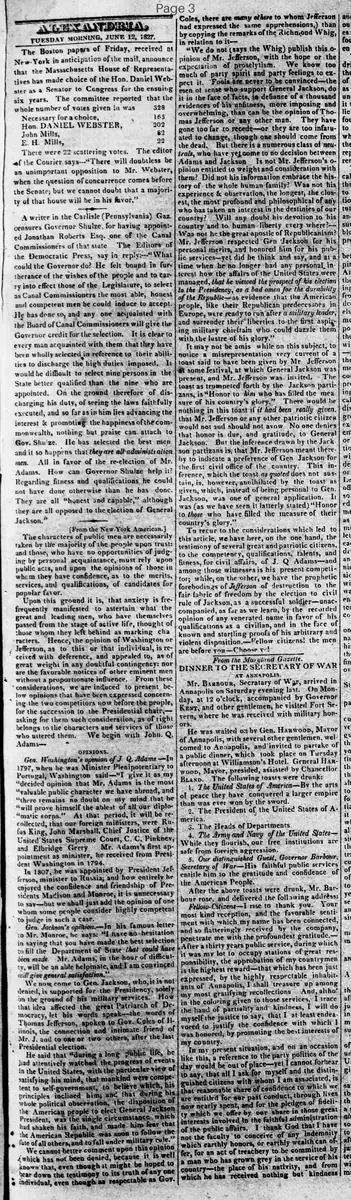
The characters of public men are necessarily taken by the majority of the people upon trust: and those, who have no opportunities of judging by personal acquaintance, must rely upon public acts, and upon the opinions of those in whom they have confidence, as to the merits, services, and qualifications, of candidates for popular favor.
Upon this ground it is, that anxiety is frequently manifested to ascertain what the great and leading men, who have themselves passed from the stage of active life, thought of those whom they left behind as marking characters. Hence, the opinion of Washington or Jefferson, as to this or that individual, is received with deference, and appealed to, as of great weight in any doubtful contingency: nor are the favorable notices of other eminent men without a proportionate influence. From these considerations, we are induced to present below opinions that have been expressed concerning the two competitors now before the people, for the succession to the Presidential chair,-- asking for them such consideration, as of right belongs to the characters and services of those who uttered them. We begin with John. Q. Adams-
OPINIONS.
Gen. Washington's opinion of J. Q. Adams --In 1797, when he was Minister Plenipotentiary to Portugal, Washington said- "I give it as my "decided opinion that Mr. Adams is the most "valuable public character we have abroad, and "there remains no doubt on my mind that he "will prove himself the ablest of all our diplo- "matic corps." At that period, it will be re- collected, that our foreign ministers, were Rufus King, John Marshall. Chief Justice of the United States Supreme Court, C. C. Pinkney, and Elbridge Gerry Mr. Adams's first ap- pointment as minister, he received from Presi- dent Washington in 1794.
In 1807, he was appointed by President Jefferson, minister to Russia; and how entirely he enjoyed the confidence and friendship of Presidents Madison and Monroe, it is unnecessary to say--but we shall just add the opinion of one whom some people consider highly competent to judge in such a case.
Gen. Jackson's opinion. In his famous letter to Mr. Monroe, he says: "I have no hesitation in saying that you have made the best selection to fill the Department of State that could have been made. - Mr. Adams, in the hour of difficulty, will be an able helpmate, and I am convinced will give general satisfaction."
We now come to Gen. Jackson, who, it is not denied, is supported for the Presidency, solely on the ground of his military services. How that idea affected the great Patriarch of Democracy, let his words speak--the words of Thomas Jefferson, spoken to Gov. Coles of Illinois, the connection and intimate friend of Mr. J. and to one or two others, after the last Presidential election.
He said that "during a long public life, he had attentively watched the progress of events in the United States, with the particular view of satisfying his mind, that mankind were competent to self-government, to believe which, his principles inclined him; and that during his whole political observation, the disposition of the American people to elect General Jackson President, had shaken his faith, and made him fear that the American Republic was soon to follow the fate of all others, and to fall under military rule."
(which has not been denied, because it is well known that, even though it might be hoped to bear down the testimony to its truth of any one individual, even though as respectable as Gov. Coles, there are many others to whom Jefferson had expressed the same apprehensions,) than by copying the remarks of the Richmond Whig! in relation to it--
"We do not (says the Whig) publish this opinion of Mr. Jefferson, with the hope or the expectation of proselytism. We know too much of party spirit and party feelings to expect it. Fools are never to be convinced--the men of sense who support General Jackson, do it in the face of facts, in defiance of a thousand evidences of his unfitness, more imposing and overwhelming, than can be the opinion of Thomas Jefferson or any other man. They have gone too far to recede-or they are too infatuated to change though one should come from the dead. But there is a numerous class of neutrals, who have yet come to no decision between Adams and Jackson Is not Mr. Jefferson's Opinion entitled to weight and consideration with them? Did not his information embrace the history of the whole human family? Do not his experience & observation, the longest, the closest, the most profound and philosophical of any who has taken an interest in the destinies of our country? Will any doubt his devotion to his country and to human liberty every where?-- Was not he the great apostle of Republicanism? Mr. Jefferson respected Gen Jackson for his personal merits, and honored him for his public services-yet did he think and say, and at a time when he no longer had any personal interest how the affairs of the United States were managed, that he viewed the prospect of his election to the Presidency, as a bad omen for the durability of the Republic--as evidence that the American people, like their Republican predecessors in Europe, were ready to run after a military leader, and surrender their liberties to the first aspiring military chieftain who could dazzle them with the lustre of his glory.
It may not be amiss while on this subject, to notice a misrepresentation very current of a toast said to have been given by Mr. Jefferson at some festival, at which General Jackson was present, and Mr. Jefferson was invited. -The toast as trumpeted forth by the Jackson partizans, is "Honor to him who has filled the measure of his country's glory.". There would be nothing in this toast if it had been really given. that Mr. Jefferson or any other patriotic citizen would not and should not avow No one denies that honor is due, and gratitude, to General Jackson. But the inference drawn by the Jackson partizans is, that Mr. Jefferson meant thereby to indicate a preference of Gen Jackson for the first civil office of the country. This inference, which the toast as quoted does not sustain, is, however, annihilated by the toast as given, which, instead of being personal to Gen. Jackson, was one of general application. It was (as we have seen it latterly stated)"Honor to those who have filled the measure of their country's glory."
To recur to the considerations which led to this article, we have here, on the one hand, the testimony of several great and patriotic citizens, to the competency, qualifications, talents, and fitness, for civil affairs, of J. Q Adams-and among those witnesses is his present competitor; while, on the other, we have the prophetic forebodings of Jefferson of destruction to the fair fabric of freedom by the election to civil rule of Jackson, as a successful soldier-unaccompanied, as far as we learn, by the recorded opinion of any venerated name in favor of his qualifications as a civilian, and in the face of known and startling proofs of his arbitrary and violent disposition.-Fellow citizens! the men are before you =-Choose ye!
The characters of public men are necessarily taken by the majority of the people upon trust: and those, who have no opportunities of judging by personal acquaintance, must rely upon public acts, and upon the opinions of those in whom they have confidence, as to the merits, services, and qualifications, of candidates for popular favor.
Upon this ground it is, that anxiety is frequently manifested to ascertain what the great and leading men, who have themselves passed from the stage of active life, thought of those whom they left behind as marking characters. Hence, the opinion of Washington or Jefferson, as to this or that individual, is received with deference, and appealed to, as of great weight in any doubtful contingency: nor are the favorable notices of other eminent men without a proportionate influence. From these considerations, we are induced to present below opinions that have been expressed concerning the two competitors now before the people, for the succession to the Presidential chair,-- asking for them such consideration, as of right belongs to the characters and services of those who uttered them. We begin with John. Q. Adams-
OPINIONS.
Gen. Washington's opinion of J. Q. Adams --In 1797, when he was Minister Plenipotentiary to Portugal, Washington said- "I give it as my "decided opinion that Mr. Adams is the most "valuable public character we have abroad, and "there remains no doubt on my mind that he "will prove himself the ablest of all our diplo- "matic corps." At that period, it will be re- collected, that our foreign ministers, were Rufus King, John Marshall. Chief Justice of the United States Supreme Court, C. C. Pinkney, and Elbridge Gerry Mr. Adams's first ap- pointment as minister, he received from Presi- dent Washington in 1794.
In 1807, he was appointed by President Jefferson, minister to Russia; and how entirely he enjoyed the confidence and friendship of Presidents Madison and Monroe, it is unnecessary to say--but we shall just add the opinion of one whom some people consider highly competent to judge in such a case.
Gen. Jackson's opinion. In his famous letter to Mr. Monroe, he says: "I have no hesitation in saying that you have made the best selection to fill the Department of State that could have been made. - Mr. Adams, in the hour of difficulty, will be an able helpmate, and I am convinced will give general satisfaction."
We now come to Gen. Jackson, who, it is not denied, is supported for the Presidency, solely on the ground of his military services. How that idea affected the great Patriarch of Democracy, let his words speak--the words of Thomas Jefferson, spoken to Gov. Coles of Illinois, the connection and intimate friend of Mr. J. and to one or two others, after the last Presidential election.
He said that "during a long public life, he had attentively watched the progress of events in the United States, with the particular view of satisfying his mind, that mankind were competent to self-government, to believe which, his principles inclined him; and that during his whole political observation, the disposition of the American people to elect General Jackson President, had shaken his faith, and made him fear that the American Republic was soon to follow the fate of all others, and to fall under military rule."
(which has not been denied, because it is well known that, even though it might be hoped to bear down the testimony to its truth of any one individual, even though as respectable as Gov. Coles, there are many others to whom Jefferson had expressed the same apprehensions,) than by copying the remarks of the Richmond Whig! in relation to it--
"We do not (says the Whig) publish this opinion of Mr. Jefferson, with the hope or the expectation of proselytism. We know too much of party spirit and party feelings to expect it. Fools are never to be convinced--the men of sense who support General Jackson, do it in the face of facts, in defiance of a thousand evidences of his unfitness, more imposing and overwhelming, than can be the opinion of Thomas Jefferson or any other man. They have gone too far to recede-or they are too infatuated to change though one should come from the dead. But there is a numerous class of neutrals, who have yet come to no decision between Adams and Jackson Is not Mr. Jefferson's Opinion entitled to weight and consideration with them? Did not his information embrace the history of the whole human family? Do not his experience & observation, the longest, the closest, the most profound and philosophical of any who has taken an interest in the destinies of our country? Will any doubt his devotion to his country and to human liberty every where?-- Was not he the great apostle of Republicanism? Mr. Jefferson respected Gen Jackson for his personal merits, and honored him for his public services-yet did he think and say, and at a time when he no longer had any personal interest how the affairs of the United States were managed, that he viewed the prospect of his election to the Presidency, as a bad omen for the durability of the Republic--as evidence that the American people, like their Republican predecessors in Europe, were ready to run after a military leader, and surrender their liberties to the first aspiring military chieftain who could dazzle them with the lustre of his glory.
It may not be amiss while on this subject, to notice a misrepresentation very current of a toast said to have been given by Mr. Jefferson at some festival, at which General Jackson was present, and Mr. Jefferson was invited. -The toast as trumpeted forth by the Jackson partizans, is "Honor to him who has filled the measure of his country's glory.". There would be nothing in this toast if it had been really given. that Mr. Jefferson or any other patriotic citizen would not and should not avow No one denies that honor is due, and gratitude, to General Jackson. But the inference drawn by the Jackson partizans is, that Mr. Jefferson meant thereby to indicate a preference of Gen Jackson for the first civil office of the country. This inference, which the toast as quoted does not sustain, is, however, annihilated by the toast as given, which, instead of being personal to Gen. Jackson, was one of general application. It was (as we have seen it latterly stated)"Honor to those who have filled the measure of their country's glory."
To recur to the considerations which led to this article, we have here, on the one hand, the testimony of several great and patriotic citizens, to the competency, qualifications, talents, and fitness, for civil affairs, of J. Q Adams-and among those witnesses is his present competitor; while, on the other, we have the prophetic forebodings of Jefferson of destruction to the fair fabric of freedom by the election to civil rule of Jackson, as a successful soldier-unaccompanied, as far as we learn, by the recorded opinion of any venerated name in favor of his qualifications as a civilian, and in the face of known and startling proofs of his arbitrary and violent disposition.-Fellow citizens! the men are before you =-Choose ye!
What sub-type of article is it?
Partisan Politics
What keywords are associated?
Adams Endorsement
Jackson Criticism
Presidential Election
Washington Opinion
Jefferson Fears
Military Rule
What entities or persons were involved?
John Quincy Adams
Andrew Jackson
George Washington
Thomas Jefferson
James Monroe
James Madison
Rufus King
John Marshall
C. C. Pinkney
Elbridge Gerry
Gov. Coles
Richmond Whig
Editorial Details
Primary Topic
Opinions Of Great Men On Adams And Jackson For Presidency
Stance / Tone
Pro Adams, Anti Jackson
Key Figures
John Quincy Adams
Andrew Jackson
George Washington
Thomas Jefferson
James Monroe
James Madison
Rufus King
John Marshall
C. C. Pinkney
Elbridge Gerry
Gov. Coles
Richmond Whig
Key Arguments
Washington Praised Adams As Most Valuable Diplomat In 1797
Jefferson Appointed Adams To Russia In 1807
Jackson Endorsed Adams For Secretary Of State
Jefferson Feared Jackson's Election Would Lead To Military Rule And End Of Republic
Jefferson's Toast Was General, Not Endorsing Jackson Personally
No Endorsements For Jackson's Civilian Qualifications