Thank you for visiting SNEWPapers!
Sign up free
Editorial
July 12, 1851
North Carolina Standard
Raleigh, Wake County, North Carolina
What is this article about?
Editorial defends Southern Democrats against Whig accusations of agitation and disunionism over the 1850 Compromise measures, arguing Whigs provoke debate for partisan gain while Democrats acquiesce for the Union's sake. Quotes Nashville Union on Tennessee gubernatorial race between Gov. Trousdale and Judge Campbell.
Clipping
OCR Quality
98%
Excellent
Full Text
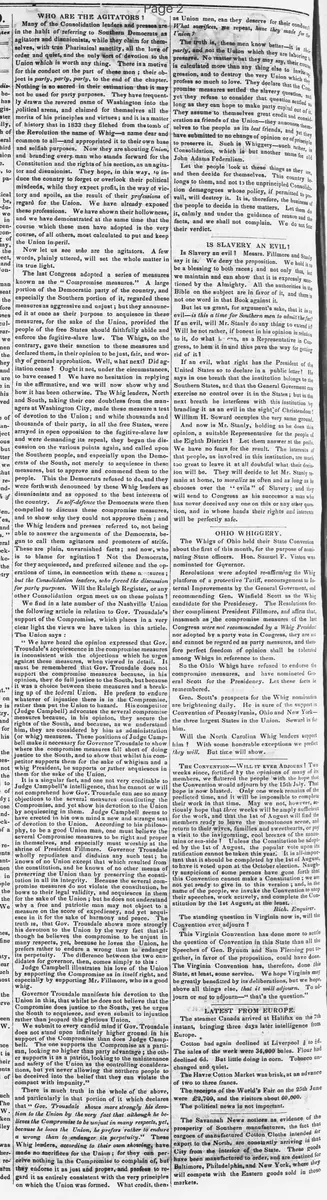
WHO ARE THE AGITATORS?
Many of the Consolidation leaders and presses are in the habit of referring to Southern Democrats as agitators and disunionists, while they claim for themselves, with true Pharisaical sanctity, all the love of order and quiet, and the only sort of devotion to the Union which is worth any thing. There is a motive for this conduct on the part of these men; their object is party, party, party, to the end of the chapter. Nothing is so sacred in their estimation that it may not be used for party purposes. They have frequently drawn the revered name of Washington into the political arena, and claimed for themselves all the merits of his principles and virtues; and it is a matter of history that in 1833 they filched from the tomb of the Revolution the name of Whig-a name dear and common to all-and appropriated it to their own base and selfish purposes. Now they are shouting Union, and branding every man who stands forward for the Constitution and the rights of his section, as an agitator and disunionist. They hope, in this way, to induce the country to forget or overlook their political misdeeds, while they expect profit, in the way of victory and spoils, as the result of their professions of regard for the Union. We have already exposed these professions. We have shown their hollowness, and we have demonstrated at the same time that the course which these men have adopted is the very course, of all others, most calculated to put and keep the Union in peril.
Now let us see who are the agitators. A few words, plainly uttered, will set the whole matter in its true light.
The last Congress adopted a series of measures known as the " Compromise measures." A large portion of the Democratic party of the country, and especially the Southern portion of it, regarded these measures as aggressive and unjust; but they announced it at once as their purpose to acquiesce in these measures, for the sake of the Union, provided the people of the free States should faithfully abide and enforce the fugitive-slave law. The Whigs, on the contrary, gave their sanction to these measures and declared them, in their opinion to be just, fair, and worthy of general approbation. Well, what next? Did agitation cease? Ought it not, under the circumstances, to have ceased? We have no hesitation in replying in the affirmative, and we will now show why and how it has been otherwise. The Whig leaders, North and South, taking their cue doubtless from the managers at Washington City, made these measures a test of devotion to the Union; and while thousands and thousands of their party, in all the free States, were arrayed in open opposition to the fugitive-slave law and were demanding its repeal, they began the discussion on the various points again, and called upon the Southern people, and especially upon the Democrats of the South, not merely to acquiesce in these measures, but to approve and commend them to the people. This the Democrats refused to do, and they were forthwith denounced by these Whig leaders as disunionists and as opposed to the best interests of the country. In self-defence the Democrats were then compelled to discuss these compromise measures, and to show why they could not approve them; and the Whig leaders and presses referred to, not being able to answer the arguments of the Democrats, began to call them agitators and promoters of strife.
These are plain, unvarnished facts; and now, who is to blame for agitation? Not the Democrats, for they acquiesced, and preferred silence and the operations of time, in connection with these measures; but the Consolidation leaders, who forced the discussion for party purposes. Will the Raleigh Register, or any other Consolidation organ meet us on these points?
We find in a late number of the Nashville Union the following article in relation to Gov. Trousdale's support of the Compromise, which places in a very clear light the views we have taken in this article. The Union says:
" We have heard the opinion expressed that Gov. Trousdale's acquiescence in the compromise measures is inconsistent with the objections which he urges against these measures, when viewed in detail. It must be remembered that Gov. Trousdale does not support the compromise measures because, in his opinion, they do full justice to the South, but because it was a choice between these measures and a breaking up of the federal Union. He prefers to endure whatever of injustice there is in the Compromise, rather than put the Union to hazard. His competitor (Judge Campbell) advocates the several compromise measures because, in his opinion, they secure the rights of the South, and because, as we understand him, they are considered by him as administration (or whig) measures. These positions of Judge Campbell make it necessary for Governor Trousdale to show where the compromise measures fall short of doing justice to the South, and to show that whilst his competitor supports them for the sake of whigism and a whig President, he supports or rather acquiesces in them for the sake of the Union.
It is a singular fact, and one not very creditable to Judge Campbell's intelligence, that he cannot or will not comprehend how Gov. Trousdale can see so many objections to the several measures constituting the Compromise, and yet show his devotion to the Union by acquiescing in them. Judge Campbell seems to have erected in his own mind a new and strange test of devotion to the Union. According to his philosophy, to be a good Union man, one must believe the several Compromise measures to be right and proper in themselves, and especially must worship at the shrine of President Fillmore. Governor Trousdale wholly repudiates and disdains any such test; he knows of no Union except that which resulted from the constitution, and he knows of no other means of preserving the Union than by preserving the constitution in all its integrity. Because the several compromise measures do not violate the constitution, he bows to their legal validity, and acquiesces in them for the sake of the Union; but he does not understand why a free and patriotic man may not object to a measure on the score of expediency, and yet acquiesce in it for the sake of harmony and peace. The truth is, that Gov. Trousdale shows more strongly his devotion to the Union by the very fact that although he believes the compromise to be unjust in many respects, yet, because he loves the Union, he prefers rather to endure a wrong than to endanger its perpetuity. The difference between the two candidates for governor, then, comes simply to this: Judge Campbell illustrates his love of the Union by supporting the Compromise as in itself right, and especially by supporting Mr. Fillmore, who is a good whig. Governor Trousdale manifests his devotion to the Union in this, that whilst he does not believe that the Compromise does justice to the South, yet he urges the South to acquiesce, and even submit to injustice rather than jeopard this glorious Union.
We submit to every candid mind if Gov. Trousdale does not stand upon infinitely higher ground in his support of the Compromise than does Judge Campbell. The one supports the Compromise as a partisan, looking no higher than party advantage; the other supports it as a patriot, looking to the maintenance and safety of the Union as the controlling consideration, but yet never allowing the northern people to be deceived into the belief that they can violate the compact with impunity."
There is much truth in the whole of the above, and particularly in that portion of it which declares that " Gov. Trousdale shows more strongly his devotion to the Union by the very fact that although he believes the compromise to be unjust in many respects, yet, because he loves the Union, he prefers rather to endure a wrong than to endanger its perpetuity." These Whig leaders, according to their own showing, have made no sacrifices for the Union; for they can perceive nothing in the Compromise to complain of, but they endorse it as just and proper, and profess to regard it as entirely consistent with the very principles on which the Union was formed. What credit, then, as Union men, can they deserve for their conduct! What sacrifices, we repeat, have they made for the Union?
The truth is, these men know better—it is their party they labor to preserve, and no course they can assume is more calculated to invite aggression and to destroy the very Union which they profess so much to love. They declare that the Compromise measures settled the slavery question, and yet they refuse to consider that question as settled. They announce themselves to the people as its best friends and yet they have submitted to no change of opinion or of principle to preserve it. Such is Whiggery-such, rather, is Consolidation, which is but another name for old John Adams Federalism.
Let the people look at these things as they are, and then decide for themselves. This country belongs to them, and not to the unprincipled Consolidation demagogues whose policy, if permitted to prevail, will destroy it. It is, therefore, the business of the people to decide in these matters. Let them do it, calmly and under the guidance of reason and the facts, and we shall not complain. We do not fear their verdict.
Many of the Consolidation leaders and presses are in the habit of referring to Southern Democrats as agitators and disunionists, while they claim for themselves, with true Pharisaical sanctity, all the love of order and quiet, and the only sort of devotion to the Union which is worth any thing. There is a motive for this conduct on the part of these men; their object is party, party, party, to the end of the chapter. Nothing is so sacred in their estimation that it may not be used for party purposes. They have frequently drawn the revered name of Washington into the political arena, and claimed for themselves all the merits of his principles and virtues; and it is a matter of history that in 1833 they filched from the tomb of the Revolution the name of Whig-a name dear and common to all-and appropriated it to their own base and selfish purposes. Now they are shouting Union, and branding every man who stands forward for the Constitution and the rights of his section, as an agitator and disunionist. They hope, in this way, to induce the country to forget or overlook their political misdeeds, while they expect profit, in the way of victory and spoils, as the result of their professions of regard for the Union. We have already exposed these professions. We have shown their hollowness, and we have demonstrated at the same time that the course which these men have adopted is the very course, of all others, most calculated to put and keep the Union in peril.
Now let us see who are the agitators. A few words, plainly uttered, will set the whole matter in its true light.
The last Congress adopted a series of measures known as the " Compromise measures." A large portion of the Democratic party of the country, and especially the Southern portion of it, regarded these measures as aggressive and unjust; but they announced it at once as their purpose to acquiesce in these measures, for the sake of the Union, provided the people of the free States should faithfully abide and enforce the fugitive-slave law. The Whigs, on the contrary, gave their sanction to these measures and declared them, in their opinion to be just, fair, and worthy of general approbation. Well, what next? Did agitation cease? Ought it not, under the circumstances, to have ceased? We have no hesitation in replying in the affirmative, and we will now show why and how it has been otherwise. The Whig leaders, North and South, taking their cue doubtless from the managers at Washington City, made these measures a test of devotion to the Union; and while thousands and thousands of their party, in all the free States, were arrayed in open opposition to the fugitive-slave law and were demanding its repeal, they began the discussion on the various points again, and called upon the Southern people, and especially upon the Democrats of the South, not merely to acquiesce in these measures, but to approve and commend them to the people. This the Democrats refused to do, and they were forthwith denounced by these Whig leaders as disunionists and as opposed to the best interests of the country. In self-defence the Democrats were then compelled to discuss these compromise measures, and to show why they could not approve them; and the Whig leaders and presses referred to, not being able to answer the arguments of the Democrats, began to call them agitators and promoters of strife.
These are plain, unvarnished facts; and now, who is to blame for agitation? Not the Democrats, for they acquiesced, and preferred silence and the operations of time, in connection with these measures; but the Consolidation leaders, who forced the discussion for party purposes. Will the Raleigh Register, or any other Consolidation organ meet us on these points?
We find in a late number of the Nashville Union the following article in relation to Gov. Trousdale's support of the Compromise, which places in a very clear light the views we have taken in this article. The Union says:
" We have heard the opinion expressed that Gov. Trousdale's acquiescence in the compromise measures is inconsistent with the objections which he urges against these measures, when viewed in detail. It must be remembered that Gov. Trousdale does not support the compromise measures because, in his opinion, they do full justice to the South, but because it was a choice between these measures and a breaking up of the federal Union. He prefers to endure whatever of injustice there is in the Compromise, rather than put the Union to hazard. His competitor (Judge Campbell) advocates the several compromise measures because, in his opinion, they secure the rights of the South, and because, as we understand him, they are considered by him as administration (or whig) measures. These positions of Judge Campbell make it necessary for Governor Trousdale to show where the compromise measures fall short of doing justice to the South, and to show that whilst his competitor supports them for the sake of whigism and a whig President, he supports or rather acquiesces in them for the sake of the Union.
It is a singular fact, and one not very creditable to Judge Campbell's intelligence, that he cannot or will not comprehend how Gov. Trousdale can see so many objections to the several measures constituting the Compromise, and yet show his devotion to the Union by acquiescing in them. Judge Campbell seems to have erected in his own mind a new and strange test of devotion to the Union. According to his philosophy, to be a good Union man, one must believe the several Compromise measures to be right and proper in themselves, and especially must worship at the shrine of President Fillmore. Governor Trousdale wholly repudiates and disdains any such test; he knows of no Union except that which resulted from the constitution, and he knows of no other means of preserving the Union than by preserving the constitution in all its integrity. Because the several compromise measures do not violate the constitution, he bows to their legal validity, and acquiesces in them for the sake of the Union; but he does not understand why a free and patriotic man may not object to a measure on the score of expediency, and yet acquiesce in it for the sake of harmony and peace. The truth is, that Gov. Trousdale shows more strongly his devotion to the Union by the very fact that although he believes the compromise to be unjust in many respects, yet, because he loves the Union, he prefers rather to endure a wrong than to endanger its perpetuity. The difference between the two candidates for governor, then, comes simply to this: Judge Campbell illustrates his love of the Union by supporting the Compromise as in itself right, and especially by supporting Mr. Fillmore, who is a good whig. Governor Trousdale manifests his devotion to the Union in this, that whilst he does not believe that the Compromise does justice to the South, yet he urges the South to acquiesce, and even submit to injustice rather than jeopard this glorious Union.
We submit to every candid mind if Gov. Trousdale does not stand upon infinitely higher ground in his support of the Compromise than does Judge Campbell. The one supports the Compromise as a partisan, looking no higher than party advantage; the other supports it as a patriot, looking to the maintenance and safety of the Union as the controlling consideration, but yet never allowing the northern people to be deceived into the belief that they can violate the compact with impunity."
There is much truth in the whole of the above, and particularly in that portion of it which declares that " Gov. Trousdale shows more strongly his devotion to the Union by the very fact that although he believes the compromise to be unjust in many respects, yet, because he loves the Union, he prefers rather to endure a wrong than to endanger its perpetuity." These Whig leaders, according to their own showing, have made no sacrifices for the Union; for they can perceive nothing in the Compromise to complain of, but they endorse it as just and proper, and profess to regard it as entirely consistent with the very principles on which the Union was formed. What credit, then, as Union men, can they deserve for their conduct! What sacrifices, we repeat, have they made for the Union?
The truth is, these men know better—it is their party they labor to preserve, and no course they can assume is more calculated to invite aggression and to destroy the very Union which they profess so much to love. They declare that the Compromise measures settled the slavery question, and yet they refuse to consider that question as settled. They announce themselves to the people as its best friends and yet they have submitted to no change of opinion or of principle to preserve it. Such is Whiggery-such, rather, is Consolidation, which is but another name for old John Adams Federalism.
Let the people look at these things as they are, and then decide for themselves. This country belongs to them, and not to the unprincipled Consolidation demagogues whose policy, if permitted to prevail, will destroy it. It is, therefore, the business of the people to decide in these matters. Let them do it, calmly and under the guidance of reason and the facts, and we shall not complain. We do not fear their verdict.
What sub-type of article is it?
Partisan Politics
Constitutional
What keywords are associated?
Agitators
Compromise Measures
Southern Democrats
Whig Leaders
Union Devotion
Fugitive Slave Law
Partisan Politics
Constitutional Rights
What entities or persons were involved?
Southern Democrats
Consolidation Leaders
Whigs
Gov. Trousdale
Judge Campbell
President Fillmore
Nashville Union
Raleigh Register
Washington
Editorial Details
Primary Topic
Defense Against Accusations Of Agitation Over Compromise Measures
Stance / Tone
Strongly Pro Southern Democrat And Anti Whig/Consolidation
Key Figures
Southern Democrats
Consolidation Leaders
Whigs
Gov. Trousdale
Judge Campbell
President Fillmore
Nashville Union
Raleigh Register
Washington
Key Arguments
Consolidation Leaders Use Union Rhetoric For Partisan Gain
Southern Democrats Acquiesce In Compromise For Union's Sake Despite Viewing It As Unjust
Whigs Force Approval Of Compromise As Test Of Union Devotion
Democrats Defend Rights Without Approving Measures
Gov. Trousdale Shows True Union Devotion By Enduring Injustice
Judge Campbell Supports Compromise For Party Reasons
Whigs Make No Sacrifices For Union
Consolidation Policy Invites Aggression And Endangers Union