Thank you for visiting SNEWPapers!
Sign up free
The Sun
New York, New York County, New York
What is this article about?
In New York Supreme Court, Justice Russell dismissed a suit against the Stock Exchange seeking to sell member Ernest Dichman's seat to satisfy Carroll Sprigg's $3,560 judgment, ruling it non-binding on the Exchange. The case proceeds against Dichman and trustee for fraudulent trust securing debt to Henry De Van Doesburgh.
Clipping
OCR Quality
Full Text
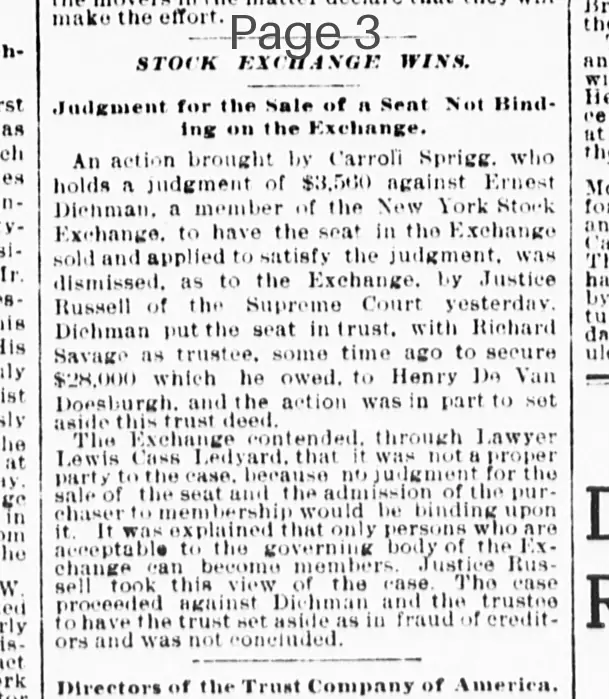
Judgment for the Sale of a Seat Not Binding on the Exchange.
An action brought by Carroll Sprigg, who holds a judgment of $3,560 against Ernest Dichman, a member of the New York Stock Exchange, to have the seat in the Exchange sold and applied to satisfy the judgment, was dismissed, as to the Exchange, by Justice Russell of the Supreme Court yesterday.
Dichman put the seat in trust, with Richard Savage as trustee, some time ago to secure $28,000 which he owed to Henry De Van Doesburgh, and the action was in part to set aside this trust deed.
The Exchange contended, through Lawyer Lewis Cass Ledyard, that it was not a proper party to the case, because no judgment for the sale of the seat and the admission of the purchaser to membership would be binding upon it. It was explained that only persons who are acceptable to the governing body of the Exchange can become members. Justice Russell took this view of the case. The case proceeded against Dichman and the trustee to have the trust set aside as in fraud of creditors and was not concluded.
What sub-type of article is it?
What themes does it cover?
What keywords are associated?
What entities or persons were involved?
Where did it happen?
Story Details
Key Persons
Location
New York
Story Details
Carroll Sprigg sued to sell Ernest Dichman's New York Stock Exchange seat to satisfy a $3,560 judgment, but the suit was dismissed against the Exchange by Justice Russell, as it could not bind the Exchange to admit a purchaser. The case continued against Dichman and trustee Richard Savage to set aside a trust deed securing $28,000 owed to Henry De Van Doesburgh, alleged as fraud of creditors.